Table of contents
1. OVERVIEW
 |  |
The textile, fashion, and apparel industry is facing increasing pressure to reduce environmental impact, leading to growing interest in tools such as Life Cycle Assessment (LCA). LCA, which evaluates the environmental impacts of a product across its entire life cycle, has become a key tool for understanding and addressing the ecological footprint of fashion and apparel brands.
The growing emphasis on LCA is not just a temporary trend. It is a response to evolving legal frameworks. The European Union (EU), for example, has taken strong measures to promote sustainability, transparency, and circular economy practices across various sectors, including fashion. These regulations require fashion businesses to conduct comprehensive LCAs for their products and communicate the results transparently to consumers. You can learn more about the regulations in our knowledge hub on global textile laws and regulations.
In addition, the rise of “green claims”—clothing brands marketing products as eco-friendly or sustainable—has increased the demand for credible evidence. Consumers, watchdog groups, and policymakers increasingly expect brands to take responsibility for these claims, and a rigorous LCA is a reliable tool for validating them. In fact, the European Commission recommends the use of Environmental Footprint Methods, such as Product Environmental Footprint (PEF).
In this article, we will guide you through the importance and details of calculating the environmental footprint of fashion products using LCA.
2. WHAT IS LIFE CYCLE ASSESSMENT (LCA)?
LCA is a structured framework for evaluating the environmental impacts of a product throughout its entire life cycle.
By examining the full product life cycle—raw material extraction, processing, usage, transportation modes and distances, and waste management—LCA enables a comprehensive assessment of overall environmental impact.
To obtain a complete view of the environmental footprint, textile brands must answer the following questions:
What materials are used in the product?
Where are the materials produced?
What chemicals are used throughout the supply chain?
What processes does the product undergo (spinning, weaving/knitting, bleaching, dyeing, finishing, etc.)?
How is the product transported and over what distance?
What happens to the product when it becomes waste?
However, the large number of questions can be overwhelming. How can we decode the complexities of sustainability in fashion and make smart decisions?
This is where Life Cycle Assessment (LCA) becomes valuable.
3. WHAT ARE THE DIFFERENT STANDARDS FOR LIFE CYCLE ASSESSMENT (LCA)?
Over the past 40 years, LCA methodologies and standards have evolved and become more sophisticated. Organizations such as the International Organization for Standardization (ISO) and the United Nations Environment Programme (UNEP) have played important roles in establishing internationally recognized LCA standards.
ISO 14040 & ISO 14044 — Provide a general framework for conducting and reporting LCA studies. Applicable to all industries, including textiles.
ISO 14067 — Focuses specifically on product carbon footprint, offering requirements and guidelines for quantifying and communicating carbon emissions.
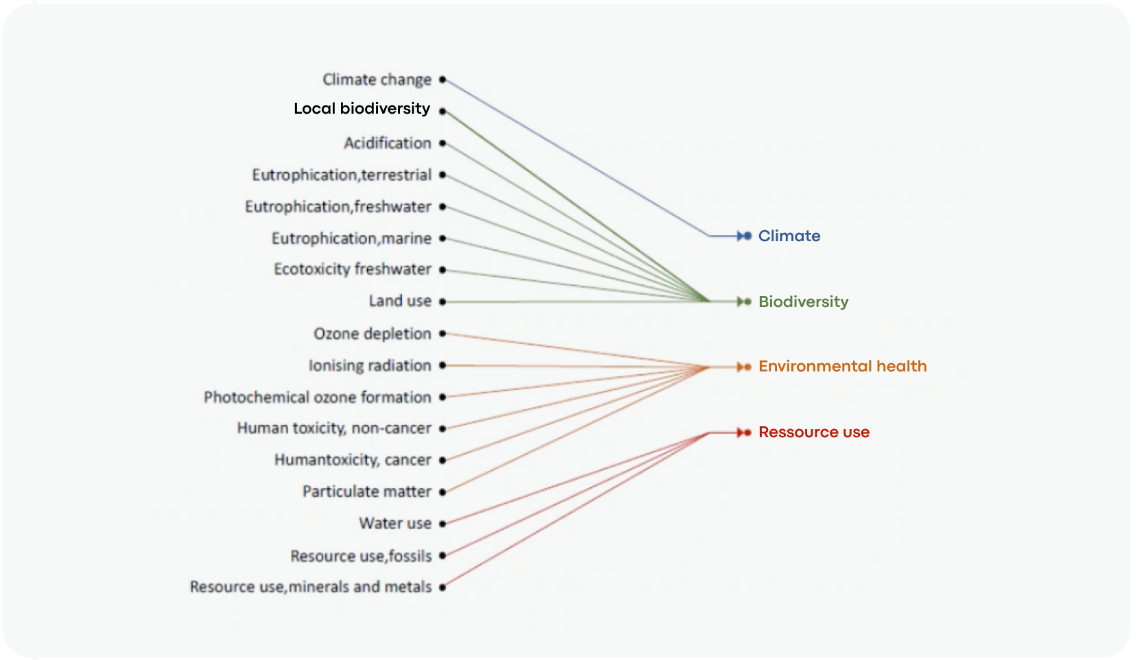
Product Environmental Footprint (PEF) — Developed by the European Commission, PEF is a multi-criteria measure of environmental performance across a product’s entire life cycle. It includes 16 impact categories such as climate change, ozone depletion, resource depletion, etc.
4. WHAT IS THE PURPOSE OF LCA IN THE TEXTILE AND FASHION INDUSTRY?
LCA helps quantify and minimize environmental impacts throughout a textile product’s life cycle. It identifies major environmental “hotspots” that inform decisions on applying more sustainable practices, such as improvements in material sourcing, production techniques, and product design.
LCA also validates green claims, ensuring brand transparency and credibility, and helps comply with tightening environmental regulations. Ultimately, LCA supports the transition toward a circular economy by encouraging longer product lifecycles, recycling, and efficient resource use.
DEFINING SYSTEM BOUNDARIES IN LCA
Clear system boundary definition is essential when conducting LCA. This defines which processes, activities, and impacts are included in the study.
Two common LCA boundary models in the fashion industry are:
Cradle-to-Grave
Comprehensive assessment from raw material extraction (“cradle”) to end-of-life (“grave”). Includes production, distribution, consumer use, and end-of-life disposal, as well as transportation impacts.
Cradle-to-Gate
Assessment from raw material extraction to the point the product leaves the factory. Excludes use and end-of-life stages. Commonly used in industry benchmarking or Environmental Product Declarations (EPDs).
Choosing which model to use depends on the LCA objective:
Cradle-to-Grave: Use when a full environmental overview is needed for sustainable strategy development, product design decisions, or consumer communication.
Cradle-to-Gate: Use when focusing on production improvements, comparing products at manufacturing stage, or when data for use or disposal is unavailable.
Note: System boundaries significantly influence LCA results and therefore must be clearly stated for transparency.
5. ENVIRONMENTAL INDICATORS TO CONSIDER
A robust LCA requires evaluation of multiple environmental indicators such as:
Climate change
Acidification
Eutrophication
Ozone depletion
Human and ecosystem toxicity
Water consumption
Land use
Resource depletion
The PEF method uses 16 environmental indicators to provide a multi-criteria assessment of overall environmental performance.
Evaluating multiple indicators helps avoid “carbon tunnel vision,” ensuring a more holistic environmental understanding.
WHY IS LCA IMPORTANT? WHAT ARE THE BENEFITS?
LCA provides scientifically backed data to:
Ensure reporting & regulatory compliance
Support sustainable product development
Improve supply chain management
Strengthen marketing & communication credibility
Guide strategic planning
With rising sustainability expectations, LCA enables fashion companies to measure, understand, and improve environmental performance.
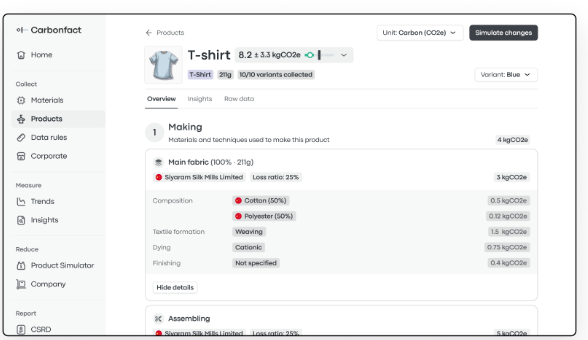
EXAMPLE: LCA FOR A T-SHIRT
A typical T-shirt life cycle includes:
Raw Material Extraction
Cotton cultivation, water use, land use, fertilizers, fuel.
Manufacturing & Processing
Spinning, knitting/weaving, bleaching, dyeing, finishing, cutting, sewing. Key data: electricity, thermal energy, chemicals used.
Transportation & Distribution
Transport from factory to distribution centers to retail or consumers (truck, ship, air freight).
Use Phase
Washing, drying, ironing — energy use, water use, detergents.
End-of-Life
Recycling, landfill, or incineration.
Environmental impacts from these stages include:
Global Warming Potential (GWP / carbon footprint)
Water consumption
Energy use
Toxicity impacts
Waste generation
The objective of LCA is to measure these impacts and identify opportunities for improvement.
CHALLENGES IN CONDUCTING LCA IN THE FASHION INDUSTRY
High Cost and Expertise Required
Software (e.g., GaBi, SimaPro) and database access (e.g., Ecoinvent) are expensive and require specialized knowledge.
Data Collection Difficulties
Suppliers often lack transparency, making it hard to collect accurate data on water, energy, chemicals, and waste.
Complex Supply Chains
Multi-tier, multi-country supply chains make it difficult to track impacts at every stage.
Fast-Changing Trends
Materials and designs change frequently, requiring constant LCA updates.
TOOLS USED TO CONDUCT LCA
Traditional tools include:
OpenLCA
GaBi
SimaPro
These tools are powerful but require large time and cost investments and often involve external consultants.
Newer tools—such as the platform offered by TTS and our partner—provide real-time LCA by integrating with:
ERP systems
PLM systems
This enables automatic calculation when new data is entered.
HOW TTS AND OUR PARTNER PERFORM PRODUCT LCA
Automation
Automated data collection and impact assessment significantly reduce time and cost.
Smart Data Filling
Uses databases like Ecoinvent, Base Empreinte, EF 3.1, and Mistra Future Fashion. Machine-learning algorithms fill missing data (e.g., estimating product weight from material composition).
Streamlined Data Collection
Focuses on high-impact hotspots so brands can collect fewer, more meaningful data points.
Real-Time LCA
Automatic updates when new data enters ERP/PLM systems. Especially valuable as fashion changes rapidly.
This transforms LCA into a more accessible, efficient, and practical process for sustainability goals.
FURTHER READING ON LCA IN FASHION
Mistra Future Fashion
Swedish research program supporting sustainable fashion. https://mistra.org/wp-content/uploads/2022/12/Annual-Report_Mistra-Future-Fashion-2017.pdf
Product Environmental Footprint Category Rules (PEFCR) – Apparel & Footwear
EU draft guideline for measuring environmental performance.
https://eeb.org/wp-content/uploads/2021/11/Draft-Product-Environmental-Footprint-Category-Rules-PEFCR-apparel-and-footwear.pdf
Textile Exchange LCA FAQ
Useful introductory document for beginners.
https://textileexchange.org/lca-faq/