


Sedex – SMETA Standard for Social Responsibility
Sustainable development is becoming an increasingly important priority for countries and businesses around the world. Besides the responsible use of natural resources, companies are expected to demonstrate strong ethical conduct and social responsibility throughout their entire supply chains. Sedex (Supplier Ethical Data Exchange) is one of the world’s leading online platforms that enables suppliers to share comprehensive information related to their social and ethical performance with customers and business partners.
1. What Is Sedex?
Sedex (Supplier Ethical Data Exchange) is a global non-profit organization established to promote responsible and ethical business practices within supply chains. The Sedex platform enables suppliers to:
Manage data related to ethical practices
Maintain transparent information on social responsibility
Share audit results with customers and international partners easily
Sedex is known as one of the largest collaborative associations for exchanging information on ethical business practices and social responsibility. Its platform provides an effective and innovative supply chain management solution that helps organizations:
Reduce operational and reputational risks
Improve global supply chain activities
Strengthen transparency for customers
Since its establishment in 2004, Sedex has attracted nearly 50,000 member organizations worldwide.
The Four Pillars of Sedex
The Sedex framework is built on four primary pillars:
Labour Standards
Health & Safety
Environment
Business Ethics
These pillars form the foundation of Sedex’s approach to ethical sourcing and responsible supply chain management.
2. What Is SMETA?
SMETA (Sedex Members Ethical Trade Audit) is an audit methodology developed by Sedex to evaluate an organization’s social responsibility and ethical business practices. SMETA audits are based on:
The Ethical Trading Initiative (ETI) Base Code
International best practices in CSR audits
Local labour laws and regulatory requirements
The objective of SMETA is to ensure workers are employed under safe, fair, and respectful conditions without discrimination and with adequate protection of their fundamental rights.
Sedex’s system is supported and maintained by the Sedex product development team in partnership with Enablon—a global leader in sustainability management software. Over 300 multinational companies and more than 200,000 users rely on Enablon to improve environmental and social performance, manage risks, and reduce operational costs. This collaboration ensures Sedex members benefit from a secure, efficient platform for exchanging social and ethical data across supply chains.
3. Key Components of the SMETA Methodology
SMETA is structured around three core components:
A unified guidance document for conducting ethical trade audits
A standardized reporting format used across all SMETA audits
A consistent Corrective Action Plan (CAPR) format
These elements ensure audits are consistent, transparent, and comparable between suppliers.
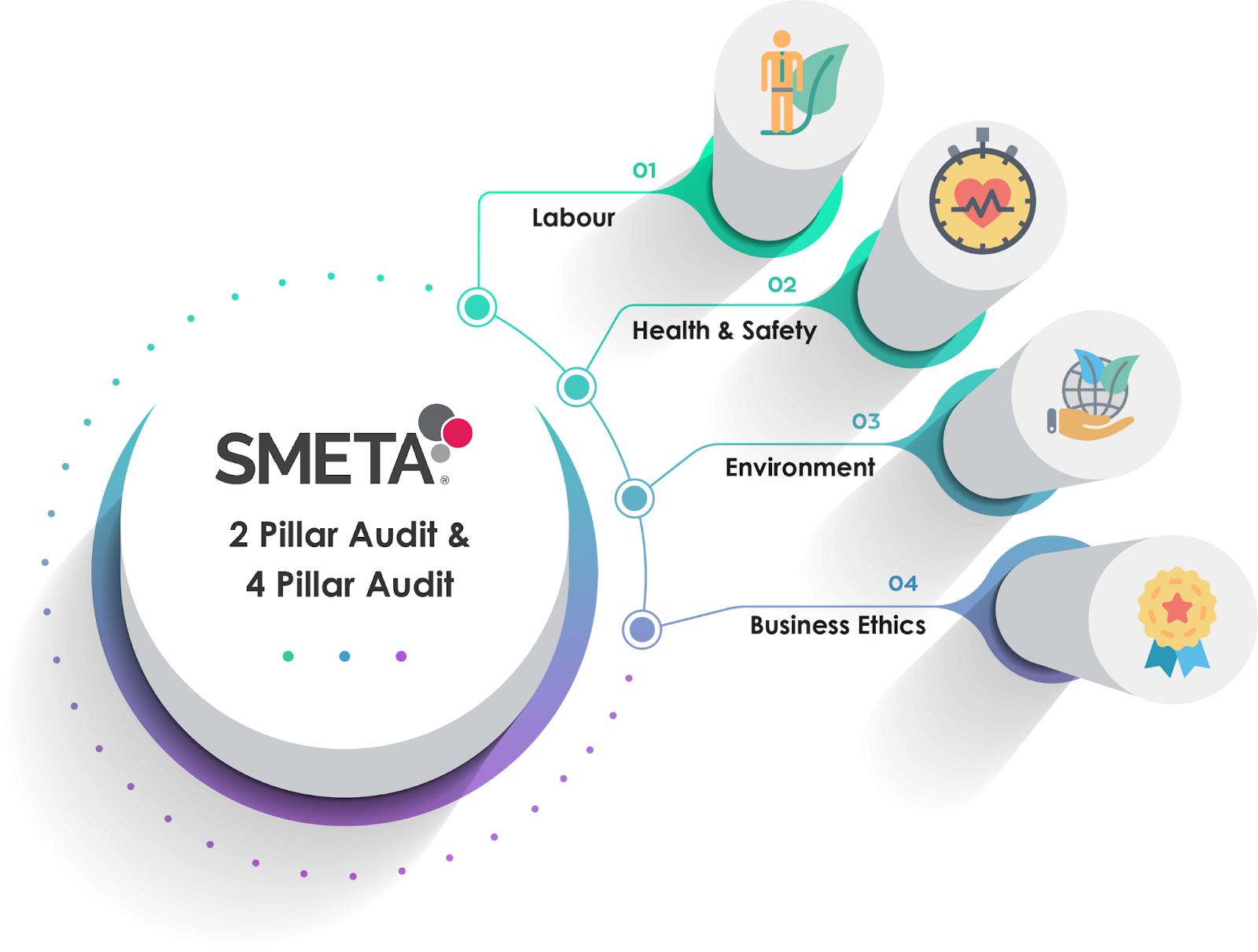
Understanding SMETA 2-Pillar and SMETA 4-Pillar Audits
SMETA audits are divided into two types:
SMETA 2-Pillar Audit Includes:
Labour Standards
Health & Safety
Additional elements such as:
Universal Rights (UCP)
Management Systems
Right to Work
Sub-contracting and Homeworking
A simplified Environmental Assessment
SMETA 4-Pillar Audit Includes everything in the 2-Pillar audit, plus:
Extended Environmental Assessment (replacing the simplified version)
Business Ethics
4. Key Updates in SMETA 7.0
SMETA 7.0 introduces several important improvements to strengthen transparency, enhance audit quality, and support more responsible supply chain management. Below are the major updates included in this latest version:
1. Clearer “Workplace Requirements” Framework
The new SMETA 7.0 includes a more structured set of Workplace Requirements to guide suppliers on what is expected for fair, transparent, and compliant working conditions.
Purpose of this update:
Help suppliers better understand specific requirements
Ensure consistent application of labour standards
Improve clarity for both auditors and auditees
This change makes it easier for businesses to determine exactly what they must prepare to meet audit expectations.
2. Stronger Management Systems Assessment
SMETA 7.0 places a higher emphasis on evaluating an organization’s management systems— including policies, procedures, internal controls, and documented evidence.
This update requires organizations to:
Implement structured and documented management systems
Provide evidence of consistent execution
Move beyond informal or intuition-based compliance
The goal is to ensure companies have long-term mechanisms to maintain ethical and social compliance, not just temporary corrective actions.
3. Enhanced Data Collection and Transparency
The latest version introduces several new data points to improve risk analysis and supply chain visibility. These additional data points help:
Strengthen risk identification
Improve monitoring of subcontracting and homeworking
Enhance buyer-supplier transparency
Examples include detailed information about subcontractors, homeworkers, recruitment practices, and labour agency involvement.
4. Introduction of “Collaborative Action Required (CAR)”
SMETA 7.0 adds a new category of findings called Collaborative Action Required (CAR). This category applies when an issue cannot be resolved by the supplier alone, and requires cooperation between:
The supplier
The buyer
External stakeholders or third parties
This reflects a more realistic approach, acknowledging that some systemic issues require multi-party collaboration to fully address.
5. Additional Focus on Labour-Specific Topics
SMETA 7.0 places stronger emphasis on:
Responsible recruitment
Recruitment fees and worker-paid costs
Prevention of forced labour
Oversight of labour providers
Monitoring of subcontracting and homeworking
These updates align SMETA with global expectations around ethical recruitment and worker protection.
6. Transition and Implementation Guidelines
SMETA 7.0 was introduced in 2024 with full guidance provided for:
Members
Buyers
Approved audit companies
Organizations are encouraged to update their internal procedures to ensure alignment with the new requirements— especially those engaged in global supply chains.
7. Sedex Adoption Worldwide
More than 6,000 companies across 150+ countries currently use Sedex to strengthen responsible sourcing practices and improve working conditions throughout global supply chains.
5. TARGET APPLICANTS OF THE SEDEX–SMETA STANDARD
The SEDEX–SMETA standard is not limited by industry, scale, or geographical location. Any organization or business aiming to:
Enhance brand reputation
Demonstrate a strong commitment to social responsibility
Meet international buyer requirements can implement and undergo a SMETA audit as an effective tool to measure and improve performance toward sustainable development.
6. KEY REQUIREMENTS OF THE SEDEX–SMETA STANDARD
The SEDEX–SMETA framework is built upon international ethical and legal principles to ensure that businesses operate transparently, ethically, and sustainably. It outlines 11 core requirements, as follows:
1. Prevention of Forced Labour
Your business must not use any form of forced or involuntary labor. Workers must not be required to provide deposits, surrender personal documents, and must have the freedom to terminate employment with justified notice.
2. Respect for Freedom of Association
Workers have the right to form or join trade unions or worker groups to negotiate working conditions. Organizations must not interfere with or obstruct such activities.
3. Ensuring Occupational Health & Safety
The working environment must be safe, clean, and risk-controlled. Organizations must provide regular safety training and required certification when employees work with machinery, equipment, or hazardous chemicals.
4. No Child Labour
Your organization must not employ workers below the legal minimum age. For young workers, tasks must be age-appropriate and must not involve excessive overtime or hazardous work.
5. Fair Compensation and Benefits
Compensation must comply with legal minimum wage regulations and be sufficient to cover basic living needs. Businesses must pay wages on time and provide full social insurance, maternity benefits, and legally mandated welfare programs.
6. Compliance with Working Hours Requirements
Regular working hours must not exceed 48 hours per week. Overtime must remain within legal limits. Workers must receive at least one day off per week.
7. No Discrimination
Businesses must not engage in discrimination in recruitment, compensation, training, or contract termination based on gender, age, race, religion, marital status, or disability.
8. Stable and Secure Employment
Workers must receive legal employment contracts. Businesses must not rely on precarious or short-term labor arrangements to avoid employer responsibilities.
9. Fair Disciplinary Practices
No disciplinary method may harm workers physically or psychologically. Discipline must follow a transparent and documented procedure, and wage deductions may not be used as punishment.
10. Compliance with Additional Requirements
Businesses must comply with all legal and ethical requirements related to workers' rights, environmental protection, security, and transparent business operations.
11. Contribution to the Community
Beyond internal responsibilities, businesses must actively support community initiatives and avoid any activity that harms society or the surrounding environment.
7. BENEFITS OF SEDEX–SMETA IMPLEMENTATION
Implementing Sedex–SMETA brings practical value to businesses by enhancing reputation and creating long-term competitive advantages in global supply chains. Key benefits include:
1. Enhanced Corporate Image and Credibility
Organizations applying Sedex–SMETA demonstrate clear commitments to social responsibility, business ethics, and safe working conditions—building trust with customers and partners.
2. Expanded International Business Opportunities
SMETA is required by many global brands and retailers, especially in textiles, food processing, consumer goods, and packaging. Strong SMETA performance can help businesses enter global supply chains and secure major contracts.
3. Improved Working Conditions and Employee Engagement
Your organization can create a safe, fair, and inclusive workplace—improving employee satisfaction, productivity, and retention.
4. Reduced Legal and Operational Risks
Compliance helps minimize risks related to labor law violations, environmental impacts, occupational health and safety issues, inspections, penalties, or worker disputes.
5. Optimized Processes and Stronger Management Capability
Businesses are encouraged to review governance systems, improve operational processes, strengthen HR policies, and enhance internal transparency.
6. Competitive Advantage in Supplier Evaluations
Many international customers prioritize suppliers with SMETA audit results. This provides a significant advantage in tenders and long-term cooperation.
8. GUIDE TO IMPLEMENTING SEDEX–SMETA FOR BUSINESSES
Step 1: Define Implementation Objectives
Determine the purpose of applying Sedex–SMETA—identify improvement priorities in ethical business practices and social responsibility.
Step 2: Define the Scope of Application
Select applicable locations, processes, or departments to ensure an implementation plan tailored to your operational reality.
Step 3: Conduct an Internal Assessment
Before the official audit, organizations should perform internal checks to identify gaps and develop corrective actions.
Step 4: Implement Improvements
Based on internal findings, update policies, improve procedures, train employees, and reinforce ethical awareness.
Step 5: Maintain Ongoing Monitoring and Review
SMETA compliance requires continuous monitoring and periodic reassessments to ensure long-term effectiveness.
Step 6: Register for the Official Audit
Once ready, businesses may book an audit with an approved Sedex Affiliate Audit Company. The audit covers document review, facility inspection, and worker interviews. If compliant, the business receives a SMETA audit report to share with customers.
No doubt, ethical production is now a key requirement for brands when selecting suppliers. Businesses that fail to prepare for social responsibility compliance may lose opportunities for new contracts. If you need Sedex–SMETA consulting support, feel free to contact us for assistance.
9. FREQUENTLY ASKED QUESTIONS ABOUT THE SMETA STANDARD
1. What are Sedex and SMETA?
Sedex: Supplier Ethical Data Exchange – a platform for managing ethical supply chain data.
SMETA: Sedex Members Ethical Trade Audit – a globally recognized social compliance audit methodology.
2. Who needs to undergo a SMETA audit?
Factories, farms, suppliers, subcontractors, and facilities within the supply chains of international brands or retailers.
3. Is the SMETA report globally recognized?
Yes. SMETA reports are accepted by major buyers (e.g., Tesco, Marks & Spencer, Unilever), helping businesses avoid duplicate audits and enhance credibility.
4. How many pillars does SMETA include?
2-pillar SMETA: Labour, Health & Safety
4-pillar SMETA: + Environment and Business Ethics
5. Is SMETA a certification?
No. SMETA is an audit, not a certification. Businesses receive a report and CAPR, not a certificate.
6. Who is authorized to conduct SMETA audits?
Only Sedex Affiliate Audit Companies (AACs) approved by Sedex.
7. How often is SMETA conducted?
Typically once a year, or more frequently depending on customer requirements or previous results.
8. How is a SMETA report shared?
Reports are uploaded to the Sedex platform, and businesses can grant access to customers via Sedex ID.
9. Does SMETA include other standards such as ISO, GRS, or BSCI?
No. SMETA focuses solely on social responsibility, ethics, and working conditions. It does not replace ISO, GRS, or BSCI.
10. What are the benefits of joining SEDEX–SMETA?
Greater supply chain transparency, enhanced customer trust, reduced labor risks, and stronger foundations for sustainable development.


