
Table of contents
The amfori BSCI Code of Conduct sets out principles and values relating to responsible business conduct, human rights, working conditions and environmental protection that businesses participating in the amfori BSCI system are expected to respect and implement.
Under the current amfori BSCI monitoring system, these principles and values are assessed through 13 Performance Areas (PAs). These Performance Areas provide the framework used by auditors to evaluate social management systems, worker rights, remuneration, working hours, occupational health and safety, child labour, forced labour, environmental protection and ethical business conduct at an audited production site.
This article explains the 13 amfori BSCI Performance Areas and provides a practical PDF reference guide that companies can use for internal review, training and audit preparation.

1. What Is the amfori BSCI Code of Conduct?
The amfori BSCI Code of Conduct provides the foundation for the social responsibility principles and values that businesses are expected to integrate into their operations and relevant supply-chain relationships.
The Code is connected with internationally recognized principles relating to labour rights, human rights and responsible business conduct and is implemented through the broader amfori BSCI management and monitoring system.
During a BSCI audit, an auditor does not simply check whether policies or procedures exist.
Evidence may also be obtained through:
- workplace observations;
- employee records;
- management interviews;
- worker interviews;
- payroll and working-hour records;
- occupational health and safety conditions;
- other relevant information.
Companies therefore need to demonstrate that their documented systems are consistent with actual workplace practices.
For a broader introduction to the programme, including the audit process, A–E rating system and audit preparation, see:
What Is BSCI? 13 Performance Areas, Audit Process and Preparation
2. Does BSCI Have 11 or 13 Performance Areas?
This is one of the most common areas of confusion when companies research BSCI requirements.
Many older articles and reference materials still refer to the “11 BSCI principles.”
However, under the current amfori BSCI monitoring structure, audited production sites are assessed across 13 Performance Areas.
The first two are:
- PA1 – Social Management System & Cascade Effect
- PA2 – Workers Involvement and Protection
PA3 through PA13 then cover worker rights, employment practices, vulnerable workers, environmental protection and ethical business conduct.
For companies preparing for an amfori BSCI audit today, the practical approach is therefore to review the full set of 13 Performance Areas, rather than relying only on an older 11-item summary.
3. Why Should Companies Understand the 13 Performance Areas?
Understanding the 13 Performance Areas helps companies prepare for BSCI in a structured and risk-based way.
Identify the Full Audit Scope
A review against each Performance Area can help identify:
- legal compliance gaps;
- gaps against BSCI expectations;
- missing documentation;
- weaknesses in management systems;
- workplace risks;
- issues that may arise during worker interviews;
- corrective actions required before the audit.
Avoid Focusing Only on Wages, Working Hours and OHS
Companies preparing for their first BSCI audit often concentrate heavily on:
- payroll;
- attendance records;
- overtime;
- fire safety;
- personal protective equipment.
These are important areas, but they are not the entire BSCI system.
PA1 and PA2 also require companies to consider their social management system, worker participation, grievance mechanisms, workplace dialogue and the way social responsibility requirements are incorporated into business activities.
Improve Internal Responsibility and Training
The 13 Performance Areas also provide a useful framework for assigning responsibilities.
For example:
- Human Resources may manage employment and worker-rights issues;
- Payroll may manage wages and working-hour data;
- HSE may manage occupational health, safety and environmental issues;
- Purchasing may support controls relating to relevant business partners;
- Senior management retains responsibility for the overall management system and improvement process.
4. The 13 amfori BSCI Performance Areas
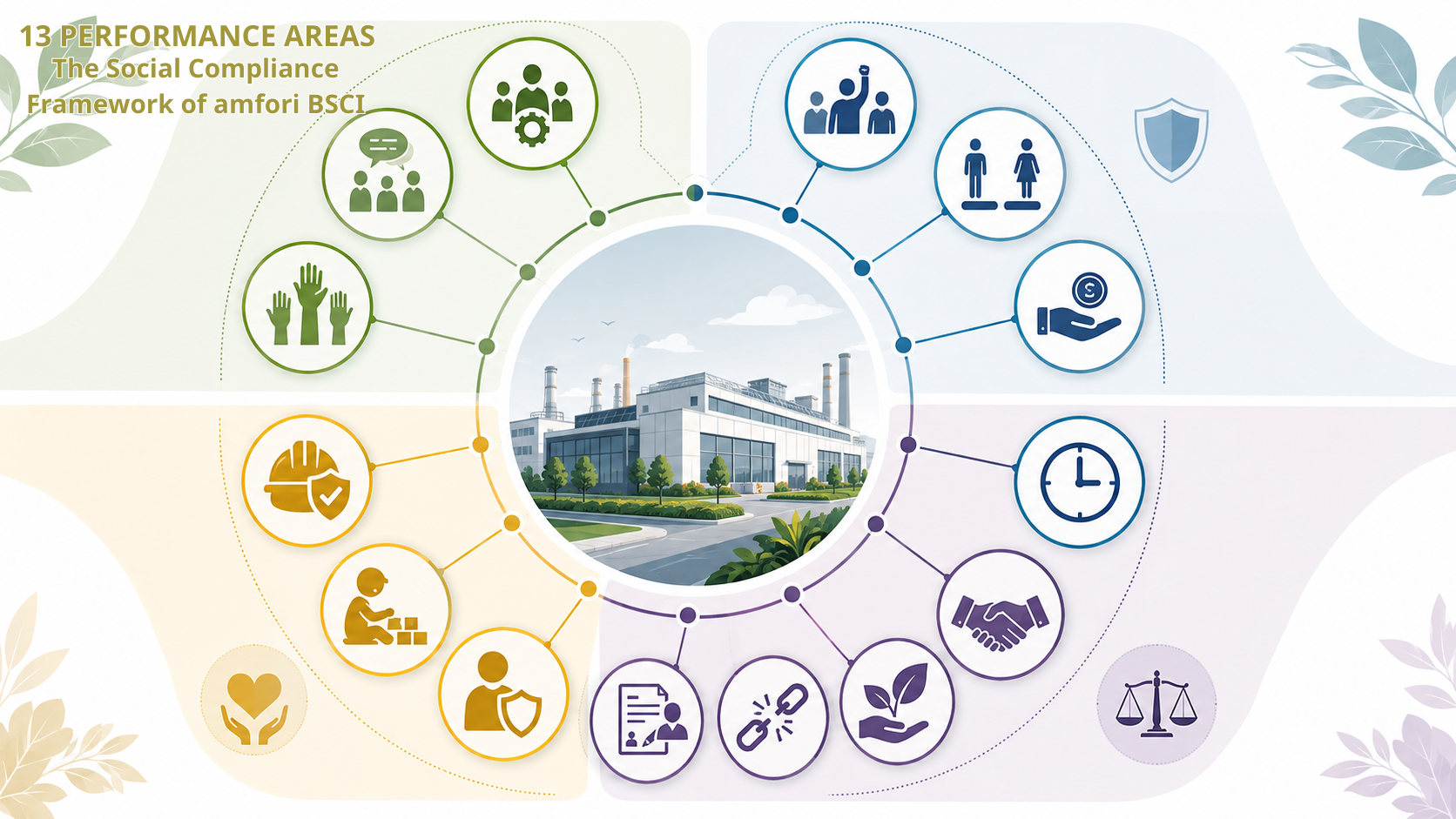
The 13 Performance Areas can be understood through four main groups.
Group 1 – Social Management & Workplace Relations
PA1. Social Management System & Cascade Effect
Companies should establish a management system capable of implementing social responsibility principles in actual business operations.
Relevant elements may include:
- policies and commitments;
- assignment of responsibilities;
- competence of responsible personnel;
- risk assessment;
- objectives and action plans;
- implementation monitoring;
- continuous improvement.
The Cascade Effect should not simply be interpreted as requiring every supplier to implement the entire BSCI system in exactly the same way.
Companies should identify relevant or significant business partners, communicate appropriate social responsibility expectations and consider how these partners align with applicable principles.
This helps extend responsible business practices beyond the company’s own operations into relevant supply-chain relationships.
PA2. Workers Involvement and Protection
Companies should provide mechanisms that enable workers to:
- receive appropriate information;
- understand their rights;
- participate in workplace dialogue;
- have appropriate representation;
- raise concerns;
- access grievance mechanisms;
- raise concerns in good faith without retaliation.
Having a suggestion box or grievance procedure on paper is not enough.
Auditors may also assess whether workers actually know that the mechanism exists, whether they can access it and whether they trust the process.
PA3. The Rights of Freedom of Association and Collective Bargaining
Companies should respect workers’ rights relating to:
- worker representation;
- joining or not joining representative organizations;
- choosing representatives;
- workplace dialogue;
- collective bargaining;
- participation in lawful representative activities.
Workers should not face discrimination or retaliation for exercising these rights.
Worker interviews may play an important role in assessing this Performance Area.
PA4. No Discrimination, Violence or Harassment
Employment decisions relating to recruitment, training, remuneration, promotion, disciplinary action or termination should not be based on unlawful or inappropriate discriminatory grounds.
Companies should also prevent:
- sexual harassment;
- bullying;
- violence;
- intimidation;
- abusive conduct;
- degrading treatment.
Group 2 – Employee Well-being & Fair Practices
PA5. Fair Remuneration
Companies should ensure that wages and employment-related benefits comply with applicable legal requirements.
Auditors may review:
- basic wages;
- overtime compensation;
- allowances;
- benefits;
- deductions;
- payment timing;
- statutory insurance;
- living-wage-related considerations.
Companies should therefore review the overall remuneration structure, rather than checking only the basic statutory minimum wage.
PA6. Decent Working Hours
Working hours are often an important risk area in manufacturing environments.
Auditors may cross-check:
- attendance records;
- payroll;
- overtime records;
- shift schedules;
- rest days;
- production data;
- worker interview statements.
Important issues may include:
- normal working hours;
- overtime;
- voluntary overtime;
- rest periods;
- weekly rest;
- accuracy of working-hour records.
PA7. Occupational Health and Safety
Companies should identify, assess and control occupational health and safety risks.
Depending on the facility, auditors may review:
- machinery;
- electrical safety;
- chemicals;
- PPE;
- fire safety;
- emergency exits;
- first aid;
- workplace hygiene;
- drinking water;
- sanitation;
- occupational environment;
- safety training;
- accidents and incidents;
- emergency preparedness and response.
Group 3 – Protection of Vulnerable Workers
PA8. No Child Labour
Companies should maintain effective age-verification controls during recruitment.
They should also establish an appropriate remediation process for situations where child labour is identified, with priority given to protecting the child’s interests rather than simply terminating the employment relationship.
PA9. Special Protection for Young Workers
Young workers should be identified and provided with additional protection.
Companies should consider:
- assigned work;
- hazardous activities;
- working hours;
- night work;
- workplace conditions;
- training;
- supervision;
- additional protection measures.
PA10. No Precarious Employment
Employment relationships should be transparent and properly recognized.
Companies should not use contractual arrangements, temporary labour, agency workers or other employment structures primarily to avoid legal obligations or employment rights.
Auditors may review:
- employment contracts;
- probation arrangements;
- temporary employment;
- agency labour;
- subcontracted labour;
- apprenticeships;
- other employment arrangements.
The key issue is whether a particular employment arrangement is being used to avoid obligations that workers would otherwise be entitled to receive.
PA11. No Bonded, Forced Labour or Human Trafficking
Employment should be voluntary.
Potential risk indicators may include:
- retention of identity documents;
- employment deposits;
- unreasonable recruitment fees;
- withholding wages;
- restrictions on freedom of movement;
- threats;
- forced overtime;
- restrictions on the right to resign;
- recruitment-related debt.
Companies using migrant workers or recruitment agencies should pay particular attention to this area.
Group 4 – Environmental Protection & Ethical Business Conduct
PA12. Protection of the Environment
Companies should identify and manage environmental impacts associated with their operations and comply with applicable environmental requirements.
Depending on the industry, relevant issues may include:
- wastewater;
- general waste;
- hazardous waste;
- air emissions;
- chemical management;
- environmental permits;
- environmental control measures.
PA13. Ethical Business Behaviour
Companies should establish controls to prevent:
- corruption;
- bribery;
- fraud;
- conflicts of interest;
- falsification of records;
- misleading information;
- unauthorized disclosure of information;
- other unethical business practices.
The integrity of records is particularly important in social audits.
Maintaining parallel attendance records, parallel payroll records or other documentation that does not reflect actual workplace conditions can create serious audit risks.
5. How Do the 81 BSCI Audit Questions Relate to the 13 Performance Areas?
A full amfori BSCI audit currently contains 81 questions distributed across the 13 Performance Areas.
Auditors do not assess compliance only by checking whether a particular document exists.
Evidence may be collected and cross-checked through:
- document reviews;
- workplace observations;
- management interviews;
- worker interviews;
- additional operational data.
A BSCI checklist can therefore be useful as an initial review tool, but it cannot replace an assessment of:
- management-system effectiveness;
- accuracy of records;
- actual worker protection;
- consistency between documented information and workplace reality.
6. Download the 13 BSCI Performance Areas PDF Guide

TTS Cert Vietnam has prepared a concise reference guide summarizing the 13 amfori BSCI Performance Areas to support companies with:
- quick reference;
- internal training;
- preliminary self-assessment;
- audit preparation;
- communication with relevant departments.
The guide is designed as a practical reference for companies operating in Vietnam.
Important: This PDF is a reference document prepared by TTS Cert Vietnam and does not replace official documentation published by amfori.
When making important compliance or audit decisions, companies should always refer to the applicable official amfori documentation and buyer-specific requirements.
7. Frequently Asked Questions
What is the difference between the “11 BSCI principles” and the 13 Performance Areas?
The term “11 BSCI principles” is still commonly found in older reference materials and online content.
However, under the current amfori BSCI monitoring structure, audited sites are assessed through 13 Performance Areas.
PA1 covers Social Management System & Cascade Effect, while PA2 covers Workers Involvement and Protection.
PA3 through PA13 address worker rights, wages, working hours, occupational health and safety, child labour, forced labour, environmental protection and ethical business behaviour.
Companies preparing for an audit should therefore review the complete 13 Performance Areas.
Are all 13 Performance Areas assessed during a BSCI audit?
The 13 Performance Areas form the overall structure of BSCI monitoring.
However, individual questions and specific evidence requirements may vary according to applicability, site activities and actual risk conditions.
A company should therefore avoid excluding a Performance Area simply because it believes that area is not relevant without first conducting an appropriate assessment.
Does the BSCI Code of Conduct have to be printed and displayed in the factory?
The important issue is not simply whether a copy of the Code of Conduct is posted on a wall.
Companies should demonstrate that relevant principles are communicated appropriately and that workers can understand and access information relating to their rights.
Displaying appropriate information in languages understood by workers can be one useful communication method, but it should form part of a broader worker communication and involvement system.
Can the TTS Cert PDF replace official amfori documentation?
No.
The TTS Cert Vietnam PDF is a summarized reference guide designed to make the 13 Performance Areas easier for Vietnamese companies to understand and review.
It is not an official amfori translation or an official replacement for amfori documentation.
Where should a company start when preparing for the 13 Performance Areas?
A practical first step is usually a Gap Assessment.
The company can review each Performance Area to identify:
- legal compliance gaps;
- BSCI-related gaps;
- missing documentation;
- workplace deficiencies;
- worker interview risks;
- corrective actions required.
For a complete explanation of the BSCI audit process, ratings and preparation, see:
[INTERNAL LINK → ENGLISH PILLAR]
What Is BSCI and How Should a Company Prepare for an Audit?
How TTS Cert Vietnam Supports BSCI Audit Preparation
TTS Cert Vietnam supports companies in developing and improving social responsibility management systems aligned with amfori BSCI expectations, including:
- Gap Assessment against the 13 Performance Areas;
- review of Vietnamese labour-law compliance;
- development and improvement of policies, procedures and records;
- wage and working-hour review;
- on-site occupational health and safety review;
- training for responsible personnel;
- Mock Audit;
- Corrective Action support;
- preparation before the official audit.
The objective is not simply to prepare a company for one audit, but to support the development of a practical social responsibility management system that can be implemented and maintained in day-to-day operations.

Lawyer Tran Thi Trang has more than 10 years of experience in corporate legal affairs and compliance, along with many years advising and training on social responsibility, environmental and sustainable development standards.
SEE MORE