Table of contents
When a buyer asks a textile supplier to meet a “BCI”, “Better Cotton” or “BCI Cotton” requirement, the first assumption is often that the supplier needs to obtain a certificate called a BCI certificate.
The Better Cotton Initiative system is considerably broader.
It includes a farm-level standard, Chain of Custody requirements for the supply chain, the BCI Platform for transaction management, Mass Balance and Physical BCI Cotton sourcing models, membership, traceability and third-party certification.
The system also changed significantly during 2025–2026. In 2025, the organisation returned to its original full name, Better Cotton Initiative (BCI), alongside a new brand identity and product label. Cotton sourced through the programme is now referred to as BCI Cotton.
For this reason, the first question should not simply be:
“How do we get BCI certified?”
It should be:
“What exactly does our customer require us to do within the BCI system?”
What is BCI Cotton?
BCI Cotton is cotton produced within the Better Cotton Initiative system in accordance with applicable BCI requirements. In textile supply chains, companies can source BCI Cotton through Mass Balance or Physical BCI Cotton models, which have different traceability and certification requirements.
1. What Is BCI – the Better Cotton Initiative?
BCI stands for the Better Cotton Initiative, a global initiative working to support more sustainable cotton production and sourcing.
Its system extends beyond farms. As cotton moves through ginning, trading, spinning, fabric manufacturing, garment manufacturing and ultimately to retailers and brands, Chain of Custody requirements and the BCI Platform connect supply with market demand.
BCI currently has more than 2,500 members across the sector.
What is BCI Cotton?
It is useful to distinguish the two terms.
BCI refers to the initiative and its standard system.
BCI Cotton refers to cotton produced and sourced within that system under the applicable requirements.
Being associated with BCI Cotton does not automatically mean that the physical cotton contained in an individual product can be traced to a specific BCI source. That depends on whether the sourcing model is Mass Balance or Physical BCI Cotton.
Are Better Cotton and the Better Cotton Initiative the same organisation?
Yes.
The organisation had been known mainly as Better Cotton for several years. In October 2025, it returned to its original full name, Better Cotton Initiative, while updating its logo, website and brand identity.
2. How Does BCI Work Through the Cotton Supply Chain?
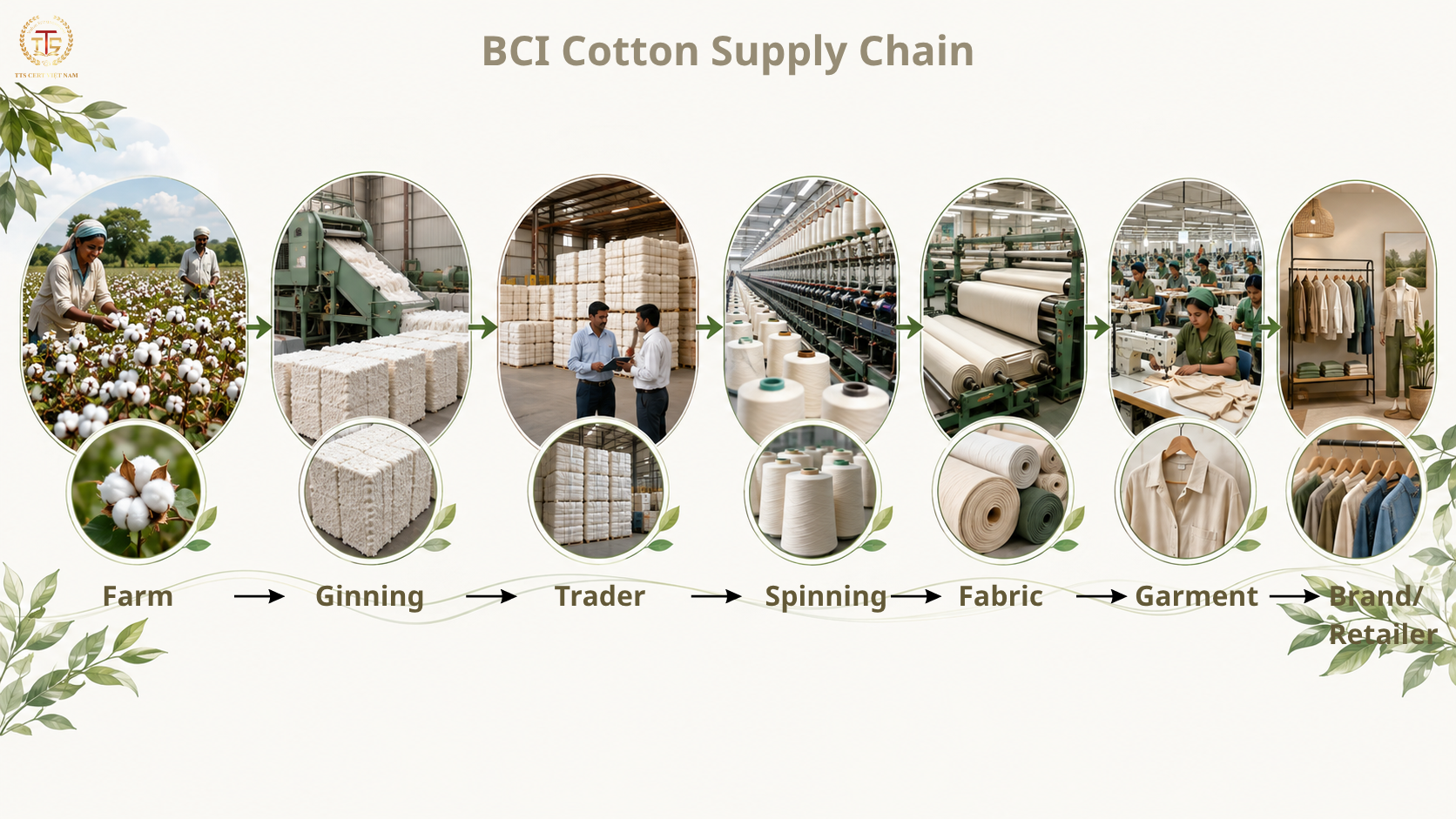
A typical BCI Cotton supply chain may include:
Cotton Farm → Gin → Trader → Spinner → Fabric Mill → Garment Manufacturer → Brand/Retailer
At farm level, Producers are assessed against BCI's farm-level requirements.
Once cotton enters the supply chain, the Chain of Custody defines how BCI Cotton, volumes and supporting evidence are managed as material moves between organisations.
The BCI Platform provides the online infrastructure for recording and managing BCI Cotton transactions.
More than 13,000 organisations, including ginners, traders, spinners, fabric mills, garment manufacturers, sourcing agents and retailers, currently use the BCI Platform.
The role of Chain of Custody
The BCI Chain of Custody provides documentation and evidence as ownership or control of material moves through the supply chain.
The current system enables two principal types of sourcing:
Mass Balance BCI Cotton and Physical BCI Cotton.
3. What Are the Main BCI Standard Requirements?
One common misunderstanding is to treat all BCI requirements as a single standard applying equally to cotton farms, spinning mills, fabric mills and garment manufacturers.
Two different elements must be distinguished:
BCI Principles & Criteria – the farm-level standard.
BCI Chain of Custody Standard – the supply-chain standard.
BCI Principles & Criteria v3.2
The current version in 2026 is BCI Principles & Criteria v3.2.
The P&C is BCI's farm-level sustainability standard covering environmental, social and economic requirements Producers must meet to become certified to sell BCI Cotton.
It is organised around six Principles:
- Management;
- Natural Resources;
- Crop Protection;
- Fibre Quality;
- Decent Work;
- Sustainable Livelihoods.
Two Cross-Cutting Priorities – Gender Equality and Climate Change – are integrated across the Principles.
Do the six Principles apply directly to garment factories?
They should not be interpreted that way.
The P&C is a farm-level standard. A spinner, fabric mill or garment manufacturer needs to identify the applicable Chain of Custody requirements for its position in the supply chain.
4. What Is the BCI Chain of Custody?
The BCI Chain of Custody defines auditable requirements for managing BCI Cotton and related evidence as material moves through the supply chain.
The current standard is:
BCI Chain of Custody Standard v1.2
effective from 6 January 2026.
Four BCI Chain of Custody Models
| CoC Model | Category |
|---|---|
| Mass Balance | Mass Balance BCI Cotton |
| Segregation – Single Country | Physical BCI Cotton |
| Segregation – Multi-Country | Physical BCI Cotton |
| Controlled Blending | Physical BCI Cotton |
BCI defines Segregation Single Country, Segregation Multi-Country and Controlled Blending as the three Physical CoC Models.
Read more: BCI Chain of Custody Standard v1.2 Explained
5. What Is Mass Balance BCI Cotton?
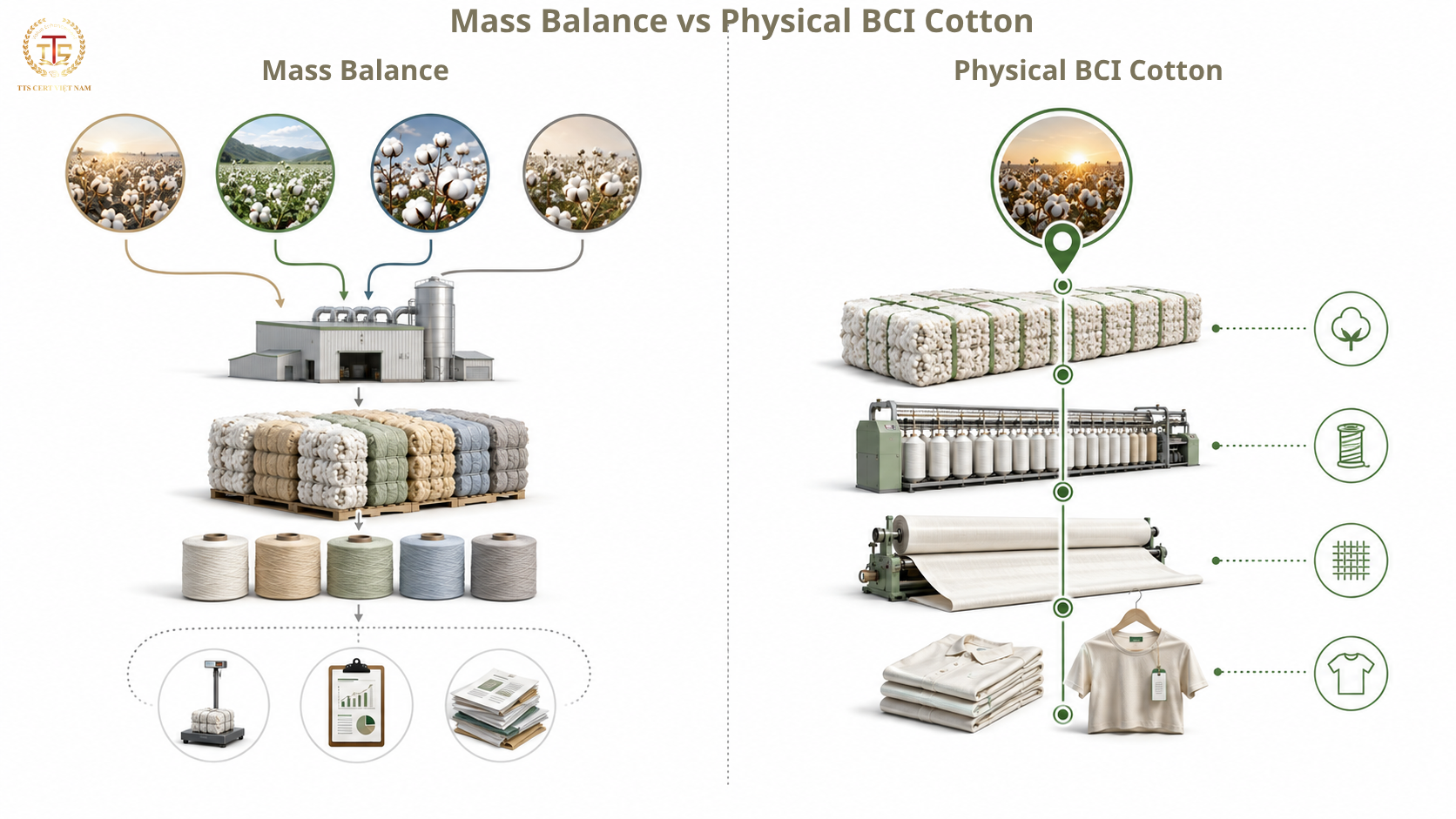
Mass Balance allows BCI Cotton and conventional cotton to flow through the supply chain without maintaining the physical identity of BCI Cotton throughout every stage.
A core principle is that the amount of BCI Cotton sold must not exceed the amount purchased, subject to applicable conversion and accounting requirements.
Therefore, sourcing an order under Mass Balance does not mean that the physical cotton fibres in that specific finished product can necessarily be traced to a BCI-certified farm.
BCI uses BCI Cotton Claim Units – BCCUs on the BCI Platform to track Mass Balance.
What is a BCCU?
A BCCU is a unit used within the BCI Platform for tracking claims associated with BCI Cotton under the Mass Balance model.
Effective controls therefore need to cover purchasing, sales, allocation, conversion, transaction records and Platform data.
Read more: Mass Balance vs Physical BCI Cotton
6. What Is Physical BCI Cotton?
Physical BCI Cotton provides a higher level of physical traceability through the supply chain.
BCI Traceability makes it possible to identify the country of origin of Physical BCI Cotton and, depending on origin, provide additional route-to-market information.
Segregation – Single Country
Physical BCI Cotton originating from one country is kept separate from conventional cotton and from BCI Cotton originating in other countries as required by the model.
Segregation – Multi-Country
Physical BCI Cotton from multiple countries may be handled together while remaining separated from conventional cotton.
Controlled Blending
Controlled Blending permits Physical BCI Cotton and conventional cotton to be mixed within a production batch under controlled requirements, allowing a percentage claim relating to the Physical BCI Cotton contained in that batch.
Mass Balance vs Physical BCI Cotton
| Topic | Mass Balance | Physical BCI Cotton |
|---|---|---|
| Physical identity maintained | No | Yes |
| Country-of-origin traceability | No physical product trace | Yes |
| BCCUs | Yes | Not the primary mechanism |
| Physical CoC model | No | Segregation / Controlled Blending |
| Supplier/Manufacturer certification | Not currently required | Required |
| Traceability model | Accounting based | Physical traceability |
7. Does Every Company Need BCI Certification?
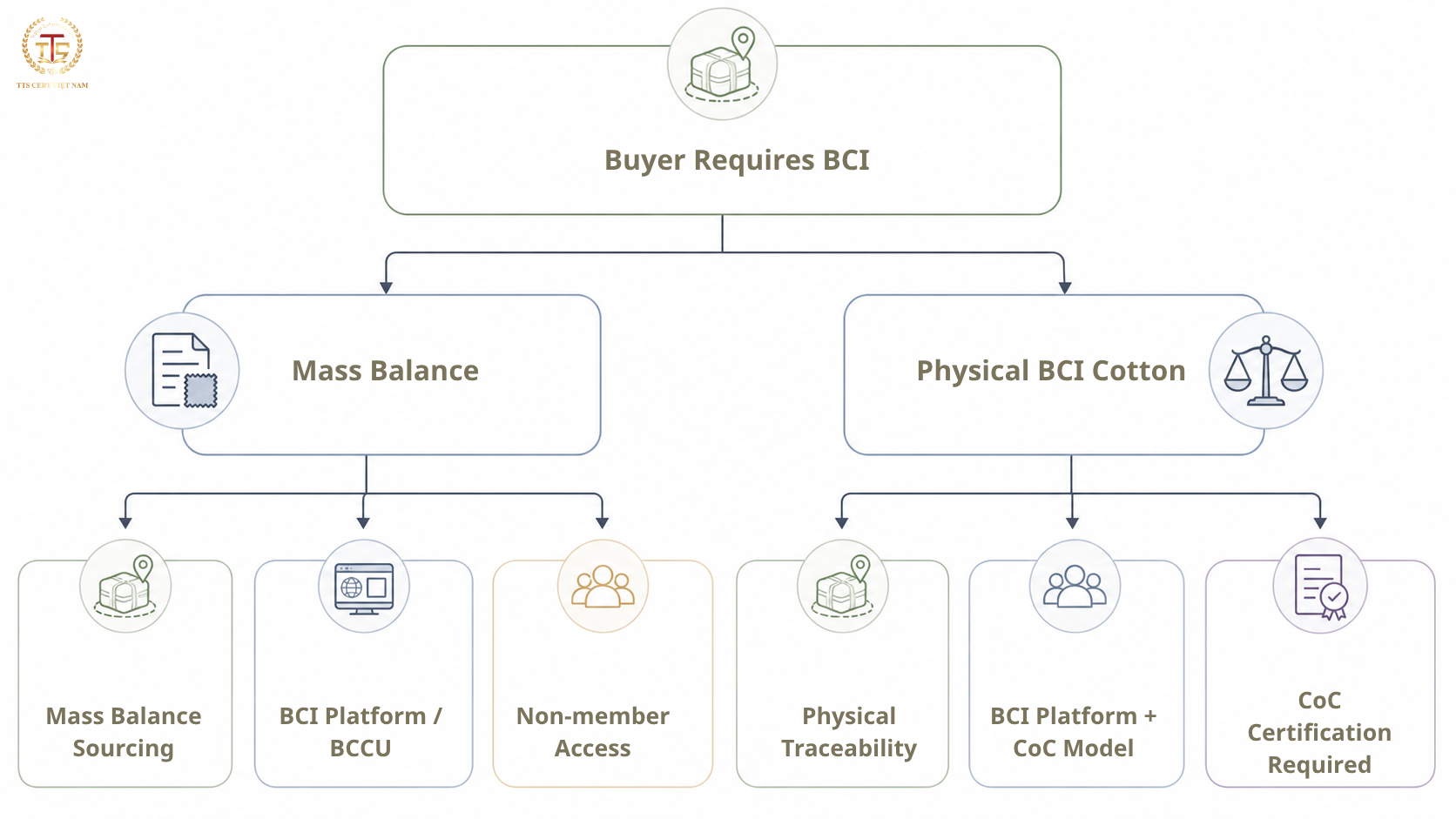
No. Not every company participating in the BCI system needs Chain of Custody certification.
The answer depends largely on the sourcing model and the organisation's role.
Does Mass Balance require certification?
For Suppliers and Manufacturers, BCI currently states that Mass Balance does not require certification at this point.
This does not mean there are no requirements. BCI Platform access, transaction controls, training and applicable Chain of Custody requirements may still need to be addressed.
Does Physical BCI Cotton require certification?
Yes.
Supply-chain organisations sourcing Physical BCI Cotton must be certified against BCI Chain of Custody Standard v1.2.
Retailers, brands and buyers have additional requirements relating to traceability, certification, claims and use of the BCI Cotton label.
Important 2026 label update
BCI has phased out its former Mass Balance on-product mark. After May 2026, new products can no longer carry the old Mass Balance mark.
The new BCI Cotton label is linked to traceable Physical BCI Cotton and applicable certification and claims requirements.
Not Sure Whether You Need BCI Platform Access or CoC Certification?
TTS Cert can review your buyer requirements, determine whether Mass Balance or Physical BCI Cotton applies, and identify the appropriate implementation scope before your company commits resources to the project.
8. What Is the BCI Platform?
The BCI Platform is an online system owned by the Better Cotton Initiative and used by supply-chain organisations to document and manage BCI Cotton transactions.
It supports both Mass Balance and Physical BCI Cotton.
Typical records include:
- BCI Cotton orders;
- purchase transactions;
- sales transactions;
- BCCUs;
- Physical BCI Cotton volumes;
- supporting transaction information.
Who uses the BCI Platform?
Users include ginners, cotton traders, spinners, fabric mills, garment and end-product manufacturers, sourcing agents, retailers and brands.
Does having a BCI Platform account mean that a company is BCI certified?
No.
Platform access and certification are separate concepts.
BCI also provides a non-member supplier Platform option for certain eligible supply-chain organisations.
Read more: What Is the BCI Platform?
9. What Is BCI Membership?
Membership should also be distinguished from Platform access and certification.
BCI currently has five main membership categories:
- Civil Society;
- Producer Organisations;
- Suppliers and Manufacturers;
- Retailers, Brands and Buyers;
- Associate Membership.
Supplier and Manufacturer Membership
This category covers organisations such as cotton traders, spinners, integrated spinners, fabric mills, vertically integrated mills, end-product manufacturers and sourcing agents.
BCI reports more than 2,200 Supplier and Manufacturer Members in 65 countries.
Membership vs Platform vs Certification
| Topic | Membership | BCI Platform | CoC Certification |
|---|---|---|---|
| Purpose | Membership status | Transaction system | Conformity verification |
| Same thing? | No | No | No |
| Transaction management | Not automatically | Yes | Does not replace Platform |
| Physical BCI Cotton | Does not replace certification | Platform required | Certification required for suppliers/manufacturers |
| Mass Balance | May apply | Used for transactions/BCCUs | Currently no certification requirement |
For this reason, the first question should not be:
“How much does BCI certification cost?”
It should be:
“Do we need membership, Platform access, certification, or a combination of these?”
Read more: BCI Membership Explained
10. Which Textile Companies Commonly Encounter BCI Requirements?
Cotton traders
Traders buy and sell cotton and may participate in either Mass Balance or Physical BCI Cotton supply chains.
Spinning mills
Spinners are critical supply-chain actors because cotton lint is converted into yarn at this stage. Controls may include supplier status, purchasing, receipt, material identification, production, reconciliation and transaction records.
Fabric mills
Fabric mills generally need clear links between BCI-related purchasing, production, stock and sales information.
Garment manufacturers
A buyer putting “BCI required” on a purchase order does not automatically mean that the garment factory requires certification.
The factory needs to clarify:
Mass Balance or Physical BCI Cotton?
Sourcing agents and trading companies
Non-manufacturing organisations that buy, sell or coordinate sourcing may also fall within relevant Platform and Chain of Custody requirements.
Retailers and brands
Retailers and brands have their own membership, sourcing, traceability, certification and claims requirements.
11. What Should a Company Do When a Buyer Requests BCI?
Step 1 – Clarify the buyer requirement
Determine whether the customer expects:
Mass Balance, Physical BCI Cotton, BCI Platform participation, CoC certification, or eligibility for a consumer-facing BCI Cotton label.
Step 2 – Identify your supply-chain position
Are you a trader, spinner, fabric mill, garment manufacturer, sourcing agent or brand?
Step 3 – Determine the sourcing model
Mass Balance or Physical?
For Physical sourcing, determine whether the applicable model is:
Segregation Single Country, Segregation Multi-Country or Controlled Blending.
Step 4 – Review BCI Platform requirements
A supply-chain organisation must already have a BCI Platform account before it can become certified for Physical BCI Cotton.
Step 5 – Determine the membership approach
Review whether BCI Membership or an eligible non-member supplier Platform arrangement is appropriate.
Step 6 – Confirm certification requirements
Certification requirements differ between Mass Balance and Physical BCI Cotton.
Step 7 – Conduct a Gap Assessment
Review current controls over:
purchasing, supplier approval, material receipt, identification, production, inventory, volume reconciliation, sales, Platform transactions, records and competence.
Step 8 – Implement the system
Policies and procedures should only be developed after the correct scope has been established.
Your Buyer Requires BCI, but Is It Mass Balance or Physical?
TTS Cert can review buyer specifications, purchase orders or sourcing requirements and help determine the correct BCI pathway before system implementation begins.
12. BCI CoC Implementation and Certification Process
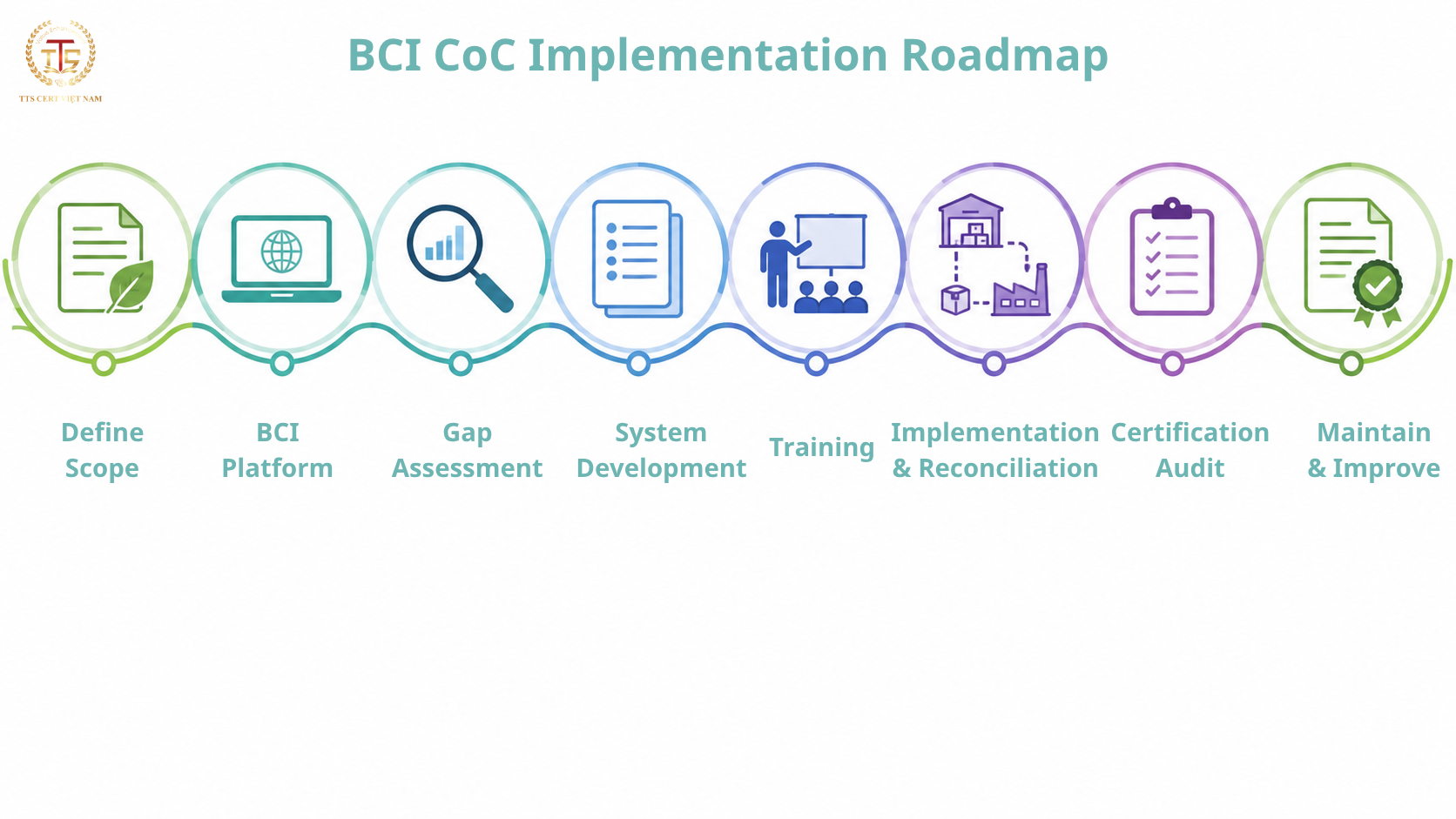
For organisations that require Physical BCI Cotton CoC Certification, a practical implementation route may include the following.
Define the certification scope
Determine the legal entity, site, activity, products, supply-chain tier and applicable Physical CoC Model.
Obtain BCI Platform access
Supply-chain organisations must have a BCI Platform account before Physical BCI Cotton certification.
Conduct a CoC v1.2 Gap Assessment
Compare existing controls with applicable BCI CoC requirements.
Develop or revise the management system
Establish roles, procedures and records covering supplier controls, purchasing, receiving, production, stock, sales, traceability and Platform transactions.
Train relevant personnel
Departments commonly involved include Purchasing, Sales, Warehouse, Production, Planning, CSR/Compliance and the BCI Platform administrator.
Run the system and verify data consistency
A key control is reconciliation across:
physical stock ↔ production records ↔ purchase/sales documents ↔ BCI Platform.
Select a BCI-approved Certification Body
BCI maintains a database of approved Certification Bodies for Chain of Custody audits, including multiple organisations operating in Vietnam.
Certification audit and corrective action
The Certification Body audits the organisation. Any identified nonconformities need to be addressed in accordance with applicable procedures.
Maintain certification and ongoing compliance
Certification is not the end of the process. Transaction records, Platform data and operational controls need to remain consistent.
Read more: BCI Certification Consulting Services
13. What Documents Should a Company Prepare?
The exact documents depend on the scope and CoC Model, but commonly include the following groups.
Organisation and scope records
Legal entity information, sites, activities, responsible personnel and process flow.
Supplier and purchasing records
Approved suppliers, purchase orders, invoices and relevant evidence of BCI status.
Material receipt and identification
Receiving records, lots/batches and identification controls.
Production records
Material issues, production orders, batch records, outputs and conversion data.
Inventory and volume reconciliation
Input, output, stock and sales reconciliation.
Sales records
Sales orders, invoices, delivery records and BCI-related information transferred to customers.
BCI Platform records
Platform transactions should correspond with relevant commercial and production records.
Management system records
Procedures, responsibilities, training, monitoring, corrective actions and record retention.
14. Is BCI the Same as Organic Cotton, GOTS, GRS or RCS?
Is BCI Cotton organic cotton?
No.
BCI explicitly states that BCI Cotton is not the same as organic cotton. Farmers follow BCI sustainability requirements but are not necessarily certified organic.
BCI vs GOTS
GOTS focuses on organic textile processing and associated supply-chain requirements.
BCI focuses on cotton sustainability from farm production through the BCI Cotton sourcing system.
Read more: What Is GOTS Certification?
BCI vs GRS and RCS
GRS and RCS focus primarily on recycled materials and chain of custody for recycled content.
BCI focuses specifically on cotton produced under the Better Cotton Initiative system.
A textile product or supplier may therefore be involved with multiple standards depending on material composition and buyer requirements.
Read more: What Is GRS Certification?
15. Benefits of BCI for Textile Supply-Chain Companies
Participation in the BCI system can support access to supply chains where buyers and brands have responsible cotton sourcing requirements.
Physical BCI Cotton also provides enhanced origin information and traceability.
Operationally, Chain of Custody implementation can strengthen controls over:
supplier approval, material identification, reconciliation, traceability, transactions and consistency between production and sales records.
However, BCI certification should not be presented as a guarantee of additional orders or higher sales. Commercial outcomes depend on individual buyer and market requirements.
16. Six Common Misunderstandings About BCI
“BCI is one certificate that applies to every company.”
Incorrect. Farm certification and supply-chain certification are different.
“We have a BCI Platform account, so we are certified.”
Incorrect. Platform access is not certification.
“BCI Membership means BCI certification.”
Incorrect. They are separate mechanisms.
“Mass Balance means the physical cotton in my product came from a BCI farm.”
Incorrect. Mass Balance does not provide that type of product-level physical-origin assurance.
“BCI Cotton is organic cotton.”
Incorrect.
“A garment factory must implement all six BCI P&C Principles for CoC certification.”
Incorrect. P&C is the farm-level standard, while supply-chain organisations need to determine applicable CoC requirements.
17. Frequently Asked Questions About BCI
What does BCI stand for?
BCI stands for Better Cotton Initiative.
What is BCI Cotton?
BCI Cotton is cotton produced within the Better Cotton Initiative system under applicable BCI requirements.
Are Better Cotton and BCI the same organisation?
Yes. The organisation returned to the full name Better Cotton Initiative in 2025 after having been known mainly as Better Cotton.
Does every company sourcing BCI Cotton need certification?
No. Mass Balance currently does not require Supplier/Manufacturer certification, while sourcing Physical BCI Cotton does.
Does a garment factory need BCI certification?
It depends on the buyer requirement and sourcing model. A PO simply stating “BCI” is not sufficient to determine the certification scope.
What is the difference between Mass Balance and Physical BCI Cotton?
Mass Balance is based primarily on accounting and BCCUs, while Physical BCI Cotton uses physical Chain of Custody models and traceability.
Can a company use the BCI logo simply because it has Platform access?
No. BCI specifically notes that non-member Platform Suppliers cannot use the BCI logo solely on the basis of Platform access.
Is BCI Membership mandatory?
Not for every supply-chain organisation. An eligible non-member BCI Platform supplier route is available in certain circumstances.
18. How Can TTS Cert Support BCI Implementation?
An effective BCI project should start by identifying the correct requirement, rather than drafting a large set of procedures before determining whether the business needs Mass Balance or Physical BCI Cotton.
TTS Cert can support companies through:
Buyer requirement review
→ Supply-chain position identification
→ Mass Balance / Physical determination
→ Platform / Membership / Certification analysis
→ CoC v1.2 Gap Assessment
→ Documentation and system development
→ Personnel training
→ Traceability and volume reconciliation support
→ Certification audit preparation
→ Corrective action support.
The objective is to develop a practical system that reflects the company's actual operations while meeting applicable BCI and customer requirements.
Build Your BCI System Correctly from the Start
If your company has received a BCI requirement from a buyer or is preparing for Physical BCI Cotton and CoC Certification, contact TTS Cert to determine the appropriate scope and implementation roadmap before you begin.