
Table of contents
SA8000 is an international social accountability standard under which organisations can be audited and certified for working conditions and how they manage workers' rights. The current version is SA8000:2026, which replaced SA8000:2014 on 1 January 2026.
TTS Cert helps organisations build an SA8000 management system, prepare for certification audits and transition from SA8000:2014 to SA8000:2026. Audits and certification are carried out by independent certification bodies.
1. What Is SA8000?
SA8000 is developed by Social Accountability International (SAI). It is based on International Labour Organization (ILO) conventions, the Universal Declaration of Human Rights and the UN Guiding Principles on Business and Human Rights.
SA8000 applies to organisations of any size, in any industry. Unlike audit programmes such as amfori BSCI or SMETA, SA8000 is a certification standard: compliant organisations receive a certificate valid for three years, with surveillance audits.
SA8000 audits are carried out by certification bodies accredited by SAAS (Social Accountability Accreditation Services).
2. SA8000:2026 Requirements
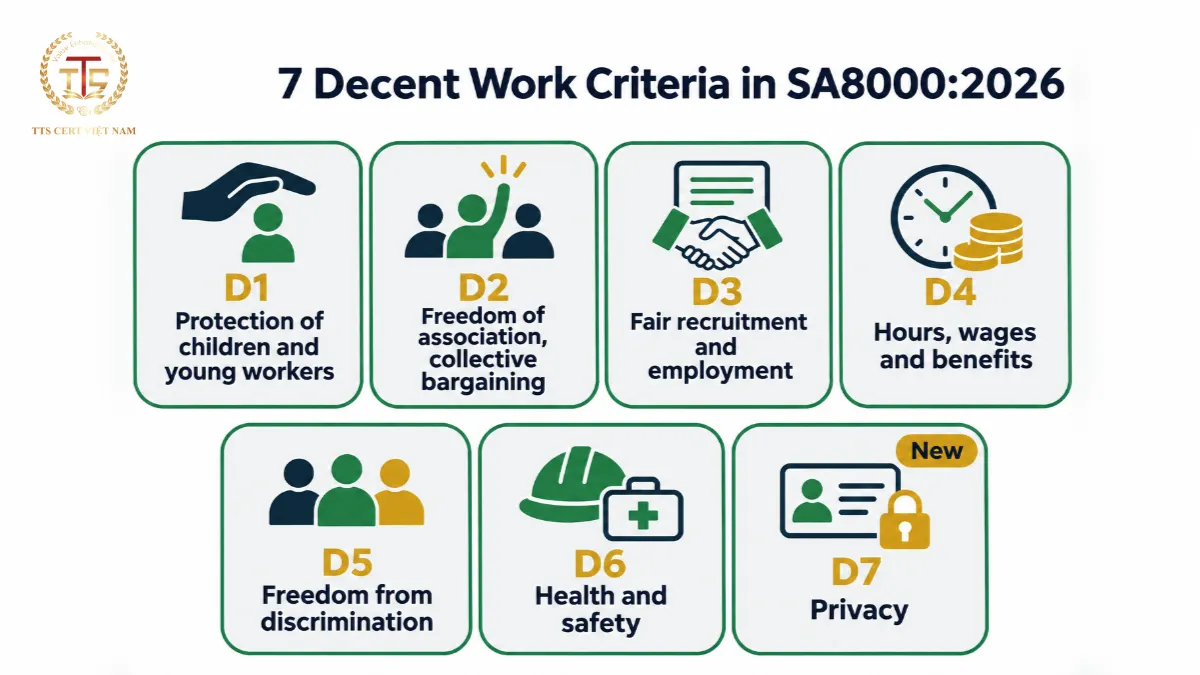
SA8000:2026 includes foundational criteria (such as legal compliance), 10 Management System criteria (M1–M10) and 7 Decent Work criteria (D1–D7).
2.1. Seven Decent Work criteria
| Code | Criterion |
|---|---|
| D1 | Protection of Children and Young Workers |
| D2 | Freedom of Association and the Right to Collective Bargaining |
| D3 | Free and Fair Recruitment, Employment and Termination |
| D4 | Decent Hours, Wages and Benefits |
| D5 | Freedom from Discrimination |
| D6 | Health and Safety |
| D7 | Privacy (new in 2026) |
2.2. Ten Management System criteria
M1 Leadership Commitment, Involvement and Integration · M2 Worker Involvement and Integration · M3 Stakeholder Involvement and Integration · M4 Policy Commitment and Coherence · M5 Context, Impacts and Risks · M6 Objectives, Planning and Resources · M7 Awareness and Implementation · M8 Integrity and Transparency · M9 Monitoring and Grievance Mechanisms · M10 Strategic Analysis, Review and Continual Improvement.
A key feature of the 2026 version is embedded human rights due diligence: organisations identify, prioritise and address risks to workers in their own operations and through business relationships. More: What's new in SA8000:2026?
3. Who Needs SA8000 Certification?
Suppliers to brands and retailers whose codes of conduct require SA8000.
Labour-intensive businesses: garments, footwear, furniture, agri-food, seafood, electronics, packaging…
Organisations that want a certificate for social accountability (not just an audit report) for tenders, ESG reporting or investors.
Organisations certified to SA8000:2014 that must transition to SA8000:2026.
4. SA8000 vs BSCI vs SMETA
| Criterion | SA8000 | amfori BSCI | SMETA |
|---|---|---|---|
| Nature | Certification standard | amfori audit programme | Sedex audit methodology |
| Output | Certificate | Report and A–E rating | Audit report shared on Sedex |
| Validity | 3 years, with surveillance audits | Depends on rating | Per customer requirements |
| Carried out by | SAAS-accredited certification bodies | amfori-approved audit companies | Sedex-approved audit companies |
Customers usually specify which programmes they accept, so check before you start. Learn more: What is BSCI? · What is SMETA?
5. The SA8000 Certification Process
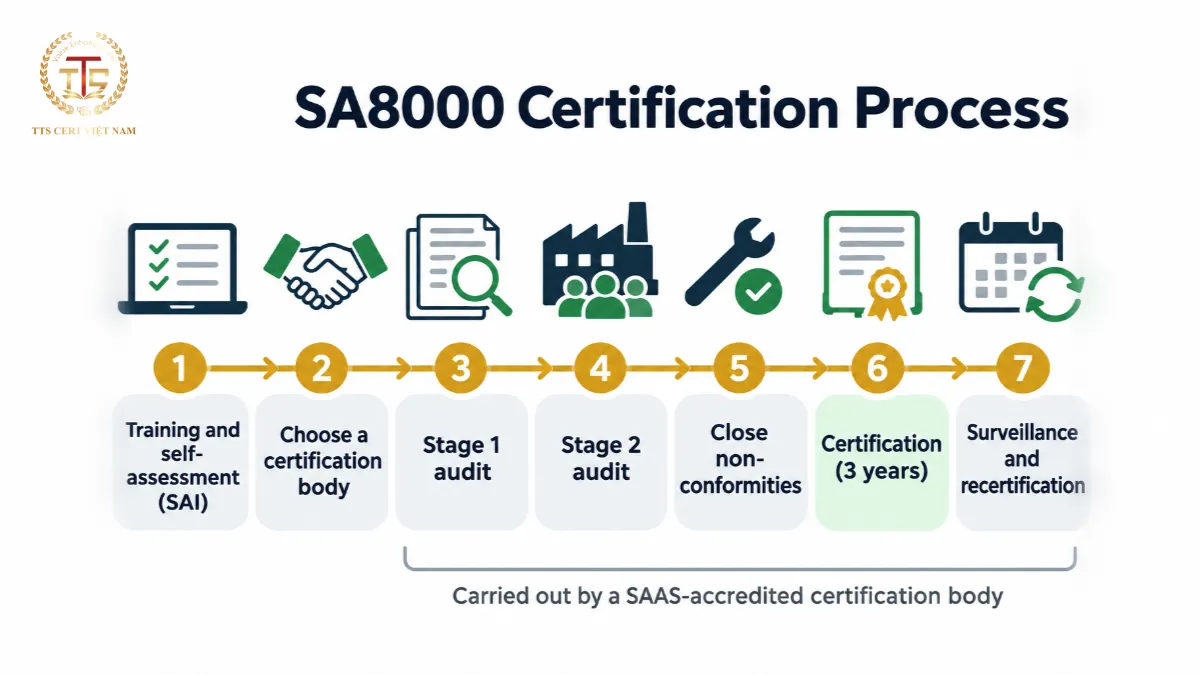
Training and self-assessment in the SAI system: complete the SA8000:2026 course and self-assessment; the self-assessment must be completed within six months before the Stage 1 or recertification audit.
Choose a SAAS-accredited certification body and sign the audit contract.
Stage 1 audit: reviews management system readiness.
Stage 2 audit: full on-site audit, worker interviews and document review, no more than six months after Stage 1.
Close non-conformities (if any) within the certification body's deadlines.
Certification, valid for three years.
Surveillance audits during the cycle (typically every six months; single-site organisations may qualify for annual surveillance under SAAS rules), and recertification at the end of the cycle.
6. Documents to Prepare
| Area | Key records |
|---|---|
| Policies and system | Social accountability policy, procedures for M1–M10, risk assessment, plans and objectives |
| Recruitment and contracts | Recruitment records, age verification, employment contracts, termination procedures |
| Hours and wages | Time records, payroll, payslips, overtime records, social insurance (usually the last 12 months) |
| Health and safety | Safety risk assessments, training, fire safety, workplace monitoring, health checks |
| Worker involvement | Worker representatives, dialogue minutes, grievance mechanism and case records |
| Privacy | Rules on collecting, using and protecting workers' personal data |
| Supply chain | Lists of suppliers, subcontractors and labour agencies, and how risks are managed |
| Legal | Licences, internal labour rules, collective agreement (if any) |
The exact list is adjusted after the gap analysis.
7. Timeline and Cost
Timeline: TTS Cert's consulting typically takes about 30–45 days, depending on the current system and document readiness. Certification audit timing depends on the certification body's schedule.
Cost depends on:
Number of workers and sites.
Current management system and gaps against SA8000:2026.
Consulting scope (new system or transition from 2014).
Certification body audit fees (quoted separately by the certification body).
8. Common Challenges
Overtime above legal limits; time records and payroll that do not match.
Workers not genuinely involved in the management system; grievance channels exist but are not used.
Risks at subcontractors and labour agencies not managed.
Documents in place but not implemented or effective.
No rules on workers' personal data (new D7 requirement).
9. How TTS Cert Supports You
Gap analysis against SA8000:2026 and Vietnamese labour law.
Training for management, worker representatives and relevant departments.
Documentation: policies, procedures and forms for M1–M10 and D1–D7.
Internal audit before the certification audit.
Support with the SAI course and self-assessment.
Support during the certification audit and with closing non-conformities.
SA8000:2014 → SA8000:2026 transition consulting for certified organisations.
TTS Cert is a consultancy and does not audit or certify SA8000. Audits and certification are carried out by SAAS-accredited certification bodies.
10. Frequently Asked Questions
Is SA8000 mandatory? Not by law. SA8000 is voluntary, but customers may require it.
How long is SA8000 certification valid? Three years, with surveillance audits during the cycle and recertification at the end.
What should organisations certified to SA8000:2014 do? Complete the SA8000:2026 course and self-assessment in the SAI system by 31 December 2026, review gaps and transition at the recertification audit. From 1 January 2027, all new certifications and recertifications must be to SA8000:2026.
If we have SMETA or BSCI, do we still need SA8000? It depends on the customer. The programmes overlap a lot but do not automatically replace each other.
Does TTS Cert issue SA8000 certificates? No. TTS Cert provides consulting and preparation support; certificates are issued by SAAS-accredited certification bodies.
11. Conclusion
SA8000 lets organisations demonstrate how they manage workers' rights with an internationally recognised certificate. SA8000:2026 makes the requirements on management systems, worker involvement and human rights due diligence clearer. Start with a gap analysis early, especially if you hold a 2014 certificate.
References
Social Accountability International – SA8000:2026 Standard
SAI – What has changed in the SA8000:2026 Standard
SAI – SA8000 Certification Program Timeline