Table of contents
When a customer or global brand asks a supplier to complete “Sedex”, a “SMETA Audit”, or even obtain a “SMETA certificate”, these terms are often treated as if they mean the same thing.
They do not.
Sedex provides a platform, tools, and solutions for managing responsible sourcing and supply chain sustainability data. SMETA – Sedex Members Ethical Trade Audit – is the social audit methodology developed and managed by Sedex.
Another important distinction is that SMETA is not a certification scheme and does not operate on a pass-or-fail basis. Instead, a SMETA audit provides information about actual workplace conditions, management systems, non-compliances, and areas requiring improvement.
This guide explains what Sedex and SMETA are, how they differ, the difference between SMETA 2-Pillar and 4-Pillar audits, what has changed under SMETA 7, how an audit is conducted, and what businesses should prepare before an assessment.
1. What Is Sedex?
Sedex is an organisation that provides a technology platform, tools, and solutions to help companies manage responsible sourcing, sustainability information, and supply chain risks.
Through the Sedex Platform, suppliers can maintain site information, complete self-assessment questionnaires, connect with customers, and share SMETA audit data with authorised business partners.
What Is the Sedex Platform Used For?
For suppliers, the Sedex Platform can be used to:
register and maintain company and site information;
complete the Self-Assessment Questionnaire – SAQ;
connect with customers and buyers;
manage and share SMETA audit information;
track responsible sourcing and sustainability-related information;
support supply chain due diligence activities.
Sedex itself does not conduct SMETA audits.
Official SMETA audits are carried out by auditors working for Sedex-approved Affiliate Audit Companies – AACs.
2. What Is SMETA?
SMETA stands for Sedex Members Ethical Trade Audit.
It is an audit methodology developed by Sedex to assess working conditions, labour practices, health and safety, environmental management, and business ethics at individual worksites.
SMETA draws on the principles of the ETI Base Code, relevant International Labour Organization – ILO conventions, and applicable local laws.
During a SMETA audit, auditors review not only policies and records but also actual workplace conditions, management systems, and information obtained from workers.
What Does a SMETA Audit Assess?
Depending on the selected audit scope, SMETA may cover:
Labour Standards
Recruitment, employment contracts, wages, working hours, child labour, forced labour, discrimination, freedom of association, worker treatment, and other employment conditions.
Health and Safety
Fire safety, machinery, personal protective equipment, chemicals, emergency preparedness, occupational health, workplace conditions, and related management systems.
Environment
Environmental permits, waste management, water, energy, chemicals, emissions, and other environmental management issues within a 4-Pillar audit.
Business Ethics
Anti-bribery, corruption, conflicts of interest, ethical business practices, and related management controls.
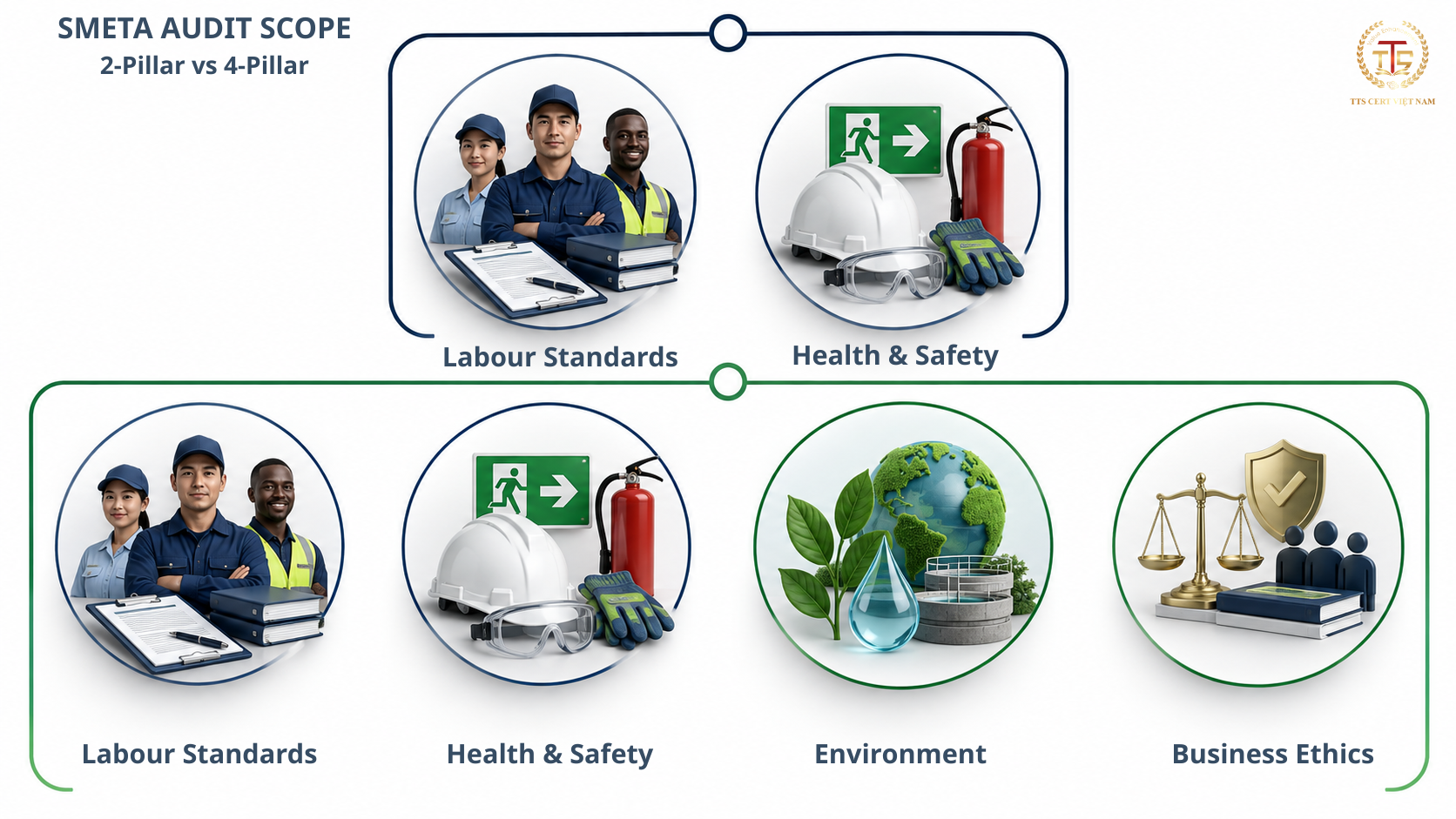
Labour Standards and Health & Safety form the core scope of SMETA, while Environment and Business Ethics are covered in greater depth under a 4-Pillar audit.
3. What Is the Difference Between Sedex and SMETA?
Sedex and SMETA are closely connected, but they are not interchangeable terms.
| Area | Sedex | SMETA |
|---|---|---|
| Nature | Organisation, platform and supply chain solutions | Social audit methodology |
| Main purpose | Manage, analyse and share supply chain information | Assess workplace conditions and management practices |
| Conducts audits | Sedex does not conduct audits directly | Audits are conducted by approved AAC auditors |
| Main output | Supply chain data and information | Audit Report, CAPR and findings |
| Certification | No | No |
| Pass/Fail | No | No |
In simple terms:
Sedex provides the ecosystem and platform; SMETA is the audit methodology.

4. Is SMETA a Certification?
Terms such as “SMETA certification” or “SMETA certificate” are commonly used in commercial discussions and online searches.
Technically, however, SMETA is not a certification programme.
After completing a SMETA audit, a company does not receive a Sedex certificate stating that it has “passed”.
Instead, the auditor records the conditions found at the site and documents relevant findings in the SMETA Audit Report and related corrective action documentation.
The buyer may then use this information together with its own supplier requirements, responsible sourcing policies, and risk criteria to determine appropriate follow-up actions.
When a customer asks for a “SMETA certificate”, the actual requirement may therefore be to:
complete a SMETA audit;
provide a recent SMETA Audit Report;
upload the audit to the Sedex Platform;
share the audit with the buyer;
address corrective actions identified during the audit.
Read more: Is SMETA a Certification? Does SMETA Issue a Certificate?
5. What Are SMETA 2-Pillar and SMETA 4-Pillar Audits?
SMETA audits are commonly conducted using either a 2-Pillar or 4-Pillar scope.
SMETA 2-Pillar
A SMETA 2-Pillar audit focuses primarily on:
Labour Standards
Health & Safety
It also includes certain additional elements relating to entitlement to work, subcontracting, homeworking, and environmental assessment.
SMETA 4-Pillar
SMETA 4-Pillar expands the assessment by adding:
Environment
Business Ethics
This provides buyers with a broader view of social, environmental, and ethical risks at the site.
Whether a supplier requires a 2-Pillar or 4-Pillar audit normally depends on the buyer's responsible sourcing programme, risk profile, and specific customer requirements.
Read more: SMETA 2-Pillar vs 4-Pillar: What Is the Difference?
6. What Is SMETA 7?
SMETA 7 is the current generation of the SMETA methodology and represents a major evolution from earlier versions.
SMETA 7 places greater emphasis on identifying not only individual non-compliances but also the management systems and root causes behind workplace issues.
Key developments include the following.
Workplace Requirements
SMETA 7 introduces clearer Workplace Requirements to support more consistent assessment against the ETI Base Code and related requirements.
This allows auditors to determine more clearly whether specific workplace expectations are being met.
Management Systems Assessment – MSA
One of the most important developments in SMETA 7 is the Management Systems Assessment – MSA.
The auditor does not simply check whether a policy or procedure exists.
The assessment also considers factors such as:
policies and procedures;
management responsibility;
communication and training;
monitoring and evaluation of effectiveness.
This means that having well-written documents alone is not sufficient if the company cannot demonstrate that its systems are effectively implemented in practice.
Additional Data Points
SMETA 7 captures additional information that can help buyers and suppliers better understand workplace context and supply chain risks.
Collaborative Action Required – CAR
Some social or labour issues cannot be solved by the supplier alone.
SMETA 7 therefore introduced Collaborative Action Required – CAR for certain complex issues where effective remediation may require cooperation among suppliers, buyers, workers, and other stakeholders.
This reflects a broader shift towards continuous improvement and collaborative remediation rather than simply “closing findings”.
Read more: SMETA 7: Key Changes Businesses Need to Know
7. What Areas Does SMETA Assess?
A SMETA audit covers a wide range of workplace and management system issues.
Relevant Base Code Areas may include:
Enabling Accurate Assessment
The site must enable auditors to conduct an accurate and effective assessment.
Employment Is Freely Chosen
Employment must be voluntary and free from forced or compulsory labour.
Responsible Recruitment and Entitlement to Work
Recruitment practices and workers' legal entitlement to work are assessed.
Freedom of Association and Collective Bargaining
Workers' rights to association and collective representation are reviewed in the context of applicable law.
Health and Safety
Workplace safety, emergency preparedness, fire safety, machinery, chemicals, PPE, occupational health, and related systems are assessed.
Child Labour
The audit examines controls designed to prevent child labour and manage young workers appropriately.
Wages
Auditors review wages, deductions, benefits, payment practices, and relevant wage requirements.
Working Hours
Working hours, overtime, rest periods, and associated records are reviewed against applicable requirements.
Discrimination
Employment practices are assessed for discrimination and unequal treatment.
Regular Employment
The audit reviews whether employment arrangements appropriately reflect the actual working relationship.
Subcontracting and Homeworking
Controls relating to subcontracting and homeworking may also be reviewed.
Harsh or Inhumane Treatment
The audit examines issues such as harassment, abuse, disciplinary practices, and worker treatment.
For 4-Pillar audits, Environment and Business Ethics are assessed in greater depth.
In Vietnam, the auditor must also consider applicable Vietnamese legal requirements relevant to each assessment area.
8. What Is the Sedex SAQ?
SAQ – Self-Assessment Questionnaire is a questionnaire that a supplier completes on the Sedex Platform.
It collects information about the site's workforce, management systems, business activities, policies, and responsible sourcing practices.
The SAQ should not be treated merely as an administrative form.
Information entered in the SAQ should be accurate and consistent with actual site conditions and supporting records.
Significant differences between information declared on the platform and conditions identified during an audit may require further clarification.
Read more: What Is the Sedex SAQ? A Guide for Suppliers
9. What Is the SMETA Audit Process?
The detailed process may vary depending on the buyer, AAC, audit scope, and site circumstances, but a typical SMETA audit process includes the following steps.
Step 1: Confirm the Buyer's Requirements
The supplier should first determine:
whether a 2-Pillar or 4-Pillar audit is required;
whether the request is for a full or follow-up audit;
which site is within scope;
whether the buyer has additional programme-specific requirements;
the required timeline.
Step 2: Register and Maintain an Active Sedex Account
Businesses undergoing an official SMETA audit need to be registered on the Sedex Platform with an appropriate active membership.
Step 3: Complete Site Information and SAQ
The supplier updates its company and site profile, workforce information, and relevant self-assessment data.
Step 4: Select an AAC and Arrange the Audit
Official SMETA audits must be conducted by an Affiliate Audit Company approved by Sedex.
Sedex owns and manages the methodology but does not directly send its own auditors to conduct SMETA audits.
Step 5: Prepare for the Audit
The company reviews:
legal compliance;
management systems;
employment records;
payroll and working hours;
health and safety;
fire safety;
environmental management;
business ethics requirements;
actual workplace conditions.
Audit preparation should focus on identifying and addressing genuine compliance gaps rather than creating documents solely for the audit.
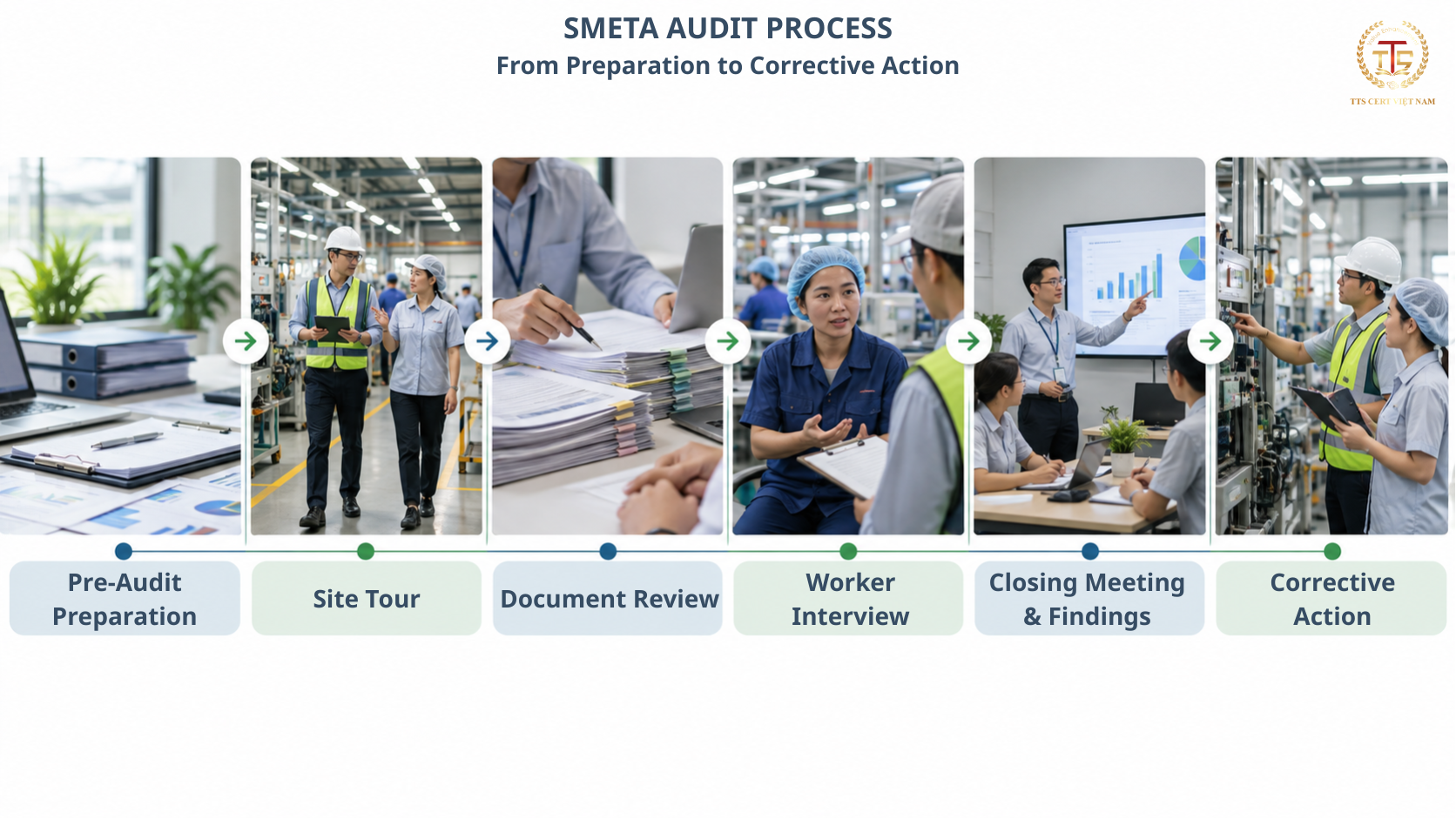
Step 6: Conduct the On-Site Audit
The auditor performs activities such as:
opening meeting;
site tour;
document review;
worker interviews;
management interviews;
data reconciliation;
closing meeting.
Step 7: Audit Findings and CAPR
Findings identified during the assessment are discussed at the closing meeting and documented in accordance with SMETA methodology.
Step 8: Corrective Action and Follow-Up
The company takes corrective action for identified findings.
Depending on the issue and buyer requirements, verification may involve documentary evidence or a follow-up audit.
Preparing for a SMETA Audit?
TTS CERT supports businesses with requirement review, gap assessment, and pre-audit preparation for documents and site conditions.
10. What Happens During a SMETA Audit at a Factory?
Understanding how an auditor works helps suppliers prepare more effectively.
Opening Meeting
The auditor normally discusses:
site activities;
workforce profile;
working hours;
production processes;
audit scope;
access requirements;
documents required for review.
Site Tour
The auditor observes actual conditions across relevant areas of the facility.
Depending on the nature of the site, this may include:
production areas;
warehouses;
chemical storage and use areas;
fire safety arrangements;
machinery;
emergency exits;
PPE;
canteen;
sanitation facilities;
dormitories, where applicable.
Document Review
Auditors may review records such as:
personnel files;
employment contracts;
attendance records;
payroll records;
overtime information;
leave records;
social insurance documentation;
training records;
health and safety documentation;
fire safety records;
environmental documentation;
management policies and procedures.
Worker Interviews
Worker interviews are an important part of a social audit.
They can provide information about:
recruitment;
wages;
working hours;
rest days;
treatment;
grievance mechanisms;
workplace conditions;
worker rights.
Data Reconciliation
A SMETA auditor does not normally assess each record in isolation.
Information may be cross-checked across:
attendance records ↔ payroll ↔ employment contracts ↔ worker interviews ↔ production records ↔ actual workplace conditions.
Consistency across different evidence sources is therefore important.
Closing Meeting
At the end of the assessment, the auditor presents and discusses the findings identified during the audit.
Read more: What Is a Sedex Audit? The SMETA Audit Process at a Factory
11. How Should a Business Prepare for a SMETA Audit?
SMETA preparation should not begin only a few days before the auditor arrives.
Businesses should review three areas together.
Management Systems
Review policies, procedures, responsibilities, training, monitoring, and methods used to evaluate effectiveness.
Documents and Records
Review employment documentation, working hours, payroll, occupational safety, environmental records, licences, permits, training records, and other relevant evidence.
Actual Workplace Conditions
Review the factory floor, machinery, fire safety, chemical management, PPE, emergency exits, worker welfare facilities, and implementation of procedures in practice.
Particular attention may be required for:
working hours;
payroll and attendance consistency;
employment documentation;
legal permits;
risk assessments;
training;
fire safety;
machinery safety;
chemical management;
grievance mechanisms.
Read more: SMETA Audit Checklist: Documents and Site Conditions to Prepare
Need to Check Your Audit Readiness?
TTS CERT can conduct a pre-audit gap assessment covering labour records, payroll, working hours, health and safety, environment, and actual factory conditions.
12. What Are the SMETA Audit Report and CAPR?
After a SMETA audit, the assessment results are recorded through the relevant SMETA reporting process, including the SMETA Audit Report and Corrective Action Plan Report – CAPR.
The Audit Report provides information about the site and the assessment performed.
The CAPR records relevant findings and corrective actions that require follow-up.
Businesses should not treat a CAPR simply as a “list of findings to close”.
A strong corrective action process should consider:
correction → root cause analysis → corrective action → evidence → verification of effectiveness.
This helps address not only the immediate issue but also the management system weaknesses that allowed it to occur.
13. What Is the Difference Between an NC and a CAR in SMETA?
A Non-Compliance – NC identifies a situation where an applicable workplace requirement has not been met.
Depending on the finding, the business may need to implement correction and corrective action and provide appropriate evidence.
SMETA 7 also introduced Collaborative Action Required – CAR.
CAR is designed for certain complex issues where effective resolution may be beyond the direct control of the supplier and may require cooperation among several parties.
This reflects the continuous improvement approach of SMETA 7: addressing social risks sometimes requires action beyond simply setting a corrective action deadline for the factory.
Read more: CAPR, NC and CAR in SMETA Explained
14. Can a Company Pass or Fail a SMETA Audit?
No.
SMETA does not operate as a certification programme with a formal Pass or Fail decision.
The auditor assesses conditions at the site and records relevant findings according to the SMETA methodology.
The buyer then uses the audit information together with its own responsible sourcing policies, supplier requirements, and risk criteria.
Therefore, rather than asking:
“Did the factory pass SMETA?”
a more useful question is:
“What issues were identified, what risks do they represent, and does the business have effective systems to correct and prevent them from recurring?”
15. How Long Is a SMETA Audit Valid?
A SMETA audit should not be understood in the same way as a management system certificate with a universal issue date and expiry date.
The frequency of audits may depend on:
buyer requirements;
supplier risk level;
previous audit findings;
nature and severity of identified issues;
the buyer's supplier management programme;
follow-up requirements.
Businesses should therefore avoid assuming that every SMETA audit is automatically “valid for one year”.
Where a buyer requests a SMETA audit, the supplier should confirm how recent the report must be and whether a new or follow-up audit is required.
16. Which Businesses May Be Asked to Complete SMETA?
SMETA is designed for use across different industries and geographic regions.
A SMETA request may arise when:
a supplier is onboarding with an international buyer or brand;
an existing customer is implementing a responsible sourcing programme;
a buyer needs visibility into labour, health and safety, environmental or ethical risks;
a supplier needs to share social audit information with multiple customers;
the buyer is conducting supply chain due diligence.
SMETA is therefore not limited to the garment or textile sector.
It may be applied across manufacturing and other supply chain environments depending on customer requirements.
17. What Are the Benefits of a SMETA Audit?
The primary value of SMETA does not come from obtaining a certificate.
A well-conducted SMETA audit can help businesses:
Identify Actual Risks
The assessment may identify gaps relating to labour conditions, health and safety, environmental management, or business ethics.
Strengthen Management Systems
SMETA 7 places increased emphasis on how a business manages and prevents workplace risks, rather than simply checking whether documents exist.
Improve Transparency With Customers
SMETA data can be shared with authorised customers through the Sedex Platform.
Reduce Audit Duplication
SMETA was designed in part to provide a common audit methodology that can reduce repetitive social audits requested by different customers.
Support Responsible Sourcing and Due Diligence
Buyers can use SMETA information together with other risk data to identify, prioritise, and monitor supply chain risks.
18. SMETA and Other Social Compliance Programmes
SMETA is not the only framework used in social compliance.
Businesses may also encounter customer requirements relating to:
amfori BSCI;
SA8000;
WRAP;
customer-specific social compliance programmes.
Each programme has its own objectives, governance structure, assessment method, and approach to the use of results.
For this reason, businesses should not begin by asking which programme is “better”.
The first question should be:
Which programme does the customer require, and which audit result will the customer accept?
Read more: SMETA vs BSCI: What Is the Difference?
19. Frequently Asked Questions About Sedex and SMETA
Is SMETA a certification?
No. SMETA is an audit methodology and continuous improvement tool, not a certification scheme.
Are Sedex and SMETA the same thing?
No. Sedex is the organisation and platform ecosystem. SMETA is the social audit methodology developed and managed by Sedex.
Who Can Conduct an Official SMETA Audit?
SMETA audits must be conducted by auditors working for a Sedex-approved Affiliate Audit Company – AAC.
Does Sedex Conduct Audits Directly?
No. Sedex owns and develops the SMETA methodology, while independent approved AACs conduct the audits.
Does a Business Need a Sedex Account for a SMETA Audit?
Businesses undergoing an official SMETA audit need an active Sedex membership and account for the audit information to be uploaded and shared through the Sedex Platform.
Should a Business Choose SMETA 2-Pillar or 4-Pillar?
The decision should primarily follow the buyer's requirements. A 4-Pillar audit includes Labour Standards, Health & Safety, Environment, and Business Ethics, while the 2-Pillar scope focuses primarily on Labour Standards and Health & Safety.
Does a SMETA Audit Have to Be Repeated Every Year?
There is no single annual audit cycle that applies universally to every supplier. Audit frequency depends on buyer requirements, risk, previous findings, and the supplier management programme.
20. How Should a Business Start Preparing for SMETA?
When a company receives its first SMETA request from a customer, the first step should not be to look for a “SMETA certificate”.
Instead, the business should clarify:
What does the buyer require? → Which audit scope applies? → Which site will be assessed? → Is the Sedex account and SAQ complete? → What gaps exist in the management system and records? → Do actual workplace conditions meet the relevant requirements?
An effective pre-audit review allows the business to identify problems early and address root causes before the formal assessment rather than making last-minute changes to documents.
TTS CERT Support for SMETA Audit Preparation
TTS CERT supports businesses preparing for social compliance assessments and SMETA audits, from understanding customer requirements to reviewing management systems, documents, and actual workplace conditions.
Support may include:
reviewing applicable SMETA requirements;
guidance on Sedex and SAQ preparation;
pre-audit gap assessment;
review of employment, payroll, and working-hour records;
review of health and safety, fire safety, chemicals, and workplace conditions;
review of Environment and Business Ethics requirements for 4-Pillar audits;
awareness training for relevant personnel;
mock audits;
support with root cause analysis and corrective action planning following an audit.
TTS CERT's consulting and preparation services are independent from the official SMETA audit process. Official SMETA audits must be conducted by a Sedex-approved Affiliate Audit Company.
Prepare for Your SMETA Audit with TTS CERT
TTS CERT supports businesses with buyer requirement review, Sedex/SAQ preparation, gap assessment, document and site review, staff awareness training, and corrective action planning before or after the audit.
TTS CERT's consulting services are independent from the official SMETA audit. Official SMETA audits must be conducted by a Sedex-approved Affiliate Audit Company.