
Table of contents
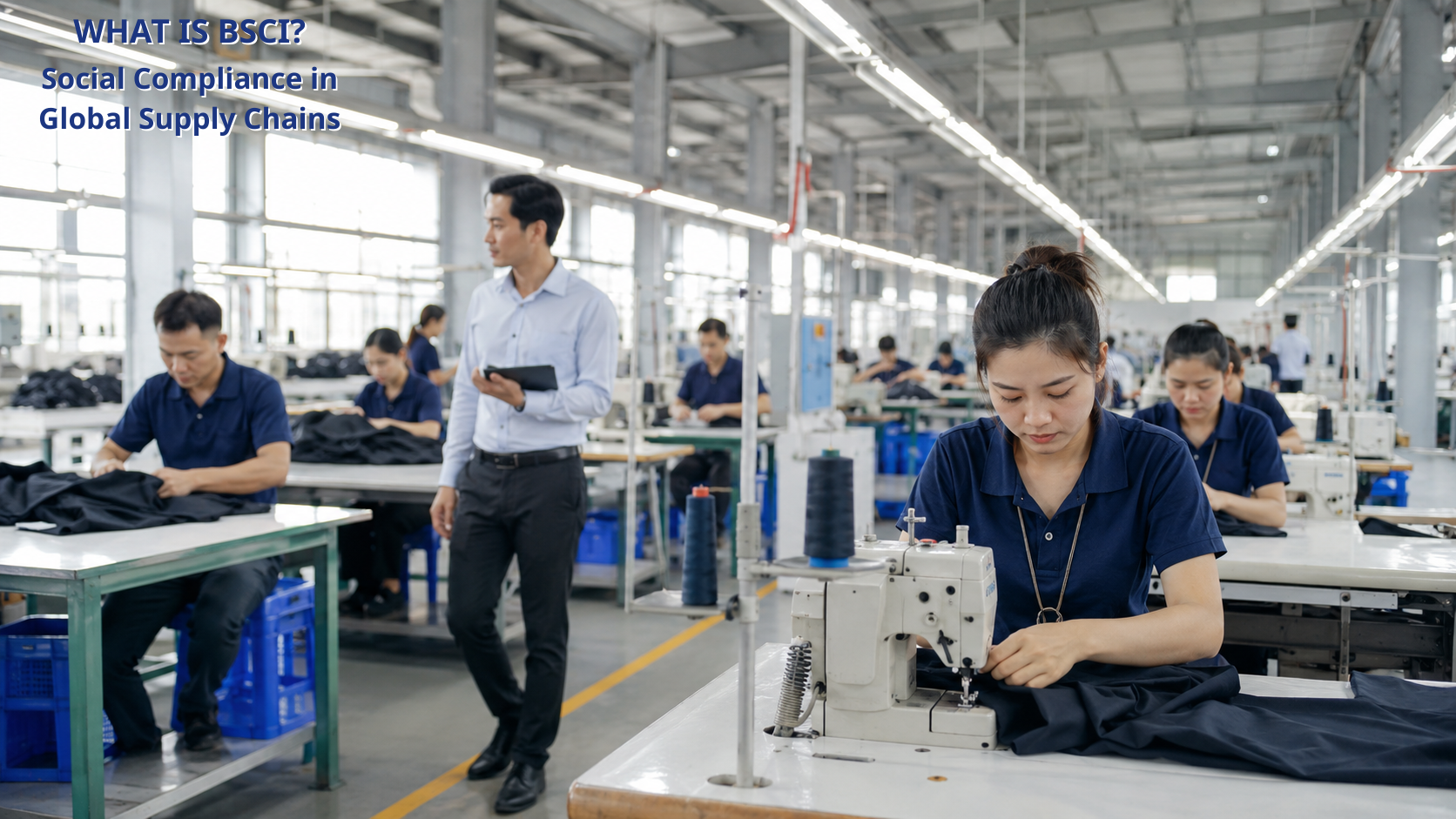
BSCI stands for Business Social Compliance Initiative, an amfori solution designed to help businesses manage social risks, human rights, and working conditions across their supply chains.
In Vietnam, BSCI is often referred to as a “BSCI standard” or “BSCI certification.” However, amfori BSCI is not a certification scheme based on a pass/fail model like ISO certification. Following an audit, the production site receives an audit report and an overall rating from A to E, rather than a BSCI certificate.
Under the current amfori BSCI system, the principles and values of the amfori BSCI Code of Conduct are assessed through 13 Performance Areas (PAs). A full BSCI audit consists of 81 questions and combines document review, on-site observations, and interviews.
amfori BSCI at a Glance
| Item | Information |
|---|---|
| Full name | Business Social Compliance Initiative |
| Organization | amfori |
| Nature | Social risk management and monitoring system for supply chains |
| Current Code of Conduct | amfori BSCI Code of Conduct v.2021 |
| Main structure | 13 Principles / Performance Areas |
| Full audit questions | 81 questions |
| Audit methodology | Document review + on-site observations + interviews |
| Audit result | Rating A–E |
| Is it a certification? | No |
| Full audit cycle | Up to 2 years for an A or B rating |
| Follow-up audit | C, D or E: generally within 2–12 months |
| Fully announced audit | No longer accepted since September 2024 |
1. What Is BSCI?
amfori BSCI is a solution designed to help businesses manage and improve working conditions, human rights, and social responsibility within their supply chains.
BSCI is widely used in international supply chains, particularly where brands, importers, retailers, or buyers need to assess working conditions at factories and supplier facilities.
Rather than simply checking whether a company has the required documents, BSCI focuses on how social responsibility principles are actually implemented in day-to-day operations.
An auditor may cross-check information from:
policies and procedures;
employee records;
payroll and working-hour records;
actual workplace conditions;
management interviews;
worker interviews;
other relevant evidence.
Therefore, one of the most important principles when preparing for a BSCI audit is:
Documents, workplace conditions, and interviews should reflect the same reality.
A BSCI audit reflects the conditions observed at a particular point in time and should form part of a broader due diligence and continuous improvement process.
2. Is BSCI a Certification?
No. amfori BSCI is not a certification.
This is an important distinction for companies that are new to BSCI.
Management system standards such as ISO 9001, ISO 14001, or ISO 45001 may result in a Certification Body issuing a certificate when the organization meets the applicable requirements.
BSCI works differently.
Following an amfori BSCI audit, the company receives:
an audit result;
findings identified during the audit;
an overall rating from A to E;
corrective action and follow-up requirements, where applicable.
BSCI therefore does not operate on a simple pass/fail certification model. Instead, it applies a risk-based and continuous improvement approach.
From a technical perspective, it is therefore more accurate to use terms such as:
BSCI audit;
BSCI assessment;
BSCI audit report;
BSCI audit result;
BSCI rating.
The term “BSCI certification” is still commonly used in the market, particularly by companies searching for BSCI-related services, but it does not fully reflect the nature of the amfori BSCI system.
3. Does BSCI Have 11 or 13 Principles?
This is one of the most common areas of confusion when companies research BSCI requirements.
Many older online resources still refer to the “11 BSCI principles.”
However, the updated amfori BSCI system presents the amfori BSCI Principles as including:
Social Management System and Cascade Effect;
Workers Involvement and Protection;
together with the other principles addressing freedom of association, discrimination, remuneration, working hours, occupational health and safety, child labour, forced labour, environmental protection, and ethical business behaviour.
Under the current monitoring system, the principles and values of the amfori BSCI Code of Conduct correspond to 13 Performance Areas.
Therefore, when preparing BSCI content or implementing the current system, companies should work with the 13 Principles / 13 Performance Areas rather than relying solely on the older 11-principle structure.
4. The 13 amfori BSCI Principles and Performance Areas
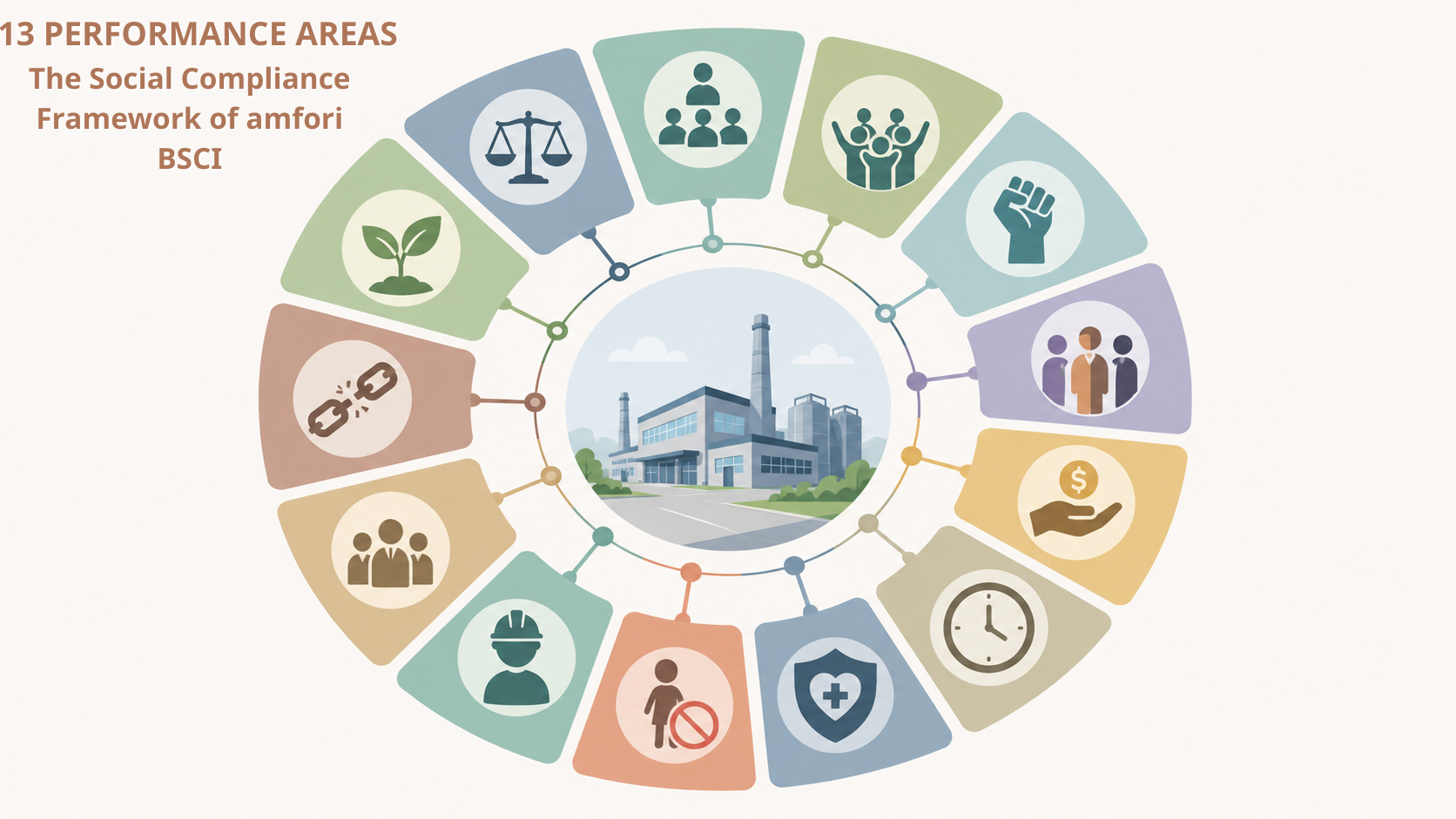
The current amfori BSCI system organizes the 13 Performance Areas into several key areas of social responsibility.
Group 1 – Social Management & Workplace Relations
PA1. Social Management System & Cascade Effect
This Performance Area focuses on the organization’s social management system and the cascade of social responsibility requirements throughout the supply chain.
A company should establish a management system capable of implementing the amfori BSCI principles in practice.
Auditors may review:
human rights and social responsibility policies;
assignment of responsibilities;
competence of responsible personnel;
risk assessments;
action plans;
controls over relevant suppliers and business partners;
communication of social requirements throughout the supply chain;
processes for identifying and addressing adverse human rights impacts.
The key point under PA1 is that a company should not simply have policies on paper. It should demonstrate that those policies are integrated into its management system and daily operations.
PA2. Workers Involvement and Protection
This area focuses on worker participation, communication, grievance mechanisms, and worker protection.
Companies should enable workers to:
understand their rights and responsibilities;
receive relevant information;
participate in workplace dialogue;
have appropriate worker representation;
access grievance mechanisms;
raise concerns without fear of retaliation.
An auditor will therefore not only check whether the company has a suggestion box or grievance procedure, but also whether the mechanism actually works in practice.
PA3. The Rights of Freedom of Association and Collective Bargaining
Companies should respect workers’ rights to:
form or join lawful worker organizations;
choose not to participate where permitted;
select representatives;
engage in collective bargaining;
participate in lawful representative activities without discrimination or retaliation.
PA4. No Discrimination, Violence or Harassment
Companies should prevent discrimination in recruitment, remuneration, training, promotion, disciplinary action, or termination based on characteristics protected by applicable law and international standards.
The company should also prevent:
sexual harassment;
violence;
intimidation;
abuse;
bullying;
humiliating or degrading treatment.
Group 2 – Employee Well-being and Fair Practices
PA5. Fair Remuneration
This Performance Area focuses on fair remuneration and related employee benefits.
Auditors may examine:
basic wages;
overtime compensation;
allowances;
benefits;
deductions;
payment methods and timing;
statutory insurance obligations;
the gap between actual remuneration and living wage benchmarks.
Companies should not limit their review to whether wages meet the statutory minimum wage. They should assess the overall remuneration structure and employee entitlements.
PA6. Decent Working Hours
Working hours are one of the areas most likely to generate findings in manufacturing facilities.
Auditors may cross-check:
attendance records;
payroll;
production records;
overtime documents;
rest days;
shift schedules;
worker interview statements.
Companies should pay particular attention to:
normal working hours;
overtime hours;
voluntary overtime;
weekly rest days;
breaks;
appropriate rest periods;
accuracy of working-hour records.
PA7. Occupational Health and Safety
This Performance Area covers occupational health and safety (OHS).
The audit may include:
risk assessments;
machinery safety;
electrical safety;
chemical management;
personal protective equipment (PPE);
fire safety;
emergency exits;
first aid;
workplace hygiene;
drinking water;
sanitation facilities;
occupational environment;
health and safety training;
accidents and incidents;
emergency preparedness and response.
OHS is not assessed solely through documentation. Actual workplace conditions play an important role in the audit.
Group 3 – Protection of Vulnerable Workers
PA8. No Child Labour
Companies should maintain an effective age-verification process during recruitment and be able to detect questionable or falsified age documentation.
In addition to prevention, companies should have a child labour remediation procedure defining appropriate actions if child labour is identified.
PA9. Special Protection for Young Workers
Young workers should be specifically identified and appropriately protected.
Companies should control:
types of work assigned;
hazardous work;
working hours;
night work;
workplace conditions;
training;
supervision;
applicable legal requirements.
PA10. No Precarious Employment
Companies should not use employment arrangements designed to avoid legal or contractual obligations toward workers.
Auditors may examine:
employment contracts;
probation arrangements;
temporary employment;
agency workers;
subcontracted labour;
apprenticeship arrangements;
other potentially unstable employment relationships.
PA11. No Bonded, Forced Labour or Human Trafficking
Companies must not use bonded labour, forced labour, or human trafficking.
Potential indicators may include:
retention of national identification documents or passports;
deposits required from workers;
unreasonable recruitment fees;
withholding wages;
restrictions on freedom of movement;
threats or intimidation;
forced overtime;
restrictions on workers’ right to resign;
recruitment-related debt.
This area requires particular attention where companies employ migrant workers or use recruitment agencies.
Group 4 – Ethical Practices
PA12. Protection of the Environment
Although BSCI primarily focuses on social responsibility, environmental protection remains one of its Performance Areas.
Companies should identify environmental impacts arising from their activities and comply with applicable environmental requirements.
Depending on the industry, auditors may review:
wastewater;
general waste;
hazardous waste;
chemicals;
air emissions;
permits;
environmental impact controls.
PA13. Ethical Business Behaviour
Companies should establish measures to prevent unethical business practices such as:
corruption;
bribery;
fraud;
falsification of records;
conflicts of interest;
unauthorized disclosure of information;
other unethical business conduct.
The integrity and accuracy of records provided to auditors are particularly important during social audits.
5. The 81 Questions in a BSCI Audit
A full BSCI audit currently consists of 81 questions distributed across the 13 Performance Areas.
Auditors assess individual questions using statuses such as:
Yes;
No;
Partial;
Not Applicable.
The system then uses the assessment results to calculate the overall BSCI rating from A to E.
This is why companies should not prepare for BSCI simply by downloading a “BSCI checklist” and ticking off individual requirements.
Many BSCI questions require auditors to assess the actual effectiveness of the management system, not merely whether a particular document exists.
6. Which Companies Are Commonly Required to Undergo a BSCI Audit?
BSCI is not a legal requirement for every company operating in Vietnam.
The requirement usually comes from:
buyers;
brands;
importers;
retailers;
international groups;
amfori members within the supply chain.
In Vietnam, BSCI audits are commonly requested in industries such as:
textiles and garments;
footwear;
furniture;
toys;
household goods;
handicrafts;
electronics;
food processing;
agricultural processing;
packaging;
consumer goods and export manufacturing.
Company size is not the only determining factor.
Even a factory with only several dozen employees may be required to undergo a BSCI audit if this is a buyer requirement.
7. BSCI Audit Process
The exact process may vary depending on the amfori member, supplier, and monitoring partner, but the overall process can generally be described as follows.
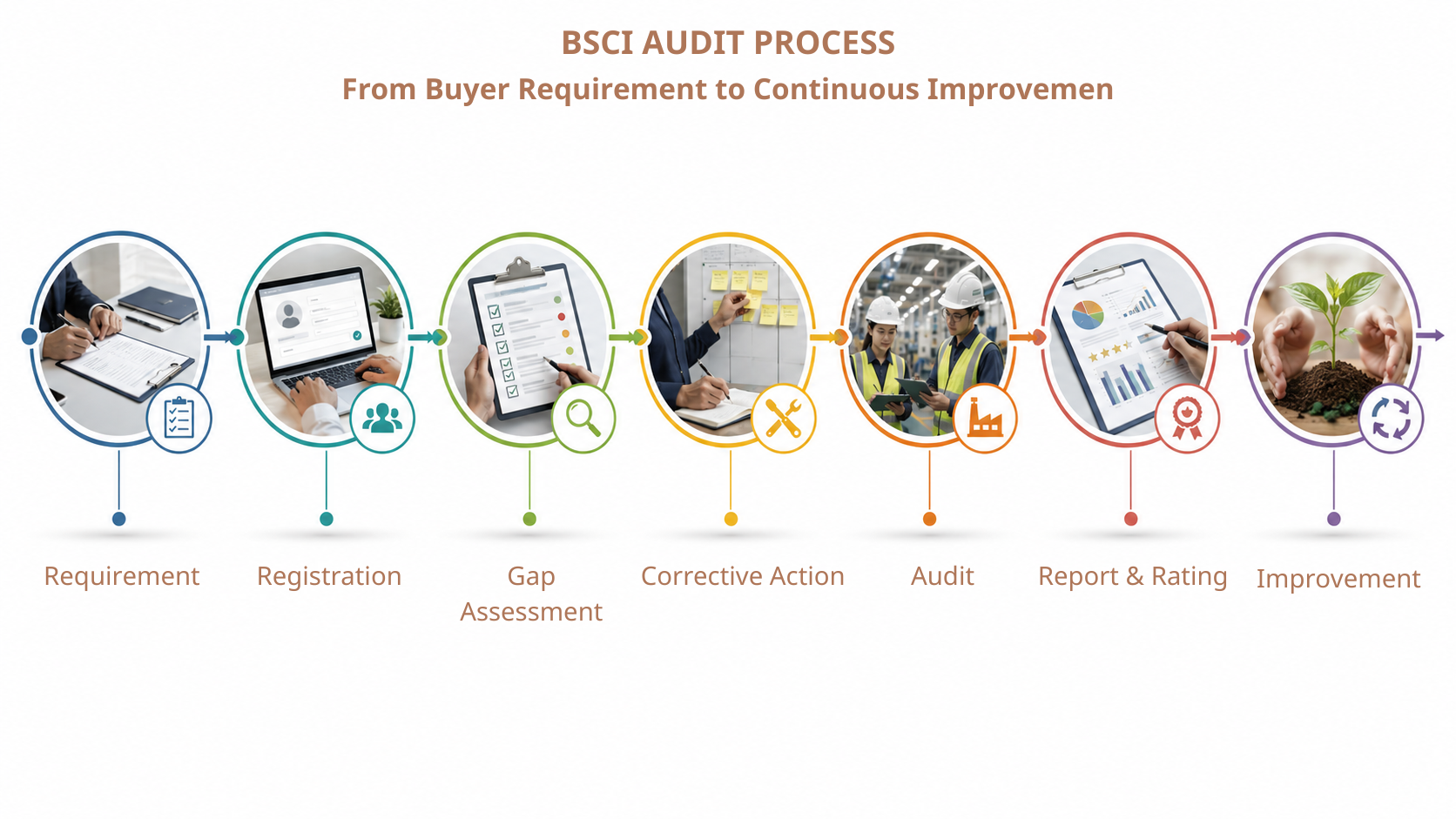
Step 1. Confirm the Customer Requirement
The company should first determine:
which buyer requires BSCI;
which production site is in scope;
the required timeline;
the minimum rating expected by the customer;
any additional buyer-specific requirements.
Step 2. Register or Manage the Supplier/Site in the amfori System
amfori manages BSCI-related activities through the amfori Sustainability Platform.
Production sites, sourcing relationships, and monitoring activities are managed through the platform.
Step 3. Conduct a Gap Assessment
Before the audit, the company should perform a gap assessment against the 13 Performance Areas.
This helps identify:
legal compliance gaps;
weaknesses in the social management system;
missing records;
wage-related risks;
working-hour risks;
OHS risks;
workplace deficiencies;
issues that may arise during worker interviews.
Step 4. Implement Corrective Actions
The company should address the identified gaps.
Corrective actions may include:
revising policies;
developing procedures;
correcting records;
providing training;
improving machinery safety;
providing appropriate PPE;
improving fire safety;
reviewing payroll practices;
correcting excessive working hours;
establishing an effective grievance mechanism.
Step 5. On-Site Audit
A BSCI audit commonly includes:
Opening meeting;
Site tour;
Document review;
Management interviews;
Worker interviews;
Cross-checking of evidence;
Compilation of findings;
Closing meeting.
Step 6. Audit Report and Rating
The audit result is recorded in the amfori system and an overall rating from A to E is determined.
Step 7. Continuous Improvement and Follow-up
Where the audit identifies areas requiring improvement, the company should implement corrective actions and may be required to undergo a follow-up audit.
8. Is a BSCI Audit Announced in Advance?
Since September 2024, amfori has no longer accepted fully announced BSCI audits.
This has an important practical implication:
Companies should not operate their BSCI system on the basis of preparing only when an audit date is known.
Records such as:
attendance;
payroll;
overtime;
grievances;
training;
accident records;
safety inspections;
PPE issuance;
worker dialogue;
should be maintained as part of normal business operations.
If records are created only immediately before an audit but do not correspond with actual workplace practices, an auditor may identify inconsistencies through document cross-checking or worker interviews.
9. What Do BSCI Ratings A, B, C, D and E Mean?
amfori BSCI uses an overall rating from A to E.
The system should not be interpreted simply as:
A = Pass
E = Fail
BSCI is not a pass/fail certification scheme.
The rating reflects the audit result and helps amfori members determine the level of improvement required and the next monitoring cycle.
Rating A or B
Where a full audit results in an A or B rating, the next full audit may generally be required within a maximum period of two years.
Rating C, D or E
Where the rating is below B, meaning C, D or E, the supplier is generally required to undergo a follow-up audit within approximately 2–12 months following the full audit.
The period should provide sufficient time for the company to implement and demonstrate meaningful corrective actions.
10. What Is Checked During a BSCI Follow-up Audit?
A follow-up audit does not necessarily repeat all 81 questions from the full audit.
The auditor focuses primarily on the Performance Areas identified as requiring improvement during the previous audit.
However, minimum due diligence is still performed for:
PA5 – Fair Remuneration;
PA6 – Decent Working Hours;
PA7 – Occupational Health and Safety.
For this reason, companies should not treat corrective action as merely closing individual findings on paper. They should review the root causes and underlying management systems associated with those findings.
11. Documents Required for BSCI Preparation
There is no single BSCI documentation package that applies identically to every factory.
The management system should reflect:
industry;
business size;
number of workers;
employment arrangements;
production processes;
workplace conditions;
actual risk profile.
However, the following documentation groups are commonly reviewed:
| Area | Typical Records and Documents |
|---|---|
| Social Management | Policies, responsibilities, risk assessments, objectives, action plans |
| Workers | Personnel files, employment contracts, recruitment records, age verification |
| Wages | Payroll, payslips, payment evidence, allowances |
| Working Hours | Attendance records, overtime, shifts, weekly rest |
| Worker Involvement | Worker representatives, dialogue records, communication |
| Grievance | Procedure, grievance channels, logs and case-handling records |
| Child Labour | Age verification and remediation procedure |
| Young Workers | Lists, risk assessments and protection measures |
| Forced Labour | Recruitment processes, recruitment fees, personal documents |
| OHS | Risk assessments, PPE, machinery, chemicals, fire safety, first aid |
| Environment | Relevant permits and environmental management records |
| Ethics | Anti-bribery, anti-corruption and conflict-of-interest controls |
| Supply Chain | Relevant business partner lists and controls |
The objective is not to create as many SOPs as possible.
A concise system with clear responsibilities and genuine implementation evidence is generally more effective than a large set of documents that are not actually used.
12. Common Issues Vietnamese Factories Should Review Before a BSCI Audit
Companies should prioritize several risk areas before undergoing an audit.

Working Hours
Review consistency between:
attendance records;
overtime;
payroll;
production records;
rest days;
worker interviews.
Wages
Review:
statutory minimum wage;
overtime premiums;
allowances;
deductions;
benefits;
statutory insurance;
living wage assessment where relevant.
Recruitment Records
Pay particular attention to:
age verification;
probation;
employment contracts;
recruitment agencies;
recruitment fees;
worker identification documents.
Grievance Mechanism
Having a grievance procedure alone is not sufficient.
Companies should be able to demonstrate that:
workers know how to raise grievances;
workers can access the mechanism;
confidentiality is appropriately protected;
grievances are actually investigated and resolved;
workers are protected against retaliation.
Occupational Health and Safety
Review carefully:
machinery;
machine guarding;
electrical systems;
chemicals;
PPE;
emergency exits;
fire safety;
first aid;
training;
risk assessments.
Integrity of Records
A major risk in social audits is documentation that does not reflect actual working conditions.
Companies should not create:
falsified attendance records;
parallel payroll records;
training records for training that did not occur;
unauthorized or false signatures;
documents created solely to satisfy the audit.
Auditors may use multiple sources of evidence to cross-check the accuracy of information.
13. BSCI vs SMETA vs SA8000
| Item | amfori BSCI | SMETA | SA8000 |
|---|---|---|---|
| Organization | amfori | Sedex | Social Accountability International |
| Nature | Social risk management and monitoring system | Ethical/social audit methodology | Social accountability standard |
| Result | Rating A–E + audit result | Audit report | Certificate may be issued |
| Certification | No | No | Yes |
| Usually requested by | Buyer / amfori member | Buyer / Sedex member | Company or customer |
A company should not assume that having a SMETA audit or SA8000 certification will automatically replace a buyer’s BSCI requirement.
Acceptance depends on the specific buyer, brand, and supply chain policy.
14. What Is the Difference Between BSCI and BEPI?
Both are part of the amfori ecosystem but have different areas of focus.
amfori BSCI focuses on social risk management, working conditions, and human rights.
amfori BEPI focuses more deeply on environmental management and environmental performance within supply chains.
Depending on customer requirements and supply chain risks, a production site may be required to participate in BSCI, BEPI, or both.
15. Is BSCI Mandatory Under Vietnamese Law?
No.
BSCI is not a mandatory license, permit, or statutory certification required for all companies operating in Vietnam.
However, companies participating in amfori BSCI must still comply with applicable Vietnamese legislation relating to:
labour;
wages;
working hours;
social insurance;
occupational safety and health;
fire safety;
environmental protection;
other applicable legal obligations.
In practice, BSCI may become a mandatory commercial requirement where a buyer makes a satisfactory BSCI audit result a condition for joining or remaining in its supply chain.
16. Frequently Asked Questions About BSCI
Is BSCI a certification?
No.
amfori BSCI is not a certification scheme. A company receives an audit or monitoring result and an overall rating rather than an ISO-style certificate.
Does BSCI currently have 11 or 13 principles?
The updated amfori system presents 13 amfori BSCI Principles, which correspond to 13 Performance Areas within the monitoring system.
References to the “11 BSCI principles” are generally associated with older structures or materials published before the system revision.
How many questions are included in a BSCI audit?
A full BSCI audit currently includes 81 questions across 13 Performance Areas.
Does BSCI issue a certificate?
Not in the same sense as a certification scheme.
The production site receives an audit or monitoring result with a rating from A to E.
How long is a BSCI audit result valid?
It is better not to refer to the “validity of a BSCI certificate” because BSCI does not issue such a certificate.
For an A or B rating, the next full audit may generally be required within a maximum period of two years.
For a C, D or E rating, a follow-up audit is generally required within approximately 2–12 months.
Do small companies need a BSCI audit?
Possibly.
If a buyer requires BSCI, even a relatively small production site may need to undergo a BSCI audit.
Can a company prepare for BSCI immediately before the audit?
This is not recommended.
Payroll, attendance, training, grievance, OHS, and other evidence should be generated and maintained through genuine day-to-day operations.
In addition, fully announced audits have no longer been accepted since September 2024.
Does a BSCI auditor mainly check documents or the workplace?
Both, together with interviews.
BSCI audits rely on a combination of:
on-site observations;
interviews;
document reviews.
Can one BSCI result be used by multiple buyers?
Within the amfori system, members sourcing from the same supplier may access monitoring results subject to applicable platform permissions and sourcing relationships.
However, whether a particular buyer accepts an existing BSCI result still depends on that buyer’s own requirements.
17. Where Should a Company Start When Preparing for BSCI?
If your company has just received a BSCI requirement from a customer, the first step should not be to immediately download a set of SOPs or checklists from the Internet.
A more effective starting point is a Gap Assessment against the 13 Performance Areas.
This helps identify:
gaps against applicable Vietnamese legislation;
gaps against amfori BSCI requirements;
weaknesses in the social management system;
wage and working-hour risks;
occupational health and safety issues;
missing records;
workplace improvements required;
potential risks that may arise during worker interviews.
The company can then develop a prioritized Corrective Action Plan.
This approach is more effective than creating dozens of procedures while significant operational risks remain unresolved.
How TTS Cert Vietnam Supports BSCI Preparation
TTS Cert Vietnam supports companies in developing and improving social responsibility management systems aligned with amfori BSCI requirements, including:
Gap Assessment against the 13 Performance Areas;
review of compliance with Vietnamese labour legislation;
development and improvement of policies, procedures, and forms;
review of wages and working hours;
on-site occupational health and safety assessment;
training for responsible personnel;
Mock Audit;
Corrective Action support;
preparation of documentation and management systems before the audit.
Our objective is not simply to help a company prepare for one audit, but to support the development of a practical, sustainable, and maintainable social responsibility management system.