



The BSCI Code of Conduct (amfori BSCI Code of Conduct) is the original document setting out the 11 principles that every business participating in the BSCI program commits to uphold in its production and business operations. This is the foundational reference that anyone preparing for a BSCI audit — business owners, HR managers, or compliance officers — needs to understand before going through the actual audit process.
This article explains each of the 11 principles in detail, along with a full PDF version you can download to store, print, or use as internal training material.
[CTA-1 — jump link to Section 4, xem cảnh báo về id ở đầu file]
1. What Is the BSCI Code of Conduct?
The BSCI Code of Conduct was developed and issued by amfori, drawing on widely recognised international conventions — including the International Labour Organization (ILO) Conventions, the OECD Guidelines for Multinational Enterprises, and the UN Guiding Principles on Business and Human Rights (UNGPs). It is not a code belonging to any single brand or audit organisation, but a shared standard used across amfori's entire global membership.
When a business joins the BSCI program, it commits to fully applying all 11 principles of the Code of Conduct in practice — not merely signing a commitment on paper, but demonstrating this through documentation, internal processes, and actual working conditions, since these are exactly what will be examined during an audit.
2. Why You Should Understand the BSCI Code of Conduct Before an Audit
Understanding each principle before an audit brings several practical benefits:
Proactively identify and fix gaps early: rather than waiting until audit day to discover shortcomings, a business can compare its current practices against each principle in advance.
More effective internal training: when managers and workers alike understand the requirements, compliance becomes a genuine day-to-day practice rather than something staged only when auditors are present.
Avoid common misunderstandings: many businesses new to BSCI confuse its requirements with Vietnamese labour law — while the two overlap significantly, BSCI includes some additional requirements reflecting international standards.
3. The 11 Principles of the BSCI Code of Conduct in Detail
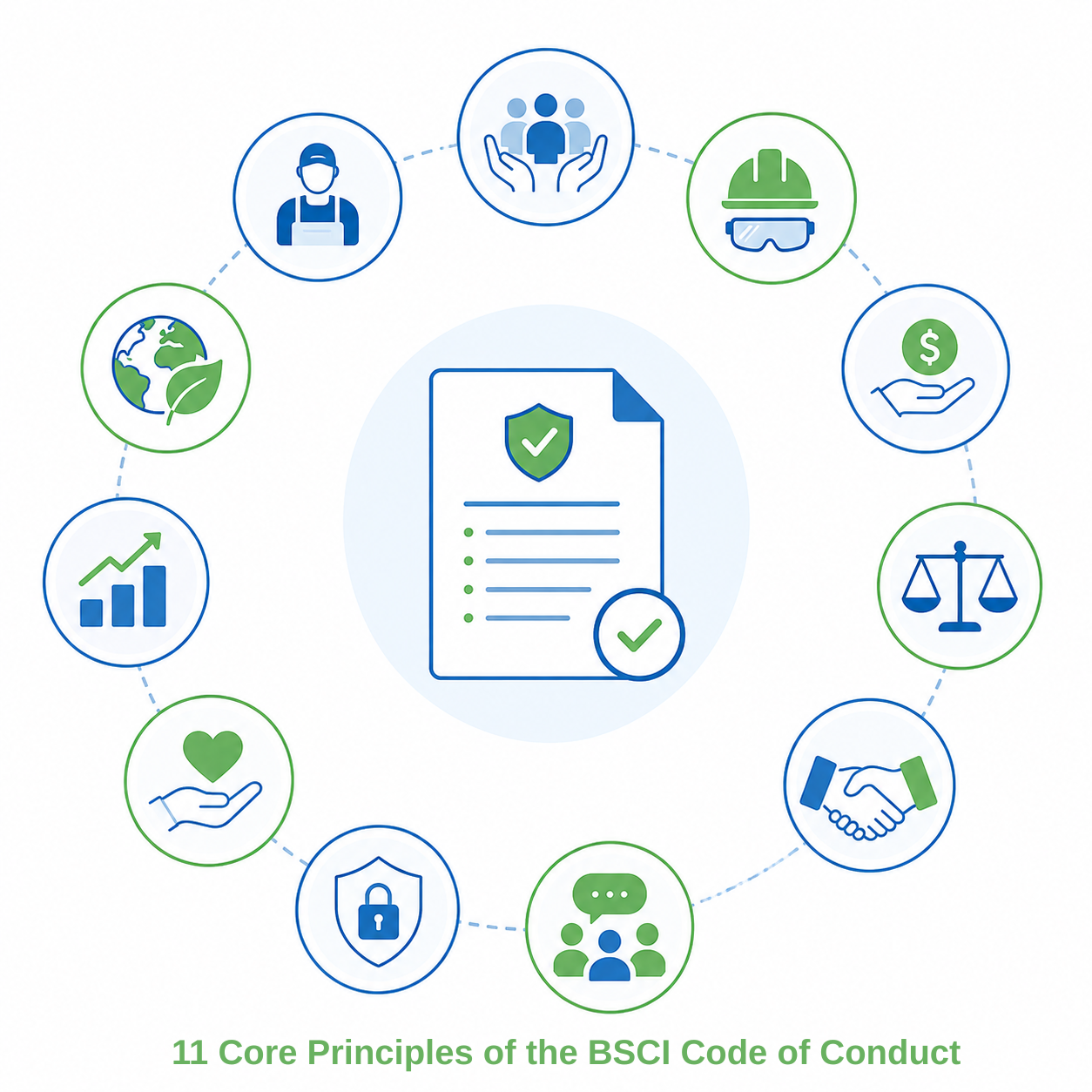
3.1. Freedom of Association and Collective Bargaining
Workers have the right to freely form, join, or decline to join any representative organisation of their choosing, and to bargain collectively with their employer over working conditions. Businesses must not interfere with, obstruct, or retaliate against workers for participating in lawful union activity. This is often the first principle examined through worker interviews during an audit, since compliance is difficult to demonstrate through paperwork alone.
3.2. Fair Remuneration
Wages paid to workers must meet at least the regional statutory minimum wage, be paid in full and on time, and be sufficient to cover a basic standard of living. Businesses need to clearly demonstrate how wages are calculated, what deductions are lawful, and must not use fines as a form of labour discipline. Payroll records, payslips, and labour contracts are the documents most closely reviewed in this section.
3.3. Occupational Health and Safety
Businesses are responsible for providing a safe working environment, with systems in place to identify and control risks, and adequate personal protective equipment appropriate to each role. Specific requirements typically include: clear, unobstructed emergency exits, functioning fire safety systems, a first-aid response plan, and regular occupational safety training for workers.
3.4. Special Protection for Young Workers
Workers who have not yet turned 18 (but are above the minimum working age) must be assigned work suited to their physical development, kept away from hazardous environments, and excluded from night shifts or excessive overtime as defined for underage workers. Businesses need separate records to track this group of workers.
3.5. No Forced Labour, Bonded Labour, or Human Trafficking
Workers must enter into contracts entirely voluntarily and have the right to terminate employment in accordance with the law, without being forced to stay. Businesses must not retain workers' original identification documents, must not require deposits as a condition of employment, and must ensure workers are not charged unreasonable recruitment fees by intermediaries.
3.6. Ethical Business Behaviour
Businesses commit to not engaging in corruption or bribery in any form, including in dealings with partners, customers, or government authorities. This principle also covers not providing false information to auditors — fraudulent conduct during an audit (such as maintaining two sets of books) is a serious violation that can directly affect the outcome.
3.7. No Discrimination
All decisions relating to recruitment, job assignment, training, pay, promotion, or termination must be based on ability and performance — not on gender, age, religion, ethnicity, marital status, pregnancy, or other personal characteristics unrelated to job performance.
3.8. Decent Working Hours
Regular and overtime working hours must comply with the limits set by Vietnamese law, with adequate rest between shifts and at least one day off per week. Timekeeping records are the key documents cross-checked against payroll in this section.
3.9. No Child Labour
Businesses must not employ, whether directly or indirectly through a third party, any worker below the minimum legal working age. Where child labour is discovered, businesses need an appropriate remediation process that prioritises the child's best interests (such as supporting a return to school) rather than simply terminating employment.
3.10. No Precarious Employment
Labour contracts must be in writing, clearly stating the job role, contract term, wage, and related entitlements (social insurance, health insurance, etc.). Businesses should not repeatedly rely on short-term seasonal contracts as a way to avoid insurance obligations or other long-term worker entitlements.
3.11. Protection of the Environment
Businesses need measures to control and minimise the negative environmental impact of their operations — including proper management of waste, wastewater, and emissions, and compliance with relevant environmental permits under Vietnamese law.
[CTA-2 → link về bài Pillar EN: tts-cert.vn/en/what-is-bsci, anchor "Back to the BSCI overview"]
4. Download the BSCI Code of Conduct (Full PDF)
To make it easier to store, print, or use as internal training material, TTS Cert has compiled all 11 principles above into a concise, easy-to-reference PDF. Want the full reference to keep for internal use? Download the complete PDF document below. [CTA-3 — nút "Download Now", xem Mục 3 file gốc tiếng Việt để biết cách thao tác chèn nút]
5. Frequently Asked Questions
Does the BSCI Code of Conduct need to be printed and posted at the factory? Many audit organisations recommend posting a summary of the Code of Conduct (typically in the language workers use) in visible areas of the factory, helping workers understand their rights — this is common practice that demonstrates transparency, though it is not always a strict requirement.
Do all 11 principles apply equally to every industry? In principle, yes, all 11 principles apply across every industry. However, the level of scrutiny during an audit can vary by industry — for example, sectors with more seasonal labour tend to receive closer review of the precarious-employment principle, while sectors involving chemicals tend to receive closer review of occupational health and safety.
Can this PDF be used in place of the original amfori document? No. This is a reference summary, interpreted in Vietnamese [đối với bản gốc]/English to make it easier to understand and apply within a Vietnamese business context. For important decisions, businesses should also refer to the official original document at amfori.org.
[CTA-4 — CMS button block, giống bài Pillar]


