
An EPD (Environmental Product Declaration) is a document disclosing a product's environmental impacts across its life cycle, built from a life cycle assessment (LCA) and verified by an independent third party. In construction, EPDs are increasingly requested by project owners, designers and green building consultants.
1. What Is an EPD?
An EPD is a Type III environmental declaration under ISO 14025. Unlike ecolabels (Type I) or self-declared claims (Type II), an EPD does not rate a product as pass or fail; it discloses quantified data, for example:
Global warming potential (GWP, kg CO₂e).
Energy and resource use.
Acidification, eutrophication, ozone depletion.
Waste and recycled material flows.
Three conditions for an EPD:
An LCA following the product category rules (PCR) for the product type.
Independent third-party verification.
Registration and publication through an EPD programme (programme operator).
EPD vs LCA vs PCF: What is the difference?
2. Standards for Construction Product EPDs
| Standard | Content |
|---|---|
| ISO 14025 | Principles and procedures for Type III environmental declarations |
| ISO 14040, ISO 14044 | LCA methodology |
| EN 15804+A2 | Core product category rules for construction products and services (widely used in Europe) |
| ISO 21930 | Similar international rules for construction products |
EPDs under EN 15804+A2 are valid for five years from the date of issue.
3. Life Cycle Modules in Construction EPDs
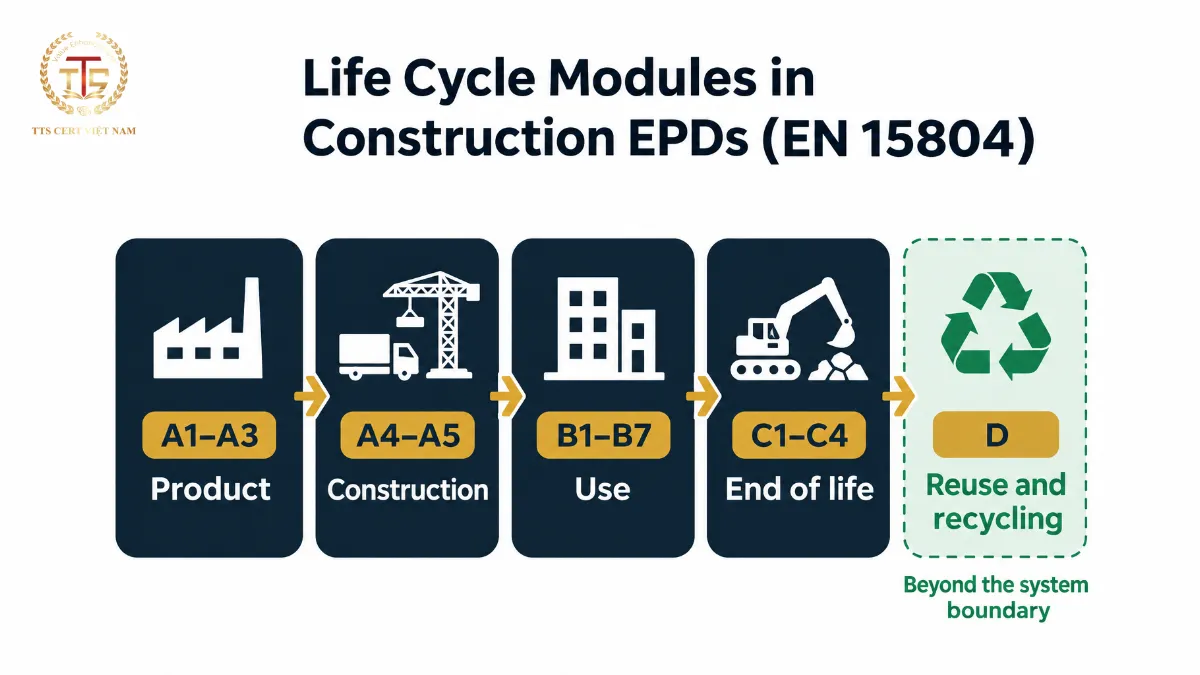
| Group | Stage | Content |
|---|---|---|
| A1–A3 | Product | Raw material supply, transport to factory, manufacturing |
| A4–A5 | Construction | Transport to site, installation |
| B1–B7 | Use | Use, maintenance, repair, replacement, refurbishment, operational energy and water |
| C1–C4 | End of life | Deconstruction, transport, waste processing, disposal |
| D | Beyond the system boundary | Benefits and loads from reuse, recycling and energy recovery |
Under EN 15804+A2, most EPDs must declare at least A1–A3, C1–C4 and D; other modules depend on the product and PCR.
4. Types of EPD
| Type | Characteristics |
|---|---|
| Manufacturer-specific EPD | Data from one plant and one specific product; most specific |
| Average EPD | Average data across several plants or similar products of one company |
| Sector EPD | Compiled by an industry association from several companies, representing a sector |
When project owners need data close to the actual product, a manufacturer-specific EPD is most valuable.
5. Why Construction Products Increasingly Need EPDs
Green buildings: rating systems such as LEED and BREEAM reward products with EPDs.
EU market: the new Construction Products Regulation (EU) 2024/3110, applicable from 8 January 2026, will progressively add life cycle environmental information – including GWP – to product declarations.
Tenders and green procurement: many owners request embodied carbon data for materials.
Product improvement: the LCA behind an EPD shows where emissions concentrate.
6. How to Develop an EPD
Define the product, market and suitable EPD programme.
Select the PCR (for construction products, usually based on EN 15804+A2).
Collect 12 months of production data and carry out the LCA according to the PCR.
Prepare the EPD document and background LCA report.
Independent verification.
Registration and publication in the programme's library.
TTS Cert advises on steps 1–4 and supports you during verification. See: LCA and EPD consulting
7. Frequently Asked Questions
Are EPDs mandatory? EPDs are mostly voluntary today but increasingly required or encouraged by project owners, green building systems and EU regulation.
How long is an EPD valid? EPDs under EN 15804+A2 are valid for five years. If the product or process changes significantly, update it sooner.
Is an EPD a certification? No. An EPD discloses verified data; it does not rate the product.
8. Conclusion
An EPD is the most transparent way for construction product manufacturers to disclose environmental impacts. It requires an LCA following the right PCR, independent verification and registration with an EPD programme.

Expert Tang Mong Diep has more than 15 years of experience in environmental management, ESG and sustainable development, with particular expertise in the Higg Facility Environmental Module (Higg FEM).
SEE MORE