LEED (Leadership in Energy and Environmental Design) is a green building certification developed by the U.S. Green Building Council (USGBC). Projects earn points across categories such as energy, water, materials and indoor environmental quality, and are placed in one of four certification levels according to their total.
1. What Is LEED?
LEED is a framework that helps owners design, build and operate buildings that save resources, reduce environmental impact and provide healthier spaces. It applies to many building types: offices, factories, retail centres, schools, homes and whole neighbourhoods.
LEED certification reviews and awards are handled by Green Business Certification Inc. (GBCI).
2. History
USGBC was founded in 1993 in the United States. LEED was introduced in the late 1990s and has been updated through several versions. USGBC currently runs LEED v4.1 and the latest version, LEED v5.
3. LEED Rating Systems
| Rating system | Applies to |
|---|---|
| LEED BD+C (Building Design and Construction) | New construction or major renovation |
| LEED ID+C (Interior Design and Construction) | Interior fit-outs and tenant spaces |
| LEED O+M (Operations and Maintenance) | Existing buildings in operation |
| LEED ND (Neighborhood Development) | Neighbourhood and district projects |
| LEED Homes | Homes |
| LEED for Cities and Communities | Cities and communities |
Certification for new buildings is tied to design and construction; operations certification (O+M) assesses actual performance and requires periodic recertification.
4. LEED Certification Levels
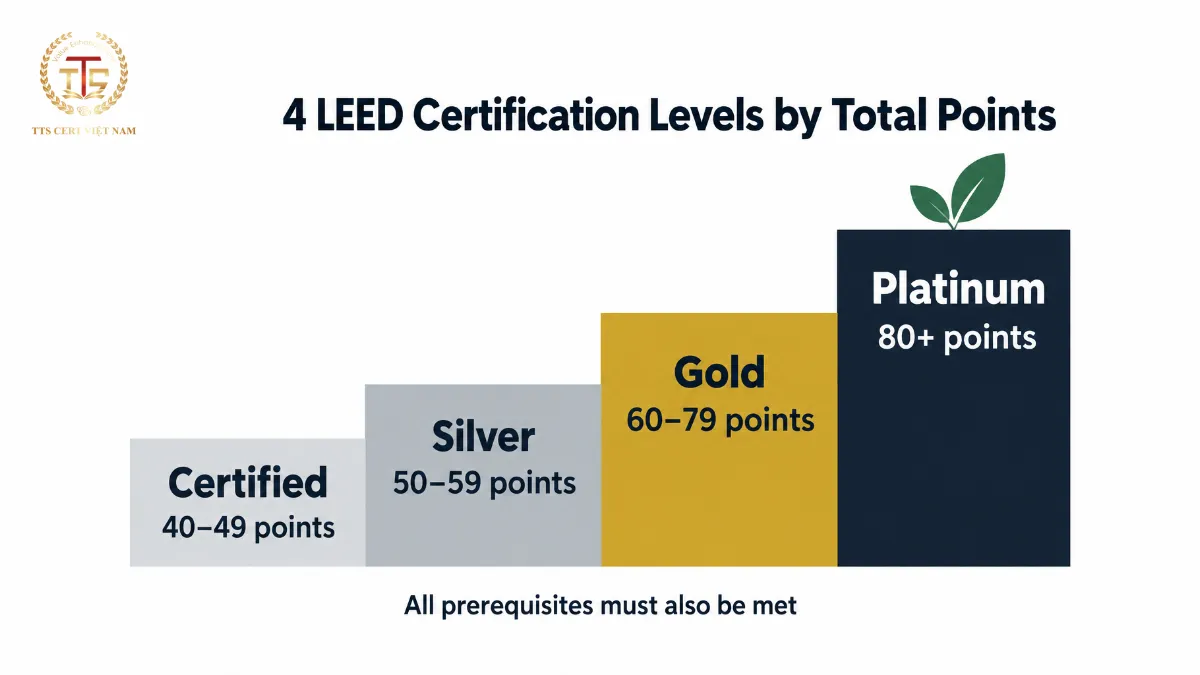
| Level | Total points |
|---|---|
| LEED Certified | 40–49 |
| LEED Silver | 50–59 |
| LEED Gold | 60–79 |
| LEED Platinum | 80 and above |
In addition to points, a project must meet all prerequisites of the applicable rating system.
5. Credit Categories
LEED points are earned across categories such as:
Location and transportation – access to public transit, less reliance on private cars.
Sustainable sites – erosion control, rainwater management, reduced heat island effect.
Water efficiency – water-saving fixtures, metering and water reuse.
Energy and atmosphere – energy performance, renewable energy, commissioning.
Materials and resources – sustainable materials, construction waste management.
Indoor environmental quality – air quality, daylight, thermal comfort.
Innovation and regional priority – bonus points.
Points and requirements vary by version and rating system.
6. The LEED Certification Process
Register the project with GBCI and choose the appropriate rating system.
Design and implement the selected credits and collect evidence.
Submit documentation on the USGBC/GBCI online platform.
GBCI review; the project team responds to clarification requests.
Certification at the level matching the total points achieved.
Registration and review fees are published by USGBC/GBCI and depend on project type and size.
7. What Value Does LEED Provide?
Lower energy and water use, and therefore lower operating costs.
Lower greenhouse gas emissions and environmental impact.
Better indoor environments for occupants.
Meeting expectations of customers, investors and tenants interested in green buildings.
Actual savings depend on each building's design and operation.
8. LEED in Vietnam
LEED is used for offices, retail centres, factories and mixed-use developments in Vietnam, particularly export factories whose customers ask for green buildings. Besides LEED, owners in Vietnam can also consider systems such as LOTUS (Vietnam Green Building Council) and EDGE (International Finance Corporation – IFC).
9. Frequently Asked Questions
Is a "LEED certificate" different from "LEED certification"? Both usually refer to certification of a building. LEED AP / LEED Green Associate are professional credentials for individuals.
Who awards LEED certification? GBCI reviews and certifies LEED projects.
How many points are needed for LEED Gold? 60 to 79 points, plus all prerequisites.
Is LEED mandatory? No. LEED is voluntary; some customers or investors may require it.
10. Conclusion
LEED is a widely used green building certification with four levels from Certified to Platinum. Owners should choose the rating system and target level early, at the design stage.
This article is for general knowledge. Official LEED information is available at usgbc.org. The services TTS Cert currently provides are listed on our Services page.

Expert Tang Mong Diep has more than 15 years of experience in environmental management, ESG and sustainable development, with particular expertise in the Higg Facility Environmental Module (Higg FEM).
SEE MORE