Table of contents
1. THE ORIGIN OF HIGG FEM: COMBATING “AUDIT FATIGUE”
Higg FEM was created as an essential solution to overlapping and inefficient environmental audits. Before 2012, a single factory often faced dozens of different environmental assessments from major buyers—each with its own criteria and templates. Higg FEM provides the following advantages:
Collective Initiative: Cascale (Sustainable Apparel Coalition) brought together major industry competitors (brands, retailers, manufacturers, NGOs) to develop a unified environmental standard.
Defined Purpose: The core goal of Higg FEM is to establish a “Measure Once, Share Many” system, helping suppliers save resources and focus on actual performance improvement instead of reacting to multiple audits.

2. THE 7 PILLARS OF HIGG FEM CRITERIA: THE FOUNDATION OF GREEN PERFORMANCE
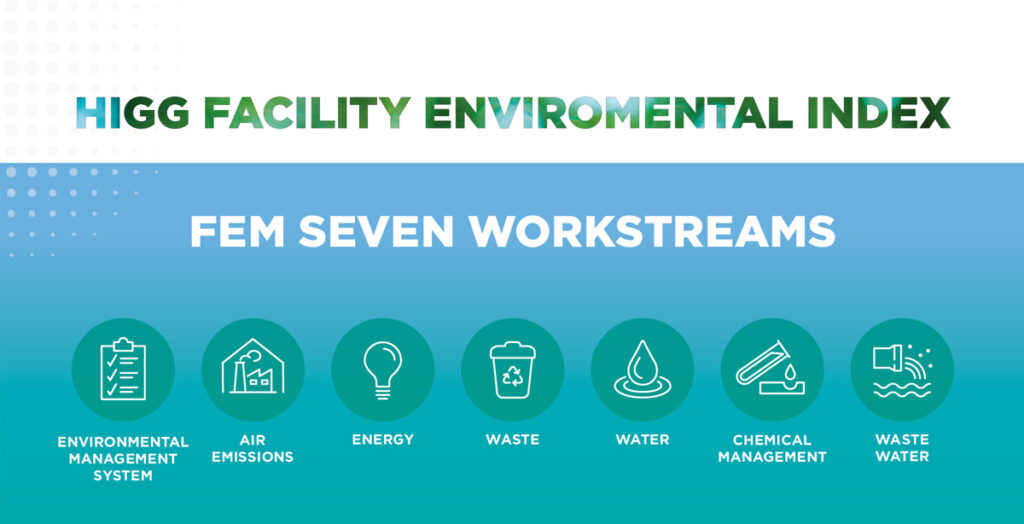
Higg FEM evaluates the environmental performance of manufacturing facilities based on 7 detailed impact areas, each requiring quantitative data and system-based evidence:
Environmental Management System: Reviews environmental commitment, policies, and managerial responsibility.
Energy Use & GHG Emissions: Requires accurate accounting of energy consumption (electricity, coal, gas) and calculation of Scope 1 and Scope 2 emissions.
Water Use: Measures total incoming water and its sources (municipal water, groundwater, harvested rainwater).
Wastewater: Includes requirements for wastewater treatment processes, testing frequency, and discharge permits.
Air Emissions: Controls non-GHG air pollutants (e.g., SOx, NOx).
Waste Management: Covers waste segregation, reduction, and handling of both general and hazardous waste.
Chemical Management: Ensures proper control and safety of chemicals under MRSL/RSL restrictions.
3. THREE SERIOUS DISADVANTAGES OF NOT IMPLEMENTING HIGG FEM OR HAVING A LOW SCORE
Neglecting Higg FEM is not just missing an opportunity—it exposes the business to major risks:
3.1. Loss of Access to Major Customers (The Door Closes)
Excluded from Preferred Supplier Lists: Most global brands now use Higg FEM as a supplier screening criterion. A score below the minimum threshold (e.g., under 60%) can lead to immediate disqualification from sourcing or bidding processes.
Lack of Transparency: Without a verified Higg FEM report, suppliers cannot meet modern requirements for supply chain transparency, leading to lost trust and difficulty securing long-term partnerships.
3.2. Environmental Risks and Uncontrolled Operational Costs
Hidden Cost Increases: Without Higg FEM, factories lack a standardized tool to track resource efficiency. This results in wasteful energy, water, and chemical consumption—directly increasing production costs.
Legal Compliance Risks: Poor environmental management systems raise the likelihood of violations in wastewater, emissions, and hazardous waste regulations—leading to penalties and operational disruption.
3.3. Loss of Benchmarking Advantage
No Industry Comparison: Higg FEM is the most powerful benchmarking tool in the global textile supply chain. Without it, businesses cannot identify where they stand relative to competitors.
Difficult to Improve: Without year-over-year quantitative data, it is impossible to determine which areas (energy, water, chemicals) need investment for environmental optimization.
4. CONCLUSION AND THE ROLE OF TTS-CERT
Higg FEM is an essential tool for any sustainable export strategy. TTS-CERT helps businesses not only achieve strong Higg FEM scores but also optimize production processes—turning environmental responsibility into a long-term competitive advantage.

Expert Tang Mong Diep has more than 15 years of experience in environmental management, ESG and sustainable development, with particular expertise in the Higg Facility Environmental Module (Higg FEM).
SEE MORE