Table of contents
When a customer requires a supplier to provide BCI Cotton, the company normally needs to clarify not only whether the order is Mass Balance or Physical BCI Cotton, but also whether a BCI Platform account is required.
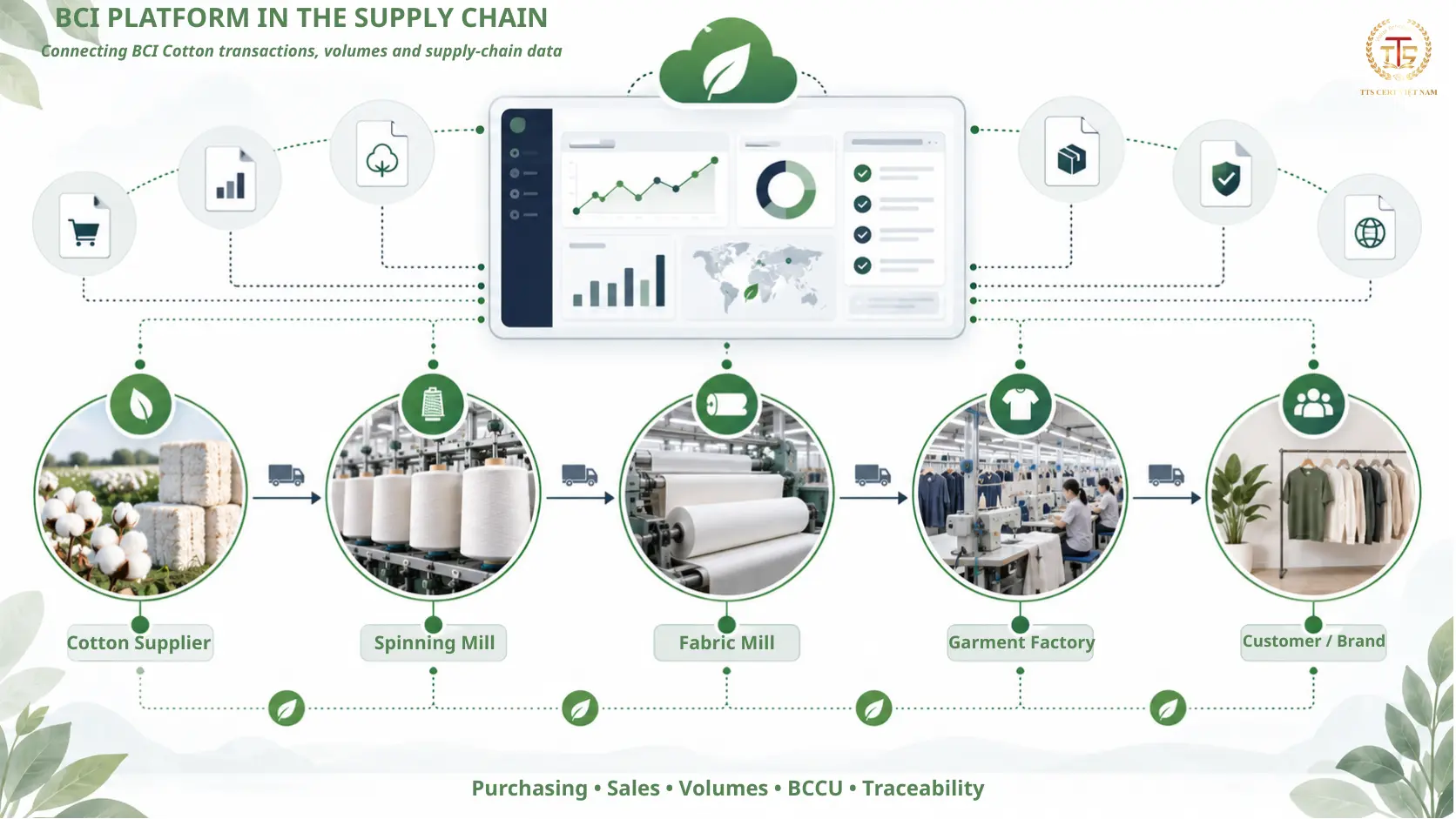
The BCI Platform (BCP) is an online system owned by the Better Cotton Initiative. It enables registered supply-chain organisations to document and monitor BCI Cotton transactions electronically.
More than 13,000 organisations currently use the BCI Platform, including ginners, traders, spinners, fabric mills, garment and end-product manufacturers, sourcing agents, retailers and brands.
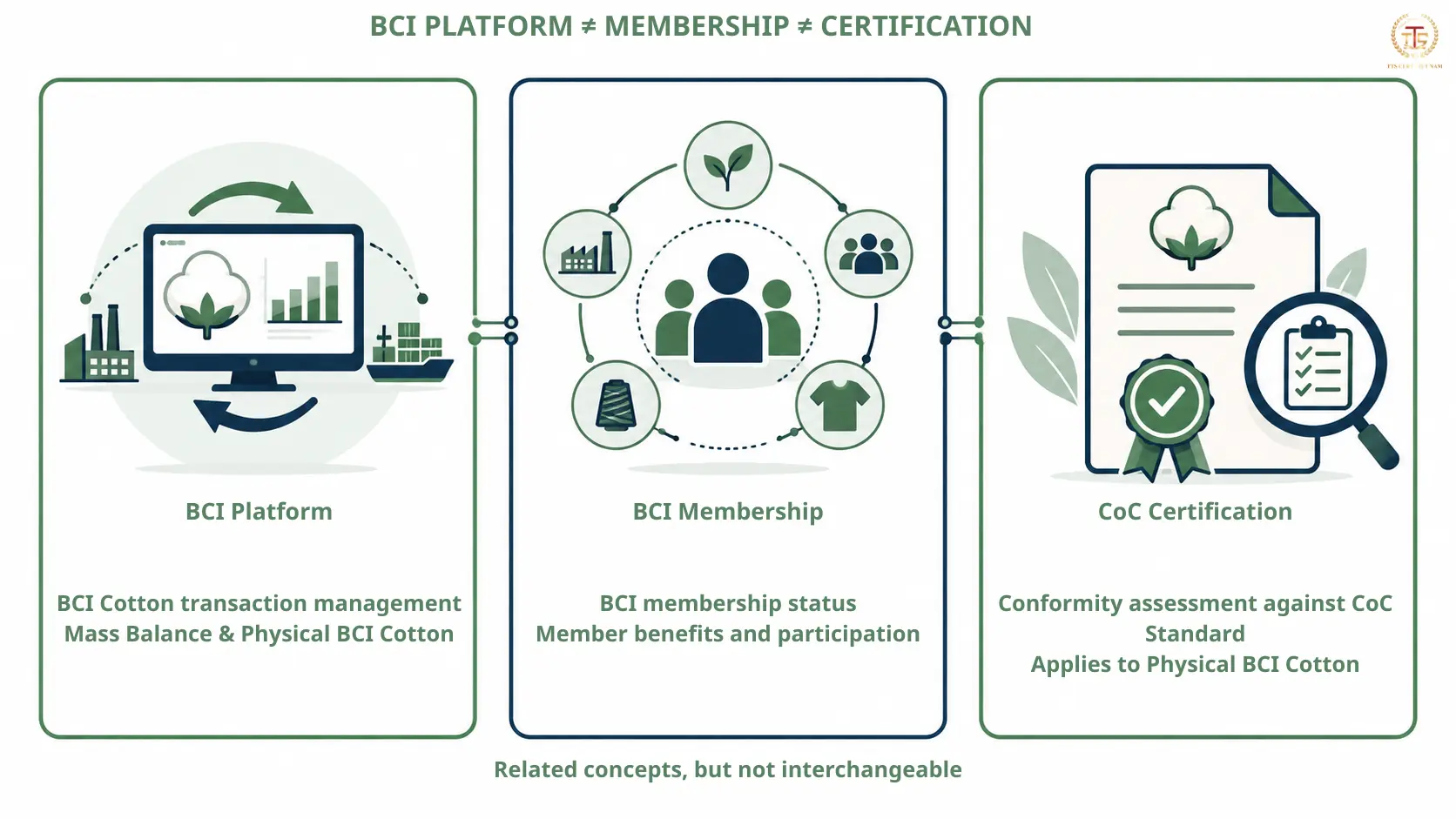
In simple terms: the BCI Platform is the digital system used to record and monitor BCI Cotton transactions. Having Platform access does not automatically mean that a company is a BCI Member or is BCI CoC certified.
Read more: What Is BCI Cotton?
1. What Is the BCI Platform Used For?
The main purpose of the BCI Platform is to provide an online database where supply-chain organisations can record and monitor transactions involving BCI Cotton.
The Platform supports organisations in:
recording BCI Cotton orders;
monitoring purchased and sold volumes;
managing Mass Balance transactions;
recording Physical BCI Cotton transactions;
maintaining transaction documentation;
enabling BCI to verify BCI Cotton volumes sourced through the supply chain.
In practical terms, it creates a digital connection between:
Supplier → Manufacturer → Customer → BCI Platform
The transaction data recorded in the Platform should correspond with the organisation's commercial and Chain of Custody records.
2. How Does the BCI Platform Manage Mass Balance and Physical BCI Cotton?
The BCI Platform supports both Mass Balance and Physical BCI Cotton, but the two sourcing models are tracked differently.
Mass Balance
Under Mass Balance, the organisation does not physically trace the individual cotton fibres contained in a specific finished product.
Instead, the Platform uses BCI Cotton Claim Units (BCCUs) to track eligible volumes through a mass-balance accounting system.
The core principle is that the amount of BCI Cotton sold cannot exceed the eligible amount purchased after applicable conversion requirements are considered.
Physical BCI Cotton
For Physical BCI Cotton using Segregation or Controlled Blending, Physical BCI Cotton volumes are recorded at each transaction in the supply chain.
This makes it possible to trace cotton contained in the end product back to its country of origin.
The important distinction is:
Mass Balance is based primarily on volume accounting, while Physical BCI Cotton provides physical traceability.
Read more: Mass Balance vs Physical BCI Cotton.
3. Which Companies Can Use the BCI Platform?
All major cotton supply-chain actors may have access to the BCI Platform.
These can include:
ginners;
cotton traders;
spinning mills;
fabric mills;
garment manufacturers;
end-product manufacturers;
sourcing agents;
retailers;
brands.
For textile companies in Vietnam, BCI Platform access is particularly relevant when a buyer requires the supplier to participate directly in a BCI Cotton transaction flow.
However, having Platform access does not by itself determine whether the company also needs CoC certification.
That depends mainly on whether the organisation is working with Mass Balance or Physical BCI Cotton.
4. Are BCI Platform Access, Membership and Certification the Same?
No.
These are three different concepts.
| Topic | BCI Platform | BCI Membership | CoC Certification |
|---|---|---|---|
| Main purpose | Transaction management | Membership status | Verification of conformity with CoC requirements |
| Used for BCI Cotton transactions | Yes | Not its primary purpose | Does not replace the Platform |
| Mass Balance | Used | May apply | Currently no Supplier/Manufacturer certification requirement |
| Physical BCI Cotton | Required for transactions | Membership does not replace certification | Certification required |
| Right to use BCI logo | Not automatic | Subject to membership rules | Not automatically granted by certification |
BCI confirms that a company does not necessarily need to be a BCI Member in order to obtain access to the BCI Platform. Non-member suppliers can apply for access subject to the applicable requirements.
BCI also states that non-member BCI Platform Suppliers cannot use the BCI logo merely because they have Platform access.
Read more: What Is BCI Membership?
5. What Are the Eligibility Requirements for BCI Platform Access?
According to BCI, organisations applying for Platform access must meet several basic requirements.
The organisation must:
be a registered legal entity;
not be listed on recognised international default lists or affiliated with an organisation on such lists;
complete the applicable online training;
pay the relevant access fees;
comply with applicable BCI Chain of Custody requirements.
Is a BCI Platform account registered by company or by site?
BCI's current Terms and Conditions state that Platform access must generally be registered at site level.
A BCI Platform account normally relates to the site where cotton is processed or handled. A company with multiple sites generally needs an account for each site, although companies qualifying for a single multi-site Chain of Custody audit and certificate may be exempt from this rule.
This point is important for groups operating several factories.
6. How to Register for the BCI Platform
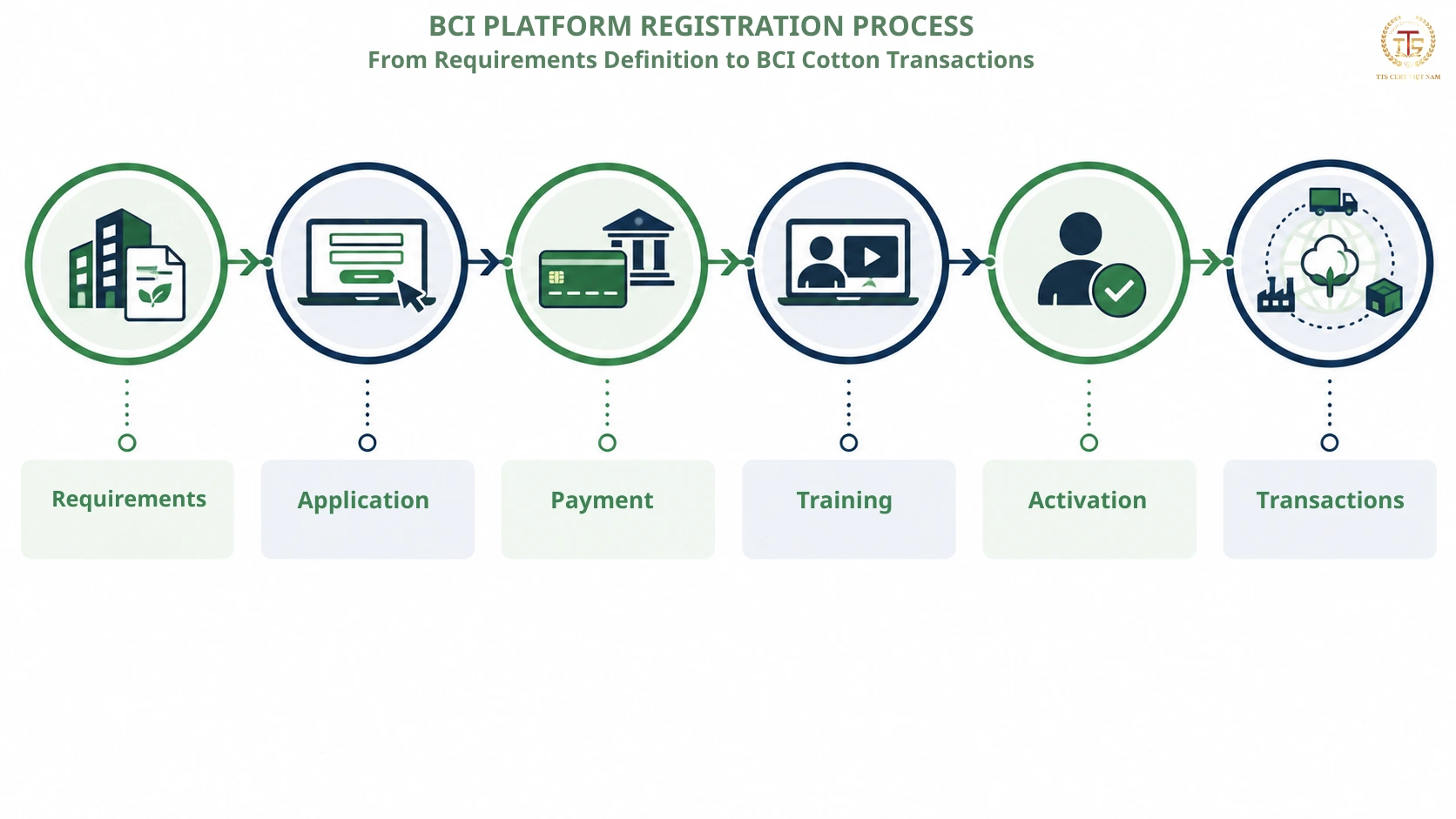
A practical registration process can be organised as follows.
Step 1 – Define the Company Requirement
Before applying, identify:
legal entity;
relevant site;
business activity;
products handled;
Mass Balance or Physical BCI Cotton requirement.
Step 2 – Review the Terms and Submit an Application
The organisation should review the BCI Platform Terms and Conditions and submit the registration form provided by BCI.
Step 3 – Pay the Applicable Access Fee
Non-member access is charged according to the number of Platform accounts requested.
Access is valid for 12 months.
Step 4 – Complete the Required Training
After the registration and payment process, the organisation receives access to the relevant online training.
BCI provides different training courses for different types of supply-chain actors. For example, an organisation that buys fabric and sells garments should complete training appropriate to that activity.
Step 5 – Activate Platform Access
Once the applicable requirements are satisfied, BCI activates the company's access.
For Physical BCI Cotton transactions, additional Chain of Custody certification requirements apply before the organisation receives access to physical transactions.
7. How Much Does BCI Platform Access Cost in 2026?
It is important to distinguish Platform access fees from BCI Membership fees or Chain of Custody certification costs.
For non-member BCI Platform access, the following fees apply from 1 March 2026:
| Number of BCI Platform Accounts | Fee for 12 Months |
|---|---|
| 1 account | EUR 1,030 |
| 2 accounts | EUR 1,820 |
| 3 accounts | EUR 2,550 |
| 4 accounts | EUR 3,230 |
| 5 accounts | EUR 3,750 |
The fees are reviewed annually, so companies should verify the current fee structure before registering.
How long is access valid?
Non-member access is valid for 12 months and must be renewed by paying the applicable renewal fee.
If the renewal fee is not paid on time, access may be blocked.
How can the fee be paid?
BCI currently accepts:
VISA;
Mastercard;
international bank transfer.
BCI notes that international bank-transfer reconciliation can take more than 10 working days, and the applicant is responsible for associated bank charges and local taxes.
Important: these are Platform access fees for non-members. They are not BCI CoC certification fees.
8. Do BCI Members Pay Separate Platform Access Fees?
BCI distinguishes between Member access and non-member Platform access.
BCI Platform access is a membership benefit for BCI Members, while non-members can purchase limited Platform access separately.
Under the current terms:
non-members may have a maximum of five BCI Platform accounts;
each non-member account may have up to two BCI Platform users;
companies requiring more than five accounts need to become BCI Members.
Therefore, a company operating several sites should compare:
Non-Member Platform Access
with
BCI Membership
rather than looking only at the cost of a single account.
9. Does Having a BCI Platform Account Mean a Company Is BCI Certified?
No.
This is one of the most common misunderstandings.
A BCI Platform account provides access to the transaction system. It does not automatically demonstrate conformity with BCI Chain of Custody Standard v1.2.
For Suppliers and Manufacturers:
Mass Balance: certification is not currently required;
Physical BCI Cotton: supply-chain organisations wishing to source, process and sell Physical BCI Cotton need CoC certification.
BCI also requires supply-chain organisations to already have a BCI Platform account before they can become certified for Physical BCI Cotton.
Before physical transaction access is enabled on the Platform, the organisation must be certified against the applicable Chain of Custody requirements.
A simplified sequence is:
BCI Platform Account
↓
CoC v1.2 Implementation
↓
Certification
↓
Physical BCI Cotton Transactions
Have BCI Platform Access but Unsure Whether Certification Is Required?
TTS Cert can help review your Mass Balance or Physical BCI Cotton requirements, determine the appropriate CoC scope and prepare an implementation roadmap before certification.
10. What Should a Company Prepare Before Using the BCI Platform?
The Platform should not operate separately from the company's real commercial and production records.
Before implementation, the organisation should establish clear controls over the following areas.
Responsible Personnel
Personnel responsible for the Platform should understand:
purchasing;
sales;
production;
inventory;
BCI CoC;
Platform transaction requirements.
Suppliers and Customers
Platform transaction data should be linked to actual supply-chain partners.
Purchase and Sales Documents
Platform records should correspond to:
purchase orders;
invoices;
delivery documents;
product descriptions;
quantities.
Production and Inventory Data
For Physical BCI Cotton, Platform data should correspond with traceability and volume-reconciliation records.
A practical control principle is:
BCI Platform ↔ Commercial Documents ↔ Production Records ↔ Inventory
Where these four data groups do not reconcile, the company may encounter issues during compliance reviews or CoC audits.
11. Common Misunderstandings About the BCI Platform
“Having Platform access means we are a BCI Member.”
Incorrect.
Eligible non-members can obtain Platform access.
“Having Platform access means we are BCI certified.”
Incorrect.
Platform access and certification are separate.
“Having Platform access means we can use the BCI logo.”
Incorrect.
BCI states that non-member Platform Suppliers cannot use the BCI logo simply because they have Platform access.
“One account can automatically cover all factories.”
Not necessarily.
Platform access is generally registered at site level, with specific exceptions for eligible multi-site arrangements.
“The Platform is only used for Mass Balance.”
Incorrect.
The BCI Platform supports both Mass Balance and Physical BCI Cotton.
12. Frequently Asked Questions About the BCI Platform
What is the BCI Platform?
The BCI Platform is the Better Cotton Initiative's online system for recording and monitoring BCI Cotton transactions through the supply chain.
Does a company need to be a BCI Member to access the Platform?
No.
Eligible non-member suppliers can apply for Platform access subject to the applicable conditions.
How much does BCI Platform access cost in 2026?
From 1 March 2026, non-member Platform access starts at EUR 1,030 for one account for 12 months.
Does a BCI Platform account mean that the company is certified?
No.
The Platform is a transaction-management system, while certification is a conformity-assessment process against the BCI CoC Standard.
Is the BCI Platform used for Mass Balance?
Yes.
Mass Balance transactions are tracked using BCCUs.
Is the BCI Platform used for Physical BCI Cotton?
Yes.
Physical BCI Cotton volumes are captured through transactions and support traceability back to the country of origin.
Is training required before access is activated?
Yes.
BCI requires relevant training for Platform users, and the primary user must complete the applicable training for the account type and CoC access.
13. How Can TTS Cert Support BCI Platform Implementation?
Registering an account is only one part of the process.
The company also needs to make sure its BCI Platform transactions are aligned with the CoC model, commercial documentation and actual material flow.
TTS Cert can support companies through:
Customer requirement review
↓
Mass Balance or Physical BCI Cotton determination
↓
Platform / Membership / Certification analysis
↓
Account and site scope determination
↓
Registration-document preparation
↓
Transaction-data standardisation
↓
Alignment between Platform records and CoC controls
↓
Personnel training
↓
Pre-certification review
Set Up Your BCI Platform Correctly from the Start
If your customer requires BCI Platform access but your company is unsure whether to register as a Member or Non-Member Supplier, or whether CoC certification is also required, TTS Cert can help review the requirements and identify an appropriate implementation pathway.
Internal Links
→ What Is BCI Cotton?
→ What Is BCI Chain of Custody Standard v1.2?
→ Mass Balance vs Physical BCI Cotton
→ What Is BCI Membership?

Lawyer Tran Thi Mai has more than 10 years of experience in legal affairs, social responsibility, ESG and sustainable development.
SEE MORE