ISO 9001 is the international standard that sets out requirements for a quality management system (QMS), published by the International Organization for Standardization (ISO). On 16 September 2026, ISO published ISO 9001:2026, replacing ISO 9001:2015.
This guide explains what ISO 9001 is, how the standard is structured, what is new in the 2026 edition and how certification works.
1. What Is ISO 9001?
ISO 9001 helps an organization show that it can consistently provide products and services that meet customer and legal requirements, while improving continually. It applies to any organization regardless of size or sector: manufacturing, trading, services, public bodies, schools and more.
ISO 9001 belongs to the ISO 9000 family:
| Standard | Content |
|---|---|
| ISO 9000 | Fundamentals and vocabulary for quality management systems |
| ISO 9001 | Requirements – the only standard in the family used for certification |
| ISO 9004 | Guidance for achieving sustained success |
2. The Seven Quality Management Principles
ISO 9001 is built on seven quality management principles:
- Customer focus – understand and meet current and future customer needs.
- Leadership – leaders set direction and create conditions for people to achieve objectives.
- Engagement of people – competent, empowered and engaged people.
- Process approach – manage activities as interrelated processes.
- Improvement – maintain continual improvement.
- Evidence-based decision making – base decisions on data analysis.
- Relationship management – manage relationships with suppliers and other interested parties.
3. Structure of ISO 9001
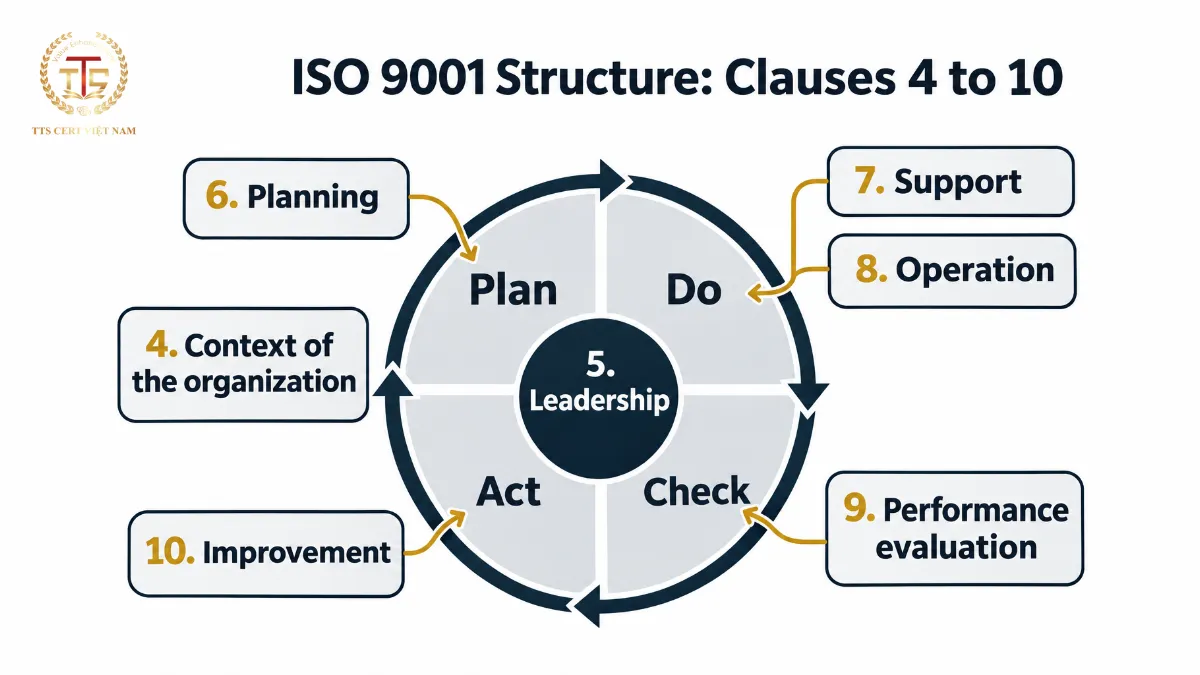
ISO 9001 follows the Harmonized Structure shared by ISO management system standards, making integration with ISO 14001, ISO 45001 and others easier. It has 10 clauses; clauses 1–3 cover scope, normative references and terms, and the requirements are in clauses 4 to 10:
| Clause | Main content |
|---|---|
| 4. Context of the organization | Internal and external issues, interested parties, scope of the system |
| 5. Leadership | Leadership commitment, quality policy, roles and responsibilities |
| 6. Planning | Risks and opportunities, quality objectives, planning of changes |
| 7. Support | Resources, competence, awareness, communication, documented information |
| 8. Operation | Planning and control of products and services |
| 9. Performance evaluation | Monitoring, measurement, internal audit, management review |
| 10. Improvement | Nonconformity, corrective action, continual improvement |
4. What Is New in ISO 9001:2026?
According to ISO, the 2026 edition keeps the familiar framework with targeted updates:
- Greater emphasis on leadership, quality culture and ethical conduct.
- Clearer guidance on considering risks and opportunities in strategic decisions.
- Adoption of the latest Harmonized Structure, easing integration with other management system standards.
- A new explanatory section to help users understand the purpose of the requirements and apply them consistently.
Transition: certification bodies have announced a transition period of about three years, until around September 2029. Organizations holding ISO 9001:2015 certificates should confirm the exact deadline with their certification body and plan a gap review early.
5. How Does ISO 9001 Certification Work?
Certification is carried out by an independent certification body. Choose a certification body accredited for the relevant scope. See also: What Is an Accreditation Body?
A typical certification cycle:
- Initial certification audit in two stages: a readiness review, then an on-site audit of implementation.
- Closure of any nonconformities and issue of the certificate, valid for three years.
- Surveillance audits, usually annually.
- Recertification audit before the certificate expires.
Time and cost depend on size, number of sites and complexity, and are set by the certification body.
6. Benefits of Implementing ISO 9001
- Clear processes, fewer errors and less waste.
- Meeting customer, importer or tender requirements.
- Data-driven decisions and measurable quality objectives.
- A foundation for integrating other management systems such as environment or occupational health and safety.
7. Frequently Asked Questions
Is ISO 9001 mandatory? For businesses, ISO 9001 is usually voluntary or a customer requirement. Some sectors may have specific rules.
Are ISO 9001:2015 certificates still valid? Yes, during the transition period. Organizations must move to ISO 9001:2026 before the deadline set by their certification body.
What is the difference between ISO 9000 and ISO 9001? ISO 9000 is both the name of the family and the standard on fundamentals and vocabulary; ISO 9001 is the requirements standard used for certification.
Does ISO 9001 work with other standards? Yes. Thanks to the Harmonized Structure, ISO 9001 integrates easily with ISO 14001 (environment), ISO 45001 (occupational health and safety) and ISO 27001 (information security).
8. Conclusion
ISO 9001 is the most widely used foundation for quality management. With ISO 9001:2026 now published, certified organizations should review their systems during the transition period.
This article is for general knowledge. The services TTS Cert currently provides are listed on our Services page.
References
- ISO – ISO launches update to world's most widely used quality management standard (16 September 2026)
- SGS – ISO 9001:2026 key updates and transition guidance