Table of contents
When a customer requires BCI Cotton, a company needs to understand not only where the material comes from, but also how its volume, origin and related information are controlled as it moves through the supply chain.
This is the role of Chain of Custody (CoC).
BCI defines Chain of Custody as the documentation and evidence associated with BCI Cotton as ownership or control of the material is transferred from one organisation to another.
The current auditable requirements are set out in BCI Chain of Custody Standard v1.2, which became effective on 6 January 2026.
In simple terms: BCI CoC helps a company demonstrate that its purchasing, storage, production, sales, volume reconciliation and BCI Cotton transactions are consistently controlled within the applicable scope.
Read more: What Is BCI Cotton? A Better Cotton Initiative Guide
1. What Is BCI Chain of Custody Standard v1.2?
BCI Chain of Custody Standard v1.2 defines requirements for supply-chain organisations that buy or sell Physical BCI Cotton or fulfil Mass Balance orders.
The Standard may apply to organisations such as:
ginners;
traders;
spinning mills;
fabric mills;
dyeing facilities;
end-product manufacturers;
sourcing organisations;
and other relevant supply-chain actors.
Outsourced activities also need to be considered when they form part of the applicable Chain of Custody scope.
The Standard currently applies to virgin cotton and does not extend to pre-consumer or post-consumer recycled cotton.
What changed in version 1.2?
BCI CoC Standard v1.2 became effective on 6 January 2026.
Compared with version 1.1, BCI describes v1.2 as a revision that does not fundamentally change the core requirements. The Membership requirement was removed from the CoC Standard, BCI branding was updated, and several editorial and grammatical changes were made.
This also reinforces an important point:
BCI Membership and BCI CoC Certification are not the same thing.
2. Which Companies Need BCI CoC Certification?
Not every company using BCI Cotton is required to become certified.
For Suppliers and Manufacturers, the current distinction is particularly important:
companies sourcing only through Mass Balance are not currently required to obtain CoC certification;
companies that want to source, process or sell Physical BCI Cotton need to meet the applicable certification requirements under BCI Chain of Custody Standard v1.2.
Therefore, when a buyer writes “BCI required” on a purchase order, a company should not immediately conclude that certification is required.
The first question should be:
Does the customer require Mass Balance or Physical BCI Cotton?
What about companies that never physically handle the goods?
BCI CoC Standard also provides an exemption in certain situations for organisations that do not physically receive or hold BCI Cotton.
Such organisations may not need certification where all relevant conditions are met, for example where:
the upstream supplier is certified;
goods are delivered directly from the supplier to the customer;
the transaction is recorded on the BCI Platform;
and no subcontractor is used for storage or production.
For this reason, the scope should be determined according to the actual flow of goods, not simply the company's business category.
3. The Four BCI Chain of Custody Models
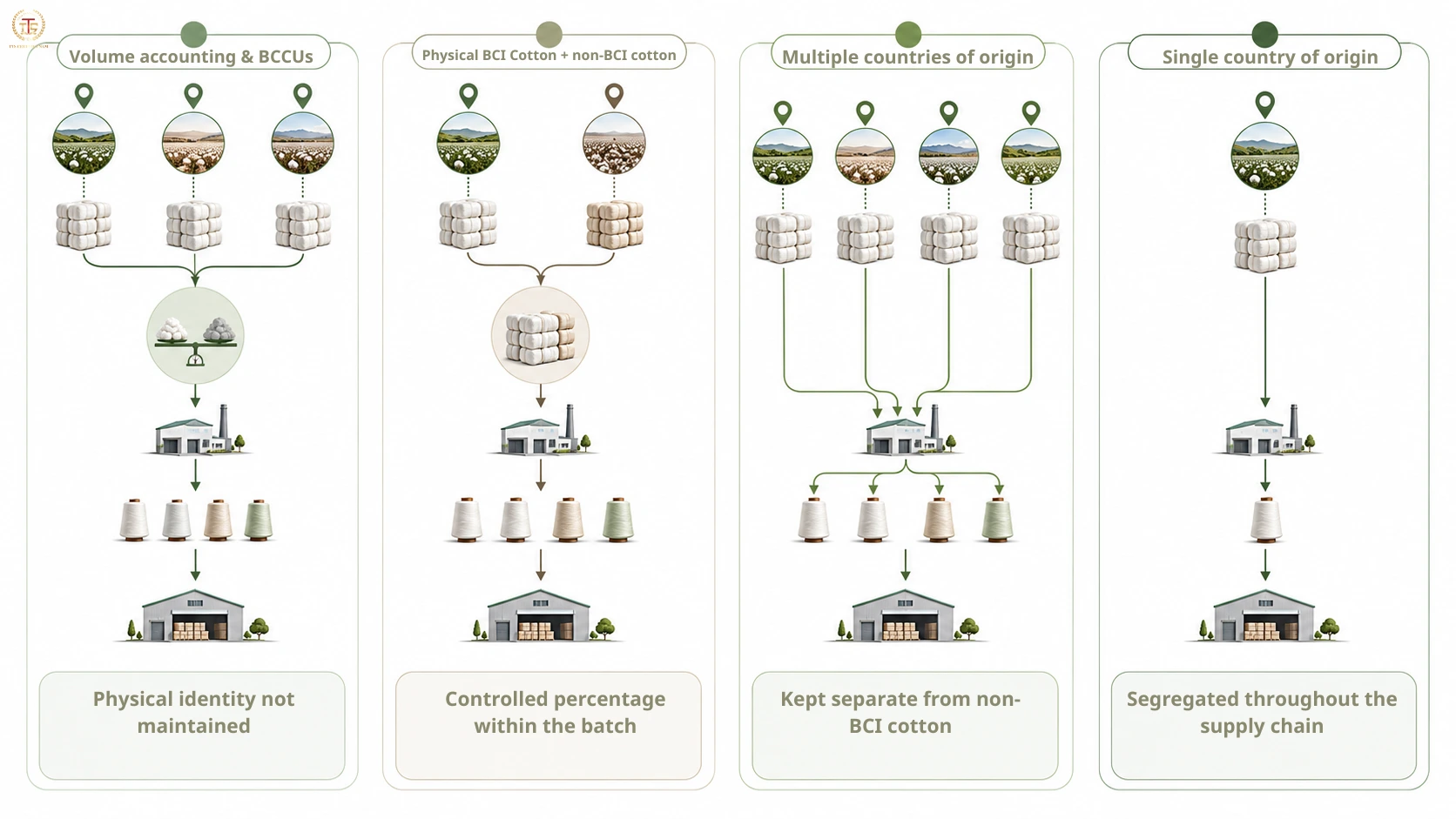
BCI CoC Standard v1.2 contains four Chain of Custody models.
An organisation may apply one model or a combination of models depending on its operations.
| Model | Main Principle |
|---|---|
| Mass Balance | Tracks BCI Cotton using volume accounting and BCCUs without maintaining physical identity throughout the entire supply chain |
| Controlled Blending | Allows Physical BCI Cotton to be blended with other cotton within a controlled production batch while maintaining the applicable percentage |
| Segregation – Multi-Country | Physical BCI Cotton from multiple countries may be handled together but remains separated from non-Physical BCI Cotton |
| Segregation – Single Country | Physical BCI Cotton from one country remains separated from cotton from all other origins |
Mass Balance
Mass Balance is a volume-accounting system.
BCI uses BCI Cotton Claim Units (BCCUs) to manage claims associated with BCI Cotton volumes.
The volume sold as Mass Balance BCI Cotton cannot exceed the eligible purchased volume after applicable conversion factors have been considered.
Controlled Blending
Controlled Blending allows Physical BCI Cotton to be blended with other cotton within the same production batch.
The organisation must determine and retain records of the percentage of Physical BCI Cotton in the batch.
Controlled Blending can only be used in manufacturing or processing activities from the spinning stage onwards. It is not intended for pure trading or distribution activities where no manufacturing takes place.
Segregation – Multi-Country
Physical BCI Cotton may originate from several countries but must remain separated from cotton that is not Physical BCI Cotton.
Segregation – Single Country
Physical BCI Cotton from one country must remain separated from:
cotton that is not Physical BCI Cotton; and
Physical BCI Cotton originating from other countries.
The organisation must also maintain information about the country of origin.
Read more: Mass Balance vs Physical BCI Cotton: What Is the Difference?
4. Key Management Requirements of BCI CoC v1.2
A company does not need to create an unnecessarily complex documentation system, but it must maintain a documented management system that is appropriate to the size and complexity of its certification scope.
Key requirements include the following.
Roles and Responsibilities
The organisation needs to appoint a person with overall responsibility for CoC compliance and identify personnel responsible for critical control points.
Typical functions may include:
Purchasing;
Warehouse;
Production;
Planning;
Sales;
Compliance;
BCI Platform administration.
Training
The company must maintain a training plan, review it annually and retain training records.
Personnel responsible for entering data into the BCI Platform must complete training provided by BCI or an approved training provider.
Record Retention
Applicable records need to be:
accurate;
complete;
up to date;
retrievable.
BCI requires applicable records to be retained for at least three years.
Annual Self-Assessment
Organisations within the certification scope must complete an annual self-assessment using the BCI template.
If nonconformities are identified, they must be addressed and closed within 90 days.
The self-assessment results are also shared with the Certification Body.
Management Review
The organisation must conduct an annual management review covering topics such as:
self-assessment results;
external audit results;
complaints;
corrective actions;
system changes;
resource needs;
improvement opportunities.
5. How Should Purchasing, Material Receipt and Production Be Controlled?
BCI CoC is not simply a set of documents maintained by the CSR or Compliance department.
It directly affects material flow and commercial records.
Supplier Control
The company should maintain current information about relevant BCI Cotton suppliers, including the products supplied and applicable CoC models where relevant.
Checking Documents at Material Receipt
For Physical BCI Cotton or Mass Balance orders, receiving documentation should provide the relevant information, such as:
supplier → product description → reference or batch number → quantity → delivery date → invoice → shipping information → applicable CoC model
Identifying Physical BCI Cotton
When a Physical CoC model is used, the organisation must maintain adequate material identification during storage, production and handling.
Depending on the operation, controls may include:
physical separation;
time separation;
material identification;
batch codes;
designated storage areas;
dedicated production scheduling.
The objective is to prevent unintended mixing outside the requirements of the applicable model.
6. Sales and Volume Reconciliation
When selling Physical BCI Cotton or fulfilling Mass Balance orders for another commercial organisation, supporting documents need to allow the relevant information to be identified.
This may include:
customer;
product;
batch or reference number;
quantity;
invoice;
shipping details;
applicable CoC model.
For Physical BCI Cotton, sales transactions must also be reflected appropriately on the BCI Platform.
BCI also does not allow BCI Cotton to be double claimed with another certification or sustainability programme in a way that conflicts with the applicable claims requirements.
What Is Volume Reconciliation?
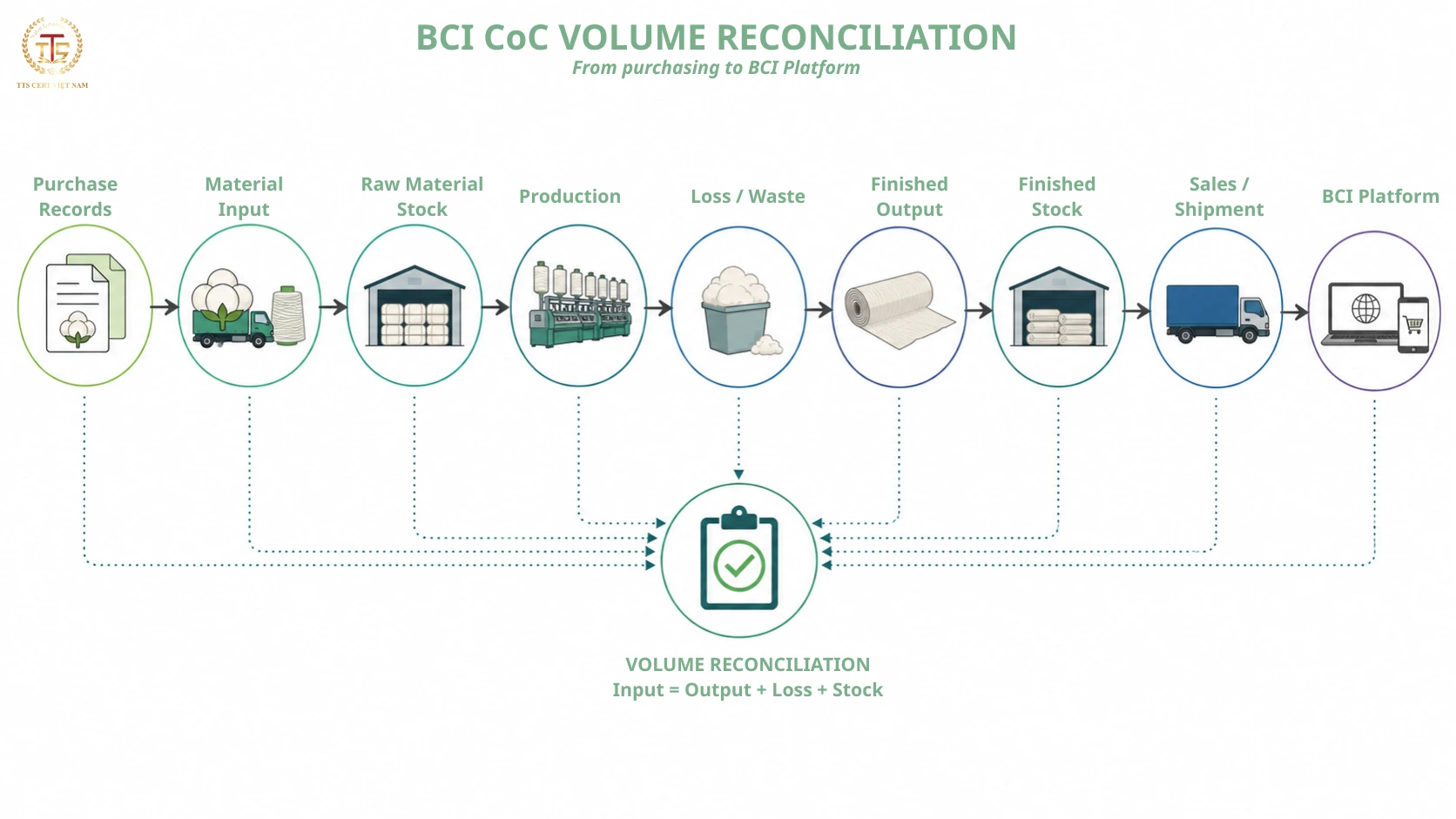
Volume reconciliation is the process of checking whether purchased material, production, losses, inventory and sales volumes are logically consistent.
A practical flow is:
Purchase → Input → Production → Waste → Output → Stock → Sales → BCI Platform
The company needs to maintain input and output figures at each relevant site and prepare an annual aggregate volume summary covering Physical BCI Cotton and Mass Balance orders.
The reconciliation should consider relevant factors such as:
opening and closing stock;
conversion factors;
production losses;
waste;
outsourced activities;
permitted model conversions.
7. What Is the Role of the BCI Platform?
The BCI Platform is BCI's central digital system for recording and tracking BCI Cotton transactions.
Under CoC Standard v1.2, use of the Platform is mandatory for BCI Cotton transactions, including both Mass Balance and Physical BCI Cotton.
The Platform helps companies:
record purchase and sales volumes;
manage BCCUs for Mass Balance;
record Physical BCI Cotton;
connect transaction data between supply-chain organisations.
More than 13,000 organisations use the BCI Platform.
Detailed account setup and transaction procedures should be covered in a separate article rather than expanding this satellite article too broadly.
Read more: What Is the BCI Platform? Registration and Usage Guide.
8. How to Prepare for BCI CoC Certification
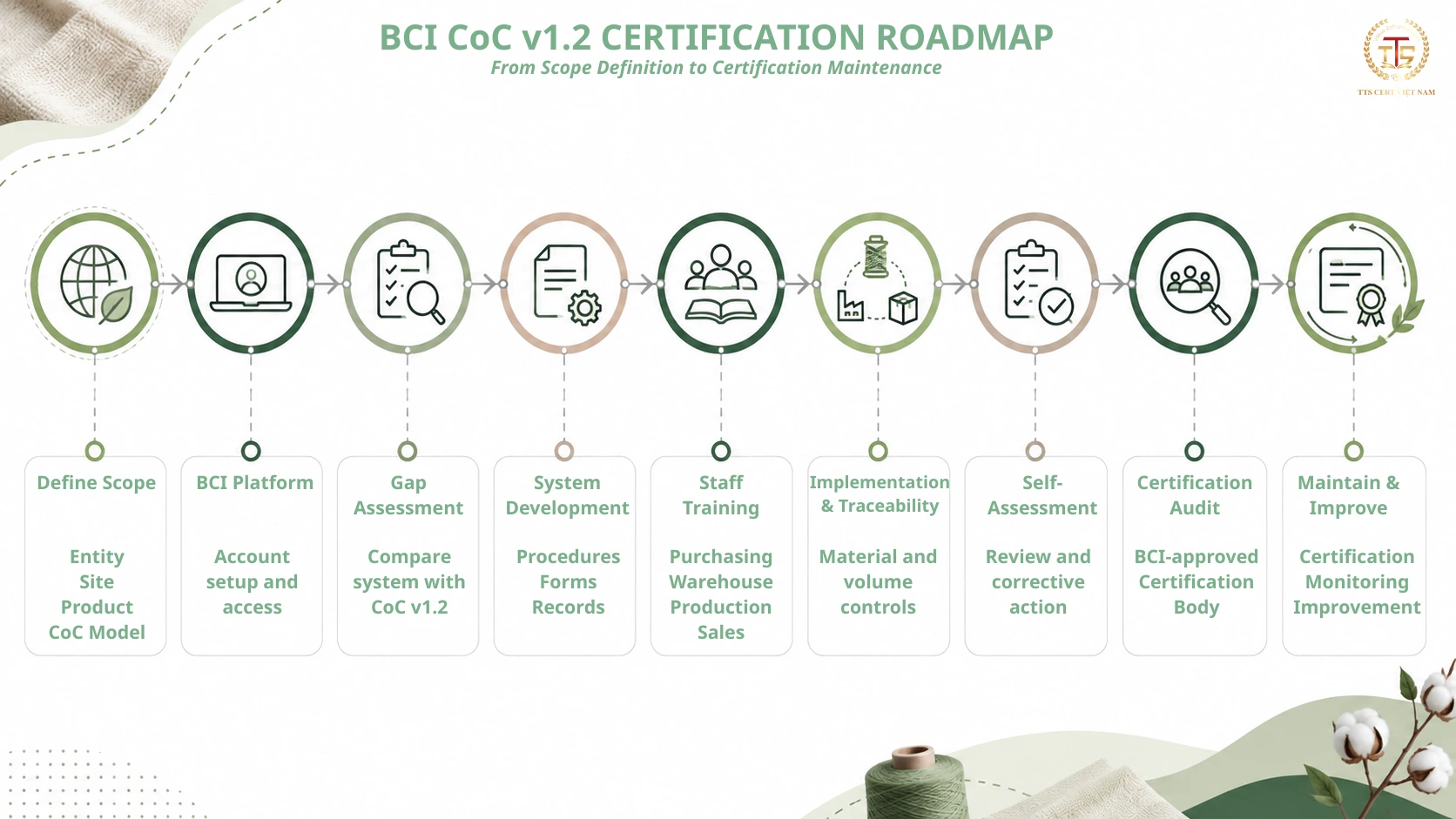
For companies that need certification in order to participate in a Physical BCI Cotton supply chain, a practical preparation process can follow these steps.
Step 1 – Clarify the Customer Requirement
Confirm whether the customer requires:
Mass Balance or Physical BCI Cotton.
Step 2 – Define the Scope
Determine:
legal entity;
site;
products;
activities;
applicable CoC model;
outsourced activities.
Step 3 – Obtain BCI Platform Access
Supply-chain organisations need a BCI Platform account before becoming certified for Physical BCI Cotton.
Step 4 – Conduct a Gap Assessment
Compare the existing management system against CoC Standard v1.2 to identify missing requirements.
Step 5 – Develop and Implement the System
Establish:
procedures;
records;
material controls;
traceability;
transaction management;
volume reconciliation.
Step 6 – Conduct Self-Assessment and Management Review
Complete the required internal review activities before and during ongoing system implementation.
Step 7 – Certification Audit
Select a BCI-approved Certification Body to perform the certification audit.
BCI maintains a list of approved Certification Bodies for Chain of Custody certification.
Where nonconformities are identified, the company needs to implement the required corrective actions before completing the certification process.
Not Sure Which BCI CoC Model Applies to Your Company?
TTS Cert can review customer requirements, determine the appropriate scope and CoC model, and conduct a Gap Assessment before system implementation begins.
9. What Documents Should a Company Prepare?
A satellite article does not need to list dozens of individual forms.
In practice, companies should focus on the following document groups:
| Area | Typical Records |
|---|---|
| Management | Scope, responsibilities, procedures, training |
| Suppliers & Purchasing | Supplier list, purchase orders, invoices, receiving documents |
| Warehouse | Receiving records, batch identification, stock records |
| Production | Production orders, inputs, outputs, losses, conversion factors |
| Sales | Sales orders, invoices, delivery documents |
| Traceability | Batch numbers, origin information, applicable CoC model |
| Volume Reconciliation | Inputs, outputs, stock, annual volume summary |
| BCI Platform | Purchase and sales transactions and related data |
| System Maintenance | Self-assessment, nonconformities, corrective actions, management review |
The most important point is not the number of documents.
It is the company's ability to connect the data.
A company should be able to trace a transaction through the following chain:
Sale → Product → Production Batch → Material Input → Supplier → Purchase Documents → BCI Platform
10. Frequently Asked Questions About BCI CoC
What does BCI CoC mean?
BCI CoC means BCI Chain of Custody, the system used to control BCI Cotton as it moves through the supply chain.
What is the current BCI CoC version?
The current version is BCI Chain of Custody Standard v1.2, effective from 6 January 2026.
How many BCI CoC models are there?
There are four:
Mass Balance;
Controlled Blending;
Segregation – Multi-Country;
Segregation – Single Country.
Does Mass Balance require certification?
For Suppliers and Manufacturers, BCI does not currently require CoC certification where the organisation participates only in Mass Balance.
Certification applies when a company intends to source, process or sell Physical BCI Cotton within the applicable scope.
Does having a BCI Platform account mean that a company is certified?
No.
The BCI Platform is a transaction-management system, while certification is a conformity-assessment process against the CoC Standard.
How long must BCI CoC records be retained?
Applicable records must be retained for a minimum of three years.
Is annual self-assessment required?
For organisations within the certification scope, the Standard requires an annual self-assessment.
Nonconformities identified during the self-assessment must be addressed within 90 days.
11. How Can TTS Cert Support BCI CoC Implementation?
An effective BCI CoC project should begin by identifying the correct scope and CoC model, rather than copying a generic set of procedures.
TTS Cert can support companies through:
Customer requirement review
↓
Mass Balance or Physical BCI Cotton determination
↓
Scope and CoC model identification
↓
CoC v1.2 Gap Assessment
↓
Procedure and record development
↓
Traceability and volume-reconciliation system setup
↓
Personnel training
↓
BCI Platform data review
↓
Certification audit preparation
↓
Corrective action support
Prepare Your BCI CoC System Correctly from the Start
If your customer requires Physical BCI Cotton or your organisation is preparing for Chain of Custody certification, TTS Cert can help determine the appropriate scope and implementation roadmap based on your actual operations.
Internal Links
→ What Is BCI Cotton?
→ What Is the BCI Platform?
→ Mass Balance vs Physical BCI Cotton
→ BCI Certification Consulting Services

Lawyer Tran Thi Mai has more than 10 years of experience in legal affairs, social responsibility, ESG and sustainable development.
SEE MORE