Table of contents
Customers in the EU, the US and global brands increasingly ask suppliers for environmental data per product, not just per factory. Common tools to meet this demand are life cycle assessment (LCA), environmental product declarations (EPD) and product carbon footprint (PCF).
TTS Cert advises businesses on LCA under ISO 14040 and ISO 14044, EPD preparation under ISO 14025 and PCF under ISO 14067: defining the scope, guiding data collection, calculating, and preparing reports and EPD documents.
1. What Are LCA, EPD and PCF?
LCA – life cycle assessment
LCA (Life Cycle Assessment) assesses a product's environmental impacts across its life cycle: raw material extraction, manufacturing, transport, use and end of life. It covers several impact categories such as climate change, water use, acidification and eutrophication.
LCA follows ISO 14040 (principles and framework) and ISO 14044 (requirements and guidelines), in four phases: goal and scope definition; life cycle inventory (LCI); life cycle impact assessment (LCIA); interpretation.
PCF – product carbon footprint
PCF (Product Carbon Footprint) measures only the greenhouse gas emissions and removals of a product, expressed in CO₂ equivalent (CO₂e). It follows ISO 14067, using LCA methodology but focusing on climate change.
Detailed comparison: EPD, PCF and LCA: what is the difference?
EPD – environmental product declaration
An EPD (Environmental Product Declaration) is a Type III declaration under ISO 14025. It is built from LCA results following product category rules (PCR), must be verified by an independent third party and is registered and published through an EPD programme. For construction products, EPDs follow EN 15804+A2 and are valid for five years. Learn more: What is an EPD?
2. Who Needs LCA, EPD and PCF?
Suppliers to international brands asked for product-level carbon or environmental data (textiles, footwear, furniture, packaging, electronics).
Construction product manufacturers supplying green building projects or the EU market. The new EU Construction Products Regulation (Regulation (EU) 2024/3110, applicable from 8 January 2026) will progressively add life cycle environmental information to product declarations.
Exporters of CBAM goods (iron and steel, aluminium, cement, fertilisers…) wanting to understand emission sources in their products. Note that CBAM has its own calculation rules — see What is CBAM?
Businesses aiming to reduce product emissions: LCA/PCF identifies the processes and materials with the highest impact (hotspots).
Businesses asked for an EPD by customers or projects, especially construction products, furniture and packaging.
3. Common Assessment Scopes
| Scope | Includes | Typically used when |
|---|---|---|
| Cradle-to-gate | Raw material extraction and processing, inbound transport, manufacturing | B2B customers request data for intermediate products; most common for suppliers |
| Cradle-to-grave | Cradle-to-gate + distribution, use, end of life | Final consumer products; comparing design options |
| Gate-to-gate | Factory processes only | Internal analysis, finding hotspots in production |
Agree the scope with your customer from the start; for an EPD, the scope is set by the applicable PCR.
4. How TTS Cert Supports You
TTS Cert is a consultancy. Our team:
Clarifies customer or market requirements to choose LCA, EPD or PCF, the scope and the functional unit; for an EPD, identifies the PCR and intended EPD programme.
Prepares a data checklist and guides production, purchasing and logistics teams.
Checks data completeness and plausibility, and fills gaps with background data where primary data is not available.
Calculates and analyses results, identifying emission hotspots.
Prepares the LCA / PCF report following the structure of ISO 14044 / ISO 14067.
EPD consulting: carries out the LCA according to the PCR, prepares the EPD documentation and draft, and supports you in responding to the verifier's comments.
Recommends reduction options based on the results.
TTS Cert is a consultancy and does not carry out third-party verification. Independent verification and EPD registration and publication are done by the verifier and EPD programme you choose.
5. The LCA and EPD Consulting Process
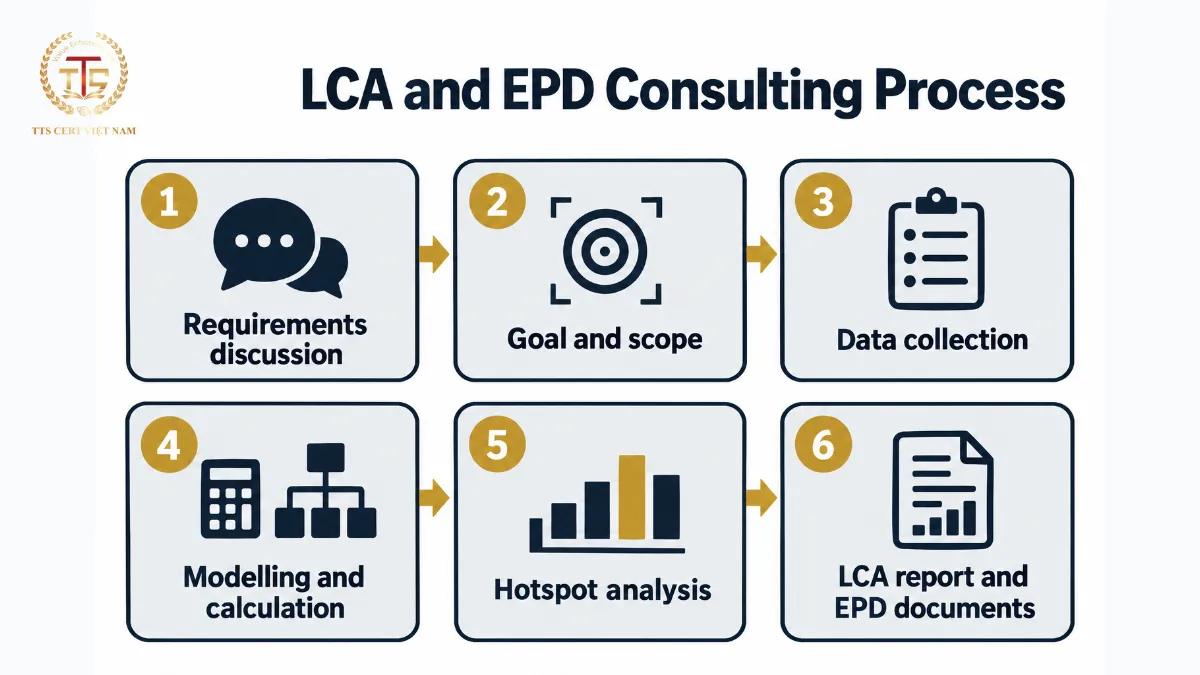
Requirements discussion: product, customer or market requirement, intended use of results.
Goal and scope: functional unit (e.g. 1 kg of product, 1 m² of material), system boundary, data year; for an EPD, the PCR and EPD programme.
Data collection: you provide data using the checklist; TTS Cert guides and checks.
Modelling and calculation: building the life cycle model with primary and background data.
Results analysis: hotspots and sensitivity to key assumptions.
Reports and documents: LCA or PCF report; for an EPD, the EPD documentation and draft according to the PCR.
EPD verification and registration (if applicable): you work with an independent verifier and the EPD programme; TTS Cert supports responses and revisions to the verifier's comments.
6. What Data Do You Need to Prepare?
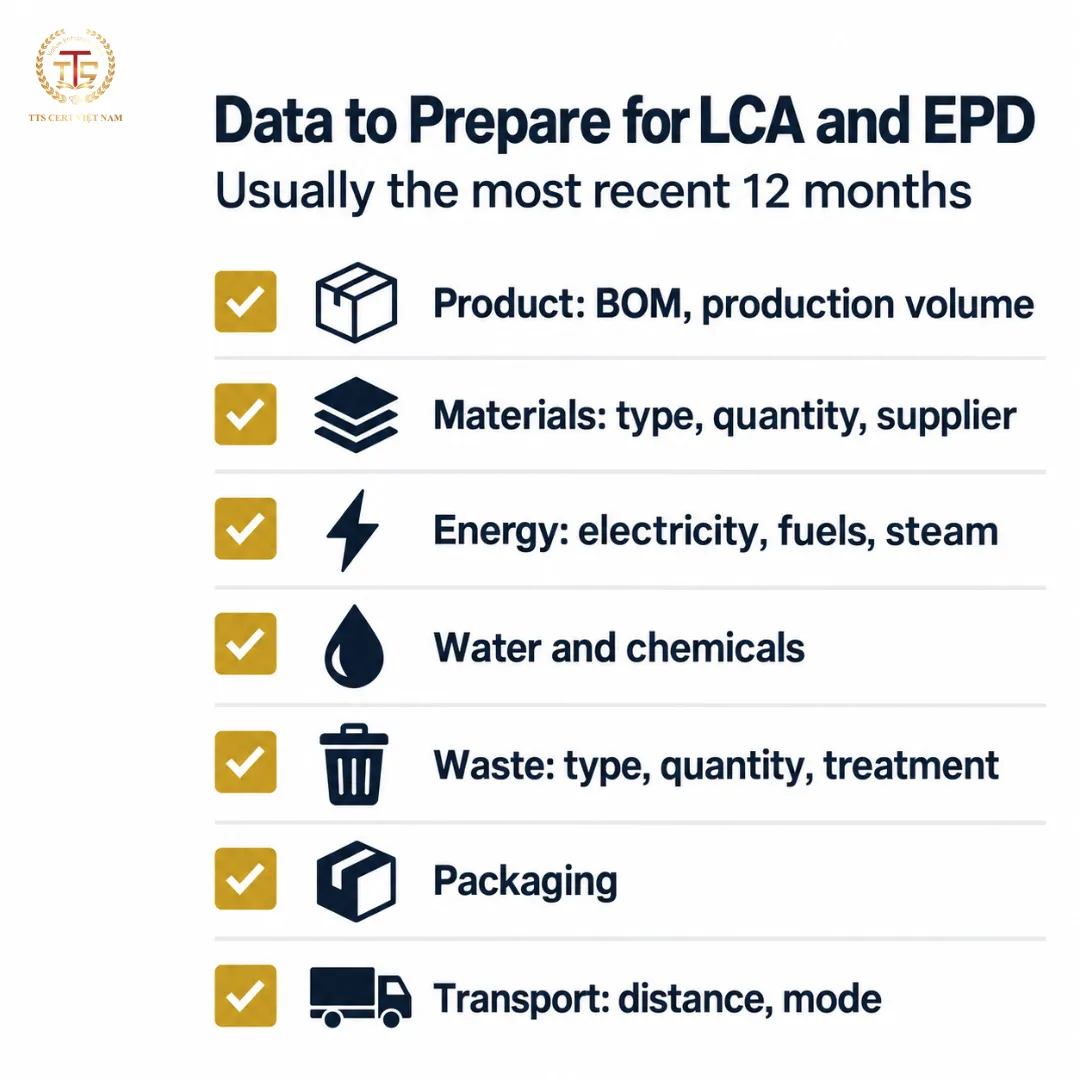
Data usually covers the most recent 12 months:
| Data group | Examples |
|---|---|
| Product | Bill of materials (BOM), production volume, product weight |
| Materials | Type, quantity, supplier, recycled content |
| Energy | Electricity, fuels (diesel, gas, coal, biomass), steam |
| Water and chemicals | Water use, main chemicals |
| Waste | Type, quantity, treatment method |
| Packaging | Materials and weight of packaging per product |
| Transport | Distances and transport modes for materials and finished goods |
If the factory makes several products, an allocation basis (by mass, machine hours…) is needed to split data per product.
7. Timeline and Cost Factors
An LCA or PCF consulting project typically takes about 6–8 weeks, depending on data readiness. For an EPD, add the time needed for verification and registration by the verifier and EPD programme.
Cost depends on:
The number of products or product groups.
The scope (cradle-to-gate or cradle-to-grave).
The number of production sites and process complexity.
Availability of primary and supplier data.
Specific report format requirements from your customer; for an EPD, the PCR and EPD programme chosen (verification and registration fees are charged by third parties).
8. Common Challenges
Data not split by product: electricity and water are often metered only at factory level.
Missing supplier data: background data must be used, making results less specific.
Wrong scope: doing cradle-to-grave when the customer only needs cradle-to-gate, or vice versa.
Results not comparable: different functional units, scopes or databases from those your customer uses.
Choosing the PCR too late: an LCA completed without following the EPD programme's PCR has to be partly redone.
9. LCA by Industry
10. Frequently Asked Questions
What is the difference between LCA and PCF? LCA covers several environmental impacts; PCF measures greenhouse gas emissions only. PCF can be seen as one part of LCA results, under its own standard, ISO 14067.
Should we do LCA, EPD or PCF? If your customer only asks for carbon data, PCF is enough. If you need several impacts, do an LCA. If your customer or project requires a verified public declaration, do an EPD (based on an LCA).
How long does it take? LCA or PCF consulting usually takes about 6–8 weeks, depending on data readiness. An EPD needs additional time for verification and registration.
Does TTS Cert verify or issue EPDs? No. TTS Cert provides consulting on LCA, PCF and EPD preparation. Verification is carried out by an independent verifier, and EPDs are registered and published by an EPD programme.
Can LCA results be used for an EPD? Yes, if the LCA follows the PCR of the EPD programme you plan to register with. Identify the PCR at the scoping stage.
Does LCA replace CBAM emissions reporting? No. CBAM has its own rules and calculation methods. Data collected for LCA/PCF can help, but does not replace CBAM reporting.
11. Conclusion
LCA, EPD and PCF help you respond to customer and market demands for product-level environmental data and show where to improve. The key step is defining the purpose and scope correctly from the start, so the results are usable for your customers.
References
ISO 14040, ISO 14044 – Environmental management – Life cycle assessment
ISO 14067 – Greenhouse gases – Carbon footprint of products
ISO 14025 – Environmental labels and declarations – Type III environmental declarations
Regulation (EU) 2024/3110 on construction products