



Chứng Nhận ISO 9001:2015 - Hệ thống Quản lý Chất lượng
THE KEY TO SUSTAINABLE BUSINESS SUCCESS
The key to sustainable business success lies in robust quality control. Achieving this requires a well-structured and effective management system for production activities. With over one million certified organizations worldwide, ISO 9001 remains the most recognized standard, providing a structured approach to quality management. It enables organizations to consistently deliver products and services that meet, and potentially exceed, customer expectations.
Obtaining ISO 9001 certification provides your business with a clear quality management system, enhancing efficiency across specific processes and delivering tangible economic benefits.
WHAT IS ISO 9000?

ISO 9000 is a set of international standards for quality management systems, applicable to all types of organizations. It ensures the consistent capability to deliver products that meet customer and regulatory requirements while continuously enhancing customer satisfaction. Additionally, it addresses risks and opportunities in line with the organization's context and objectives.
The ISO 9000 series provides a framework for quality management systems applicable to any organization, enabling them to consistently deliver high-quality products that meet customer requirements.
COMPONENTS OF THE ISO 9000 SERIES
The ISO 9000 system includes the following standards:
ISO 9000:2015 – Quality Management Systems – Fundamentals and Vocabulary
ISO 9001:2015 – Quality Management Systems – Requirements
ISO 9002:2016 – Quality Management Systems – Guidelines for the application of ISO 9001:2015
ISO 9004:2009 – Managing for the sustained success of an organization – A quality management approach
ISO 9001:2015 – QUALITY MANAGEMENT SYSTEM
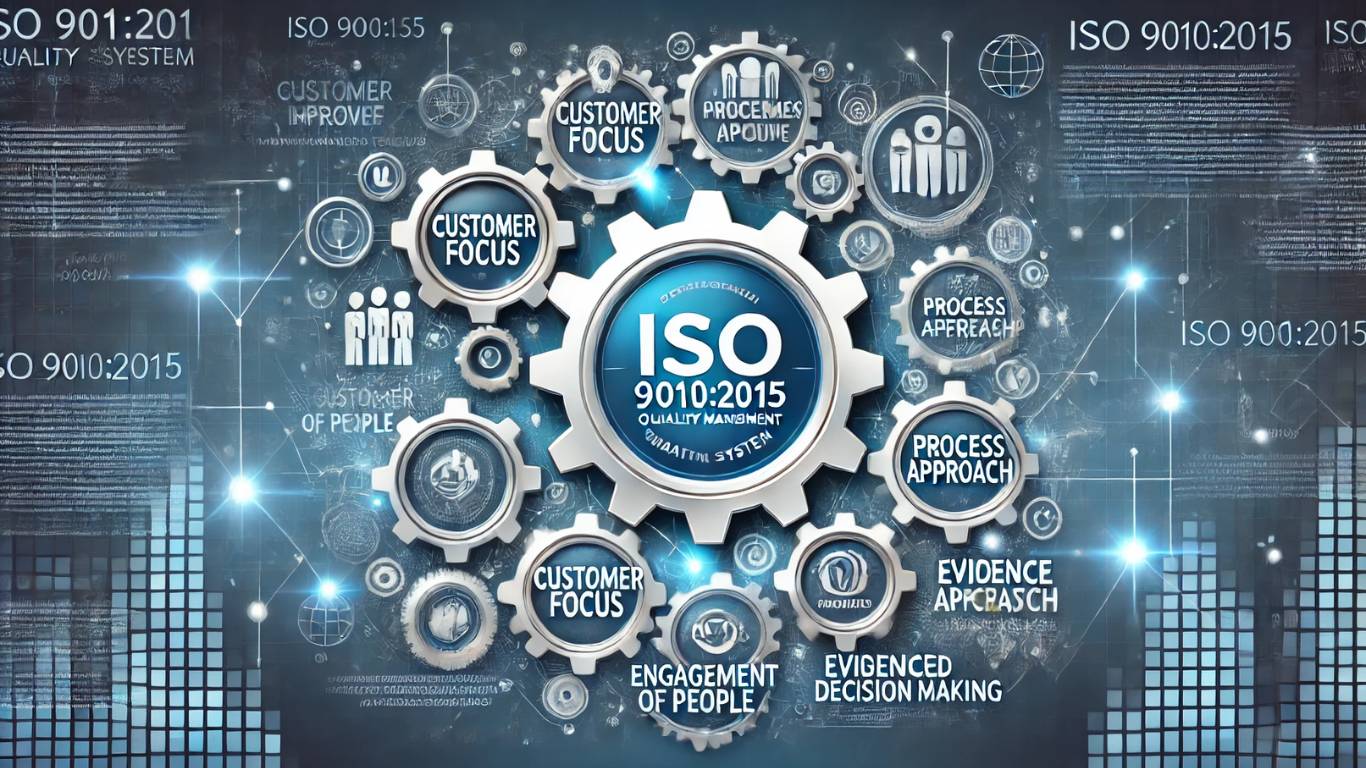
ISO 9001:2015 is the most widely used standard within the ISO 9000 series. It outlines requirements for a quality management system that enables organizations to consistently meet product quality requirements. The ISO 9001 quality management system operates based on the following principles:
Customer Focus
Leadership
Engagement of People
Process Approach
System Approach to Management
Continuous Improvement
Evidence-based Decision Making
Mutually Beneficial Supplier Relationships
An ISO 9001:2015 certification demonstrates that your organization has a quality management system that meets ISO 9001 requirements. This certification ensures stable compliance with customer and regulatory requirements while enhancing customer satisfaction. Currently, approximately 2 million ISO 9001:2015 certificates have been issued worldwide, with the number continuing to grow.
ISO 9001:2015 CLAUSES
The ISO 9001:2015 requirements are outlined in seven clauses, from Clause 4 to Clause 10:
Scope
Normative References
Terms and Definitions
Context of the Organization
Leadership
Planning
Support
Operation
Performance Evaluation
Improvement
These clauses provide a structured approach to quality management. Organizations can design their own quality management systems to comply with these requirements.
ISO 9001:2015 ASSESSMENT AND CERTIFICATION
To help TTS Cert's clients better understand the process and timeline for obtaining ISO 9001:2015 certification, here are some key details:
TIMEFRAME FOR ISO 9001:2015 CERTIFICATION
Evaluation and Implementation: Approximately 60 to 90 days
Certification Issuance: Usually 15 to 30 days
CERTIFICATE VALIDITY
An ISO 9001:2015 certificate is valid for three years from the issuance date. During this period, the organization must maintain its system regularly and continuously improve its processes to maximize effectiveness.
The certifying body will conduct periodic audits to ensure ongoing compliance with ISO 9001:2015 requirements. These audits are typically conducted every 9 to 12 months. After three years, the organization must apply for recertification, which involves a process similar to the initial certification. The renewed certificate will be valid for another three years.
BENEFITS OF ISO 9001:2015 CERTIFICATION
ISO 9001:2015 certification offers significant competitive advantages, serving as a testament to product reliability, quality, and customer satisfaction. Key benefits include:
Demonstrating compliance with customer and legal requirements
Building confidence for external audits
Enhancing operational efficiency through continuous improvement
Ensuring product consistency and reliability
Expanding business opportunities by meeting international market standards
TTS Cert is committed to providing internationally recognized ISO certification at competitive costs.
TTS CERT ISO 9001:2015 CERTIFICATION PROCESS
No. | Task | Timeline | Responsibility |
|---|---|---|---|
1 | Contract Signing | After mutual agreement | TTS Cert, Client |
2 | Certification Registration | Immediately after contract signing | Client |
3 | Evaluation Team Formation and Planning | After receiving the request | TTS Cert |
4 | Document Submission | Upon receiving evaluation plan | Client |
5 | Preliminary Assessment | Estimated within 7 days | TTS Cert, Client |
6 | Formal Evaluation | Estimated within 7 days | TTS Cert |
7 | Corrective Actions | Dependent on Client (TTS Cert support available) | Client |
8 | Evaluation Review | 3 days | TTS Cert |
9 | Certificate Issuance | 2 days | TTS Cert |
10 | Periodic Surveillance | Once every 12 months (2 times/3 years) | TTS Cert |
11 | Recertification | Every 3 years | TTS Cert, Client |
FREQUENTLY ASKED QUESTIONS ABOUT ISO 9001 CERTIFICATION
1. What is the validity period of ISO 9001:2015 certification?
The certificate is valid for three years, with periodic audits conducted every 12 months. Upon expiration, the certifying body will conduct a recertification assessment.
2. How long does it take to receive the certificate after providing all necessary documents?
Typically, 5 to 7 days after the formal assessment is completed, depending on the promptness of corrective action submissions (if required).
3. Can the certification timeline be shortened?
No. However, the timeline can be more efficient if the client's Quality Management System (QMS) is fully implemented and all necessary documents are readily available.
4. Can the certification date be backdated?
No. The certification date must reflect the official completion date of the formal assessment.
5. Can the certificate scope be broader than the actual operational scope?
No. The certification scope is determined based on the actual evidence collected during the evaluation. If a broader scope is required, an additional evaluation can be arranged.
THÔNG TIN LIÊN HỆ
- Trụ sở chính: Tầng 9, Tòa nhà Hồ Gươm Plaza, 102 Trần Phú, Hà Đông, Hà Nội
- Chi nhánh: Goldora Building, Đường Lê Văn Lương, Nhà Bè, TP.HCM
- Hotline: 094 323 5816
- Email: info@tts-cert.vn
- Fanpage: https://www.facebook.com/TTSCertVN
Recommend Posts


