


Demand and Potential of the Halal Food Market
The demand for Halal food is increasing worldwide, not only among Muslims but also among non-Muslims in developed countries such as the United States, the European Union (EU), China, Japan, and more. Halal-certified products are favored because they meet strict standards for food safety, hygiene, and environmental protection.
The global Halal food market holds great potential for growth, offering vast opportunities for Vietnamese businesses looking to enter and expand their presence. Let's explore Halal certification and the process for businesses to obtain this certification with TTS-Cert!
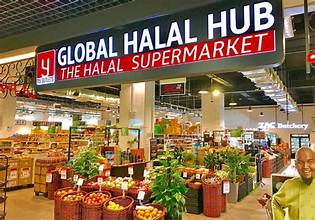
What is Halal?
In Arabic, "Halal" means "permitted" or "lawful." In the context of food, Halal refers to strict dietary rules followed by Muslims, as prescribed in the Qur'an (the Islamic holy book). The opposite of Halal is "Haram," which means "illegal" or "prohibited."
These terms are commonly used for products such as meat, cosmetics, personal care products, and materials that come into contact with food or pharmaceuticals. Additionally, products that are not clearly classified as Halal or Haram are considered “Mashbooh” (doubtful or uncertain).
What is Halal Certification?
Halal certification confirms that a product complies with strict requirements regarding ingredients, production processes, and Halal standards.
Although most plant-based products are considered Halal, they can become Haram if the manufacturing process is contaminated or involves prohibited substances. Halal certification ensures not only the safety of ingredients but also the control of the entire process, from production, processing, and packaging to labeling, storage, and transportation.
Who Needs Halal Certification?
According to Halal standards, products that require certification when exporting to Islamic markets include:
- Food and beverages (excluding alcohol and alcoholic substances)
- Medicines
- Cosmetics
Dietary supplements
Types of Halal Certification Programs
Currently, there are three popular Halal certification programs:
- Halal Jakim
- Validity: 1 year
- Scope: Food, cosmetics, raw materials, services, etc.
- Export Markets: All countries except Indonesia and GCC countries.
- GCC Certification
- Scope: Food products only
- Market Validity: GCC countries (Dubai-UAE, Kuwait, Oman, Qatar, Saudi Arabia, Bahrain, Yemen)
- Validity: 3 years
- Halal Mui
- Validity: 1 year
- Scope: Raw materials, semi-finished products, or flavorings
- Export Markets: All countries except Malaysia and GCC countries.
Businesses can choose one or multiple certification programs simultaneously to facilitate easier export processes.
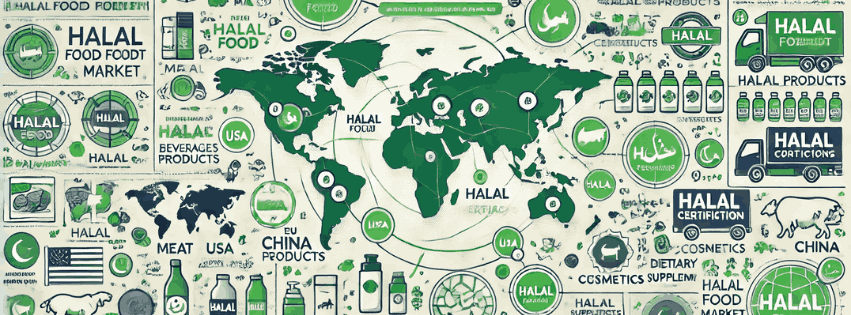
Principles of Identifying Halal Food
To classify Halal and Haram food, Islamic law applies five basic principles:
- Definition of Halal Food: Food and beverages permitted for consumption under Islamic law.
- General Standard: Products must not contain any prohibited or unacceptable ingredients according to Islamic law.
- Scope of Application: Covers animals, plants, food additives, and beverages.
- Animal Slaughtering Methods: Must follow strict procedures, including reciting prayers and facing the animal towards Qibla (Mecca).
- Mandatory Requirements: Halal-certified products must display the Halal logo on their packaging, and the certification must be valid.
Halal Certification Process
To obtain Halal certification, businesses need to follow these steps:
1. Document Preparation
- Halal Certification Application Form
- Halal Certification Contract
- Company Profile and Organizational Chart
- Business Registration Certificate and Related Permits
- Production Process and Production Flowchart
- ISO, HACCP, GMP, GAP Certificates (if applicable)
- Certificates of Environmental Hygiene, Fire Safety, and Wastewater Treatment
2. Document Review
- Review and evaluate all documents submitted by the business.
- If incomplete, additional documents will be requested.
3. On-Site Inspection
- Inspect the factory, production processes, raw materials, products, and storage.
- Interview employees and management about compliance with Halal standards.
4. Evaluation and Certification Issuance
- Experts evaluate and analyze the reports.
- If all requirements are met, the business will receive Halal certification.
Periodic Monitoring After Certification
Halal certification is valid for a certain period and is subject to periodic monitoring. If non-compliance is detected, the certification may be suspended or revoked.
- MINOP (Minor Non-Conformance): Related to food safety and hygiene.
- MAJOR (Major Non-Conformance): Changes in ingredients, suppliers, machinery, or factory relocation.
- Severe Non-Conformance: Use of Haram ingredients (e.g., pork) or improper Islamic slaughtering methods.
Contact for Halal Certification Consultation
With the information provided above, TTS-Cert hopes to help you better understand Halal certification and its process. If your business needs consultation to obtain Halal certification, feel free to contact TTS-Cert for detailed and dedicated support!


