Table of contents

As sustainability becomes an increasingly important requirement in global supply chains, many manufacturers are beginning to use recycled materials to meet the expectations of customers, international brands, and export markets.
However, using recycled materials is only the first step. What matters more is whether a business can prove the origin of those materials, the percentage of recycled content in its products, and its ability to control recycled materials throughout the entire production process.
This is why the GRS standard has become increasingly important for many businesses.
GRS not only helps verify recycled materials but also requires companies to control traceability, environmental management, chemical management, social responsibility, and management systems. As a result, GRS certification has become one of the common requirements for businesses participating in supply chains for textiles, yarn, fabrics, plastics, packaging, footwear, and consumer goods.
1. What Is GRS?
GRS stands for Global Recycled Standard.
It is an international standard used to verify the recycled content of products while also controlling the chain of custody, environmental requirements, chemical management, and social responsibility during production.
In simple terms, GRS helps businesses answer important questions such as:
Where do the recycled materials come from?
What percentage of recycled material does the product contain?
Are recycled materials controlled during production?
Can the finished product be traced back to the input materials?
Does the production process meet environmental, chemical, and social responsibility requirements?
Therefore, GRS is not merely a standard for recycled products. It is a more comprehensive assessment system that helps businesses demonstrate transparency and responsibility within the supply chain.
2. What Is GRS Certification?
GRS certification is granted to businesses that meet the requirements of the Global Recycled Standard. This certification confirms that a company has an appropriate management system to control recycled materials, ensure traceability, and comply with requirements related to environmental management, chemical management, and social responsibility.
It is important to note that GRS certification does not only assess the final product. The assessment also reviews the company’s entire management system, including purchasing, material receiving, storage, production, record control, material balance calculation, and product sales.
Therefore, to achieve GRS certification, a business needs to prepare not only eligible recycled materials but also a proper documentation system and operational procedures that comply with the standard’s requirements.
3. Which Businesses Can Apply GRS?
GRS can apply to many types of businesses involved in the supply chain of products containing recycled materials.
Common businesses applying GRS include:
Recycled material suppliers.
Yarn spinning mills.
Fabric mills, dyeing facilities, and finishing facilities.
Garment manufacturers.
Footwear and accessory manufacturers.
Plastic and packaging manufacturers.
Trading companies dealing with recycled materials or recycled products.
Packaging and distribution units.
Brands or retailers that want to verify products with recycled origin.
GRS is especially suitable for businesses supplying products to international customers, major brands, or markets with high requirements for sustainability and traceability.
4. Key Requirements of GRS
To achieve GRS certification, a business must not only use recycled materials but also demonstrate its ability to control materials, maintain traceability, and comply with requirements related to environmental management, chemical management, social responsibility, and management systems.
Recycled Content
GRS requires businesses to demonstrate that their products contain recycled materials at a percentage that meets the requirements of the standard and the customer.
Businesses need to maintain records showing the origin of recycled materials, input quantity, recycled content percentage, and the connection between input materials and finished products.
Chain of Custody
Businesses must establish a Chain of Custody system to track recycled materials from suppliers, receiving, storage, production, and final shipment.
The objective is to ensure that GRS materials are properly identified, separately managed, and not confused or mixed with conventional materials without proper control.
Environmental Management
GRS requires businesses to control environmental impacts arising from production activities, including wastewater, air emissions, waste, energy use, and resource consumption.
Businesses need to maintain appropriate records, procedures, or control measures to demonstrate that production activities are managed in an environmentally responsible manner.
Chemical Management
For businesses using chemicals in production, GRS requires chemical control from purchasing, storage, use, and disposal.
Common records include chemical lists, SDS/MSDS, chemical assessments, safe-use instructions, and related employee training records.
Social Responsibility
GRS includes requirements related to working conditions to ensure that workers operate in a safe, fair, and responsible working environment.
Businesses need to control issues such as child labor, forced labor, working hours, wages, discrimination, occupational health and safety, and grievance mechanisms.
5. GRS Certification Consulting Process
The GRS certification consulting process at TTS Cert is designed to help businesses meet the requirements of the GRS standard and achieve certification effectively. The process typically includes the following steps:
Step 1: Information Collection and Preliminary Review
TTS Cert receives the company’s request and collects initial information about products, production processes, supply chains, and the intended GRS certification scope.
Step 2: Current Status Assessment and Gap Analysis
TTS Cert conducts an assessment of the company’s current practices against the requirements of the GRS standard and identifies gaps that need to be addressed.
Step 3: System Development and Documentation Support
TTS Cert supports the company in developing procedures, policies, and documentation related to traceability, environmental management, social responsibility, and chemical management according to GRS requirements.
Step 4: Internal Training and Awareness Building
Training sessions are provided for key personnel to ensure they understand GRS requirements and can effectively implement and maintain the system.
Step 5: Certification Document Preparation and Certification Body Selection
TTS Cert supports the company in preparing certification documents and helps connect the business with certification bodies recognized by Textile Exchange.
Step 6: Support During the Certification Audit
TTS Cert accompanies the company during the on-site assessment conducted by the certification body and supports clarification or explanation when needed.
Step 7: Post-Certification Follow-up and Improvement Support
After certification is achieved, TTS Cert continues to support the company in maintaining the system, implementing periodic improvements, and preparing for surveillance or renewal audits.
6. Documents Required for a GRS Assessment
Documentation is one of the most important elements in a GRS certification assessment. Businesses need to demonstrate the complete flow of recycled materials from input to output.
The main document groups usually include the following.
Input Material Documents
Businesses need to maintain records proving that recycled materials are purchased from suitable suppliers.
Common documents include purchase contracts, purchase orders, invoices, delivery notes, warehouse receiving records, supplier certificates, and input Transaction Certificates, if applicable.
Warehouse and Material Identification Records
Businesses need to demonstrate that GRS materials are properly identified, stored, and managed to avoid confusion with conventional materials.
Relevant records may include inventory records, material identification labels, warehouse layout, stocktaking records, and rules for distinguishing GRS materials from non-certified materials.
Production and Traceability Records
Businesses need records showing which production batch used the recycled materials and which finished products were produced from those materials.
Common records include production orders, material issuance records, material consumption standards, production logs, finished goods receiving records, and traceability records from input materials to output products.
Material Balance Records
Material Balance helps businesses demonstrate that the quantity of recycled input materials is consistent with the quantity of output products claimed under GRS.
Businesses need to track purchased material quantities, materials used in production, production loss, waste, inventory, and the quantity of products sold with GRS claims.
Environmental, Chemical, and Social Responsibility Records
Depending on the production activities, businesses need to prepare records related to environmental management, chemical management, and labor conditions.
These records may include environmental permits, waste management records, chemical lists, SDS/MSDS, chemical safety training records, employment contracts, payroll records, attendance records, occupational health and safety records, and grievance mechanisms.
7. What Is the Difference Between GRS and RCS?
GRS and RCS are both standards related to recycled materials, but their scopes are different.
RCS mainly focuses on verifying recycled content and ensuring traceability. GRS has a broader scope because, in addition to recycled materials and Chain of Custody, it also includes requirements related to environmental management, chemical management, and social responsibility.
| Criteria | RCS | GRS |
|---|---|---|
| Full name | Recycled Claim Standard | Global Recycled Standard |
| Main objective | Verifies claims related to recycled materials | Verifies recycled materials and broader sustainability requirements |
| Recycled Content | Yes | Yes |
| Chain of Custody | Yes | Yes |
| Environmental management | No | Yes |
| Chemical management | No | Yes |
| Social responsibility | No | Yes |
| Level of requirements | More basic | More comprehensive |
In simple terms, RCS is suitable when a business needs to demonstrate the percentage of recycled material, while GRS is more suitable when a business needs to meet broader requirements from customers or international brands.
8. Common Mistakes During GRS Assessment
During GRS certification preparation, many businesses face difficulties not because they do not use recycled materials, but because they do not have a suitable documentation and traceability system.
Common issues include:
Incomplete input material documentation: The company purchases recycled materials but lacks documents proving origin, supplier certificates, or input Transaction Certificates when required.
Weak Chain of Custody control: GRS materials are not clearly identified in the warehouse, are mixed with conventional materials, or production records cannot demonstrate the material flow.
Inconsistent Material Balance: Data between purchasing, warehouse, production, inventory, and sales records is inconsistent, making it difficult to justify the quantity of products claimed under GRS.
Incomplete chemical records: The company uses chemicals but lacks a chemical list, SDS/MSDS, chemical assessment records, or safe-use instructions.
Insufficient environmental and labor records: Some companies have not prepared adequate environmental records, occupational safety records, payroll records, attendance records, employment contracts, or grievance mechanisms required for the assessment.
Identifying these issues early helps businesses prepare more effectively before the official certification audit.
9. Benefits of GRS Certification
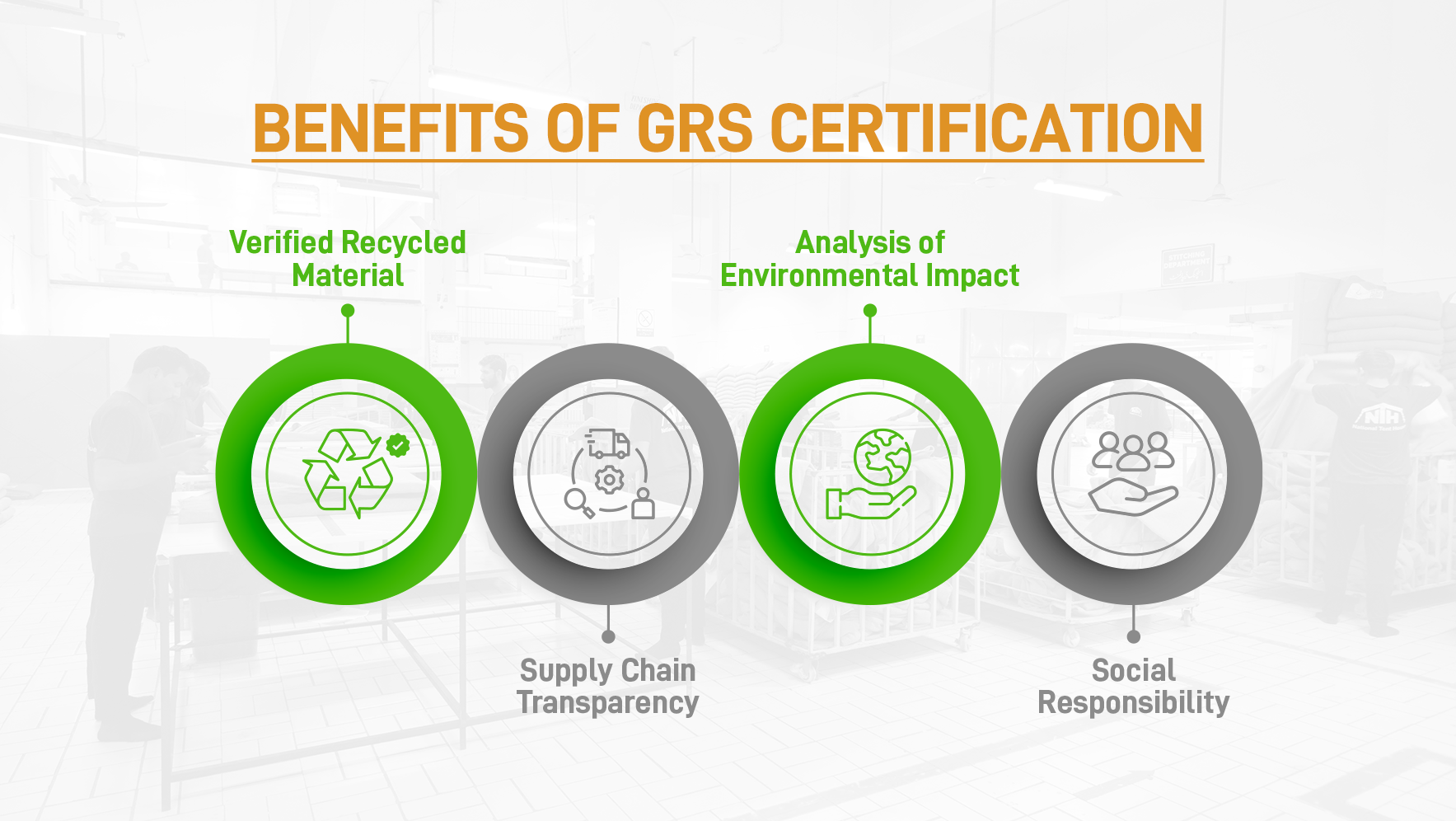
Achieving GRS certification provides several benefits for businesses.
Demonstrating commitment to sustainability: The company can demonstrate that it uses recycled materials in a transparent and controlled manner, in line with the trend toward green consumption.
Enhancing brand reputation and image: GRS helps build the image of a company that is responsible toward the environment and society, creating trust with partners and consumers.
Increasing access to international markets: GRS certification is one of the requirements considered by many global brands and major export markets such as the EU, the United States, and Japan.
Creating a competitive advantage: GRS helps businesses stand out from competitors that have not achieved certification, especially in industries such as textiles, packaging, and consumer goods.
Supporting process control and improvement: Compliance with GRS requires businesses to review, improve, and operate their production systems in a more controlled and efficient manner.
Improving supply chain transparency: GRS requires material traceability and supply chain transparency, thereby increasing the credibility of products.
10. How TTS Cert Supports Businesses in GRS Implementation
TTS Cert supports businesses throughout the preparation and implementation process for GRS certification, from current status assessment to system development, training, documentation preparation, and support during the certification audit.
Typical support activities include:
Assessing the current recycled material management system.
Identifying gaps between current practices and GRS requirements.
Guiding the development of GRS material control procedures.
Supporting the establishment of Chain of Custody and Material Balance systems.
Training personnel responsible for purchasing, warehouse, production, environmental management, chemical management, and documentation.
Supporting certification document preparation.
Accompanying the company during the process of working with the certification body.
Supporting corrective actions after the audit, if any.
With experience supporting businesses in textiles, yarn, fabrics, packaging, plastics, and industrial manufacturing, TTS Cert focuses on practical solutions tailored to each company’s operational model.
The goal of TTS Cert is not only to help businesses achieve certification but also to build a management system that can be maintained and effectively applied in daily operations.
11. Frequently Asked Questions About GRS
What is GRS?
GRS stands for Global Recycled Standard. It is an international standard used to verify recycled content in products while also controlling traceability, environmental management, chemical management, and social responsibility in the supply chain.
What is GRS certification?
GRS certification confirms that a business meets the requirements of the GRS standard within the assessed scope. It shows that the company has an appropriate system to control recycled materials and trace them from input to output.
What are GRS Certificate and GRS certification documents?
In practice, many businesses use terms such as GRS Certificate, GRS certification, or GRS certificate documents to refer to documents proving that a company has been assessed against the GRS standard. However, businesses should distinguish between Scope Certificate and Transaction Certificate (TC), as these documents serve different purposes.
How is GRS different from RCS?
RCS mainly focuses on verifying recycled content and traceability. GRS has a broader scope because it also includes environmental management, chemical management, and social responsibility requirements.
What should businesses prepare to achieve GRS certification?
Businesses need to prepare a management system and documentation related to recycled materials, suppliers, warehouse control, production, traceability, Material Balance, environmental management, chemical management, and social responsibility.
Where can businesses verify GRS certification?
Businesses can verify GRS certification based on the Scope Certificate or Transaction Certificate provided by suppliers. When checking certificates, companies should compare the company name, address, product scope, applicable standard, validity period, and issuing certification body.
12. Related Articles
👉 What Are Recycled Materials?
https://tts-cert.vn/nguyen-lieu-tai-che-la-gi-vai-tro-trong-nen-kinh-te-tuan-hoan-va-chuoi-cung-ung-ben-vung
👉 What Is Recycled Content?
https://tts-cert.vn/recycled-content-la-gi-vi-sao-doanh-nghiep-can-hieu-dung-truoc-khi-cong-bo-san-pham-tai-che
👉 What Is RCS? The Recycled Claim Standard for Businesses
https://tts-cert.vn/rcs-tieu-chuan-tuyen-bo-tai-che
👉 What Is the Difference Between GRS and RCS?
👉 What Is GRS Certification?
👉 What Is a GRS Certificate?
👉 What Is a Transaction Certificate in GRS?
👉 What Is Material Balance in GRS?