



What Is RCS? The Recycled Claim Standard for Businesses
As sustainability becomes an increasingly important requirement in global supply chains, more companies are using recycled materials to meet the expectations of customers, international brands, and export markets.
However, using recycled materials is only the first step. What matters more is whether a company can prove that its products actually contain recycled materials at a specific and verifiable percentage.
This is where the RCS standard becomes important.
RCS helps businesses verify recycled content in products, control the chain of custody of recycled materials, and provide credible evidence to support recycled product claims.
What Is RCS?
RCS stands for Recycled Claim Standard.
It is an international standard used to verify the recycled content of products and ensure the traceability of recycled materials throughout the supply chain.
In simple terms, RCS helps businesses demonstrate that their products contain recycled materials and that these claims are supported by clear records, data, and management systems.
For example, if a company claims that a product contains 50% recycled material, it needs evidence to support that claim. Such evidence may include purchasing records, supplier documentation, production records, inventory data, and traceability documents.
What Is RCS Certification?
RCS certification confirms that a company has an appropriate system to control recycled materials and support claims related to recycled content in its products.
It is important to understand that RCS certification is not based only on whether a company purchases recycled materials. The standard also evaluates how those materials are controlled during receiving, storage, production, recordkeeping, sales, and traceability.
Therefore, to achieve RCS certification, a business needs to establish a clear management system, maintain sufficient documentation, and ensure that information related to recycled materials is controlled from input to output.
Purpose of the RCS Standard
The main purpose of RCS is to provide a reliable mechanism for verifying claims related to recycled materials.
Instead of simply claiming that a product “uses recycled materials,” RCS requires businesses to demonstrate that:
The recycled materials have a suitable and verifiable origin.
The materials are controlled during the production process.
The percentage of recycled content in the product is calculated and recorded clearly.
The product can be traced when requested by customers or certification bodies.
This helps improve transparency in the supply chain, reduce unsupported claims, and provide customers with a reliable basis for trusting product information.
Which Businesses Can Apply RCS?
RCS can apply to many types of businesses involved in the supply chain of products containing recycled materials.
Common examples include:
Yarn spinning mills using recycled fibers.
Fabric mills, dyeing mills, and finishing facilities.
Garment factories.
Recycled plastic manufacturers.
Packaging manufacturers.
Traders of recycled materials.
Exporters of products with recycled material claims.
RCS is especially suitable for businesses that want to demonstrate recycled content in their products but do not yet need to implement a broader standard such as GRS.
Key Requirements of the RCS Standard
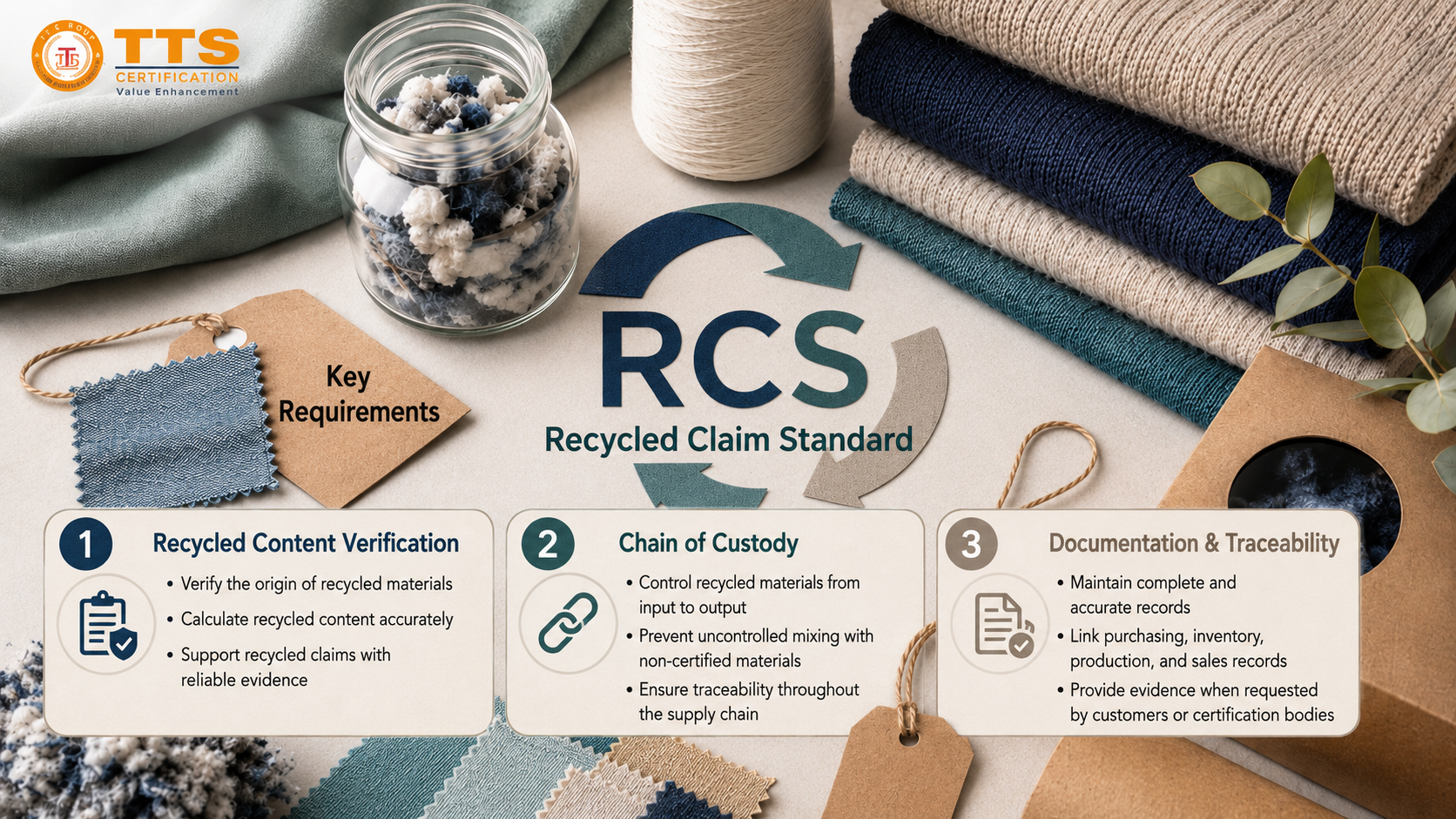
RCS mainly focuses on verifying recycled materials and ensuring traceability throughout the supply chain.
1. Verification of Recycled Content
Businesses need to demonstrate that the input materials are eligible recycled materials and that the recycled content percentage in the product is clearly determined.
For example, if a product is claimed to contain 60% recycled material, the company must maintain records to support this percentage through purchasing documents, production records, product formulas, and relevant data.
This requirement helps customers understand exactly how much recycled material is contained in a product, rather than relying on general claims such as “eco-friendly,” “green product,” or “made with recycled materials.”
2. Chain of Custody
RCS requires businesses to establish a Chain of Custody system to control the flow of recycled materials throughout the process.
Chain of Custody helps track materials from suppliers, receiving, storage, production, packaging, sales, and delivery to customers.
The objective is to ensure that recycled materials are not mixed, replaced, or confused with conventional materials without proper control during production.
A strong Chain of Custody system helps businesses answer important questions such as:
Which supplier provided the recycled material?
Which production batch used that material?
Which finished products were produced from that material?
Which customer received the final product?
3. Documentation and Traceability
Businesses need to maintain sufficient records to demonstrate the origin and movement of recycled materials.
Typical records include:
Purchasing records.
Supplier certificates or supporting documents.
Material receiving records.
Warehouse records.
Production records.
Delivery notes.
Invoices.
Traceability records.
Recycled content calculation records.
Proper documentation helps businesses respond more easily when customers or certification bodies request evidence.
How Is RCS Different from GRS?
RCS and GRS are both standards related to recycled materials, but their scopes are different.
RCS focuses on verifying recycled content and ensuring traceability.
GRS has a broader scope. In addition to recycled material verification and Chain of Custody, GRS includes requirements related to environmental management, chemical management, social responsibility, and management systems.
In simple terms:
RCS is suitable when a company needs to demonstrate the percentage of recycled material in a product.
GRS is suitable when a company needs to meet broader sustainability requirements from customers or international brands.
Quick Comparison Between RCS and GRS
Criteria | RCS | GRS |
| Full name | Recycled Claim Standard | Global Recycled Standard |
| Main objective | Verifies recycled content | Verifies recycled materials and assesses additional sustainability requirements |
| Recycled Content | Yes | Yes |
| Chain of Custody | Yes | Yes |
| Traceability | Yes | Yes |
| Environmental management | No | Yes |
| Chemical management | No | Yes |
| Social responsibility | No | Yes |
| Level of requirements | More basic | More comprehensive |
When Should a Business Choose RCS?
A business should consider RCS when its main objective is to demonstrate the recycled content percentage in its products.
RCS is suitable in the following cases:
The customer only requires verification of Recycled Content.
The business does not yet need to meet environmental, chemical, and social responsibility requirements like GRS.
The business is starting to build a traceability system for recycled materials.
The business is a trader that needs to demonstrate the origin of recycled materials.
The product needs a recycled content claim for sales or export purposes.
RCS can be a suitable starting point for many companies on their journey to building a recycled material management system.
Benefits of RCS Certification
RCS certification brings several benefits to businesses, especially as customers increasingly focus on product transparency.
Key benefits include:
Helping demonstrate recycled content in products.
Increasing credibility with customers and international brands.
Supporting traceability requirements.
Reducing risks when making recycled product claims.
Creating a foundation for implementing higher-level standards such as GRS.
Improving internal material and documentation management.
For exporters, RCS also helps improve the ability to meet international supply chain requirements, especially in textiles, plastics, packaging, and consumer goods.
What Should Businesses Prepare for RCS Certification?
To prepare for an RCS assessment, businesses need to establish a management system capable of controlling recycled materials from input to output.
Typical preparation items include:
List of recycled material suppliers.
Documents proving the origin of recycled materials.
Procedures for receiving and identifying RCS materials.
Warehouse and inventory records.
Production records by batch.
Product formulas or material consumption standards.
Sales and delivery records.
Traceability records.
Material Balance data, if applicable.
Preparing clear documentation from the beginning helps reduce errors during the assessment and improves the likelihood of achieving certification.
Common Mistakes When Implementing RCS
During RCS preparation, many businesses face difficulties not because they do not use recycled materials, but because they do not have a proper documentation system to prove their claims.
Common mistakes include:
Not checking supplier documents properly.
Not identifying recycled materials separately in the warehouse.
Production records cannot be linked to input materials.
The recycled content percentage in finished products is not clearly calculated.
There is no traceability system from raw materials to finished products.
Records from purchasing, warehouse, production, and sales are inconsistent.
These issues may cause difficulties when customers or certification bodies request evidence to support recycled claims.
Expert Insight from TTS Cert
Based on our experience supporting businesses in implementing recycled material standards, TTS Cert has found that many companies already use recycled materials in production but do not yet have sufficient documentation to prove the recycled content percentage in their products.
This is why RCS plays an important role. The standard helps businesses build a basic but effective management system focused on material control, traceability, and verification of recycled claims.
For companies that are new to international recycled material standards, RCS is often a suitable starting point before expanding to GRS or other sustainability standards.
How TTS Cert Supports Businesses in RCS Implementation
TTS Cert supports businesses throughout the preparation and implementation process for RCS certification, including:
Assessing the current recycled material management system.
Identifying gaps between the company’s current practices and RCS requirements.
Guiding the development of recycled material control procedures.
Training personnel in purchasing, warehouse, production, and documentation control.
Supporting the preparation of traceability records.
Guiding recycled content calculation and control.
Assisting businesses during the process of working with certification bodies.
The goal of TTS Cert is to help businesses prepare correctly from the beginning, reduce assessment risks, and build a management system that can be applied effectively in daily operations.
Conclusion
RCS is an important standard that helps businesses demonstrate recycled content in products in a transparent and verifiable way.
Although RCS does not have as broad a scope as GRS, it still plays a foundational role in building traceability systems and managing recycled product claims within the supply chain.
For businesses receiving customer requirements related to recycled products, applying RCS not only helps meet commercial expectations but also improves credibility, reduces risks, and creates a foundation for future sustainability programs.
If your company is exploring RCS certification or needs to prepare documentation to meet customer requirements, TTS Cert is ready to support you with practical solutions tailored to your actual operations.
Frequently Asked Questions About RCS
What is RCS?
RCS stands for Recycled Claim Standard. It is a standard used to verify recycled content and ensure the traceability of recycled materials throughout the supply chain.
What is RCS certification?
RCS certification confirms that a company has an appropriate system to control recycled materials and support claims related to recycled products.
Is RCS the same as GRS?
Not exactly. RCS focuses on recycled materials and traceability, while GRS also includes environmental, chemical, and social responsibility requirements.
Which businesses should apply RCS?
RCS is suitable for manufacturers, processors, and traders of products containing recycled materials, especially when customers require verification of Recycled Content.
Does RCS include environmental management requirements?
RCS does not have the same broad scope as GRS. If customers require additional requirements related to environment, chemicals, and social responsibility, businesses should consider GRS certification.
Does RCS require Chain of Custody?
Yes. RCS requires businesses to control the flow of recycled materials in the supply chain to ensure traceability from input to output.
Is RCS suitable for trading companies?
Yes. Trading companies involved in buying and selling recycled materials or products containing recycled materials can apply RCS if they need to demonstrate origin and recycled claims within the supply chain.
Related Articles
👉 What Is GRS? A Comprehensive Guide to the Global Recycled Standard
https://tts-cert.vn/tieu-chuan-tai-che-toan-cau-grs
👉 What Is the Difference Between GRS and RCS?
👉 What Is Recycled Content?
https://tts-cert.vn/recycled-content-la-gi-vi-sao-doanh-nghiep-can-hieu-dung-truoc-khi-cong-bo-san-pham-tai-che
👉 What Are Recycled Materials?
https://tts-cert.vn/nguyen-lieu-tai-che-la-gi-vai-tro-trong-nen-kinh-te-tuan-hoan-va-chuoi-cung-ung-ben-vung
THÔNG TIN LIÊN HỆ
- Trụ sở chính: Tầng 9, Tòa nhà Hồ Gươm Plaza, 102 Trần Phú, Hà Đông, Hà Nội
- Chi nhánh: Goldora Building, Đường Lê Văn Lương, Nhà Bè, TP.HCM
- Hotline: 094 323 5816
- Email: info@tts-cert.vn
- Fanpage: https://www.facebook.com/TTSCertVN
Recommend Posts


