
Table of contents
On 1 January 2026, Social Accountability International (SAI) published SA8000:2026, replacing SA8000:2014. Organisations certified to SA8000 must complete the new course and self-assessment by 31 December 2026, and from 1 January 2027 all new certifications and recertifications must be to SA8000:2026.
1. At a Glance
| Topic | SA8000:2014 | SA8000:2026 |
|---|---|---|
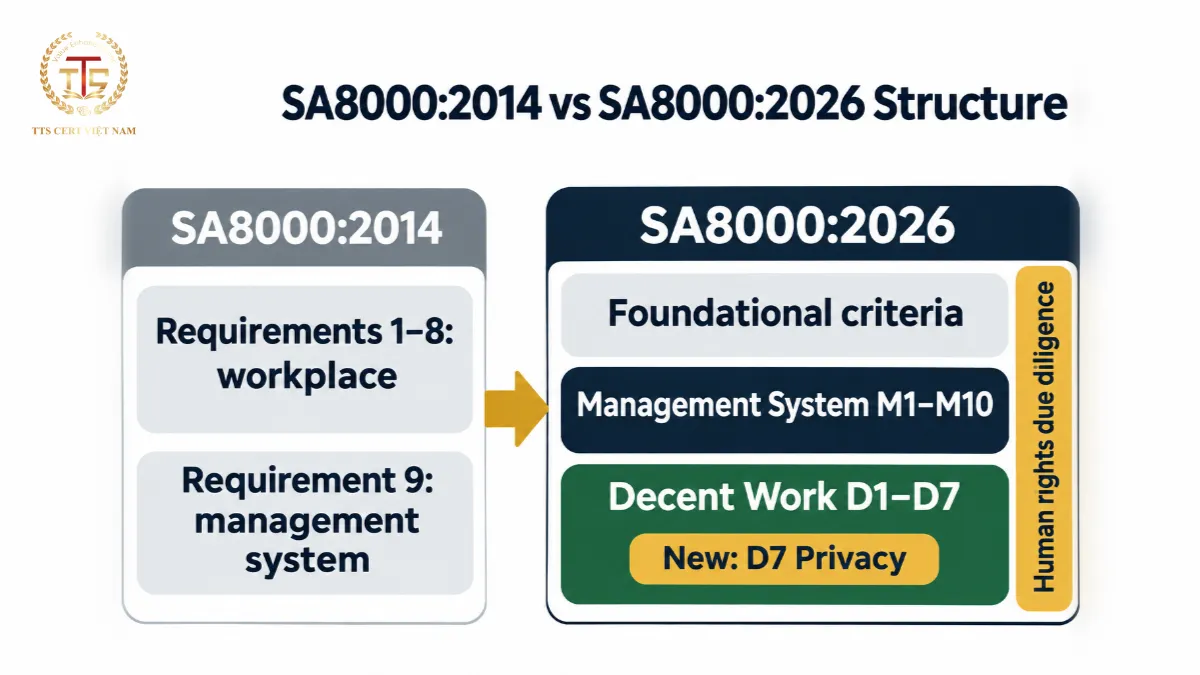
| Structure | 9 workplace requirements + management system (clauses 9.1–9.10) | Foundational criteria + 10 Management System criteria (M1–M10) + 7 Decent Work criteria (D1–D7) |
| Management system position | Last | First, aligned with Annex SL and the OECD Due Diligence Guidance |
| How requirements are written | Mainly prohibitions | Outcome-based |
| Privacy | No dedicated criterion | New criterion D7 |
| Human rights due diligence | Not explicitly embedded | Embedded throughout the management system |
2. Key Changes
2.1. New structure
Foundational criteria (new): baseline expectations such as legal compliance, included in audits.
Principles (new): guide interpretation; they are not auditable requirements.
Management System M1–M10: replace clauses 9.1–9.10, expanded and ordered from commitment and risk identification to monitoring and improvement.
Decent Work D1–D7: some 2014 clauses are merged, e.g. forced labour and disciplinary practices into D3; working hours and remuneration into D4.
2.2. New privacy criterion (D7)
SA8000:2026 adds requirements on privacy, reflecting risks from technology-driven collection and use of workers' data (biometric timekeeping, cameras, HR software…). SAI notes that organisations will likely need to dedicate resources to this.
2.3. Human rights due diligence
The management system must cover all workers whose rights the organisation may affect through its operations or business relationships. Risks are addressed by priority, the most severe and likeliest first, following the UN Guiding Principles on Business and Human Rights.
2.4. Outcome-based requirements
Criteria describe results rather than prescribing methods. SA8000:2026 does not prohibit specific employment models but sets outcome requirements for different forms of employment.
2.5. What stays the same?
According to SAI, the protected rights and core expectations have not changed significantly. Organisations meeting SA8000:2014 are likely already meeting most of the new criteria, but should still review each one carefully.
3. Transition Timeline
| Date | Milestone |
|---|---|
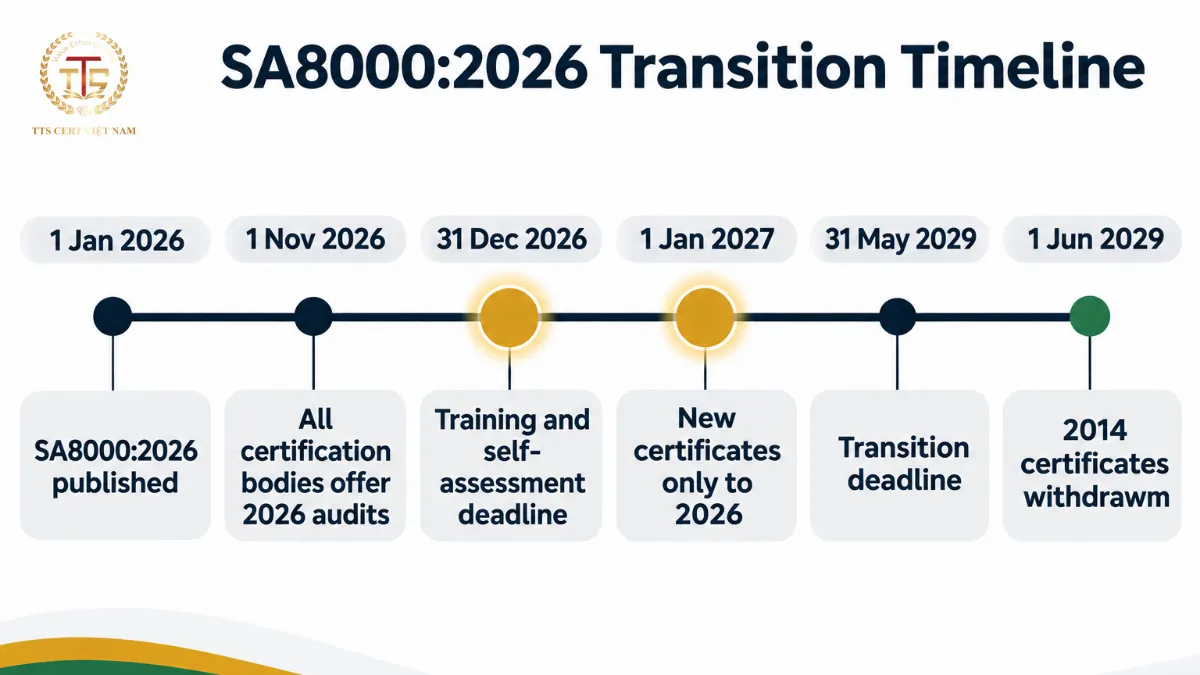
| 1 Jan 2026 | SA8000:2026 published |
| 1 Jun – 31 Oct 2026 | Certification bodies gradually start 2026 audits |
| 1 Nov 2026 | All accredited certification bodies offer 2026 audits |
| 31 Dec 2026 | Deadline for the SA8000:2026 course and self-assessment; last day for on-site SA8000:2014 audits |
| 1 Jan 2027 | New certifications and recertifications only to SA8000:2026 |
| 31 May 2029 | All organisations must hold SA8000:2026 certification |
| 1 Jun 2029 | Remaining SA8000:2014 certificates withdrawn |
Note: organisations can only transition at a recertification audit, not at a surveillance audit. If a certificate expires after 31 May 2029, early recertification may be needed.
4. What Should Organisations Do?
4.1. Organisations certified to SA8000:2014
Complete "Getting Started with SA8000:2026 and Due Diligence" and the SA8000:2026 self-assessment by 31 December 2026. According to SAI, organisations that miss this cannot have audits assigned in the SAI database.
Run a gap analysis against SA8000:2026.
Update policies and procedures, especially on privacy, risk assessment and worker involvement.
Plan the 2026-version recertification with your certification body.
4.2. Organisations seeking first certification
From 1 January 2027 only SA8000:2026 certification is available. Audits in 2026 may still use the 2014 version if the certification body is not ready, but must then transition before 1 June 2029 — so consider building the system to the 2026 version from the start.
See the certification process, documents and timeline: SA8000 certification
5. Frequently Asked Questions
Is my SA8000:2014 certificate still valid? Yes, until you transition at recertification, but no later than 31 May 2029.
Can we transition at a surveillance audit? No. Surveillance audits can review readiness, but transition only happens at recertification.
What if we miss the 31 December 2026 deadline? According to SAI, organisations that have not completed the course and self-assessment cannot have audits assigned in the SAI system until they do.
6. Conclusion
SA8000:2026 keeps the core rights but requires a stronger management system, human rights due diligence and new privacy requirements. Certified organisations should complete the course and self-assessment and review gaps during 2026.
TTS Cert provides SA8000:2014 to SA8000:2026 transition consulting, from gap analysis to updating your documentation.
References
SAI – Now Available: SA8000:2026
SAI – What has changed in the SA8000:2026 Standard
SAI – SA8000:2026 transition is underway: key dates and new resources
SAI – SA8000 Certification Program Timeline

Lawyer Tran Thi Trang has more than 10 years of experience in corporate legal affairs and compliance, along with many years advising and training on social responsibility, environmental and sustainable development standards.
SEE MORE