
Table of contents
After a SMETA audit, businesses mostly want to know what the report says, what must be fixed and how long they have. The answer sits in the CAPR (Corrective Action Plan Report). A CAPR is not a verdict and SMETA has no pass or fail result, but how a site handles it affects how buyers view the supplier.
This guide goes into the detail: who prepares the CAPR, the types of findings, when CAR applies, timescales, closure evidence, follow-up audits and how reports are published. For what SMETA is, see What Is SMETA? A Complete Guide to Sedex SMETA.
1. What Does a Business Receive After a SMETA Audit?
There are two main outputs:
Audit Report: records information about the site and what the auditor observed, cross-checked and assessed.
CAPR: lists the findings and the corresponding corrective actions.
According to Sedex, these two documents are the most important outputs of the audit and are visible to the site's customers. Findings specific to one buyer are recorded in a separate auxiliary document and shared directly with that buyer.
2. Who Prepares the CAPR?
Under Sedex guidance, the site's management drafts the corrective action plan, then agrees it with the auditor at the closing meeting. The auditor and a site representative sign the CAPR, and the site keeps a copy in a language its management understands. If the report or CAPR is written in a language other than English, Sedex requires a dual-language version that includes English.
So the business does not simply receive a list of faults. It identifies causes and actions. The best practice is to have HR, safety and senior management present at the closing meeting.
3. Types of Findings in a CAPR
Non-compliance (NC)
An NC shows that an applicable requirement was not met. Under Sedex guidance, NC covers two situations:
Non-compliance: a breach of the law.
Non-conformance: compliant with the law but not meeting the ETI Base Code.
Severity
NCs are categorised as Business Critical, Critical, Major or Minor. Sedex sets the level; auditors do not see it, and it only becomes visible once the CAPR is uploaded to the platform.
Scope: isolated or systemic
Each NC is recorded as isolated or systemic. This determines the corrective action: fix one case or fix the process.
Good Example
Besides NCs, a report may record a Good Example, a good practice at the site. SMETA does not score sites, so this is additional information that helps buyers see the site more fully.
4. CAR – Collaborative Action Required
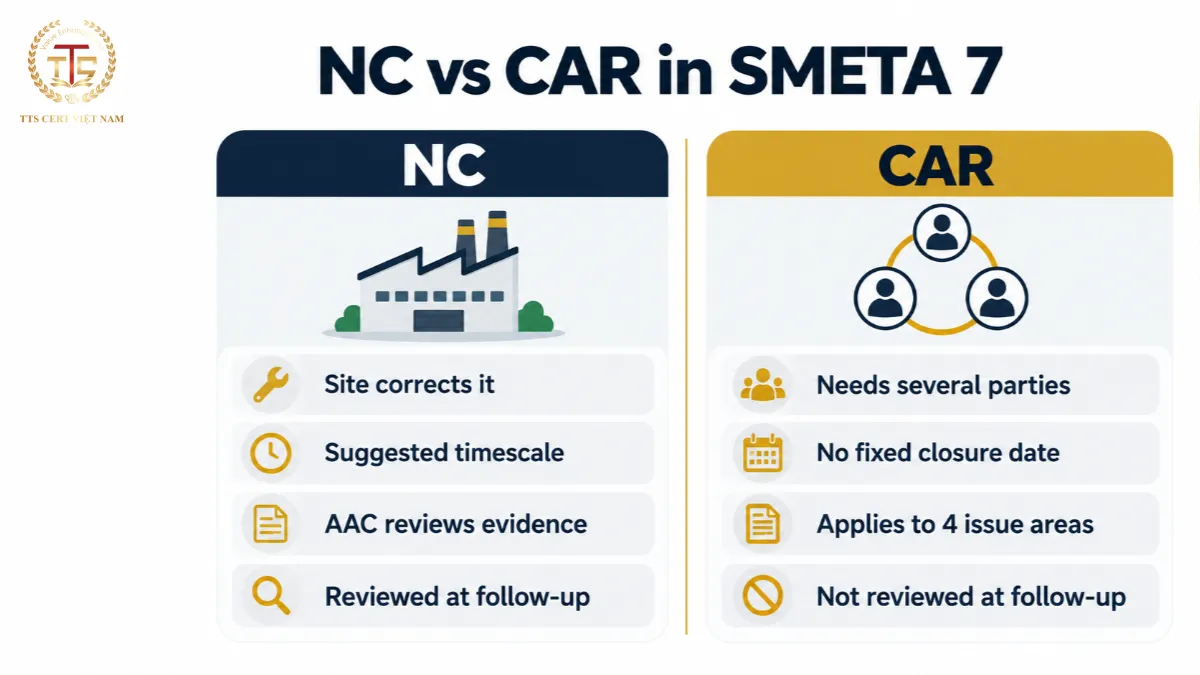
SMETA 7 (published 10 September 2024) introduced a new type of finding: Collaborative Action Required (CAR). According to DQS, CAR is used when a site fails a requirement but the supplier cannot resolve it alone, and it applies to four complex areas only: living wages, responsible recruitment, child labour and discrimination.
How it differs from an NC:
| NC | CAR | |
|---|---|---|
| Who resolves it | The site corrects it | Requires cooperation between supplier, buyer and possibly others (labour providers, NGOs, trade unions) |
| Closure date | Suggested timescale | No fixed closure date |
| Verification | AAC reviews evidence | No fixed verification method |
| When an action plan is uploaded | Tracked for closure | Status changes from "open" to "in progress" |
| Follow-up audit | Reviewed | Not reviewed in follow-up audits |
Note that CAR does not mean the supplier is "excused". The site should still engage with the buyer and record the steps taken.
5. Corrective Action Timescales
Sedex provides suggested timescales by issue type. Under current guidance:
In most cases the timescale is a minimum of 30 days, and longer where records are needed to show sustained improvement.
For Business Critical issues, the requirement is to act immediately.
Timescales reflect the time needed to prove effectiveness, not the time needed to start fixing.
Confirm the exact timescale with the AAC and the buyer, since buyers may set their own requirements.
6. Building Effective Corrective Actions
A corrective action is effective only if it addresses the root cause. A commonly used sequence:
correction → root cause analysis → corrective action → prevention → evidence → verification.
Illustrative examples (hypothetical, not real cases):
| Hypothetical finding | Surface fix only | Root cause fix |
|---|---|---|
| One team's time records do not match payroll | Correct that month's payroll | Find the cause (for example, different ways of recording overtime between teams), agree one procedure, train team leaders, add a monthly cross-check |
| Fire extinguisher past inspection date | Replace the unit | Set an inspection schedule, assign responsibility, add it to routine safety checks |
| No grievance mechanism | Post a notice | Build a grievance procedure, communicate it to workers, log and respond to grievances |
7. Evidence and Closing NCs
Under Sedex guidance, an NC closes only when the action addresses the root cause. There are two ways to verify:
Desktop review: the business sends evidence such as photos, certificates and invoices. The AAC reviews within a maximum of 5 working days of receipt.
On-site follow-up: needed where a site tour, interviews or sampling are required.
Evidence should show before and after, be dated and be linked to the specific NC.
8. Follow-up Audits
Under Sedex guidance, a follow-up audit generally takes place within six months of the initial audit. Points to note:
Book with the same AAC that carried out the original audit, since a different AAC cannot close those NCs.
Each NC is marked closed or open; the signed, updated CAPR is left on site.
CARs are not reviewed in follow-up audits.
Some buyers set their own follow-up timing and format. Confirm with your buyer.
9. How Is the Report Published on Sedex?
Under Sedex guidance:
The AAC uploads the report to Sedex within 15 days of the audit.
The site should publish the report within 7 days of upload.
If the site does not publish, Sedex publishes automatically 14 days after upload.
During this time, if the site disagrees with a finding, it can note this in the dispute box in the CAPR or follow Sedex's process after publication.
10. Common Mistakes
Treating the CAPR as a list of faults to "delete" and only fixing paperwork.
Skipping root cause analysis, so the NC returns at the next audit.
Sending evidence without dates or not linked to a specific NC.
Waiting until the deadline to start collecting evidence.
Changing AAC for the follow-up and finding the new AAC cannot close the NC.
Not discussing CARs or collaborative issues with the buyer.
Not tracking status on the Sedex platform.
Need help with root cause analysis and corrective actions after an audit? TTS Cert supports businesses reviewing CAPRs, analysing root causes, building plans and preparing evidence. Consulting is independent of the AAC that carries out the audit and closes NCs. See SMETA audit support.
11. Frequently Asked Questions
Does a CAPR mean the business "failed" SMETA? No. SMETA has no pass or fail result. The CAPR records findings and a corrective action plan; buyers assess under their own policies.
Can the business close an NC itself? No. An NC closes when the AAC reviews evidence and confirms the action addressed the root cause.
Can a finding be disputed? A site can note disagreement in the dispute box in the CAPR or follow Sedex's process after the report is published.
Who can see the CAPR? The report and CAPR are published on Sedex and the site's customers can view them.
Does Sedex close NCs in place of the AAC? No. Sedex does not audit directly and does not close NCs; confirmation is done by the AAC.
What if we need a derogation? This is handled through the buyer's own process. Sedex does not run it.
12. Conclusion
The CAPR is not the end of SMETA but the start of an improvement cycle. Businesses handle it well by identifying root causes, collecting evidence on time and keeping the AAC and buyer informed. To prepare better for the next audit, see the SMETA Audit Checklist.
See also: SMETA vs BSCI: Key Differences
References
Sedex – SMETA (sedex.com)
Sedex – Supplier Member Manual (August 2024)
DQS – SMETA 7: everything you need to know about the revision (18 September 2024)

Lawyer Tran Thi Trang has more than 10 years of experience in corporate legal affairs and compliance, along with many years advising and training on social responsibility, environmental and sustainable development standards.
SEE MORE