


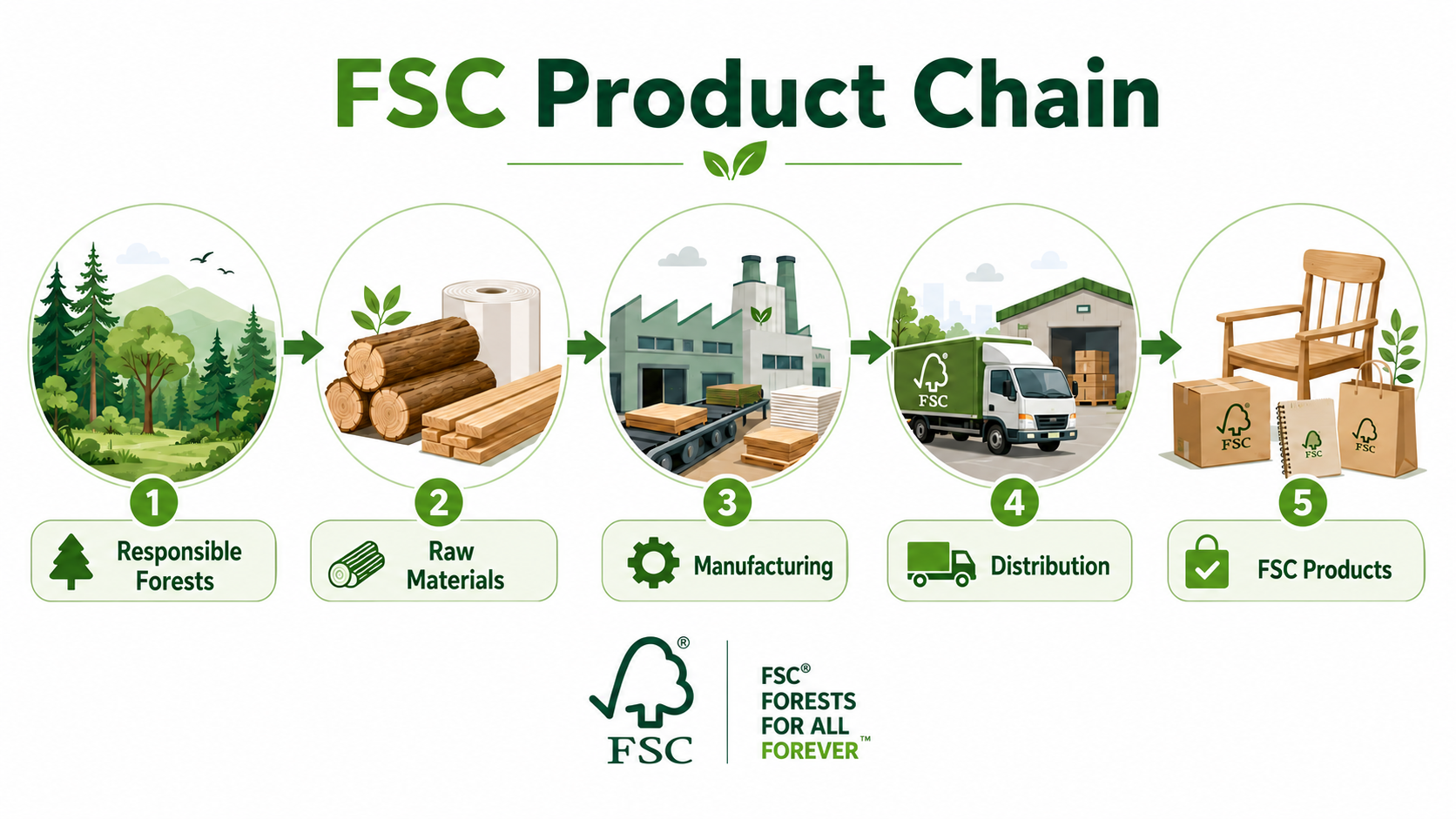
FSC Product Chain of Custody: From Responsibly Managed Forests to Wood, Paper, and Packaging Products
When customers require FSC-certified wood, FSC-certified paper, FSC-certified packaging, or an FSC claim on invoices, businesses usually need to establish a material control system and obtain FSC Chain of Custody certification.
So, what is FSC, what is FSC certification, and what must a business prepare to obtain an FSC certificate?
FSC CoC does not only require a business to purchase certified materials. The business must also control suppliers, identify materials, manage quantities, monitor production, issue the correct FSC claims, and retain sufficient evidence of traceability.
TTS Cert supports businesses in defining the certification scope, developing FSC CoC procedures, training personnel, completing documentation, and preparing for an audit by an independent certification body.
Has your customer requested FSC certification?
Provide information about your products, materials, and business activities so that TTS can help determine the appropriate FSC CoC certification scope.
1. What Is FSC?
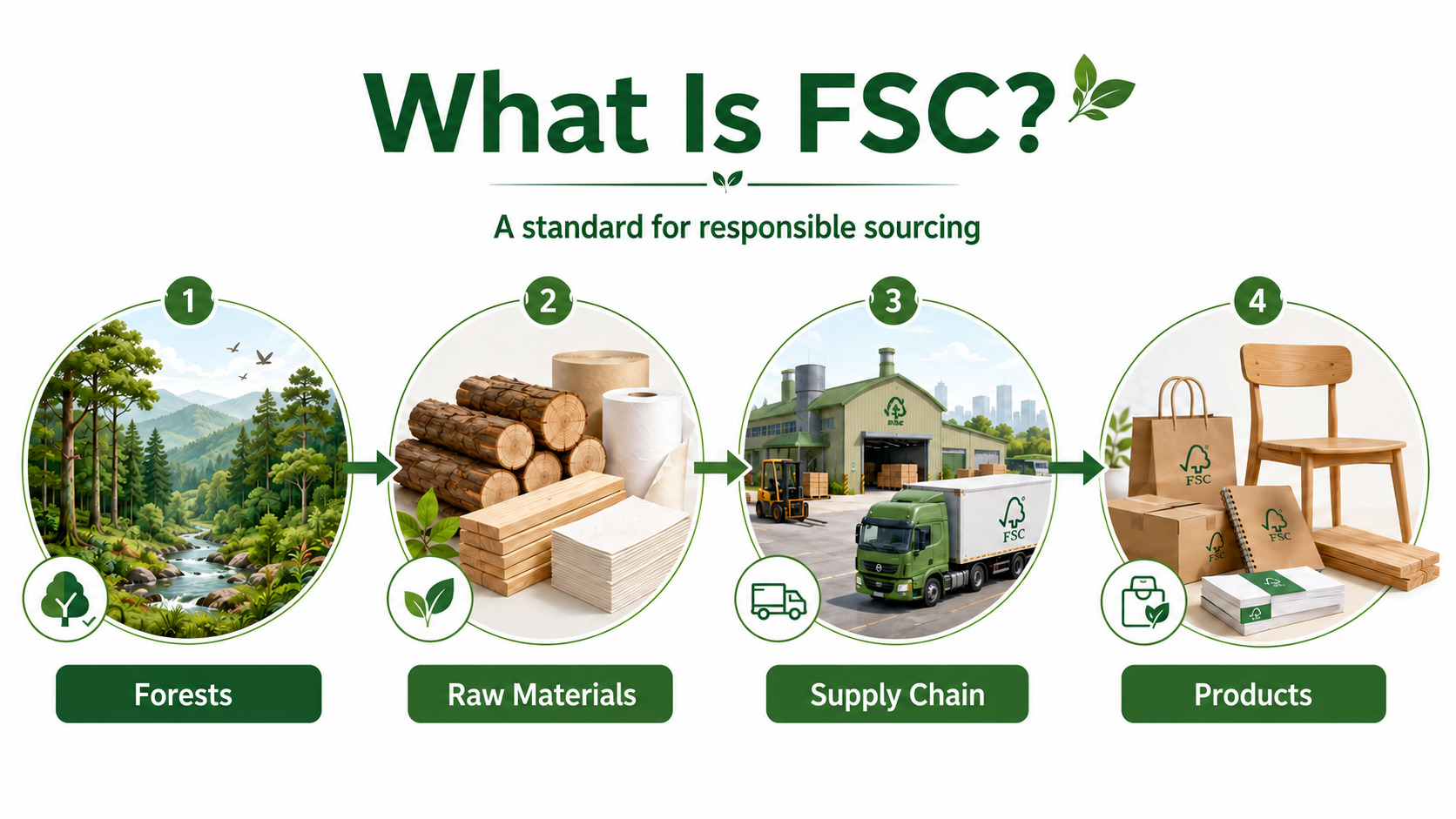
FSC stands for the Forest Stewardship Council, an international certification system related to responsible forest management and the traceability of forest-based products.
The FSC system connects materials from responsibly managed forests or recycled sources with products manufactured and placed on the market.
Common products that may be associated with FSC include:
Wood and furniture products.
Paper, paperboard, and paper packaging.
Books, documents, and printed products.
Panels, pellets, charcoal, and processed wood products.
Natural rubber and certain non-timber forest products.
Packaging or components derived from forest-based materials.
FSC offers several types of certification. For manufacturers, traders, or distributors of forest-based products, the most common type is FSC Chain of Custody, or FSC CoC.
Illustration: FSC connects forests, wood materials, paper, packaging, and final products throughout the supply chain.
2. What Is FSC Certification?
FSC certification is a general term for certifications under the Forest Stewardship Council system. In practice, businesses should distinguish between the following two main types:
| Certification Type | Applicable Organizations |
|---|---|
| FSC Forest Management – FSC FM | Forest owners and organizations responsible for forest management or harvesting |
| FSC Chain of Custody – FSC CoC | Businesses that manufacture, process, trade, or distribute forest-based products |
Manufacturers of furniture, paper, packaging, printed products, or raw materials generally require FSC CoC certification rather than forest management certification.
FSC CoC verifies that forest-based materials are controlled during purchasing, production, identification, storage, labelling, and sales. An FSC label on a finished product indicates that the relevant Chain of Custody requirements have been met at the applicable stages of the supply chain.
What Is an FSC Certificate?
An FSC certificate is a document issued by an accredited independent certification body after the organization has been audited and found to comply with the applicable requirements.
FSC International and FSC national offices do not directly audit businesses or issue FSC certificates. Only appropriately accredited independent certification bodies may conduct audits and make certification decisions.
TTS Cert therefore performs the following roles:
- Advising on the FSC CoC certification scope.
- Conducting a gap assessment.
- Developing the management system and documentation.
- Training personnel.
- Conducting a mock audit.
- Supporting corrective actions for identified gaps.
TTS does not replace the certification body and does not directly issue FSC certificates.
3. What Is FSC CoC?
FSC CoC, or FSC Chain of Custody, is the system used to control and trace FSC materials and claims from purchasing and receipt through storage, production, outsourcing, and sale to customers.
The current core standard is FSC-STD-40-004 V3-1, Chain of Custody Certification, effective from 1 September 2021. The standard applies to sourcing, processing, labelling, and selling forest-based products as FSC products.
FSC Standard Update in 2026
As of July 2026, FSC is revising its Chain of Custody standard and conducted a consultation on draft FSC-STD-40-004 V4-0 D2-0 from 15 May to 15 June 2026. The draft is still under review and has not replaced Version 3-1, which remains in force.
Businesses should therefore continue developing their systems in accordance with FSC-STD-40-004 V3-1 while monitoring the latest applicable directives, interpretations, and supporting documents.
4. Which Businesses Need FSC CoC Certification?
FSC CoC certification is suitable for organizations that manufacture or distribute forest-based products and wish to:
Sell products with an FSC claim on invoices or delivery documents.
Apply an FSC label to products or packaging.
Manufacture semi-finished products from FSC materials.
Repackage or relabel FSC products.
Outsource the processing of FSC products.
Participate in supply chains where FSC certification is required.
FSC defines CoC certification as applicable to businesses that manufacture or distribute forest-based products, including organizations that sell products with FSC claims, manufacture semi-finished products, repackage products, or apply labels.
Industries That Commonly Apply for FSC Certification
Furniture and wood product manufacturing.
Wood processing, panel manufacturing, and related industries.
Paper, paperboard, and packaging production.
Printing and publishing.
Wood pellet and biomass fuel production.
Charcoal and forest-product manufacturing.
Trading of wood, paper, or FSC products.
Warehousing and distribution.
Manufacturing of products containing natural rubber.
Outsourced processing, packaging, or labelling of FSC products.
Does a Trading Company Need FSC Certification?
A trading company will generally need FSC CoC certification when it:
Holds legal ownership of the goods.
Purchases and sells products with FSC claims.
Includes the FSC certificate code and FSC claim on invoices or sales documents.
Changes the packaging, label, or form of the product.
Manages FSC products in its own warehouse or through an outsourced service provider.
A business that only promotes finished products and does not pass an FSC claim through sales documents may be more suited to an FSC promotional licence than CoC certification. FSC also notes that some retailers without production activities may not require CoC certification, depending on their actual activities.
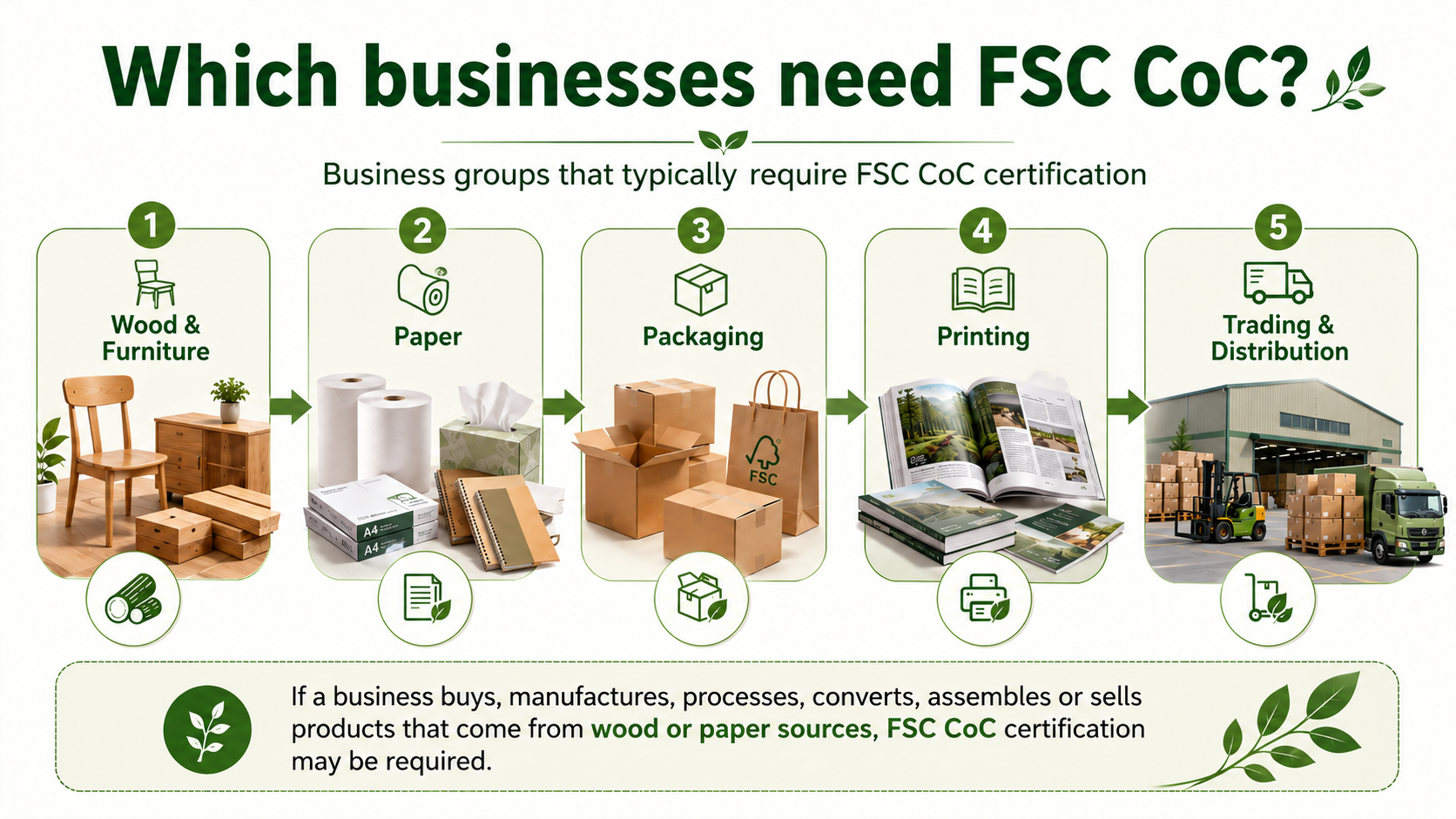
Businesses that commonly require FSC CoC certification include wood, paper, packaging, printing, trading, and distribution companies.
5. Benefits of FSC Certification
FSC CoC certification helps a business establish an evidence-based system to demonstrate the origin of materials and the integrity of FSC claims throughout the supply chain.
Common benefits include:
Meeting Customer Requirements
Many customers require suppliers to hold FSC certification before purchasing wood, paper, packaging, or printed products.
Selling Products with FSC Claims
Purchasing FSC materials alone is not sufficient for a business to pass an FSC claim to customers. The business must have an appropriate certification scope and maintain an effective CoC control system.
Using FSC Trademarks Correctly
A business with the appropriate certification may apply for permission to use FSC labels on products or FSC trademarks for promotional purposes, depending on the approved scope and form of use.
Improving Traceability
The FSC CoC system creates a documented link between:
Supplier → Input material → Warehouse → Production → Finished product → Sales document
Supporting Supply Chain Management
Requirements for supplier verification, volume reconciliation, outsourcing, and sales documentation help businesses reduce the risk of issuing incorrect claims or selling more FSC product than the eligible quantity allows.
6. Main Requirements of the FSC CoC Standard
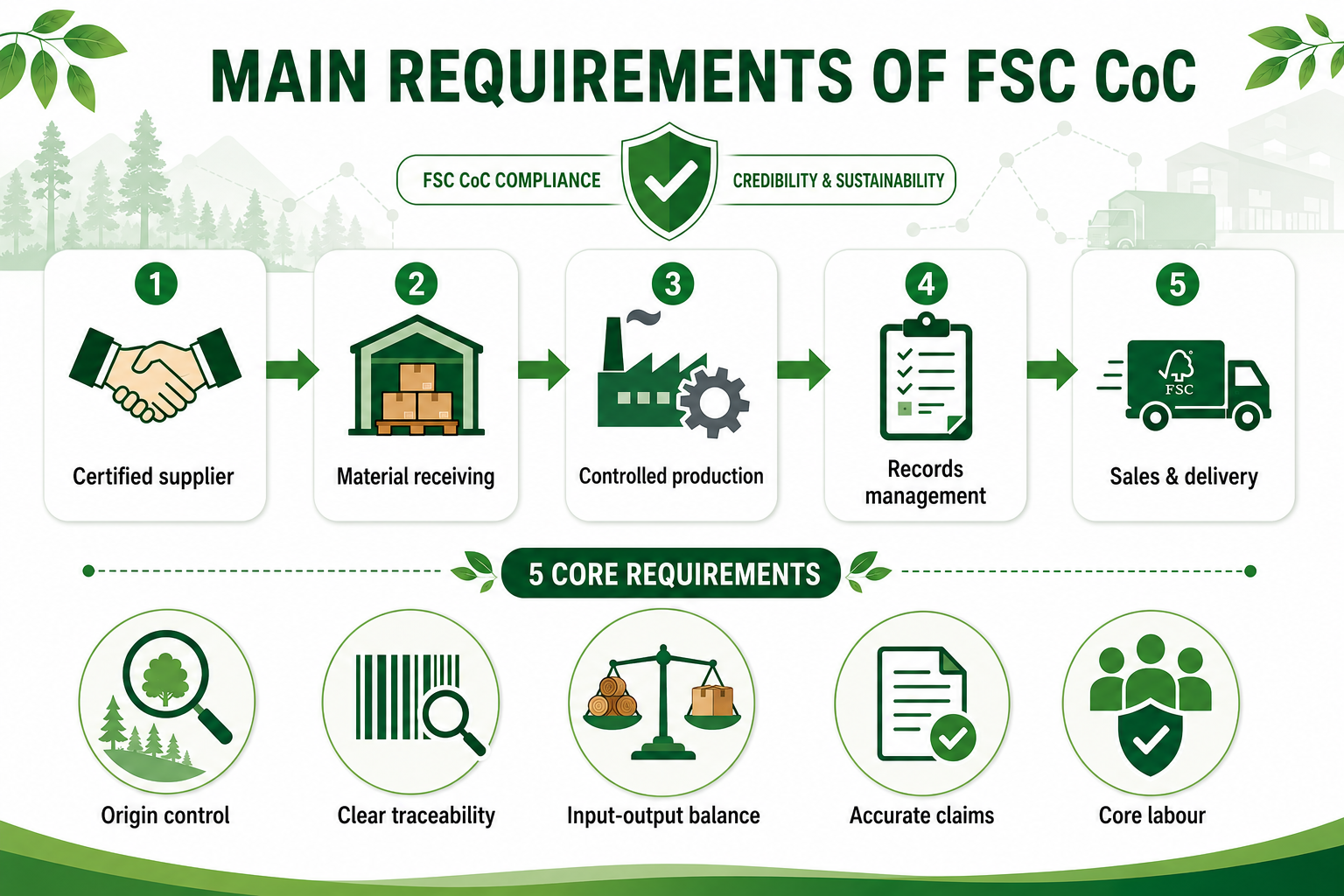
A business does not necessarily need an overly complicated system. However, the system must accurately reflect actual operations and generate sufficient traceability evidence.
6.1. FSC CoC Management System
The business needs to:
Appoint a person responsible for FSC management.
Define departmental responsibilities.
Issue applicable procedures.
Train relevant personnel.
Control documents and records.
Handle complaints and non-conforming products.
Complete the self-assessment for FSC core labour requirements.
6.2. Supplier Control
Before recognizing a material as FSC, the business must verify:
Supplier name.
FSC certificate code.
Certificate status.
Product scope.
FSC claims the supplier is authorized to provide.
Information shown on invoices and delivery documents.
The business should not rely only on a certificate image provided by the supplier. The information should be checked against FSC’s official certificate database.
6.3. Control of Input Materials
When receiving goods, the business should verify:
The FSC claim on the sales or delivery document.
The supplier’s certificate code.
Material type.
Quantity.
Identification status.
Conformity with the applicable FSC product group.
6.4. Identification and Storage
FSC materials must be identified to prevent incorrect use. Depending on actual conditions, the business may control materials using:
Separate storage areas.
Warehouse or material codes.
Identification labels.
Colour coding.
Area signs.
Management software.
Production order codes.
Physical segregation is not mandatory in every case, but the business must demonstrate that its identification system is effective.
6.5. Establishing FSC Product Groups
The product group list should include, at minimum:
Product type.
Species or material group, where applicable.
Input category.
Input claim.
Control system.
Intended output claim.
Related production or outsourcing activities.
Not every product manufactured by the business automatically becomes an FSC product after certification. Only products included within the certification scope and produced under the appropriate control system may be sold with an FSC claim.
6.6. FSC Claim Control Systems
The FSC CoC standard defines three main control systems:
| System | Principle |
|---|---|
| Transfer System | Transfers an eligible input claim to the output product |
| Percentage System | Determines the output claim based on the percentage of contributing inputs |
| Credit System | Manages FSC credit quantities within a credit account |
The appropriate system depends on the material type, product, production process, and FSC claim the business intends to sell.
6.7. Conversion Factors and Material Balance
A manufacturing business must demonstrate the relationship between:
Input material → Waste or loss → Semi-finished product → Finished output
Conversion factors may be established using:
Technical specifications.
Production records.
Trial-run results.
Actual operating data.
Characteristics of each product type.
The business must also reconcile purchasing, consumption, stock, and sales quantities to demonstrate that it has not sold more FSC product than the valid eligible quantity.
6.8. Sales Documentation
Invoices or delivery documents for FSC products must be controlled to include the applicable information, such as:
Business name and address.
Customer name.
Date of issue.
Product description.
Quantity.
FSC certificate code.
FSC claim of the product.
An incorrect certificate code, a missing claim, or an incorrect FSC claim may prevent the FSC status from being transferred to the customer.
6.9. Control of Outsourced Activities
When another organization is contracted to process, store, package, or label products, the business must define:
The outsourced activity.
Responsibilities of each party.
How materials are identified and protected.
Access rights for the certification body.
Dispatch and receipt records.
Volume controls.
Risks of mixing or material substitution.
6.10. FSC Core Labour Requirements
The business must comply with FSC core labour requirements, including:
No child labour.
No forced or compulsory labour.
No discrimination in employment and occupation.
Respect for freedom of association.
Respect for the right to collective bargaining.
The business must also maintain a policy and complete a related self-assessment.
7. What Is the Difference Between FSC 100%, FSC Mix, and FSC Recycled?
FSC uses three main product labels:
FSC Label | Meaning |
|---|---|
| FSC 100% | Forest-based material in the product comes from FSC-certified forests |
| FSC Mix | The product may contain FSC-certified material, recycled material, and/or FSC Controlled Wood |
| FSC Recycled | The product is made from 100% recycled material |
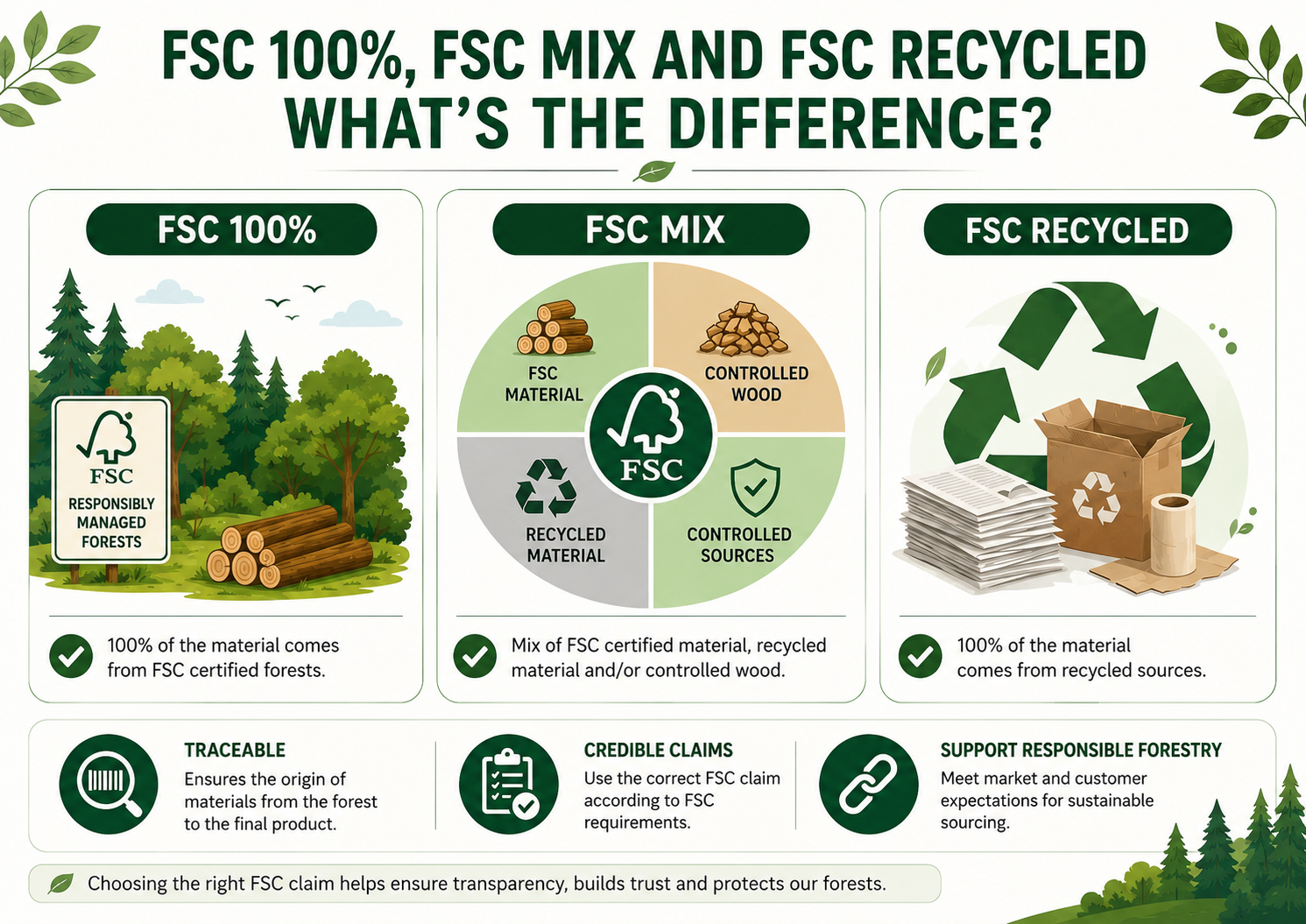
What Is FSC Controlled Wood?
FSC Controlled Wood is material controlled to reduce the risk of sourcing from unacceptable sources.
FSC Controlled Wood may be used in certain FSC Mix products when the applicable conditions are met. It is not one of the three FSC labels used for final products.
Can a Business Design Its Own FSC Logo?
No. A business must use FSC labels or trademark data provided through the official system and comply with the applicable approval requirements.
The current trademark standard for certificate holders is FSC-STD-50-001 V3-0, effective from 1 January 2026. It governs the use of FSC trademarks on products, in product promotion, and in promotion of certificate-holder status.
8. Documents Required for FSC Certification
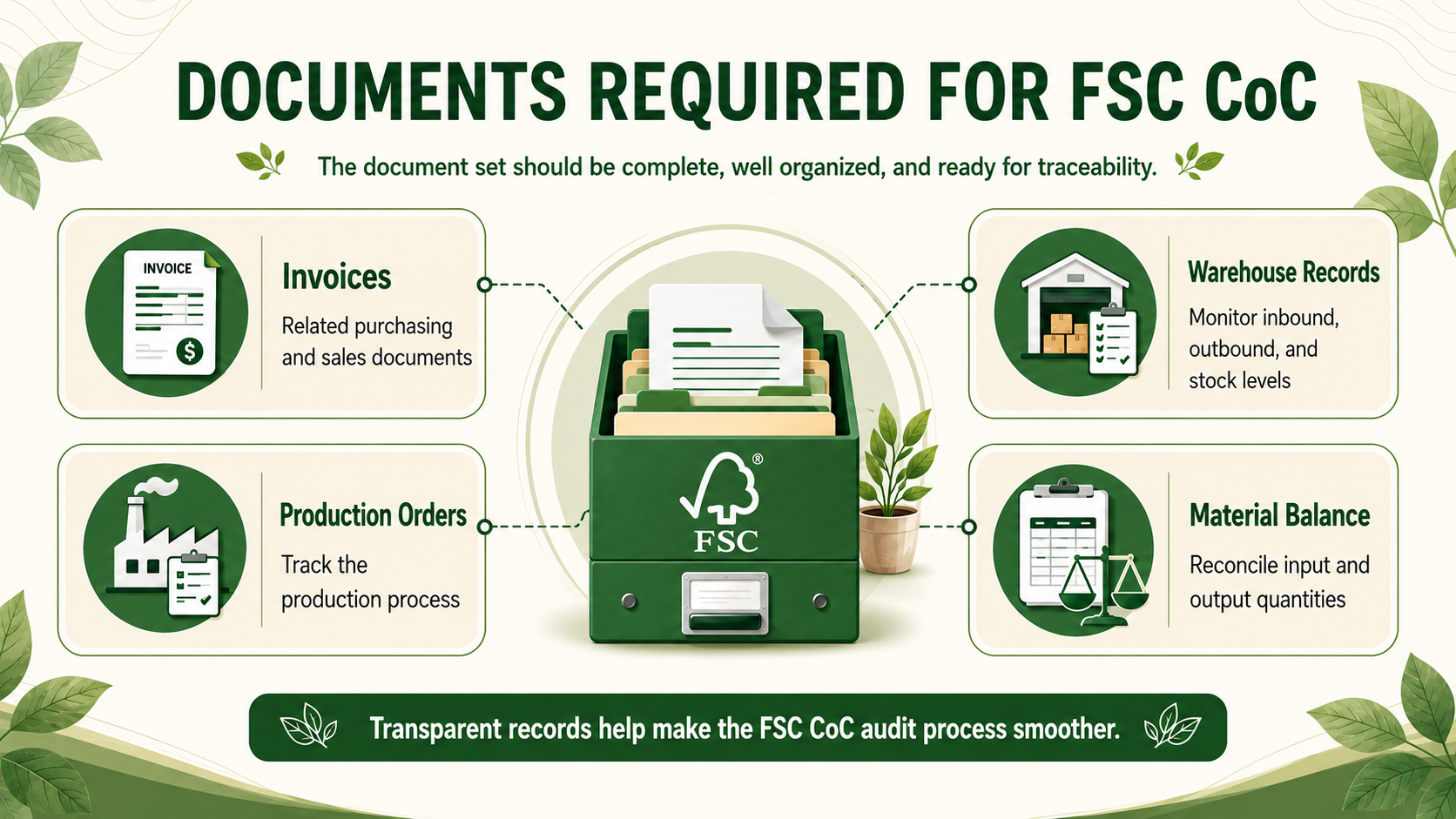
Depending on the organization’s activities, the FSC CoC audit file may include:
General Documents
Business registration certificate.
Organization chart.
Site layout.
List of sites.
Product list.
Production process.
List of outsourced activities.
FSC System Documents
FSC CoC manual or management procedures.
Appointment or responsibility assignment records.
FSC product group list.
Purchasing procedure.
Receiving and storage procedure.
Production procedure.
Sales procedure.
Trademark-use procedure.
Non-conforming product procedure.
Complaint-handling procedure.
Outsourcing control procedure.
Purchasing and Supplier Records
Approved supplier list.
Certificate verification results.
Contracts and purchase orders.
Purchase invoices.
Delivery notes.
Goods receipt notes.
Records confirming FSC claims.
Production Records
Production orders.
Material issue notes.
Material standards or bills of material.
Conversion factors.
Production reports.
Waste or loss reports.
Finished-goods receipt notes.
Product identification data.
Sales Records
Contracts.
Sales orders.
Invoices.
Delivery notes.
Goods issue notes.
Evidence of the FSC certificate code and FSC claim.
Core Labour Requirement Records
Labour policy.
Self-assessment.
Worker age records.
Employment contracts.
Payroll and working-time records.
Grievance records.
Records relating to worker dialogue and representation rights.
Not sure which documents your business needs to prepare?
TTS reviews purchasing, warehouse, production, and sales activities to identify the FSC CoC documents that need to be developed or supplemented.
9. FSC CoC Certification Process
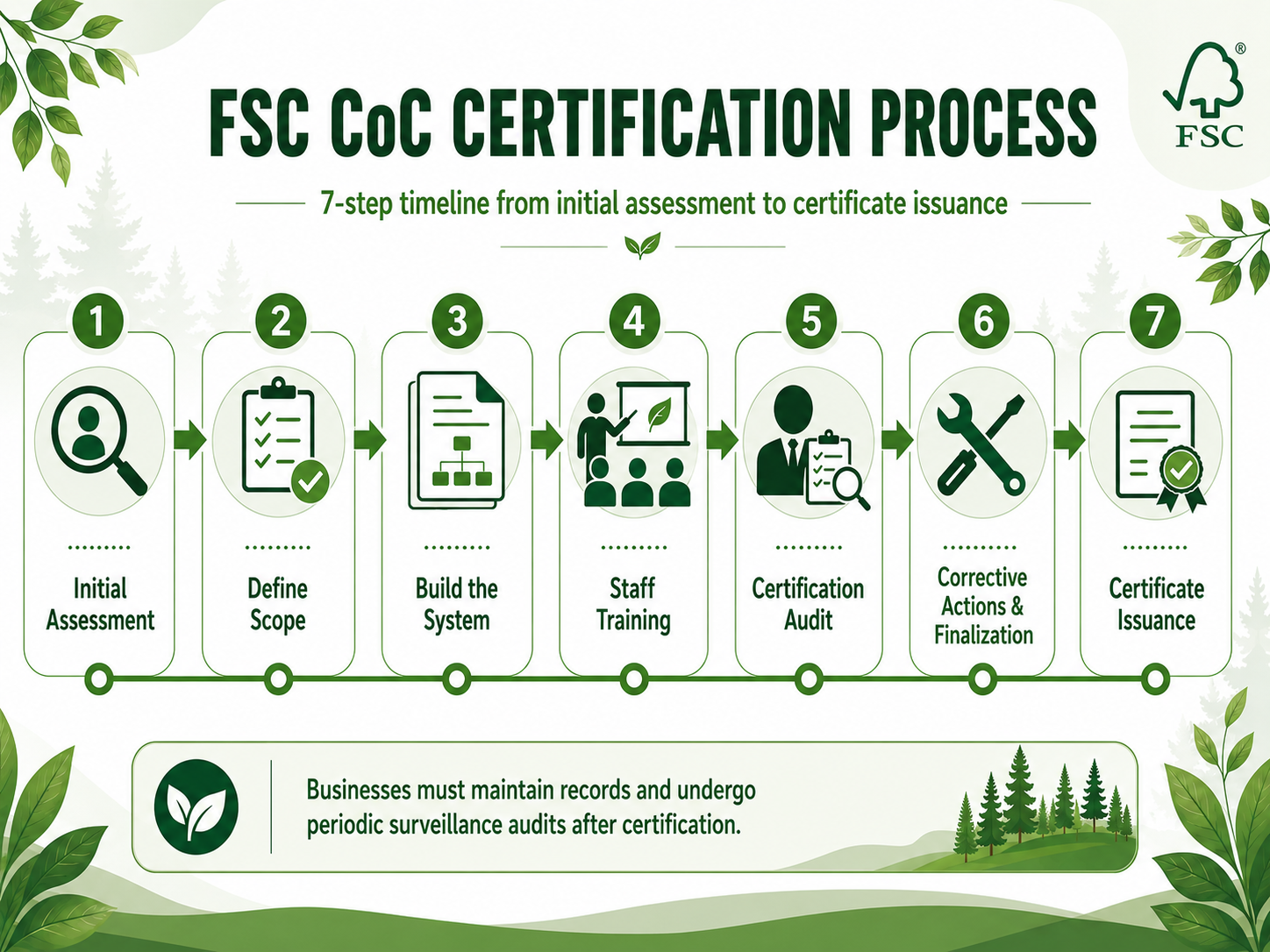
It is important to distinguish between TTS’s consulting process and the audit process performed by the certification body.
Stage 1: System Preparation with TTS Cert
Step 1. Information Collection
TTS identifies:
Product types.
Input materials.
Suppliers.
Production processes.
Applicable sites.
Outsourced activities.
Intended output claims.
Step 2. Certification Scope Definition
TTS supports the business in determining:
Certification model.
Site scope.
Product groups.
Control system.
Applicable documentation requirements.
Step 3. Gap Assessment
The existing system is compared against FSC CoC requirements to identify areas that need to be added or adjusted.
Step 4. Development of Procedures and Forms
Documents are designed around the business’s actual operations, avoiding an unnecessarily complex or difficult-to-maintain system.
Step 5. Personnel Training
Departments commonly involved include:
Purchasing.
Warehouse.
Production.
Sales.
Accounting.
Human resources.
Quality management.
Step 6. System Trial Run
The business performs one or more trial transactions to verify the linkage between purchasing, warehouse, production, and sales records.
Step 7. Readiness Assessment
TTS conducts a mock audit, identifies remaining gaps, and guides the business in completing the system before the official audit.
Stage 2: Audit by the Certification Body
The official certification process generally includes:
Selecting an accredited certification body.
Submitting an application and defining the certification scope.
Signing the audit agreement.
Completing the audit.
Completing FSC Check and related procedures.
Correcting non-conformities, if any.
Certification review and decision.
Periodic surveillance audits.
FSC confirms that only accredited independent certification bodies may audit and issue certificates. Once approved, the business may begin producing and selling FSC products within the certified scope and must subsequently undergo annual surveillance audits.
10. FSC Certification Cost
There is no single fixed FSC certification cost applicable to every business.
The cost commonly includes:
Consulting Fees
Consulting is optional. A business may implement the system independently if it has sufficiently competent personnel.
Consulting fees depend on:
Current level of readiness.
Number of sites.
Manufacturing or trading activities.
Number of product groups.
Complexity of the system.
Volume of documentation to be developed.
Scope of training and support.
Certification Audit Fees
These fees are paid to the independent certification body.
The cost depends on:
Number of audit days.
Number of sites.
Certification type.
Business size and complexity.
Outsourced activities.
Travel expenses.
The pricing policy of each certification body.
Annual Administration Fee – AAF
The Annual Administration Fee, or AAF is a fee charged by FSC to accredited certification bodies.
For FSC CoC, the AAF is calculated using the certificate holder’s actual forest-products turnover and the applicable fee scale. The business should contact the certification body for the exact amount included in its quotation.
Maintenance Costs
After certification, the business may incur:
Surveillance audit fees.
Scope update or extension fees.
Additional-site audit fees.
Costs associated with correcting non-conformities.
Internal management and training costs.
To estimate the cost accurately, the business should provide at least the following information: product types, materials, number of sites, forest-products turnover, production processes, and outsourced activities.
11. How Long Does FSC Certification Take?
FSC does not prescribe one fixed timeframe for every business. The duration depends on:
The current level of system readiness.
Availability and traceability of records.
Certification scope.
Number of sites.
Certification body audit schedule.
Number and severity of non-conformities.
A business with consistent purchasing, warehouse, production, and sales data can usually prepare more quickly than a business that has not yet established a material control method.
12. How Long Is an FSC Certificate Valid?
An FSC certification cycle does not exceed five years. During the certification cycle, the certification body continues to conduct surveillance audits, normally on an annual basis.
The business must maintain the system continuously. Holding a certificate does not mean that FSC claims may be used in subsequent years without continued document and process control.
13. Common Non-Conformities During FSC CoC Audits
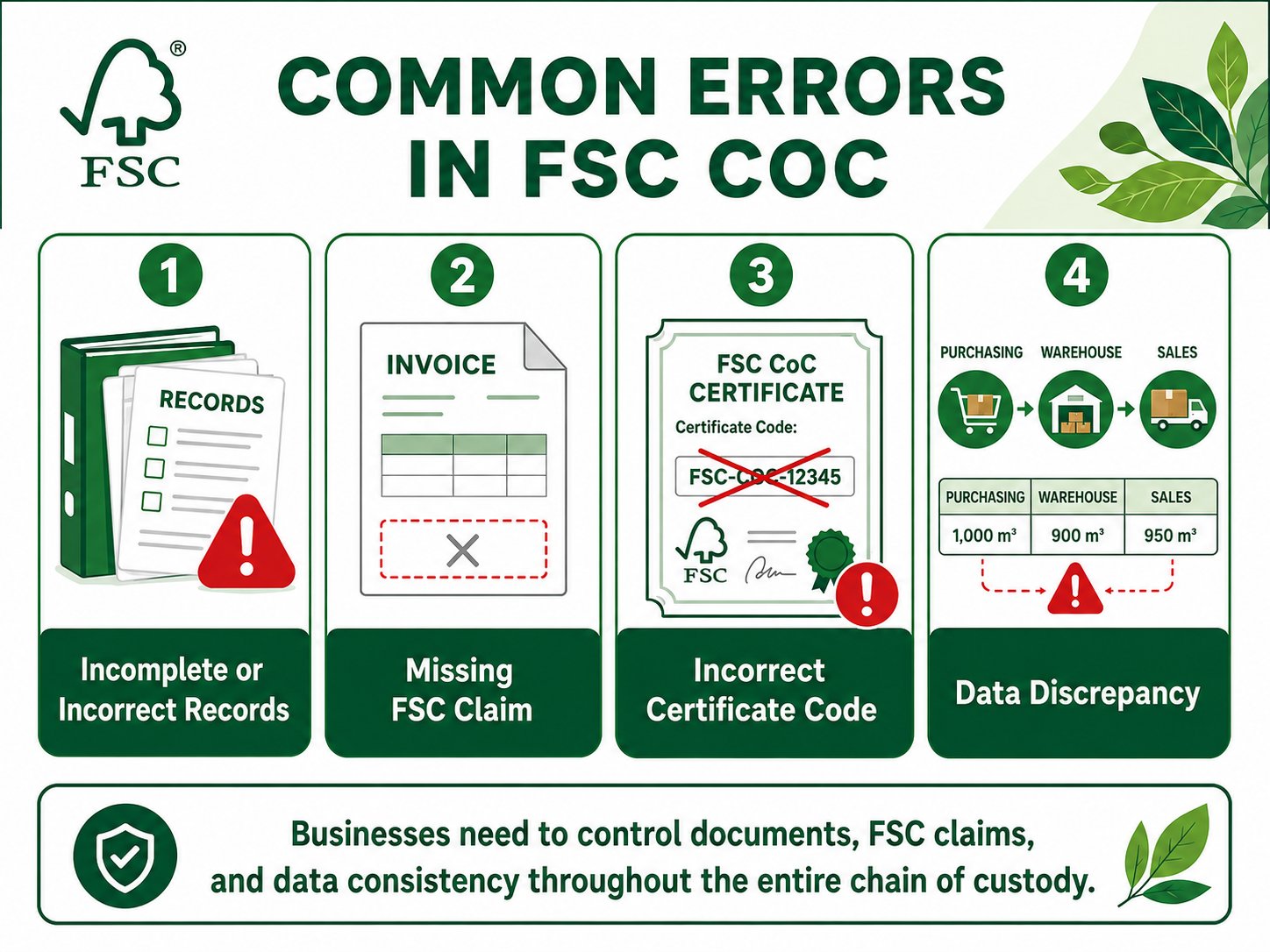
Failure to Verify Supplier Certificates Correctly
The business retains only a PDF copy of the supplier’s certificate but does not verify its status, product scope, or authorized claims.
Missing FSC Claim on Purchase Invoices
The supplier holds an FSC certificate, but the transaction document does not show the appropriate FSC claim.
Inaccurate Product Group List
The actual product, material, control system, and intended output claim are not consistent.
Inability to Demonstrate the Conversion Factor
The business has input and output data but no documented method for determining waste, loss, or the conversion factor.
Inconsistent Data Between Departments
Purchasing, goods receipt, production, stock, and sales data cannot be linked or reconciled.
Incorrect FSC Claim on Sales Documents
The invoice is missing the certificate code, uses the wrong claim, or includes an FSC claim for an ineligible product.
Insufficient Control of Outsourced Contractors
Contracts and dispatch or receipt records do not specify the required controls for FSC materials.
Incorrect Use of the FSC Logo
The business modifies the label, uses an unapproved label, or applies the logo to a product outside the certified scope.
Incomplete FSC Core Labour Requirements Self-Assessment
The business has a general policy but has not specifically assessed compliance with each FSC requirement.
14. FSC Certification Consulting Services at TTS Cert
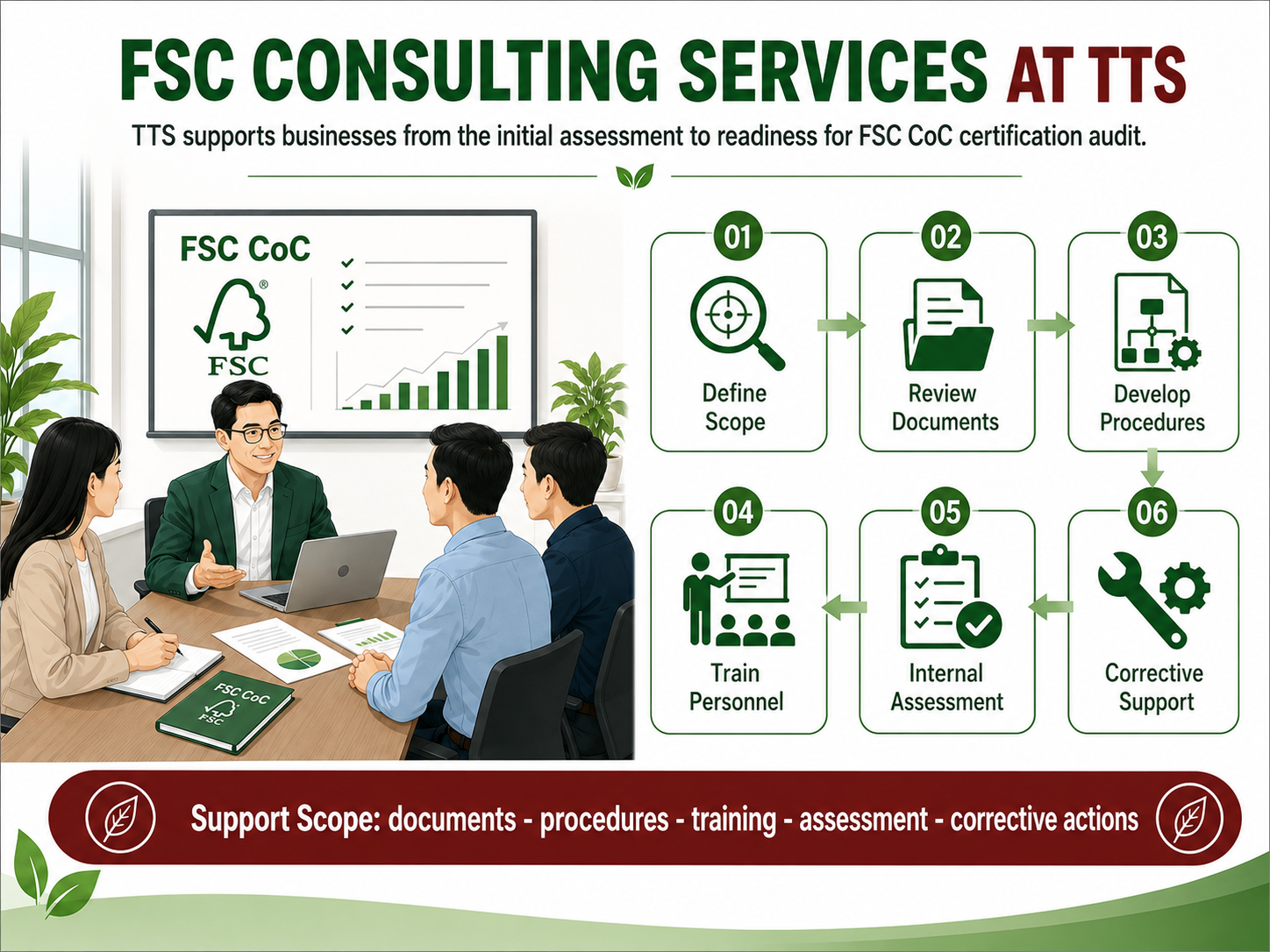
TTS supports businesses in developing an FSC CoC system suited to their scale and actual operations.
The scope of support may include:
- Determining the certification type and scope.
- Reviewing materials and the supplier chain.
- Developing the product group list.
- Selecting the Transfer, Percentage, or Credit System.
- Developing FSC CoC procedures.
- Designing purchasing, warehouse, production, and sales forms.
- Guiding the calculation of conversion factors.
- Developing the material balance.
- Guiding outsourcing controls.
- Preparing FSC core labour requirement records.
- Training personnel.
- Conducting a mock audit.
- Supporting corrective actions for non-conformities.
- Supporting communication with the certification body.
How TTS Implements the Project
TTS prioritizes systems that are:
- Compliant with the applicable standard.
- Appropriate for actual operating processes.
- Easy for employees to use.
- Designed to minimize duplicate records.
- Maintainable after certification.
- Integrated with existing management systems.
What Does FSC Stand For?
FSC stands for the Forest Stewardship Council, the organization that develops certification systems related to responsible forest management and the Chain of Custody of forest-based products.
What Is FSC Certification?
FSC certification is confirmation by an independent certification body that an audited organization complies with the applicable FSC requirements. For businesses that manufacture or trade forest-based products, the most common type is FSC CoC certification.
Is There a Difference Between FSC Certification and an FSC Certificate?
In everyday usage, both terms often refer to the same certification result. “Certification” may refer to the assessment and approval process, while the “certificate” is the document issued after the business has met the requirements.
What Is FSC CoC?
FSC CoC is the Chain of Custody system used to control and trace FSC materials during purchasing, production, storage, outsourcing, and sales.
Can a Trading Company Apply for FSC Certification?
Yes. A trading company may apply for FSC CoC certification when it purchases and sells products with FSC claims or needs to transfer FSC claims to customers through sales documents.
Does an FSC Certificate Mean That All Products Are FSC?
No. Only products included within the certification scope and controlled under the FSC CoC system may be sold with the appropriate FSC claim.
Can a Business Use the FSC Logo Immediately After Certification?
The business must use FSC trademarks in accordance with the approved scope, format, and applicable approval process. It may not download or modify the logo independently for use on products.
How Long Is an FSC Certificate Valid?
The FSC certification cycle does not exceed five years, and the business must undergo surveillance audits during the certification period.
How Can an FSC Certificate Be Verified?
The official FSC certificate search system allows users to search by company name, certificate code, licence code, country, product, or status. It also allows users to download a time-stamped certificate profile.
How Much Does FSC Certification Cost?
The cost depends on the number of sites, product scope, manufacturing or trading activities, audit duration, complexity, and forest-products turnover. The business must provide scope information to receive an accurate quotation.


