


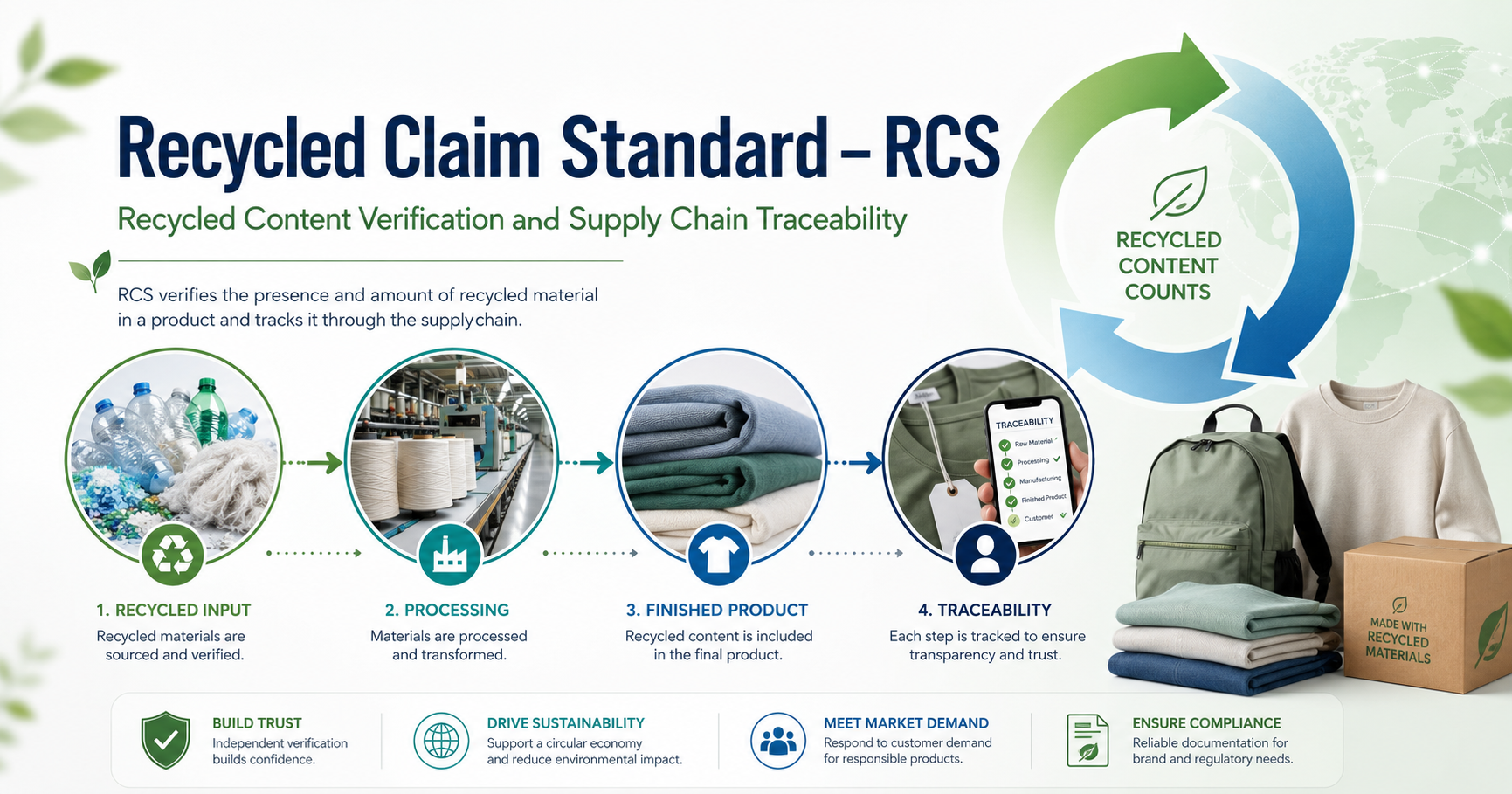
The use of recycled materials is becoming increasingly common across industries such as textiles, plastics, packaging, footwear, and consumer products. However, simply purchasing or using materials described as “recycled” is not sufficient to demonstrate that the final product actually contains the claimed amount of recycled content.
Companies must provide evidence of the material origin, recycled content percentage, production process, mass balance, and the connection between input materials and products sold to customers. The Recycled Claim Standard was developed to verify these elements.
July 2026 update: Textile Exchange has released RCS 3.0, which took effect on July 1, 2026, and will become mandatory from December 31, 2026. The new version strengthens the control and traceability of reclaimed materials before they enter the recycling process.
1. What Is RCS?
RCS stands for the Recycled Claim Standard.
It is an international and voluntary standard used to verify recycled materials and track them throughout the supply chain. RCS applies the chain-of-custody requirements established under the Content Claim Standard, or CCS.
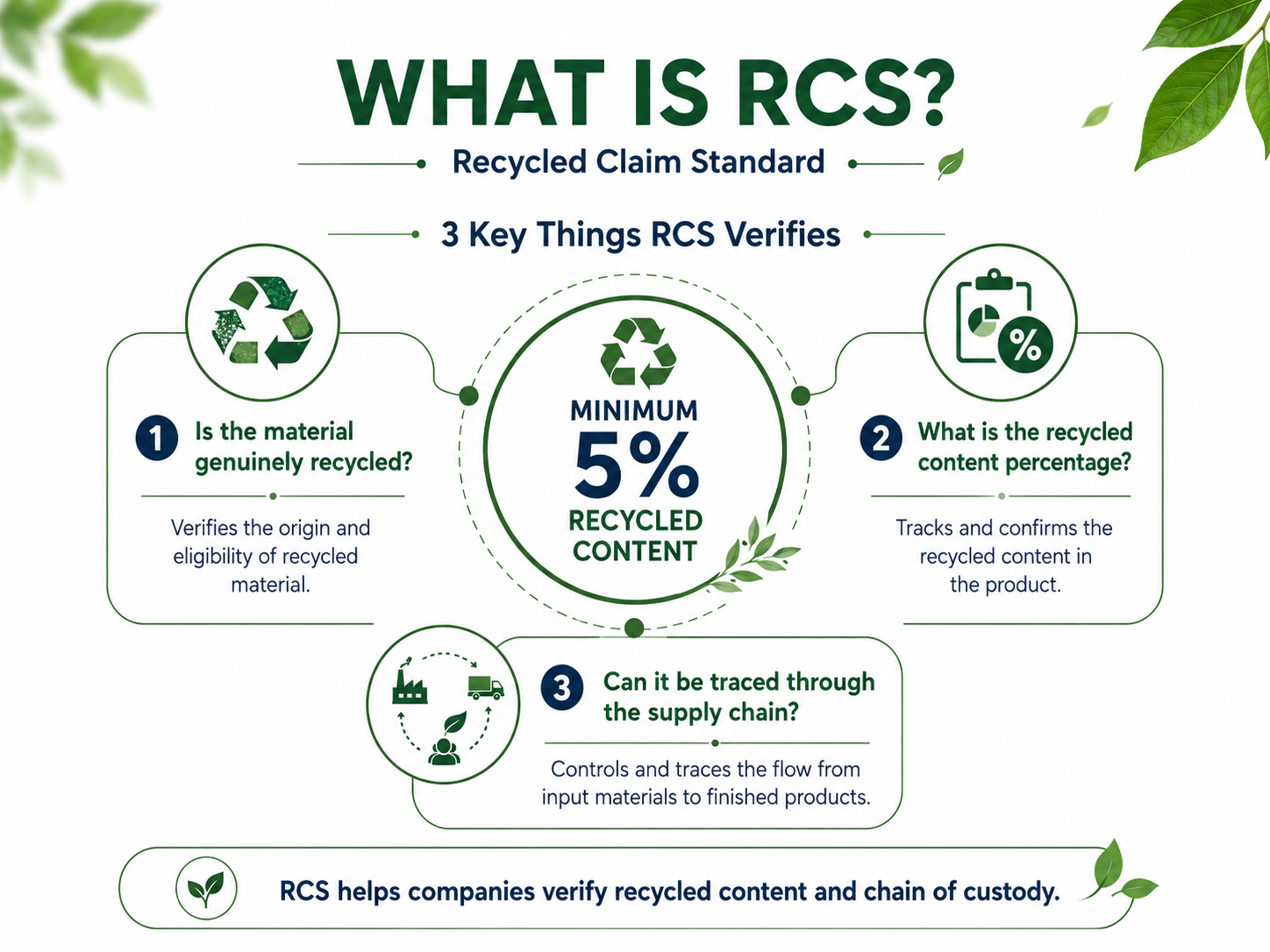
Under RCS 3.0, the standard applies to products containing at least 5% recycled content, except for certain exemptions approved by Textile Exchange.
RCS can be applied to various types of materials and supply chains and is not limited to the textile industry.
In simple terms, RCS helps answer three important questions:
Is the material genuinely recycled?
What percentage of the product consists of recycled material?
Is the material flow properly controlled and traceable throughout the supply chain?
2. What Does RCS Verify?
RCS verifies:
The origin and eligibility of recycled materials.
The percentage of recycled content in a product.
The classification of pre-consumer and post-consumer recycled materials.
The control of materials during receipt, storage, production, and delivery.
The chain of custody from input materials to finished products.
The records and data supporting recycled content claims.
RCS does not comprehensively assess working conditions, environmental management systems, or the use of chemicals in production. These requirements are covered under the broader scope of the Global Recycled Standard, or GRS.
Therefore, RCS certification does not mean that a product is environmentally friendly in every respect. The certification primarily verifies the accuracy and traceability of claims relating to recycled materials.
3. Pre-Consumer and Post-Consumer Recycled Materials
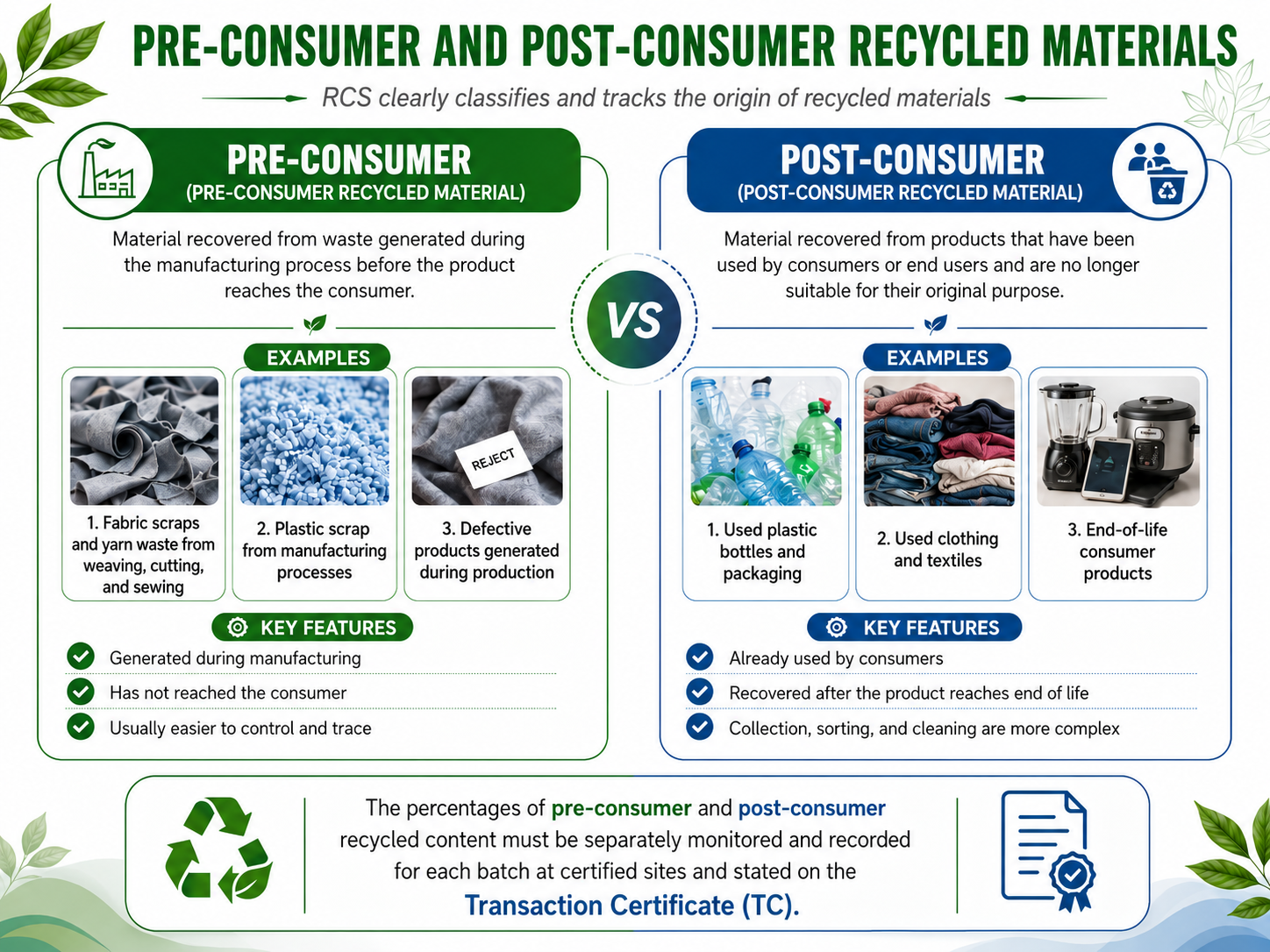
Companies must clearly identify which category their recycled materials belong to.
Pre-Consumer Recycled Material
Pre-consumer recycled material refers to material that is recovered from a waste stream generated during a manufacturing process before the product reaches the consumer.
Post-Consumer Recycled Material
Post-consumer recycled material refers to material recovered from a product that has already been used by a consumer or end user and can no longer be used for its original purpose.
The percentages of pre-consumer and post-consumer recycled content must be separately monitored and recorded for each batch at certified sites. These percentages must also be stated on the relevant Transaction Certificate.
4. What Is the Difference Between a Scope Certificate and a Transaction Certificate?
This is an important distinction that companies should understand before purchasing or selling RCS-certified products.
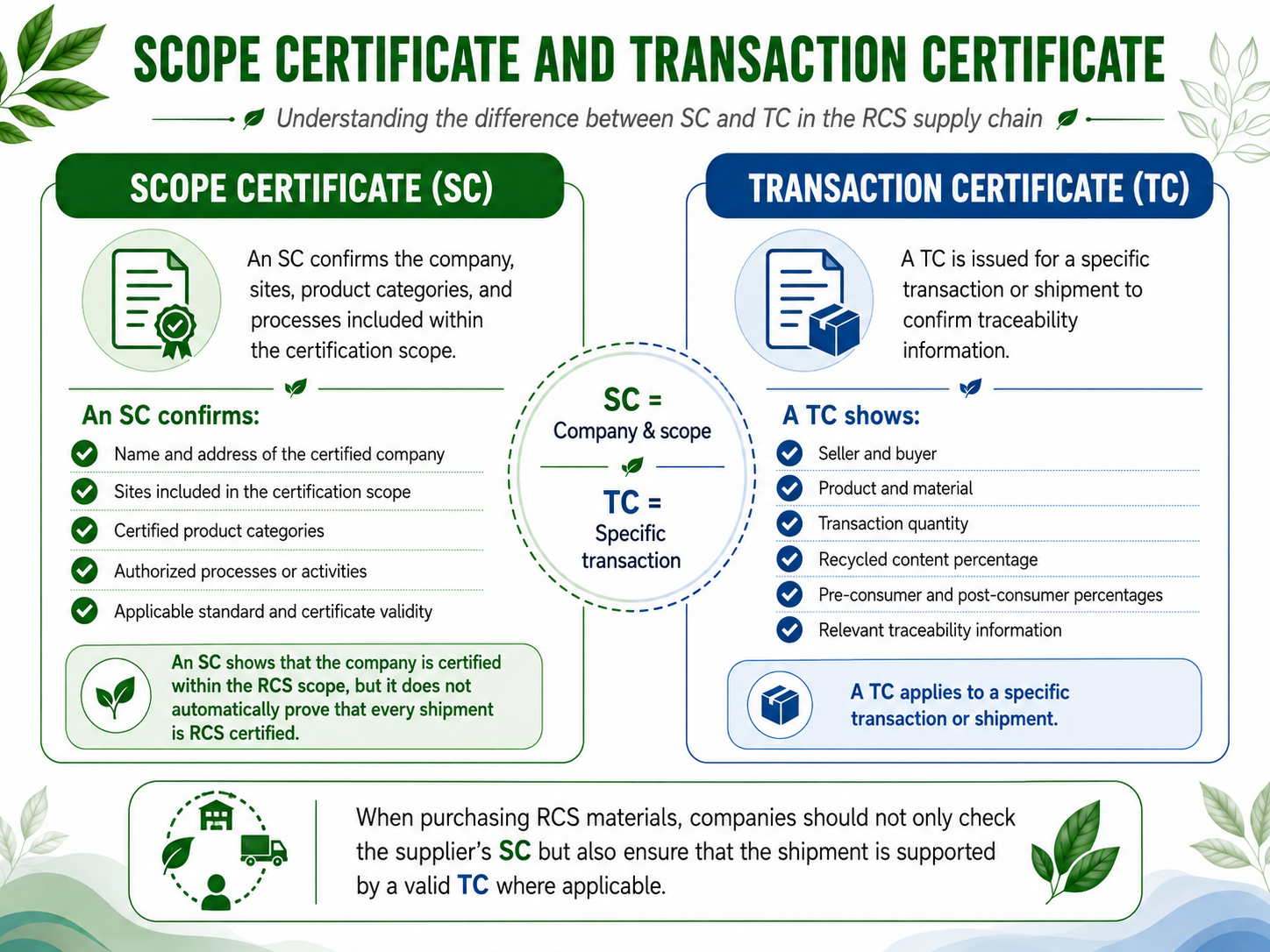
Scope Certificate – SC
A Scope Certificate confirms:
The name and address of the certified company.
The sites included within the certification scope.
The certified product categories.
The processes or activities that the company is authorized to perform.
The applicable standard and certification validity period.
An SC confirms that a company is qualified to perform the activities included within its RCS certification scope.
However, it does not automatically prove that every product or shipment supplied by that company is RCS certified.
Transaction Certificate – TC
A Transaction Certificate is issued for a specific transaction or shipment. It normally includes information such as:
The seller and buyer.
The product and material.
The quantity involved in the transaction.
The percentage of recycled content.
The percentages of pre-consumer and post-consumer recycled content.
Other relevant traceability information.
When purchasing certified RCS materials within the supply chain, companies should not only check the supplier’s Scope Certificate. They must also ensure that the material batch is supported by a valid Transaction Certificate where required.
Under RCS 3.0, recycled materials entering the RCS production and trading supply chain must be supported by a TC issued by an approved certification body.
At the beginning of the recycling supply chain, recycling organizations must also control documents such as:
Reclaimed Material Supplier Agreements.
Reclaimed Material Declaration Forms.
Evidence demonstrating that reclaimed materials have been legally and appropriately sourced.
5. Which Companies Can Apply for RCS Certification?
RCS can be applied by organizations participating in supply chains involving products containing recycled materials, including:
Facilities recycling plastics, fibers, metals, or other materials.
Spinning, weaving, dyeing, and finishing factories.
Garment, footwear, and consumer product manufacturers.
Packaging and plastic product manufacturers.
Processing, packaging, and labeling companies.
Trading and export companies.
Brands that need to maintain chain-of-custody control through to the sales stage.
Organizations involved in manufacturing or trading RCS products are generally subject to certification requirements.
RCS 3.0 provides certain limited exemptions for retailers selling only to final consumers and for traders whose RCS-related revenue remains below the prescribed threshold, provided that they do not repackage or relabel the products.
6. Main Requirements of RCS Certification
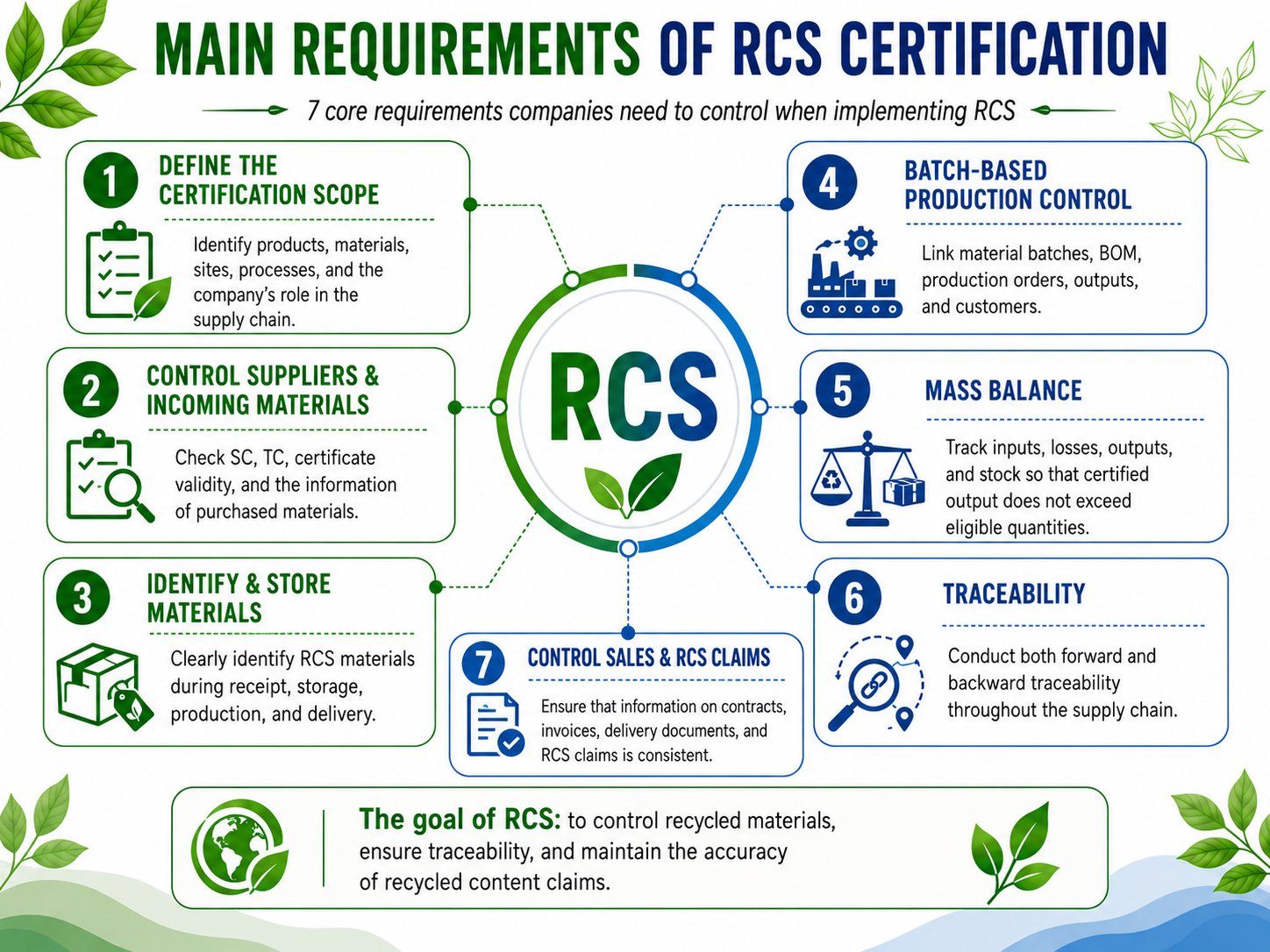
6.1. Defining the Certification Scope
A company must clearly identify:
The products to be included within the certification scope.
The recycled materials used.
The recycled content percentage.
The relevant production processes.
Production sites, warehouses, and subcontractors.
The company’s role within the supply chain.
The certification scope should not be determined solely based on the company’s business registration.
It must be based on the company’s actual products, materials, processes, and operational activities.
6.2. Controlling Suppliers and Incoming Materials
Before purchasing materials, a company should:
Check the scope of the supplier’s SC.
Verify that the supplier’s certificate remains valid.
Confirm that the purchased material is included in the supplier’s certified product scope.
Check the TC relating to the shipment where required.
Compare product names, recycled content percentages, quantities, and supporting documents.
The fact that a supplier holds RCS certification does not mean that every product sold by that supplier falls within the certified scope.
6.3. Identifying and Storing Materials
RCS materials must be clearly identified throughout the following stages:
Receipt.
Incoming inspection.
Storage.
Issuance to production.
Subcontracted processing.
Finished product storage.
Delivery.
Companies may use material codes, labels, dedicated storage areas, batch numbers, or electronic systems to prevent RCS materials from being confused or mixed with conventional materials.
6.4. Batch-Based Production Control
Production records should establish a clear connection between:
Incoming material batches.
Production orders.
Bills of Materials, or BOMs.
The quantity of materials issued to production.
Output quantities.
Waste and production losses.
Finished product batches.
Customers receiving the products.
Companies must demonstrate the recycled content percentage of their products using actual production data.
They should not rely solely on technical specifications or declarations provided by suppliers.
6.5. Mass Balance
Mass balance calculations help determine whether a company has sold more RCS products than can be supported by the eligible recycled materials purchased and used.
A typical mass balance calculation should show:
Opening stock + RCS materials purchased – materials used – production losses – quantity sold = closing stock
Where recycled and virgin materials have different production loss rates, the company must reflect these differences in its mass balance calculation methodology.
6.6. Traceability
Companies must be able to conduct:
Forward traceability from incoming materials to finished products and customers.
Backward traceability from sold products to production batches, materials, and suppliers.
Information maintained by the purchasing, warehouse, production, sales, and accounting departments must be consistent.
6.7. Controlling Sales and RCS Claims
Product names, recycled content percentages, and RCS information stated in contracts, invoices, delivery notes, and TC applications must be consistent with the certified scope.
The use of the RCS logo or RCS claims on products and marketing materials must comply with Textile Exchange’s policies on standards claims and labeling.
Consumer-facing labeled products must remain certified through the supply chain up to the seller involved in the final business-to-business transaction.
7. What Is the Difference Between RCS and GRS?
| Criteria | RCS | GRS |
|---|---|---|
| Full name | Recycled Claim Standard | Global Recycled Standard |
| Minimum recycled content | At least 5% | At least 20% |
| Verification of recycled content | Yes | Yes |
| Chain-of-custody requirements | Yes | Yes |
| Social requirements | No | Yes |
| Environmental requirements | No | Yes |
| Chemical restrictions in production | No | Yes |
| Product labeling conditions | Subject to the RCS claims policy | At least 50% recycled content for a consumer-facing GRS product label |
| Implementation level | Focuses on recycled materials and traceability | More comprehensive |
The recycled content thresholds and requirement scopes are established under RCS 3.0 and GRS 5.0.
8. When Should a Company Choose RCS?
RCS may be suitable where:
A customer requires verification of recycled content.
The product contains at least 5% recycled material.
The company needs SCs and TCs to participate in a certified supply chain.
The customer’s requirements do not include the social, environmental, and chemical criteria covered by GRS.
A trading company needs to maintain continuity in the chain of custody.
The company wants to establish a material control and traceability system before considering a broader recycled standard.
Where a customer specifically requires GRS certification, a company should not automatically substitute RCS certification.
RCS and GRS have different scopes, recycled content thresholds, and certification requirements.
9. What Documents Should a Company Prepare?
Documents commonly required for RCS implementation include:
A list of products and materials proposed for certification.
A supplier list.
Scope Certificates and Transaction Certificates for incoming materials.
Bills of Materials, formulas, or material consumption standards.
Purchasing and supplier verification procedures.
Material receipt, identification, and storage procedures.
Production orders and production reports.
Records relating to production losses, waste, and internal recycling.
Mass balance records.
Traceability records.
Contracts, invoices, and delivery documents.
A list of subcontractors and relevant control agreements.
Training records for relevant personnel.
Procedures for controlling RCS claims and logo use.
Documentation must accurately reflect the company’s actual operations.
Creating templates without maintaining consistent operational records will generally not be sufficient to meet certification requirements.
10. Common Non-Conformities During RCS Implementation
Common problems include:
Checking the supplier’s SC without verifying whether the purchased product is included in its certified scope.
Failing to obtain or verify the TC for an incoming material batch.
Confusing pre-consumer and post-consumer recycled materials.
Failing to separately identify RCS materials in the warehouse.
Production records that cannot be connected to specific incoming material batches.
Recycled content percentages on invoices that do not match the BOM or TC.
Failing to control production losses and mass balance.
Selling more RCS products than can be supported by eligible material inputs.
Failing to declare or control subcontractors.
Using the RCS logo or making RCS claims without the required approval.
11. RCS Certification Process
A typical RCS certification process includes the following steps:
Define the product, site, and operational scope.
Select an approved certification body.
Conduct a gap assessment and establish the required control system.
Train relevant personnel and implement the documentation system.
Undergo the certification audit.
Correct any identified non-conformities.
Obtain the Scope Certificate.
Maintain the system and apply for TCs for eligible transactions.
The implementation timeline depends on factors such as:
The size of the company.
The number of sites.
The type of production activity.
The status of incoming recycled materials.
The company’s existing level of documentation and operational readiness.
12. How TTS Cert Supports Companies With RCS Implementation
TTS Cert supports companies with:
Defining an appropriate certification scope.
Checking products, suppliers, Scope Certificates, and Transaction Certificates.
Conducting an RCS gap assessment.
Developing material control and chain-of-custody procedures.
Establishing BOM, traceability, and mass balance systems.
Training personnel from purchasing, warehouse, production, sales, and accounting departments.
Preparing documentation for the certification audit.
Supporting communication between the company and the certification body.
Providing guidance on corrective actions following the audit.
Companies may submit their product list, production process, recycled content percentages, and supplier certificates to TTS Cert for a preliminary assessment of their eligibility for RCS certification.
13. Frequently Asked Questions About RCS Certification
What Percentage of Recycled Material Is Required for RCS?
Under RCS 3.0, a product must contain at least 5% recycled content, except where a specific exemption has been approved.
If a Supplier Has an SC, Is the Purchased Material Automatically RCS Certified?
No.
The company must verify that the relevant product is included within the supplier’s Scope Certificate and check the Transaction Certificate for the specific shipment where required.
Does a Trading Company Need RCS Certification?
It may.
Trading companies involved in buying and selling RCS products generally need certification to maintain the chain of custody and apply for Transaction Certificates.
However, certain limited exemptions may apply under the standard.
Does RCS Include Environmental and Social Responsibility Requirements?
RCS does not comprehensively assess social responsibility, environmental management, or chemical controls in production in the same way as GRS.
RCS primarily focuses on recycled materials and supply chain traceability.
Can a Company Use the RCS Logo on Its Products After Receiving Certification?
Not automatically.
The use of the RCS logo and RCS claims must meet the applicable supply chain certification requirements and comply with Textile Exchange’s claims and labeling policies.


