Table of contents
The Materials Matter Standard (MMS) is Textile Exchange's new standard for the production and primary processing of textile raw materials. MMS takes effect on 31 December 2026 and, from 31 December 2027, replaces GRS, RCS, RWS, RMS and RAS for certification audits.
The change affects two groups of businesses differently:
Recyclers and primary processors (Tier 4): move to audits against MMS, which include all requirements of the Content Claim Standard (CCS).
Spinners, mills, dye houses and garment factories (Tiers 1–3) holding GRS: move to CCS-only certification by 31 March 2029 at the latest.
TTS Cert supports both groups through the transition: identifying the right tier, gap analysis, training, documentation and support during the audit. Audits and certificates are issued by certification bodies licensed by Textile Exchange.
1. What Is the Materials Matter Standard (MMS)?
MMS in textiles
In the textile industry, MMS stands for the Materials Matter Standard (code TE-MM-STN-101). Version 1.0 was published by Textile Exchange on 12 December 2025.
MMS is a voluntary standard setting requirements for raw material production and primary processing: land, water and energy use; working conditions; animal welfare; emissions, chemicals and waste. It brings Textile Exchange's material-specific standards into one framework and links certification to outcomes for climate, nature, people and animals.
Who is Textile Exchange?
Textile Exchange is a global non-profit that owns GRS, RCS, RWS, OCS, RDS, CCS and now Materials Matter. It sets the standards; audits are carried out by independent, licensed certification bodies.
The 7 principles of MMS
Organizational management
Human rights and livelihoods
Land use (farms)
Animal welfare (farms, slaughterhouses)
Processing facility (environment, chemicals, waste, water, air emissions, energy)
Chain of custody
Group certification (farm groups)
For recyclers, Principles 1, 2, 5 and 6 are the main ones. Principles 3, 4 and 7 apply to farms and animal materials.
How do MMS and CCS relate?
CCS (Content Claim Standard) is Textile Exchange's chain of custody standard for tracking certified material through each stage to the final product. It is a separate standard but closely linked to MMS:
MMS lists CCS as integral to implementing the standard (section A2.1.1).
Recyclers must implement the full CCS together with MMS Principle 6 (section B6.1.3) — CCS is part of the MMS audit.
Tier 1–3 facilities are certified to CCS only, not audited against MMS.
2. Which Standards Does MMS Replace?
From 31 December 2027, audits will no longer use:
GRS – Global Recycled Standard (about GRS)
RCS – Recycled Claim Standard (about RCS)
RWS – Responsible Wool Standard
RMS – Responsible Mohair Standard
RAS – Responsible Alpaca Standard
Note: from 31 December 2026 until 31 December 2027, GRS and RCS audits use **GRS 5.0** and **RCS 3.0**. These are limited revisions to introduce the new Reclaimed Material Declaration Form (RMDF), not a change to the structure of the standards.
Outside MMS: OCS (Organic Content Standard) and RDS (Responsible Down Standard) continue in parallel.
Eligible recycled materials in the first version: plant fibres, animal fibres, down, synthetic materials and man-made cellulosic fibres (MMCF). Non-textile inputs will be covered in a later version of the policy.
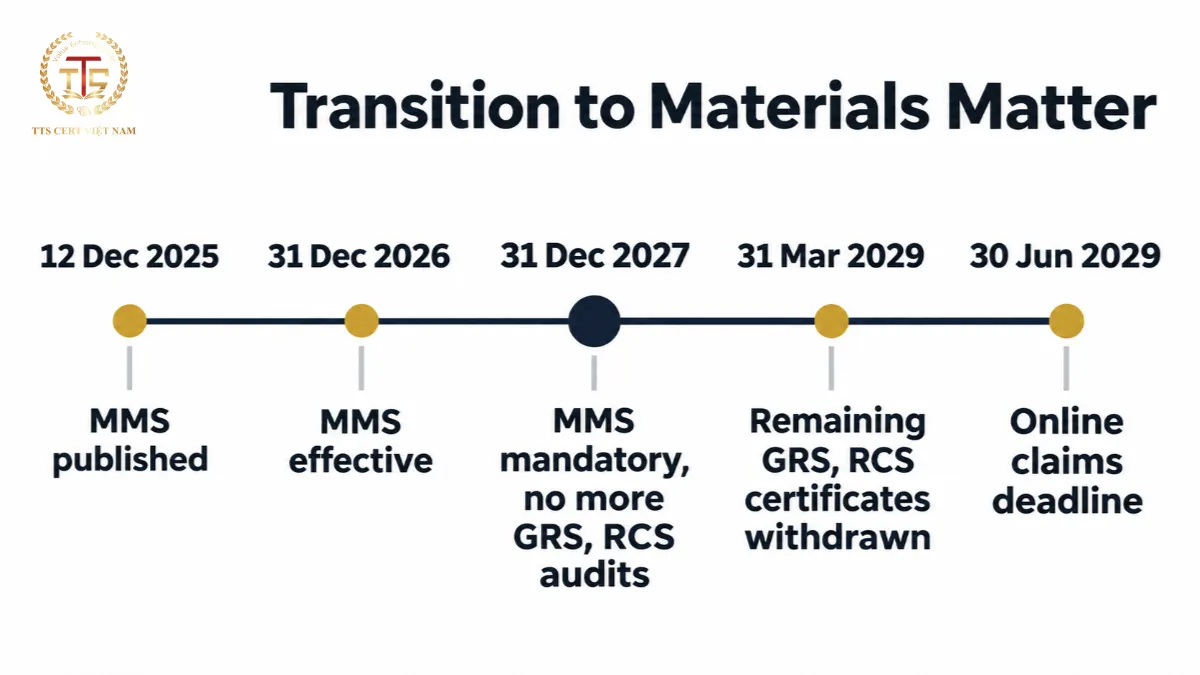
3. Transition Timeline to MMS (2025–2029)
| Date | What happens |
|---|---|
| 12 Dec 2025 | Materials Matter Standard V1.0 published |
| 1 Apr 2026 | Transition Policy (TE-MM-POL-102) published |
| 31 Dec 2026 | MMS effective: audits to MMS may begin (licensed certification bodies only). Recyclers must use the Reclaimed Material Declaration Form (RMDF) |
| 31 Dec 2027 | MMS mandatory: no more audits to GRS, RCS, RWS, RMS or RAS |
| 31 Mar 2029 | All remaining GRS, RCS, RWS, RMS and RAS scope certificates withdrawn; last date to apply for legacy transaction certificates (TCs) |
| 30 Jun 2029 | Deadline to update all online and non-printed claims to Materials Matter |
Existing GRS and RCS certificates do not all expire on 31 December 2027. That is the date from which all audits must follow the new standard.
4. Which Tier Are You, and What Certification Do You Need?
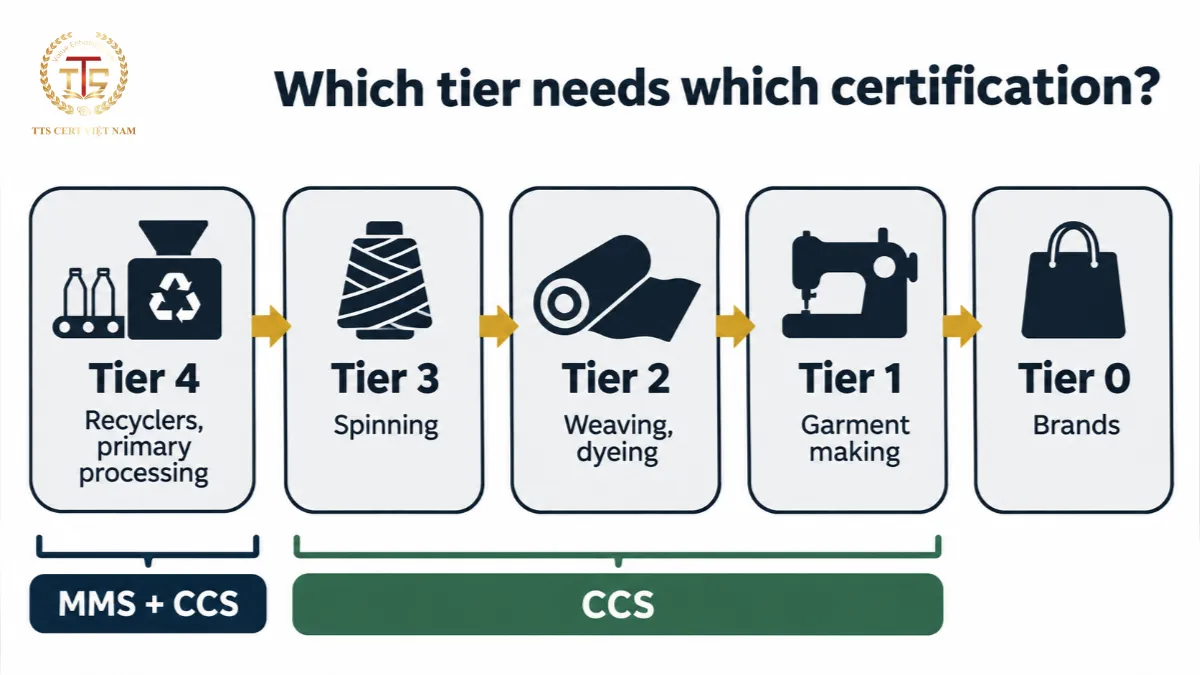
Textile Exchange divides the textile supply chain into five tiers:
| Tier | Activity | Examples | Certification after transition |
|---|---|---|---|
| Tier 4 | Raw material production and primary processing | Recycling PET bottles into chips or fibre; turning fabric scraps into recycled fibre; continuous production of recycled filament yarn from waste | MMS (including full CCS) |
| Tier 3 | Intermediate material processing | Spinning yarn from recycled fibre | CCS |
| Tier 2 | Material manufacturing | Weaving, knitting, dyeing, finishing | CCS |
| Tier 1 | Finished product manufacturing | Garment making, printing, embroidery | CCS |
| Tier 0 | Brands, retail, distribution | Brands, retailers | CCS when owning certified goods or making claims |
Recyclers and primary processors (Tier 4)
For recycled materials, primary processing covers every step that turns reclaimed feedstock into a recycled output, for example:
mechanical recycling: fabric scraps into staple fibre (opening, garneting);
thermo-mechanical recycling: bottles into chips, staple fibre or filament;
chemical recycling: into pulp, monomers, polymers or filament.
These sites must be certified to MMS and CCS.
Note: collection, sorting, concentration, shredding and baling of waste do not require certification; these operators may certify voluntarily. Recyclers must still obtain RMDFs from them.
Spinners, mills, dye houses and garment factories (Tiers 1–3)
These facilities are not audited against MMS. They are certified to CCS to buy, process and sell Materials Matter material. Facilities holding both GRS and CCS must move to CCS only by 31 March 2029, when all remaining GRS scope certificates are withdrawn.
Vertically integrated operations
Where a factory runs a continuous line from waste to yarn (e.g. from bottle flakes to POY, FDY or DTY filament), all steps until the end of the continuous process count as primary processing, i.e. Tier 4. Vertically integrated businesses should confirm their tier with the certification body before planning.
5. How Does MMS Differ from GRS and RCS?
| Topic | GRS | RCS | Materials Matter system |
|---|---|---|---|
| Who is audited | All stages of the chain | All stages of the chain | MMS for Tier 4; CCS for Tiers 0–3 |
| Social, environmental and chemical requirements | Yes | No | Yes, focused on Tier 4; adds human rights due diligence and livelihoods |
| Certificate validity | — | — | Tier 4: up to 3 years with annual audits; Tiers 0–3: 1 year |
| Usable as input for Materials Matter products | Yes, with a transition claim | No | — |
| Claims and labels | GRS label | RCS label | New Materials Matter certification mark and claims |
6. Key Requirements for Recyclers (Tier 4)
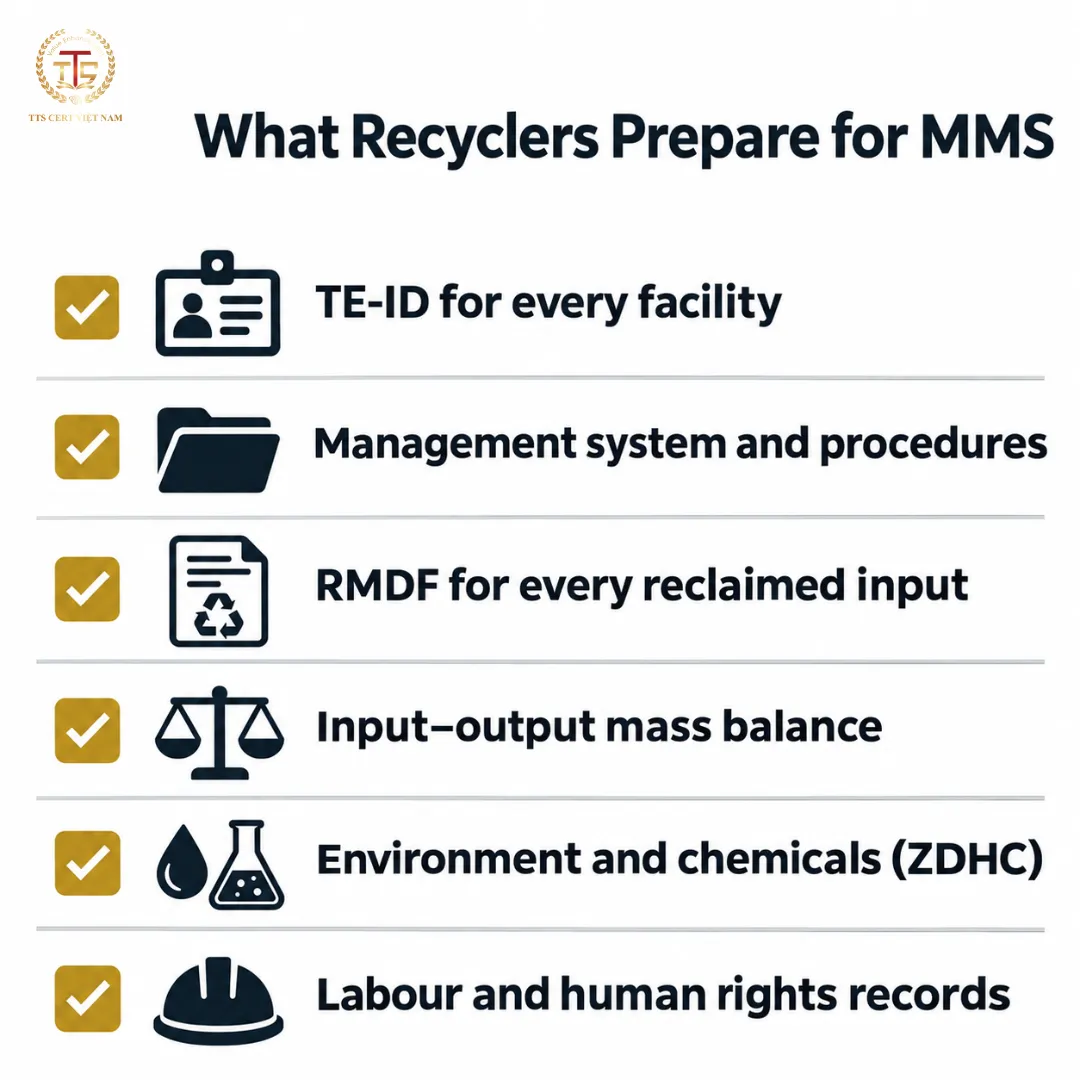
Governance and management system
A management representative responsible for certification.
A TE-ID for every facility in the scope certificate — a critical criterion (1.1.4).
A management system with objectives, resources and SOPs, reviewed at least annually.
Traceability and mass balance
Verify the source and eligibility of reclaimed inputs.
Collect and keep a Reclaimed Material Declaration Form (RMDF) (TE-MM-TEM-105) for every reclaimed input; mandatory from 31 December 2026.
Identify, segregate and control lots; reconcile inputs and outputs.
Implement the full CCS (section B6.1.3).
Environment, chemicals and resources (Principle 5)
An environmental management system (based on ISO 14001).
Chemical management and restrictions following current ZDHC guidelines, GHS and REACH.
Management of waste, water and wastewater, air emissions and energy, with regular monitoring.
Human rights and working conditions (Principle 2)
Human rights due diligence, risk assessment and a grievance mechanism.
Contracts, working hours, wages and benefits, occupational health and safety.
No child labour or forced labour.
7. Inventory, Labels and Claims During the Transition
RCS material: cannot be used as input for Materials Matter products, even with a transition claim. Keep it separate and sell and ship it before the RCS scope is withdrawn (31 March 2029 at the latest).
GRS, RWS, RMS, RAS material: can be used as input, but products must carry a transition claim. Once an input carries a transition claim, subsequent products must too.
Printed labels: previously approved GRS and RCS claims already printed or attached to products may be used until stock is exhausted. No new printing after the mandatory date.
Online claims: must be updated to Materials Matter and submitted for approval before 30 June 2029.
To use Materials Matter claims and the certification mark, you need a valid scope certificate and a trademark licence agreement with Textile Exchange.
8. How TTS Cert Supports Your Materials Matter Transition
Tier and scope: based on materials, reclaimed inputs, processes, outputs, sites, subcontracting and existing certificates — do you need MMS (with CCS) or CCS only.
Gap analysis: compare your current system (GRS, RCS) with the new requirements; identify what is met, what is missing and timing risks.
Implementation plan: actions, owners, deadlines, evidence.
Documentation: procedures, forms, RMDFs, mass balance, environment, chemicals, labour.
Training and trial run: train the responsible team and departments; run the records on real data.
Internal audit and corrective action: pre-audit review, root cause analysis, follow-up.
Certification audit support: prepare documents and people; support corrective actions after the audit.
TTS Cert is a consultancy. Audits, certification decisions and certificates are issued by certification bodies licensed by Textile Exchange.
Find out whether you need MMS or CCS and your transition plan:
9. Documents to Prepare
| Recyclers (Tier 4) – MMS + CCS | Spinners, mills, garment factories (Tiers 1–3) – CCS |
|---|---|
| TE-ID for every facility in scope | Supplier list with valid scope certificates |
| Management system, SOPs, responsibilities | Transaction certificates (TCs) for inputs |
| RMDFs for all reclaimed inputs; reclaimed material supplier records | Procedures for identification, lot segregation and storage |
| Input–output mass balance | Input–output mass balance |
| Environmental records: chemicals and SDS, waste, wastewater, air emissions, energy | Subcontractor records (if any) |
| Labour records: contracts, time records, payroll, health and safety, grievance mechanism | Approved claims and labels |
10. Timeline and Cost Factors
Up to about 45 days to certification:
about 30 days of consulting and preparation;
about 15 days from the audit to the certificate.
If you need it sooner, TTS Cert can shorten the schedule depending on how ready your records are — we do not lock you into a fixed timeline. Certificate issuance depends on the certification body and on closing any nonconformities on time. MMS audits are only possible from 31 December 2026.
Cost depends on:
Tier and applicable standard (MMS with CCS, or CCS only).
Number of sites, production lines and material types.
Existing certificates (GRS holders usually prepare faster).
Readiness of environmental, chemical and labour systems.
Audit and certification fees charged by the certification body.
11. Common Challenges
Wrong tier: especially for vertically integrated factories or sites that both collect and recycle.
RCS inventory: cannot be used for Materials Matter products and can get stuck without a sales plan.
Missing RMDFs: small waste suppliers are not used to declarations; RMDFs submitted more than 31 days late are recorded as findings.
Chemical management not aligned with ZDHC: especially for recyclers previously holding only RCS.
Segregation and mass balance when handling GRS, RCS and Materials Matter material at the same time.
Few licensed certification bodies in the early phase — book audits early.
12. Frequently Asked Questions
Should we get GRS now or wait for MMS? GRS audits remain possible until 31 December 2027. If you need a certificate now to ship orders, you can certify to GRS and transition later. Recyclers with audits due after 31 December 2026 should consider auditing directly to MMS, as Tier 4 sites cannot hold GRS and MMS scope certificates at the same time.
How long can we use our current GRS certificate? Certificates do not all expire on 31 December 2027. All remaining GRS and RCS scope certificates are withdrawn on 31 March 2029. Tier 1–3 facilities must move to CCS before then.
Do garment factories need MMS certification? No. Garment factories are Tier 1 and certify to CCS. MMS applies to recyclers and primary processors (Tier 4).
What happens to RCS material in stock? RCS material cannot be used for Materials Matter products, even with a transition claim. Keep it separate and sell and ship it before the RCS scope is withdrawn.
Is MMS required by law? No. MMS is voluntary, but brands commonly require it from suppliers of recycled materials.
What is CCS, and is it part of MMS? CCS is Textile Exchange's separate chain of custody standard. For recyclers, the full CCS is applied within the MMS audit. For Tier 1–3 facilities, CCS is the only certification needed.
How long does certification take? Up to about 45 days: about 30 days of consulting and about 15 days from audit to certificate. It can be faster depending on your readiness.
How can we use the Materials Matter logo? Under the Materials Matter Claims and Labeling Policy (TE-MM-POL-301). You need a valid scope certificate, a trademark licence agreement, and approval of your claims and label artwork before use.
Does TTS Cert issue MMS certificates? No. TTS Cert is a consultancy. Audits and certificates are issued by certification bodies licensed by Textile Exchange.
13. Conclusion
MMS is more than a new name for GRS and RCS. Recyclers must meet additional environmental, chemical, human rights and reclaimed-material declaration requirements, while textile mills move to CCS certification. The key steps are identifying the right tier, managing inventory and scheduling the transition ahead of 31 December 2027 and 31 March 2029.
Get Materials Matter transition consulting:
References
Textile Exchange – TE-MM-STN-101 Materials Matter Standard V1.0 (12 Dec 2025)
Textile Exchange – TE-MM-POL-102 Materials Matter Transition Policy (1 Apr 2026)
Textile Exchange – TE-MM-POL-101 Materials Matter Scope and Eligibility Policy
Textile Exchange – TE-MM-POL-201 Materials Matter Criteria for Certification Bodies (6 Aug 2026)
Textile Exchange – Supply Chain Taxonomy