Table of contents
ANSI/ESD S20.20 is the EOS/ESD Association (ESDA) standard for developing, implementing and maintaining an electrostatic discharge (ESD) control program to protect electronic parts, assemblies and equipment. The current version is ANSI/ESD S20.20-2021. Its technically equivalent international standard is IEC 61340-5-1:2024.
S20.20 certification is commonly required by customers of electronics suppliers: PCB assembly, semiconductors, components, equipment and component distribution.
TTS Cert provides full consulting to ANSI/ESD S20.20 and IEC 61340-5-1: gap analysis, ESD control program development, training, measurements, internal audits and support through certification. Audits and certificates are issued by certification bodies approved by ESDA.
1. What Is ANSI/ESD S20.20?
Electrostatic discharge (ESD) is a sudden flow of electricity between two objects at different potentials when they touch or come close. A discharge too small for a person to feel can still destroy an electronic component outright or cause latent damage: the product passes testing but fails early in the field.
ANSI/ESD S20.20 does not specify a particular product. It sets administrative and technical requirements so organizations can build an ESD control program that fits their own processes and show that it works.
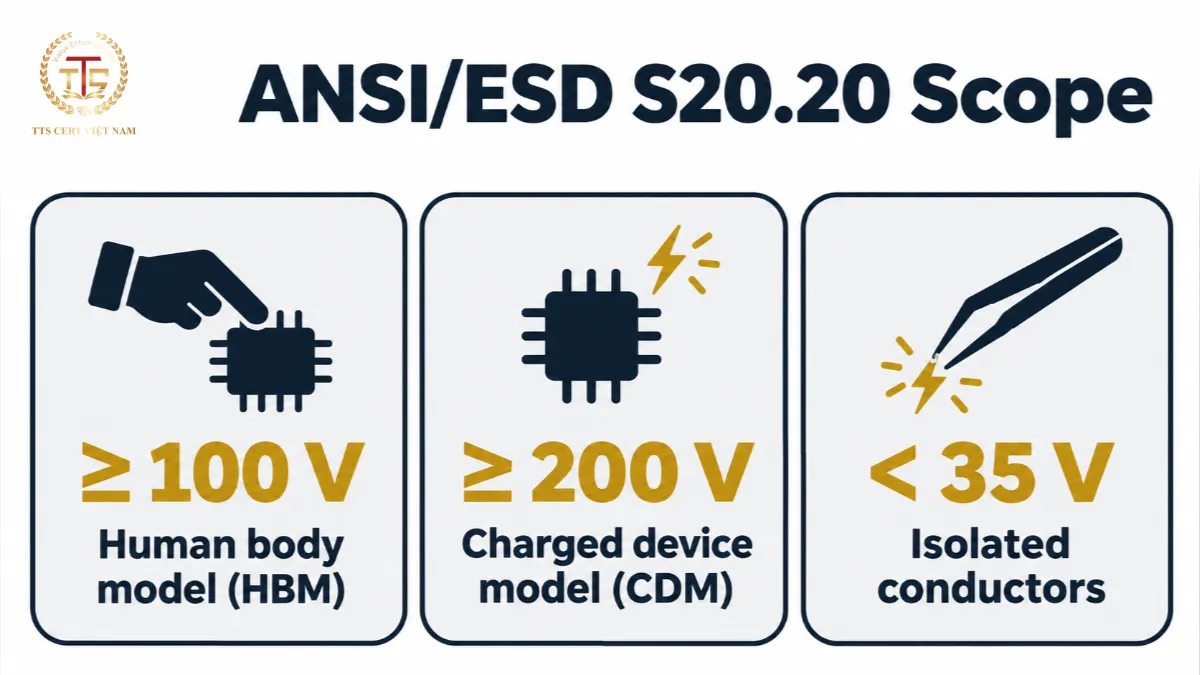
Scope: organizations that manufacture, process, assemble, install, package, label, service, test, inspect, transport or otherwise handle electrical and electronic parts, assemblies and equipment with ESD withstand voltages of:
100 V or more, human body model (HBM);
200 V or more, charged device model (CDM);
with voltage on isolated conductors controlled below 35 V.
The standard excludes electrically initiated explosive devices and flammable liquids, gases and powders. Items more sensitive than these thresholds may need additional controls or adjusted limits.
Current versions: S20.20-2021 and IEC 61340-5-1:2024
ANSI/ESD S20.20-2021 was released by ESDA in December 2021, replacing the 2014 edition. Audits to the 2021 version started in June 2022; the transition period for 2014 certificates has ended.
IEC 61340-5-1:2024 (edition 3.0) was published on 21 May 2024, replacing the 2016 edition.
Notable changes in the 2021 edition include new definitions (conductor, insulator, isolated conductor, ESD control item), clearer product qualification requirements with supporting technical reports, a rule that floor/footwear systems cannot be qualified using compliance verification data, and a new annex on tailoring.
2. Who Needs ANSI/ESD S20.20 Certification?
| Business type | Why it is often needed |
|---|---|
| PCB assembly (EMS, PCBA, SMT) | OEM customers require suppliers with a certified ESD program |
| Semiconductor manufacturing, packaging and test | Low-withstand devices, high risk of latent damage |
| Components, modules and sensors | Products are ESD-sensitive (ESDS) items |
| Electronic equipment, automotive electronics, medical devices | Boards and modules are handled directly on the line |
| Component warehousing, distribution and logistics | Unpacking, counting and repacking ESDS items |
| Repair, refurbishment and service | Direct handling of assembled boards |
When should you start?
A customer adds ESD certification to a contract, supplier requirements or supplier audit.
Functional failures, no-fault-found returns or early field failures increase.
You are opening a new plant, adding lines or taking on products with more sensitive devices.
You want one ESD program for all customers instead of meeting separate requirement sets.
3. Key Requirements of ANSI/ESD S20.20
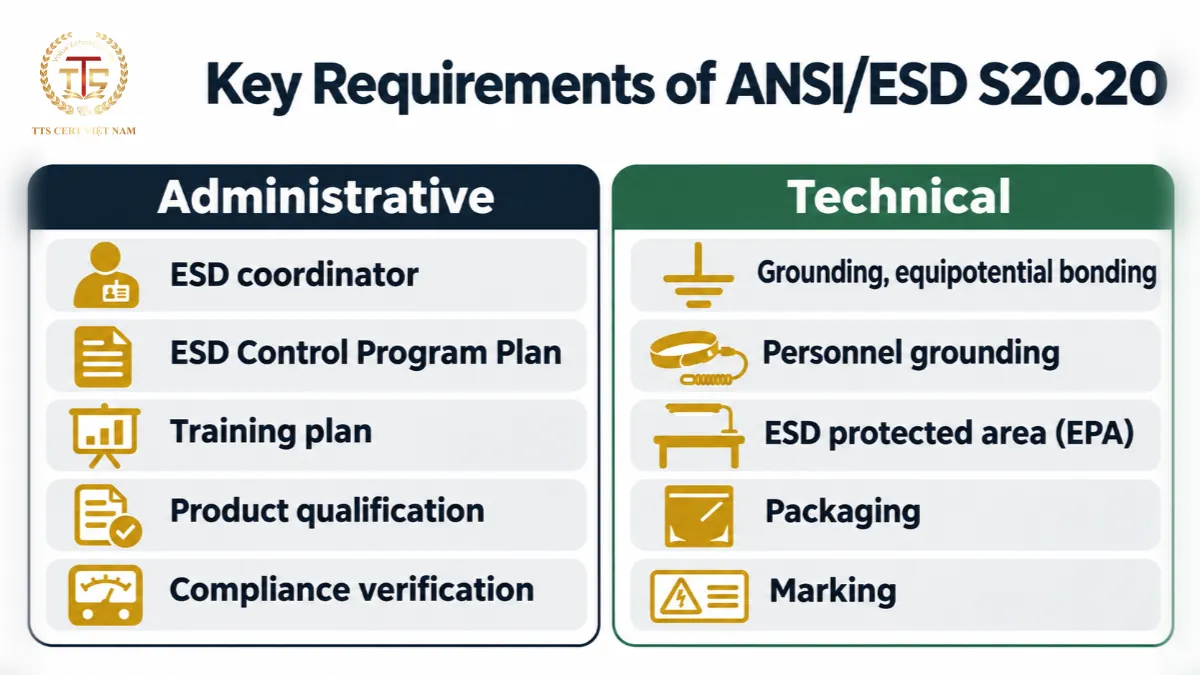
Administrative requirements
ESD coordinator: a person assigned to establish, document and implement the program.
ESD Control Program Plan: the core document describing scope, controls, verification and training.
Tailoring: requirements may be removed or modified where they do not fit the process, with a documented technical justification.
Training plan: initial and recurrent training for everyone who handles ESDS items, with records.
Product qualification: evidence that ESD control items in use (mats, wrist straps, footwear, seating, carts, packaging, etc.) meet the requirements using the standard test methods.
Compliance verification plan: periodic measurements proving controls still work; ESDA's technical report ESD TR53 describes the methods.
Technical requirements
Grounding or equipotential bonding systems: bring people, work surfaces and equipment to the same potential.
Personnel grounding: wrist straps when seated; footwear and flooring systems when standing or moving, under the conditions in the standard.
ESD protected areas (EPA): defined areas where ESDS items are handled without protective packaging. Work surfaces, seating, shelving, carts, tools, insulators and isolated conductors are controlled (e.g. with ionizers).
Packaging: defined for ESDS items inside and outside the EPA, per contract or ANSI/ESD S541 (IEC 61340-5-3 under the IEC standard).
Marking: ESDS items, packaging and areas marked as defined in the plan.
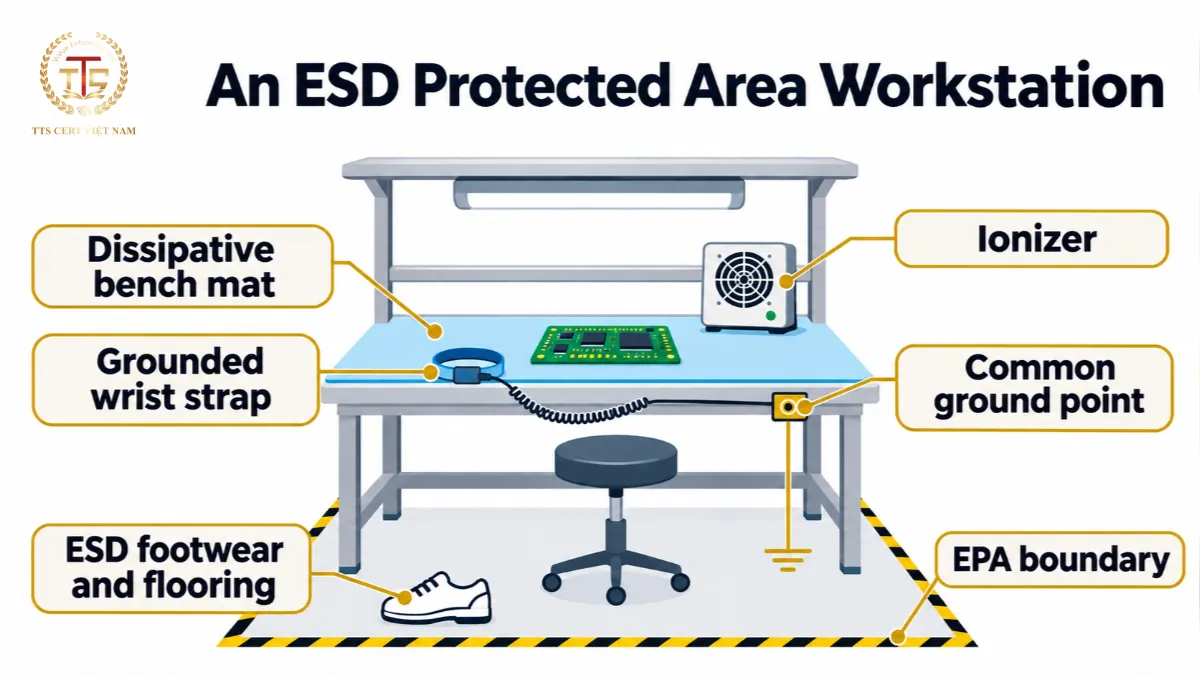
Specific limits (resistance, voltage) are set in the tables of the standard and must be stated in your program plan.
4. ESD Control Program Documents to Prepare
Appointment of the ESD coordinator
ESD Control Program Plan (scope, procedures, EPA layout)
Tailoring list with technical justification
Training plan, materials and individual training records
Product qualification records (test reports, technical reports)
Compliance verification plan: items, frequency, methods, limits
Periodic verification records and daily wrist strap and footwear checks
Calibration or verification records for test equipment
Packaging and marking rules
Nonconformity and internal audit records
5. ANSI/ESD S20.20 vs IEC 61340-5-1
| Topic | ANSI/ESD S20.20 | IEC 61340-5-1 |
|---|---|---|
| Publisher | ESDA (ANSI-accredited standards developer) | IEC Technical Committee 101 |
| Current version | 2021 | 2024 (edition 3.0) |
| Scope and thresholds | ≥100 V HBM, ≥200 V CDM, isolated conductors <35 V | Equivalent |
| Companion documents | ESD TR53 (compliance verification), ANSI/ESD S541 (packaging), ANSI/ESD test methods | IEC TR 61340-5-2 (user guide), IEC 61340-5-3 (packaging), IEC 61340-5-4 (compliance verification) |
| Facility certification | ESDA's facility certification program audits to either standard |
Which should you choose? The two are technically equivalent. Follow the standard named in your customer's contract or supplier requirements. If none is specified, TTS Cert can build a program that meets both.
6. The ANSI/ESD S20.20 Certification Process
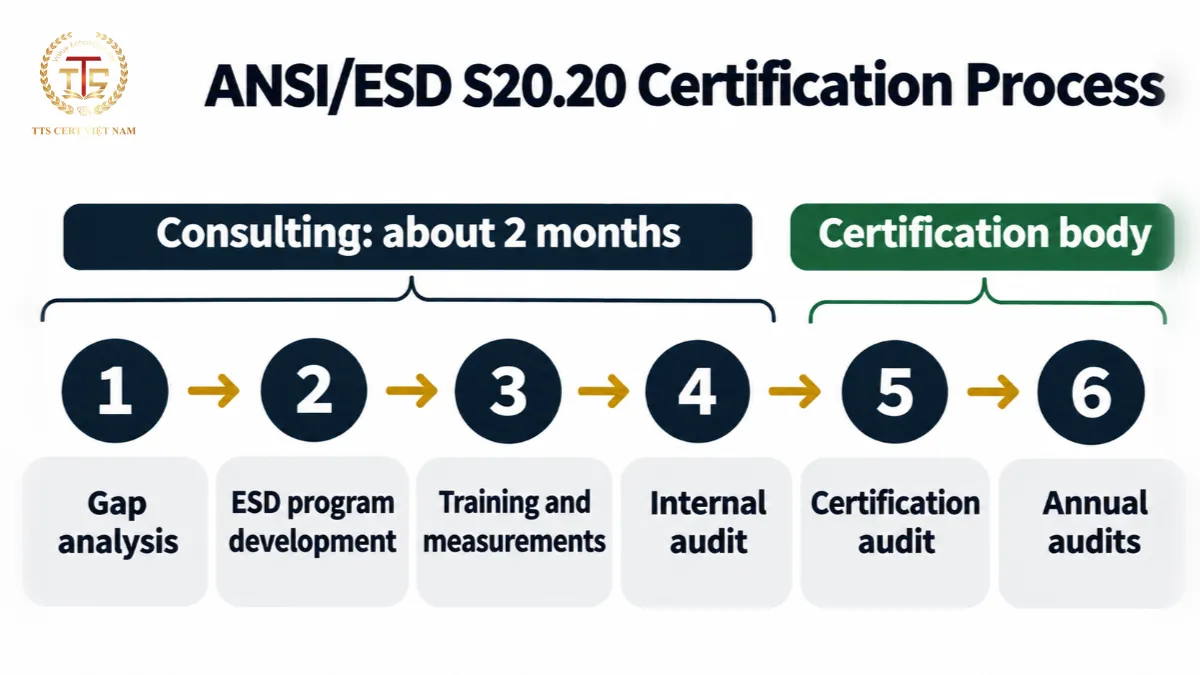
Consulting phase (TTS Cert)
Site survey and gap analysis.
Implementation plan; define EPAs, controlled items and tailoring.
Develop the ESD Control Program Plan and supporting documents.
Train the coordinator, verification technicians and operators.
Baseline measurements, compliance verification plan and trial run.
Internal audit and corrective action before the certification audit.
Certification phase
Apply to a certification body on ESDA's approved list.
The certification body's assessors (trained by ESDA) review documents and audit the site.
Close any nonconformities; the certification body decides and issues the certificate.
Annual audits maintain certification.
Certification covers one facility, or nearby buildings in the same line of business under common management. Additional locations require additional audits.
Timeline
The consulting phase typically takes about 2 months. If you need it sooner, TTS Cert can add resources to shorten the schedule. Actual timing also depends on your ESD infrastructure, document readiness and the certification body's schedule.
Cost factors
Plant size, number of EPAs and production lines.
Number of sites to certify.
Current infrastructure: flooring, workbenches, grounding, ionizers, packaging.
Number of people to train.
Audit and certification fees charged by the certification body.
Get an S20.20 roadmap for your plant:
7. Common Audit Findings
Incomplete training records: missing recurrent training, or new staff working in the EPA before training.
Compliance verification not following the plan: wrong frequency or method, or out-of-limit results not acted on.
Missing product qualification: "anti-static" mats, footwear or packaging used without evidence they meet requirements.
Insulators in the EPA: plastic bags, cups, paperwork or packaging placed next to ESDS items.
Unjustified tailoring: requirements dropped without a technical reason.
Plan out of date: EPA layouts and equipment lists not matching the site.
8. How TTS Cert Supports You
TTS Cert provides full consulting to ANSI/ESD S20.20 and IEC 61340-5-1:
Gap analysis against the standard.
ESD control program development: plan, procedures, forms and justified tailoring.
Training for ESD coordinators, verification technicians and operators.
Measurements and compliance verification planning.
Internal audits and corrective action follow-up.
Certification audit support and closing nonconformities afterwards.
TTS Cert also runs ESD training courses for companies building in-house capability.
TTS Cert works with reputable domestic and international certification bodies, connecting businesses with professional audit and certification services to help them:
Meet the technical requirements of customers and the global electronics supply chain.
Strengthen brand reputation, image and competitiveness.
Access promising export markets.
Reduce the risk of component damage and quality complaints.
For ANSI/ESD S20.20, TTS Cert works with certification bodies on ESDA's approved list.
TTS Cert is a consultancy. Audits, certification decisions and certificates are issued by the certification body.
9. Frequently Asked Questions
Is ANSI/ESD S20.20 required by law? No. It is a voluntary standard, but customers in the electronics industry commonly require it from suppliers.
Who issues ANSI/ESD S20.20 certificates? Certification bodies on ESDA's approved list. Their assessors are trained by ESDA.
Does TTS Cert issue certificates? No. TTS Cert is a consultancy that helps you prepare for and achieve certification.
How often is re-assessment required? The certification body audits annually to maintain certification.
How long does consulting take? Typically about 2 months. It can be shortened if you need it sooner, depending on your site.
Should we choose ANSI/ESD S20.20 or IEC 61340-5-1? They are technically equivalent. Follow your customer's requirement; ESDA's facility certification program accepts both.
Does one certificate cover several factories? A certificate covers one facility, or nearby buildings in the same line of business under common management. Other locations need additional audits.
Does TTS Cert offer ESD training? Yes. TTS Cert runs ESD training courses and also trains your team during the consulting project.
10. Conclusion
ANSI/ESD S20.20 helps electronics businesses control ESD risk systematically and prove it to customers. The hard part is rarely buying anti-static equipment; it is writing the right plan, proving that products meet requirements, and keeping up verification and training. Start with a gap analysis to see what needs to change before booking the certification audit.
References
ESDA – ANSI/ESD S20.20-2021
IEC 61340-5-1:2024 (Ed. 3.0) – IEC Webstore
ESDA – ESD TR53-01-22