
Table of contents
CTPAT benefits are often associated with fewer U.S. customs examinations, priority processing, and stronger international supply chain security. However, these benefits do not automatically apply to every company exporting products to the United States.
For Vietnamese manufacturers, it is essential to distinguish between official CTPAT membership benefits granted to eligible participants by U.S. Customs and Border Protection (CBP) and the practical advantages of meeting CTPAT-aligned security requirements imposed by U.S. customers.
Can factories in Vietnam obtain CTPAT certification directly? Does passing a customer security audit provide customs privileges? What should manufacturers prepare to meet buyer expectations?
This guide from TTS Cert Vietnam explains the key benefits, eligibility requirements, and practical steps for improving supply chain security.
1. What Is CTPAT and Why Does It Matter?
CTPAT stands for Customs Trade Partnership Against Terrorism, a voluntary public-private supply chain security partnership administered by U.S. Customs and Border Protection (CBP).
Established in 2001, the program encourages eligible businesses to identify security risks, implement preventive controls, and protect international supply chains against terrorism, smuggling, unauthorized access, and other unlawful activities.
CTPAT promotes a risk-based approach to supply chain security.
Participating companies are expected to maintain appropriate security measures and work with their business partners to address vulnerabilities across international trade operations.
For Vietnamese manufacturers, CTPAT is particularly relevant because U.S. importers participating in the program may require their overseas suppliers to demonstrate effective security practices.
These requirements may cover:
Physical security at factories, warehouses, and shipping areas.
Employee, visitor, contractor, and vehicle access control.
Container inspection and seal management.
Security screening of relevant business partners.
Personnel security, cybersecurity, and information protection.
Risk assessments, security awareness training, and incident management.
Meeting applicable requirements can help Vietnamese factories improve security readiness and demonstrate compliance with customer expectations.
For a full overview of the programme, the 12 security criteria categories and the factory audit process, see What Is CTPAT? Security Criteria and CTPAT Audits for Factories in Vietnam.
2. What Are the Official Benefits of CTPAT Membership?
According to CBP, eligible companies accepted into the CTPAT program may receive a range of benefits depending on their membership category, status, and applicable conditions.
2.1. Reduced Customs Examinations
CTPAT members are considered lower-risk trade partners by CBP.
As a result, shipments associated with eligible members may be less likely to be selected for customs examinations.
This is one of the most widely recognized benefits of the program.
However, CTPAT membership does not guarantee that every shipment will be exempt from inspection.
CBP retains the authority to examine shipments based on applicable regulations, available information, and risk assessments.
There is no universal customs examination rate guaranteed to all CTPAT members.
2.2. Priority Processing and Trade Facilitation
Eligible members may receive front-of-the-line inspections and other applicable trade facilitation benefits.
Certain qualified participants may also access Free and Secure Trade (FAST) lanes at designated U.S. land border crossings with Canada and Mexico.
FAST benefits depend on specific eligibility and transportation requirements.
They should not be presented as privileges automatically available to Vietnamese factories exporting goods to the United States by sea.
2.3. Access to CBP Security Resources
CTPAT members may receive support from an assigned Supply Chain Security Specialist.
They may also access program guidance, training resources, and relevant information through CBP's CTPAT systems.
These resources can help participating businesses maintain and improve their security programs.
2.4. Business Resumption Benefits
CBP identifies business resumption priority following certain natural disasters or terrorist incidents as a potential CTPAT membership benefit.
The actual implementation of this benefit depends on the circumstances and applicable CBP procedures.
2.5. Access to Additional Programs
Depending on eligibility, CTPAT members may benefit from mutual recognition arrangements with participating foreign customs administrations or qualify for other initiatives.
For example, eligible importers may apply for the CTPAT Trade Compliance Program, subject to additional requirements.
These privileges are conditional and should not be interpreted as benefits automatically granted to all foreign manufacturers or exporters.
3. Can Vietnamese Factories Obtain CTPAT Certification Directly?
This is an important question for companies manufacturing products in Vietnam for the U.S. market.
Under CBP's published Foreign Manufacturer Eligibility Requirements, applicants in the Foreign Manufacturer category must be active manufacturers incorporated in Mexico or Canada, in addition to meeting other program conditions.
Therefore, a manufacturing company incorporated in Vietnam is not eligible for direct CTPAT membership under the Foreign Manufacturer category simply because it exports goods to the United States.
A business with a separate legal entity or activities falling within another membership category would need to assess its eligibility under the requirements applicable to that category.
Why Do U.S. Customers Still Request CTPAT Audits in Vietnam?
U.S. importers participating in CTPAT may need to manage security risks involving their overseas suppliers and other supply chain partners.
Consequently, Vietnamese factories may be asked to:
Complete a CTPAT security self-assessment.
Provide security policies, procedures, and supporting records.
Undergo a customer-requested or third-party supply chain security assessment.
Implement corrective actions for identified gaps.
Maintain and continuously improve their security controls.
Passing a customer-requested security audit does not automatically make the Vietnamese factory a CBP-certified CTPAT member.
Nevertheless, these activities can deliver valuable operational and commercial benefits.
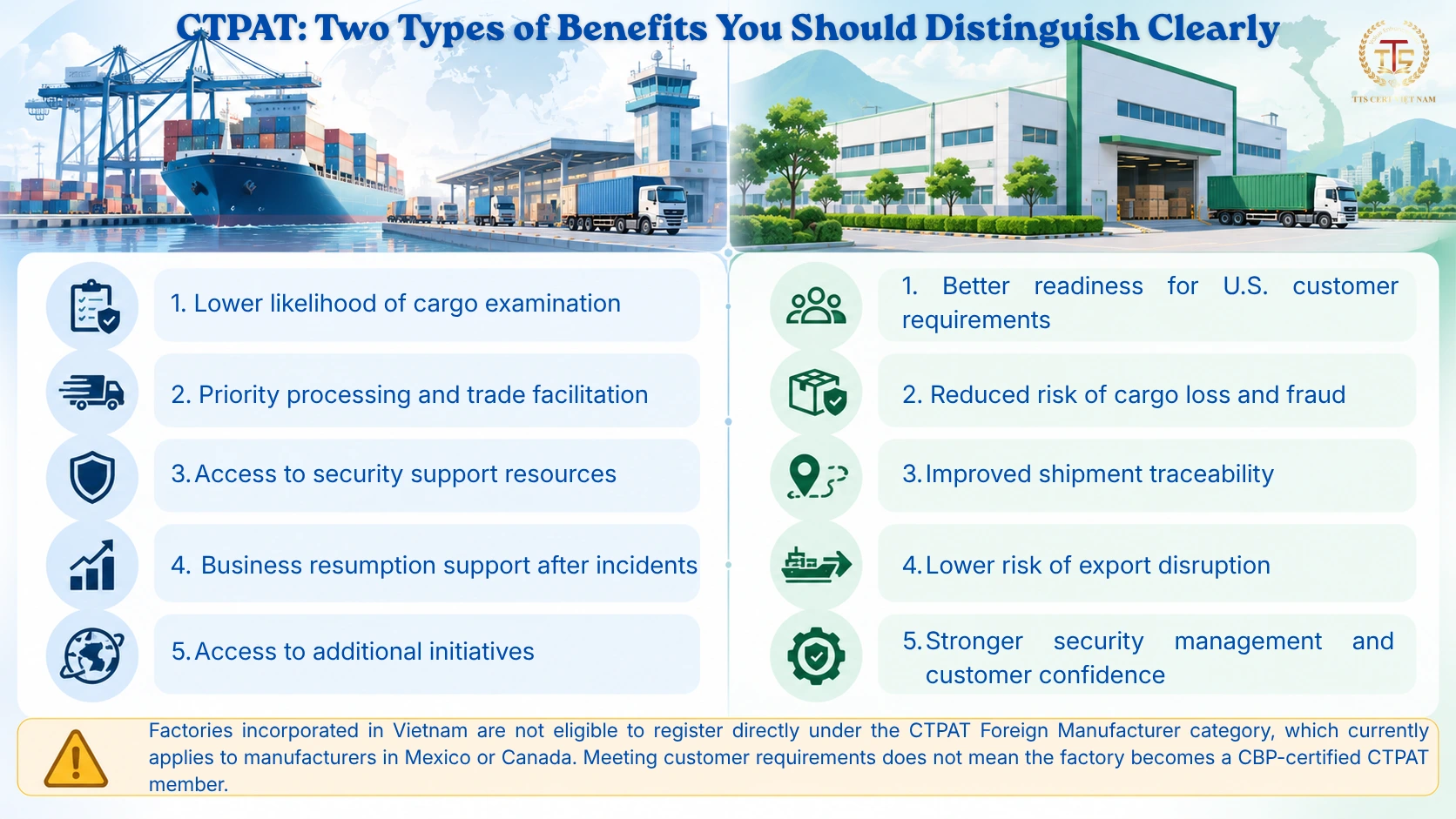
4. Five Practical CTPAT Benefits for Vietnamese Manufacturers
For most Vietnamese factories, the key value of CTPAT-aligned security practices lies in meeting buyer requirements, protecting shipments, and improving operational resilience.
4.1. Stronger Readiness for U.S. Buyer Requirements
Some U.S. importers, retailers, and brands include supply chain security requirements in their supplier qualification and monitoring processes.
Factories may be required to provide self-assessment questionnaires, documented security procedures, and evidence of implementation.
Establishing a structured security management approach can help manufacturers:
Respond more effectively to buyer assessment requirements.
Reduce preparation time before security audits.
Strengthen customer confidence.
Maintain consistent security practices during ongoing business relationships.
This is particularly relevant to garment, footwear, electronics, furniture, and other manufacturing industries exporting to the United States.
4.2. Reduced Risk of Cargo Loss and Unauthorized Access
CTPAT-aligned security measures help factories identify vulnerabilities in warehousing, container loading, cargo handling, and transportation.
Practical controls may include:
Restricting access to sensitive shipping areas.
Conducting container inspections before loading.
Monitoring loading and dispatch activities.
Controlling and recording container seals.
Establishing procedures for reporting suspicious activity.
These measures can help reduce exposure to cargo theft, tampering, unauthorized access, and other security incidents.
Their effectiveness depends on proper implementation, monitoring, and corrective action.
4.3. Improved Shipment Integrity and Traceability
Effective supply chain security requires clear controls over how goods are handled, protected, and transferred.
A Vietnamese export factory may implement a shipment security process covering:
Verification of vehicle and carrier information.
Container and security condition inspections.
Controlled loading operations.
Verification and recording of container seals.
Cross-checking shipment documentation.
Retention of records for traceability and investigation.
A consistent process can help factories verify shipment information, investigate discrepancies, and identify responsibilities when incidents occur.
4.4. Lower Risk of Export Disruptions
Cargo loss, seal discrepancies, unauthorized access, and documentation irregularities may result in investigations, additional handling, or shipment disruption.
Implementing appropriate security measures can help businesses detect problems earlier and respond more effectively.
This may reduce certain losses and operational interruptions associated with security incidents.
However, completing a customer-requested CTPAT assessment does not automatically guarantee faster customs clearance, lower demurrage charges, or reduced logistics costs in the United States.
Any financial benefits depend on actual operational improvements and supply chain arrangements.
4.5. Better Security Management and Long-Term Customer Confidence
CTPAT-aligned practices encourage businesses to establish clear security responsibilities and consistent operating procedures.
Improvements may include:
Assigning responsible security personnel.
Conducting periodic risk assessments.
Providing security awareness training.
Monitoring the effectiveness of controls.
Implementing incident reporting and investigation procedures.
Tracking corrective and preventive actions.
These measures can strengthen operational discipline and help factories maintain readiness for future customer assessments.
5. CTPAT Security Audit Preparation Checklist for Vietnamese Factories
Before preparing for an assessment, manufacturers should identify the specific security criteria required by their customers and determine the applicable scope.
The following checklist provides a practical starting point.
| Security Area | Recommended Preparation |
|---|---|
| Security management | Establish security policies, responsibilities, and management commitment |
| Risk assessment | Identify security threats and relevant supply chain vulnerabilities |
| Physical security | Review fences, gates, surveillance, lighting, and sensitive areas |
| Access control | Manage employees, visitors, contractors, and vehicle access |
| Container security | Maintain inspection, seal-control, and loading procedures |
| Cargo security | Control warehousing, handling, dispatch, and shipment records |
| Business partners | Apply risk-based screening and monitoring of relevant partners |
| Personnel security | Manage access privileges and appropriate personnel checks |
| Cybersecurity | Protect business systems, credentials, and shipment information |
| Training and incident response | Maintain training, incident reporting, and corrective action records |
Supporting evidence may include security risk assessments, container inspection checklists, training records, access logs, equipment maintenance records, and incident reports.
This checklist is intended as an introductory guide. It does not replace the full applicable CTPAT Minimum Security Criteria (MSC) or customer-specific audit requirements.

Is Your Factory Ready for a CTPAT Security Assessment?
TTS Cert Vietnam supports manufacturers in reviewing customer requirements, identifying security gaps, improving security procedures, and preparing for supply chain security assessments.
6. How to Prepare for a CTPAT Security Assessment
Manufacturers can follow four practical steps to improve their assessment readiness.
Step 1. Identify Applicable Requirements
Confirm the customer's assessment protocol, security criteria, scope, responsible assessment organization, and required completion date.
This prevents confusion between a supplier security assessment and the official CBP membership application process.
Step 2. Conduct a Gap Assessment
Review factory operations, security arrangements, documentation, and existing controls against the applicable requirements.
Potential gaps may involve container inspections, physical security, access control, employee training, or supply chain risk assessment procedures.
Step 3. Implement Security Controls
Develop or improve the required policies, procedures, records, and operational safeguards.
Relevant employees should receive training appropriate to their responsibilities.
Documentation alone is not sufficient; factories must be able to demonstrate that security controls are implemented in practice.
Step 4. Perform a Readiness Review
Before the scheduled customer assessment, conduct an internal review of documents and actual factory conditions.
Any outstanding issues should be addressed, and the effectiveness of corrective actions should be verified.
7. How TTS Cert Vietnam Supports CTPAT Audit Readiness
TTS Cert Vietnam provides consulting, training, and implementation support for Vietnamese manufacturers seeking to strengthen supply chain security and prepare for applicable customer assessments.
Our support may include:
Security Gap Assessment
Review current factory operations, security practices, procedures, and records to identify gaps against applicable requirements.
Documentation and Procedure Development
Support the development or improvement of security policies, risk assessments, container inspection procedures, access controls, and incident management processes.
Employee Training
Provide practical training to personnel responsible for security, warehousing, logistics, human resources, and relevant management functions.
Pre-Audit Readiness Review
Review records, verify practical implementation, and support corrective actions before a scheduled customer or independent security assessment.
TTS Cert Vietnam provides advisory and readiness support. Official CTPAT membership certification and program validation remain under CBP's authority for eligible applicants.
8. Frequently Asked Questions About CTPAT Benefits
Is CTPAT mandatory for Vietnamese exporters?
No. CTPAT is a voluntary CBP program, not a universal legal requirement for companies exporting goods from Vietnam to the United States.
However, individual customers may establish CTPAT-aligned security requirements as part of their supplier qualification processes.
Can a factory in Vietnam obtain CTPAT certification directly from CBP?
A manufacturer incorporated in Vietnam does not qualify under CBP's published Foreign Manufacturer eligibility criteria, which specify manufacturers incorporated in Mexico or Canada.
Eligibility under another membership category must be evaluated separately where relevant.
Is a customer-requested CTPAT audit the same as a CBP validation?
No. Customer-requested or third-party security assessments are separate from the official CBP certification and validation processes for eligible CTPAT members.
Does passing a CTPAT security audit guarantee faster U.S. customs clearance?
No. Meeting customer security requirements does not independently provide the factory with customs privileges reserved for eligible CTPAT members.
Does CBP charge a fee to join CTPAT?
CBP states that CTPAT participation is voluntary and that there is no fee to join the program.
However, businesses may incur separate costs for consulting, training, security improvements, or customer-requested assessments.
What should factories prepare before a CTPAT audit?
Manufacturers should begin by confirming the applicable assessment criteria, conducting a security gap assessment, establishing responsibilities, preparing supporting documents, and verifying operational implementation.
9. Conclusion: Focus on the CTPAT Benefits That Apply to Your Business
CTPAT offers meaningful customs and trade facilitation benefits to eligible participants in CBP's official program.
For Vietnamese factories, however, the most practical benefits generally involve stronger supply chain security, improved buyer audit readiness, better shipment traceability, and more consistent security management.
Understanding these differences enables manufacturers to invest in appropriate security improvements without relying on unrealistic expectations regarding customs privileges.
TTS Cert Vietnam supports manufacturers throughout their CTPAT assessment preparation process, from security gap assessment and documentation development to employee training and pre-audit readiness.
Official References
- U.S. Customs and Border Protection – CTPAT Program: https://www.cbp.gov/border-security/ports-entry/cargo-security/CTPAT
- CBP – Foreign Manufacturer Eligibility Requirements: https://www.cbp.gov/sites/default/files/documents/fm_eligibility_requirements_english_3.pdf

Expert Pham Van Chien has nearly 20 years of experience in quality management, information security and product technical standards.
SEE MORE