Table of contents
“What is Higg FEM?” is a question of growing interest to many factories when customers, brands, or international corporations require data on energy, greenhouse gas emissions, water, wastewater, waste, and chemicals.
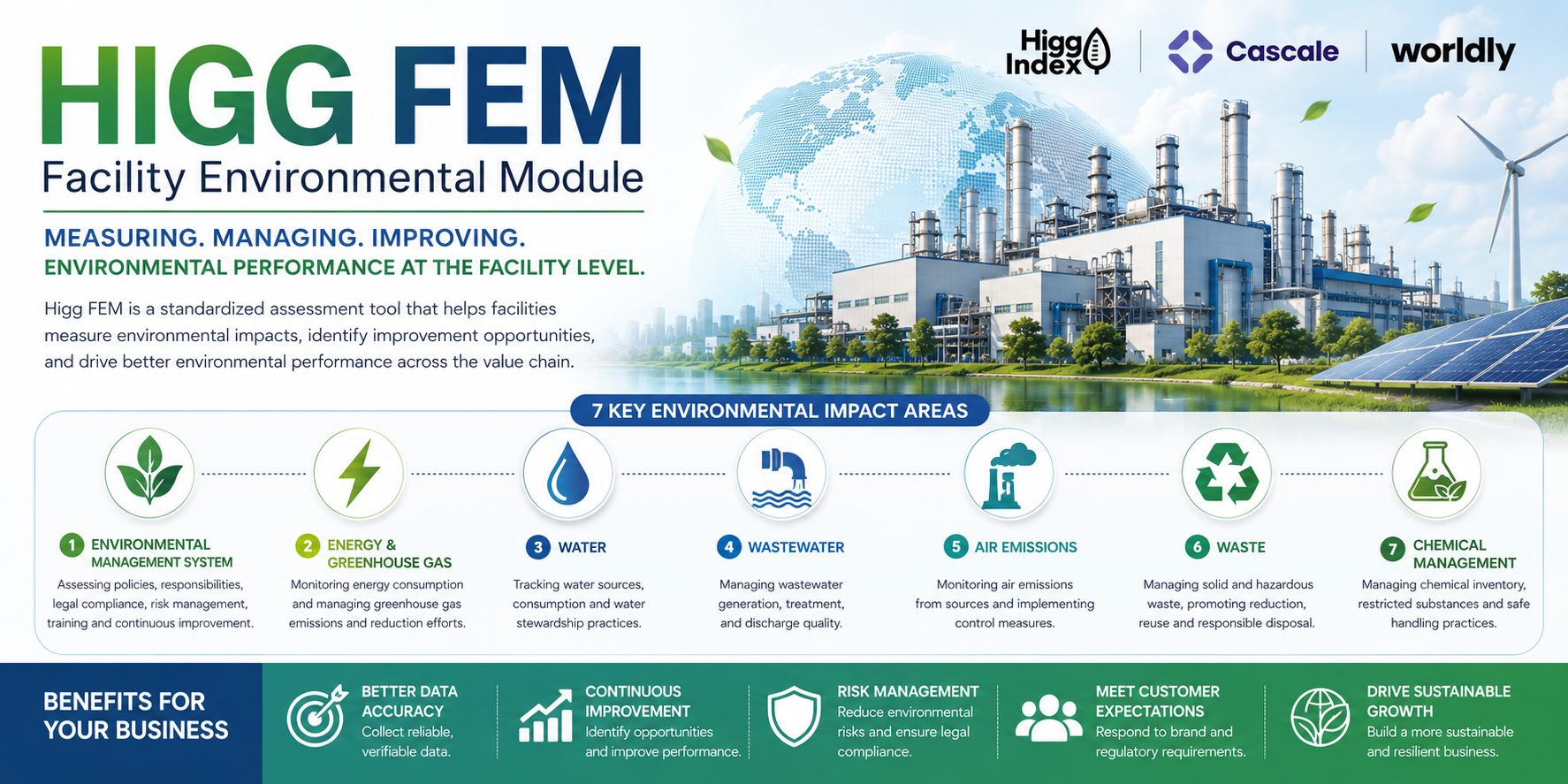
Higg FEM, short for the Higg Facility Environmental Module, is a tool used to assess environmental performance at the facility level. It helps factories collect data in a standardized structure, identify gaps, and develop environmental improvement plans based on actual data.
Higg FEM is part of the Higg Index suite of tools. Its methodology is developed and managed by Cascale, formerly known as the Sustainable Apparel Coalition. Companies complete and share assessments through the Worldly platform.
For textile, apparel, footwear, leather, bags, accessories, and other suppliers in consumer-goods supply chains, Higg FEM not only helps meet customer requirements but also supports the management of resource costs, legal risks, and sustainability objectives.
Important clarification: Higg FEM is an environmental performance assessment module. It is not a management-system certification with a three-year certification cycle like ISO 14001.
1. What Is Higg FEM?
Higg FEM is a module designed to assess the environmental impacts generated by a manufacturing facility’s operations.
Through a structured questionnaire and quantitative data, Higg FEM helps companies comprehensively review how their facilities manage:
Environmental management systems.
Energy and greenhouse gas emissions.
Water sources and water consumption.
Wastewater.
Air emissions.
Waste.
Chemicals.
Higg FEM does not simply check whether a facility has documents. It also evaluates whether the company has established baselines, set targets, monitored results, and demonstrated improvement over time.
Cascale identifies seven key Higg FEM impact areas: environmental management systems, energy and greenhouse gas emissions, water, wastewater, air emissions, waste, and chemical management.
How Is Higg FEM Different from the Higg Index?
The Higg Index is the name of the entire suite of sustainability assessment tools used across the value chain.
Higg FEM is only one module within the Higg Index and focuses specifically on environmental performance at the facility level.
Accordingly:
| Term | Meaning |
|---|---|
| Higg Index | A suite of sustainability assessment tools for the value chain |
| Higg FEM | Environmental assessment at the manufacturing-facility level |
| Higg FSLM | Assessment of labor conditions and social responsibility at the facility level |
| Worldly | The platform companies use to complete and share assessments |
| Cascale | The organization that develops and manages the Higg Index methodology |
2. What Is Higg FEM 4.0?
Higg FEM 4.0 is the methodology version introduced for the 2023 reporting cycle. This version expanded data-collection requirements, improved data accuracy, and strengthened alignment with international environmental and greenhouse gas frameworks.
Although the methodology is called Higg FEM 4.0, the module on Worldly is updated for each reporting cycle, for example:
FEM 2024.
FEM 2025.
Subsequent FEM cycles.
This means companies need to distinguish between:
Methodology version: Higg FEM 4.0.
Reported data year: FEM 2025, FEM 2026, or the corresponding cycle.
Assessment completion and publication date: usually during the following year.
Note on the FEM 2025 Cycle in 2026
Higg FEM 2025 has been launched on Worldly for companies to report their 2025 operating data. Facilities may publish results from January 1, 2026. April 30 remains an industry-recommended milestone rather than a universal mandatory deadline on the platform. However, customers or brands may establish their own deadlines for suppliers.
3. Is Higg FEM a Certification?
Higg FEM is not a pass-or-fail certification standard.
The Higg FEM process normally includes two components:
Self-Assessment: The facility declares its information and data on Worldly.
Verification: A qualified verifier or verification body checks the accuracy of the declared information.
After completing the module, a company may download a document confirming assessment completion from Worldly. If the assessment has been verified, the system may provide additional documentation relating to the verification results. However, these documents should not be understood in the same way as an ISO certificate issued by a certification body.
More technically accurate terms include:
Completed Higg FEM assessment.
Higg FEM self-assessment results.
Verified Higg FEM results.
Higg FEM verification.
The phrase “Higg FEM certification” is commonly used in online searches, but technically Higg FEM is a tool for assessing and verifying environmental data.
4. Which Companies Need to Complete Higg FEM?
Higg FEM is widely used in consumer-goods supply chains, particularly by manufacturing facilities whose customers are brands, retailers, or international corporations.
The types of companies commonly required to complete Higg FEM include:
Garment factories.
Textile, dyeing, and finishing factories.
Yarn-manufacturing facilities.
Leather and tannery facilities.
Footwear factories.
Bag and accessory factories.
Printing, embroidery, washing, and finishing facilities.
Raw-material and component suppliers.
Consumer-goods manufacturing facilities in brand supply chains.
Cascale describes Higg FEM as a tool for assessing the environmental impacts of product manufacturing activities at the facility level. It is used across the consumer-goods industry and is not limited to garment factories.
Is Higg FEM Mandatory?
Higg FEM is not an environmental permit or a legal requirement that applies universally to every company.
However, it may become a commercial requirement when:
A customer includes Higg FEM in its supplier code of conduct.
A brand requires a facility to complete FEM annually.
A customer requires the results to be verified.
A facility participates in a corporation’s environmental improvement program.
A company needs to share standardized environmental data with multiple customers.
Therefore, a requirement that is voluntary under the law may become necessary for maintaining orders or participating in a supply chain.
5. Scope of a Higg FEM Assessment
Higg FEM is a facility-level assessment. Its scope must cover all operations at the site that fall under the applicable business or operating licenses.
A company should not select only a convenient production line or exclude areas with significant environmental impacts from the assessment scope.
Under current guidance, facilities located at two different physical addresses generally need separate FEM modules, even when they have the same owner. Whether one or multiple modules are required also depends on the legal entity, location, permits, and operational relationships between the units.
Before starting, the company should clearly identify:
The legal entity completing FEM.
The facility address and assessment boundary.
Production activities included in the scope.
Supporting areas, warehouses, boilers, generators, and treatment systems.
Contractors or other entities operating at the same location.
Production and environmental data included in the reporting scope.
Incorrectly defining the scope can cause inconsistencies in energy, water, waste, and emissions data, leading to difficulties during verification.
6. Seven Key Areas Assessed in Higg FEM
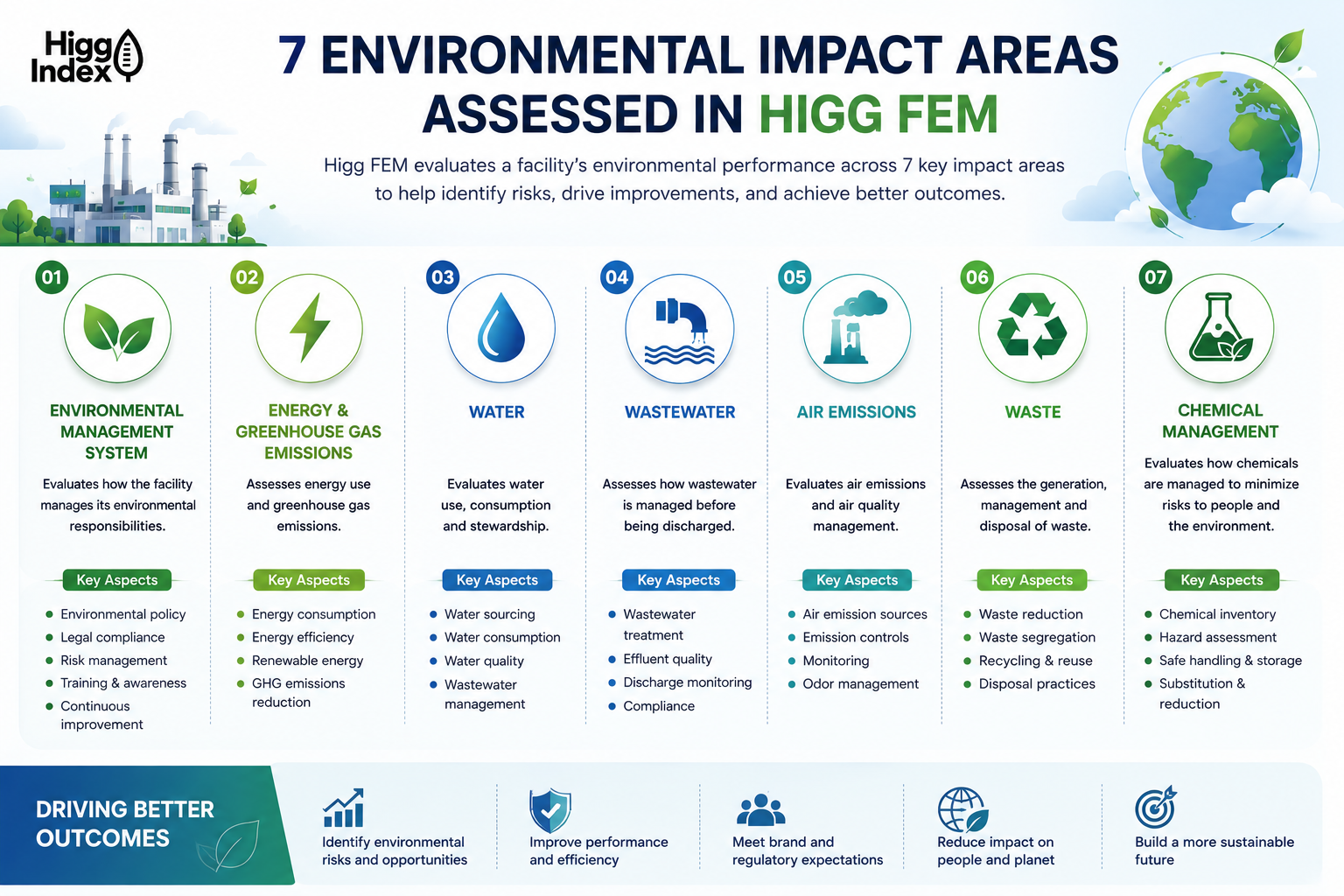
The seven main environmental areas assessed in Higg FEM
6.1. Environmental Management System
The Environmental Management System, or EMS, section examines how the company organizes and controls environmental matters.
The facility should be able to demonstrate:
Responsibilities and authority of the environmental function.
A mechanism for identifying legal requirements.
Environmental risk and impact assessments.
Environmental policies and objectives.
Employee training programs.
Monitoring, inspection, and improvement mechanisms.
Communication with employees and relevant stakeholders.
Higg FEM considers an EMS to be a comprehensive approach to identifying, monitoring, and managing a facility’s environmental impacts over time.
6.2. Energy and Greenhouse Gas Emissions
This section evaluates how the facility identifies, measures, and manages energy sources, including:
Purchased grid electricity.
Fuel used for boilers.
Diesel used for generators.
Natural gas, LPG, or other fuels.
Purchased steam, heat, or energy.
Renewable energy generated onsite or purchased.
The company should maintain consumption data, conversion methods, baselines, targets, and plans to reduce energy use or greenhouse gas emissions.
The important point is not simply having electricity or fuel invoices. The facility must demonstrate that the data is complete, consistent with the assessment scope, and traceable to its source.
6.3. Water Management
The water-management section examines:
The water sources used by the facility.
Water consumption during the reporting period.
Whether production activities use water.
Water-source risks in the local area.
Water baselines and reduction targets.
Water reuse and recycling solutions.
Higg FEM classifies water sources and requires facilities to select the sources that accurately reflect actual operations.
6.4. Wastewater Management
For wastewater, the company should identify:
Domestic and industrial wastewater sources.
The quantity of wastewater generated.
Onsite or offsite treatment methods.
Discharge points.
Permits and applicable legal requirements.
Monitoring or testing results.
Sludge generated by wastewater-treatment systems.
Emergency-response plans for treatment-system failures.
Higg FEM guidance requires facilities to identify wastewater sources, monitor generated quantities, comply with discharge requirements, and ensure that treatment systems are properly designed and operated.
6.5. Air Emissions
The facility should fully identify air-emission sources from:
Boilers.
Generators.
Incinerators or heating equipment.
Painting, printing, and solvent-use activities.
Dust-extraction systems.
Production processes that generate vapor, dust, or volatile organic compounds.
Fugitive emission sources.
The company should demonstrate applicable permits, monitoring activities, test results, and appropriate control measures.
Higg FEM encourages facilities to identify emission sources and pollutants, comply with legal requirements, monitor emissions, and consider suitable technologies to reduce impacts.
6.6. Waste Management
The waste section requires the facility to manage:
General waste.
Recyclable waste.
Hazardous waste.
Sludge.
Packaging and scrap.
Waste from canteens, offices, and supporting areas.
The company should maintain an inventory of waste sources, quantities, storage methods, treatment providers, transfer records, and targets for improving treatment methods.
Higg FEM requires facilities to disclose current waste-disposal methods and plans to shift toward options with lower environmental impacts.
6.7. Chemical Management
The chemical-management section may include:
Chemical inventory.
Safety Data Sheets.
Chemical classification.
Storage conditions.
Labeling and access control.
Restricted-substance management.
Chemical-supplier evaluation.
Training and emergency response.
Targets for replacing hazardous chemicals.
The scope of the questions depends on the facility’s operations and level of chemical use. The Higg FEM chemical-management section was developed with contributions from Cascale, the Outdoor Industry Association, and the ZDHC program.
7. What Levels Are Included in Higg FEM?
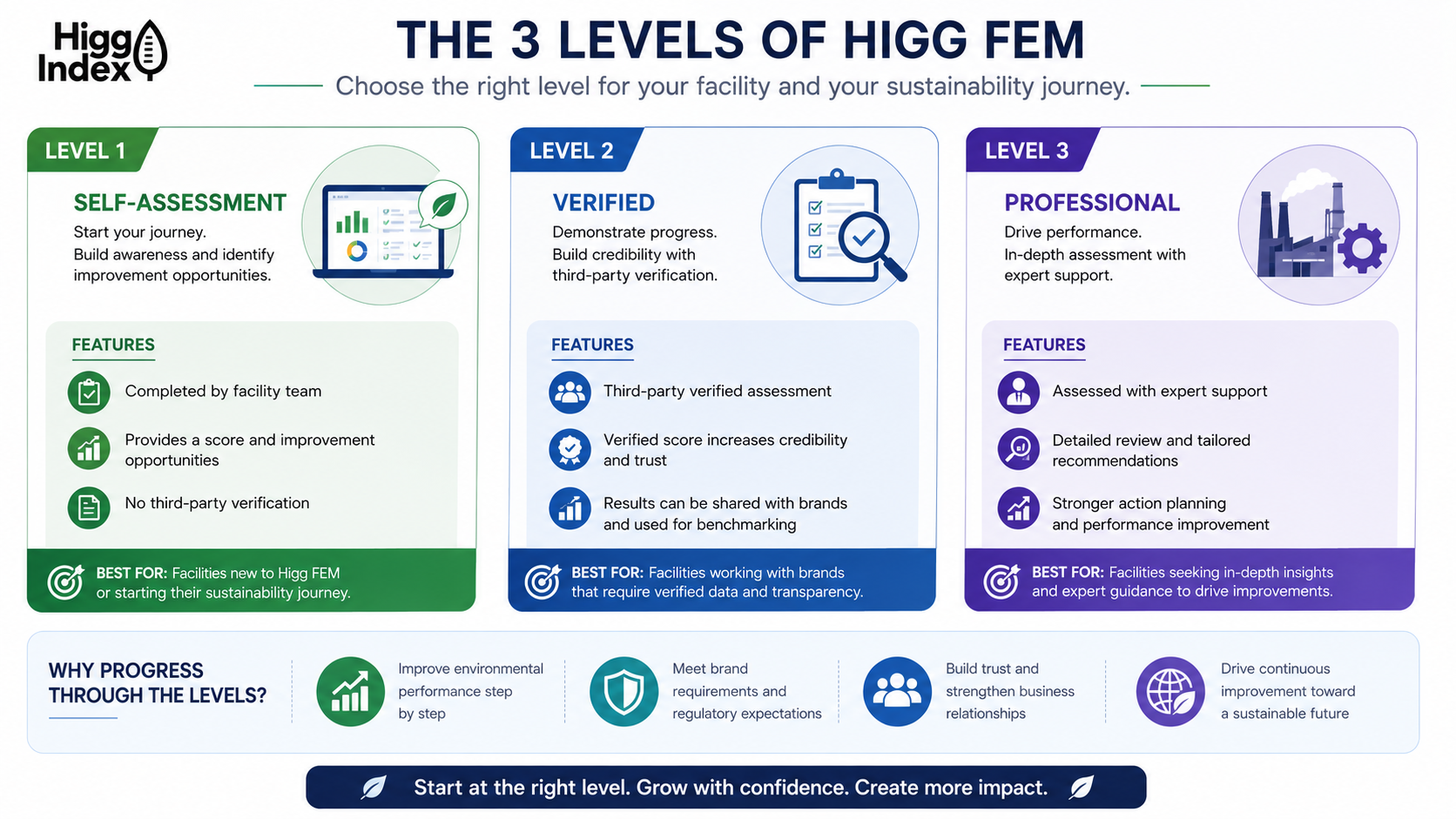
Higg FEM questions are organized into three levels of maturity.
| Level | Main Focus |
|---|---|
| Level 1 | Identify impact sources, meet basic compliance requirements, and build management systems |
| Level 2 | Establish baselines and targets and monitor improvement results |
| Level 3 | Apply advanced practices and move toward environmental leadership |
Level 1 – Identification and Basic Management
The facility needs to understand where its environmental impacts come from and demonstrate the availability of foundational data.
Examples include:
Identifying energy sources.
Tracking water consumption.
Creating a waste inventory.
Maintaining required permits.
Assigning responsible personnel.
Establishing management procedures.
Level 2 – Setting Targets and Improving Performance
The company needs to go beyond simply collecting data.
The facility should demonstrate:
Baselines.
Reduction targets.
Action plans.
Implementation results.
Methods for monitoring progress.
Corrective actions when targets are not achieved.
Level 3 – Advanced Practices
Level 3 focuses on more mature solutions, such as:
Long-term direction.
Advanced technologies or methods.
Supply-chain collaboration.
Science-based or strategic approaches.
Extending improvements beyond basic management boundaries.
Under the Higg FEM 4.0 scoring methodology, Level 1 accounts for 25%, Level 2 for 50%, and Level 3 for 25% of a section’s score, except in certain special cases. Level 2 carries the highest weighting because it focuses on targets and demonstrated performance improvement.
8. How Is Higg FEM Scored?
Higg FEM assesses seven environmental areas. Each section has its own scoring scale, and the results are combined into an overall FEM score.
When all seven sections apply, they are weighted equally. If one section does not apply to the facility, its weighting may be redistributed among the remaining sections.
Basic Scoring Principles
Scores may depend on:
Yes responses.
Partial Yes responses.
No responses.
Not Applicable responses.
Entered quantitative data.
Relationships between multiple questions.
Whether the facility has completed the requirements of the preceding level.
Not every question carries points. Some questions determine applicability or direct the facility to the appropriate question pathway.
If a facility has not fully met Level 1 requirements in a section, it may still answer Level 2 and Level 3 questions to identify improvement opportunities. However, those responses may not generate additional points until the progression requirements are met.
What Score Is Required to Pass Higg FEM?
Higg FEM does not establish a universal “passing” score for all facilities.
The required score or level usually depends on:
Customer requirements.
Individual brand programs.
The type and environmental impact level of the facility.
The previous year’s results.
Improvement targets agreed between the relevant parties.
Therefore, companies should not focus solely on increasing scores through questionnaire responses. The more important objective is to ensure that the data is accurate, supported by evidence, and reflects actual operations.
Read more: Higg FEM Scoring Guide
9. How Do Environmental Permits Affect the Higg FEM Score?
The facility-information and permit section does not directly award points. However, it is a foundational condition that can have a major impact on the final result.
Under current Higg FEM guidance, the entire FEM score may be zero if the facility:
Does not have a valid operating license.
Does not have a mandatory environmental permit without a valid explanation.
This reflects the principle that a company cannot receive recognition for advanced environmental performance if it has not met foundational legal requirements.
Before entering data, the company should review:
Business registration documents.
Operating licenses.
Applicable environmental documents.
Environmental permits.
Water-extraction or water-use permits, where applicable.
Wastewater-discharge records.
Environmental monitoring records.
Hazardous-waste management records.
Other legal requirements relevant to actual operations.
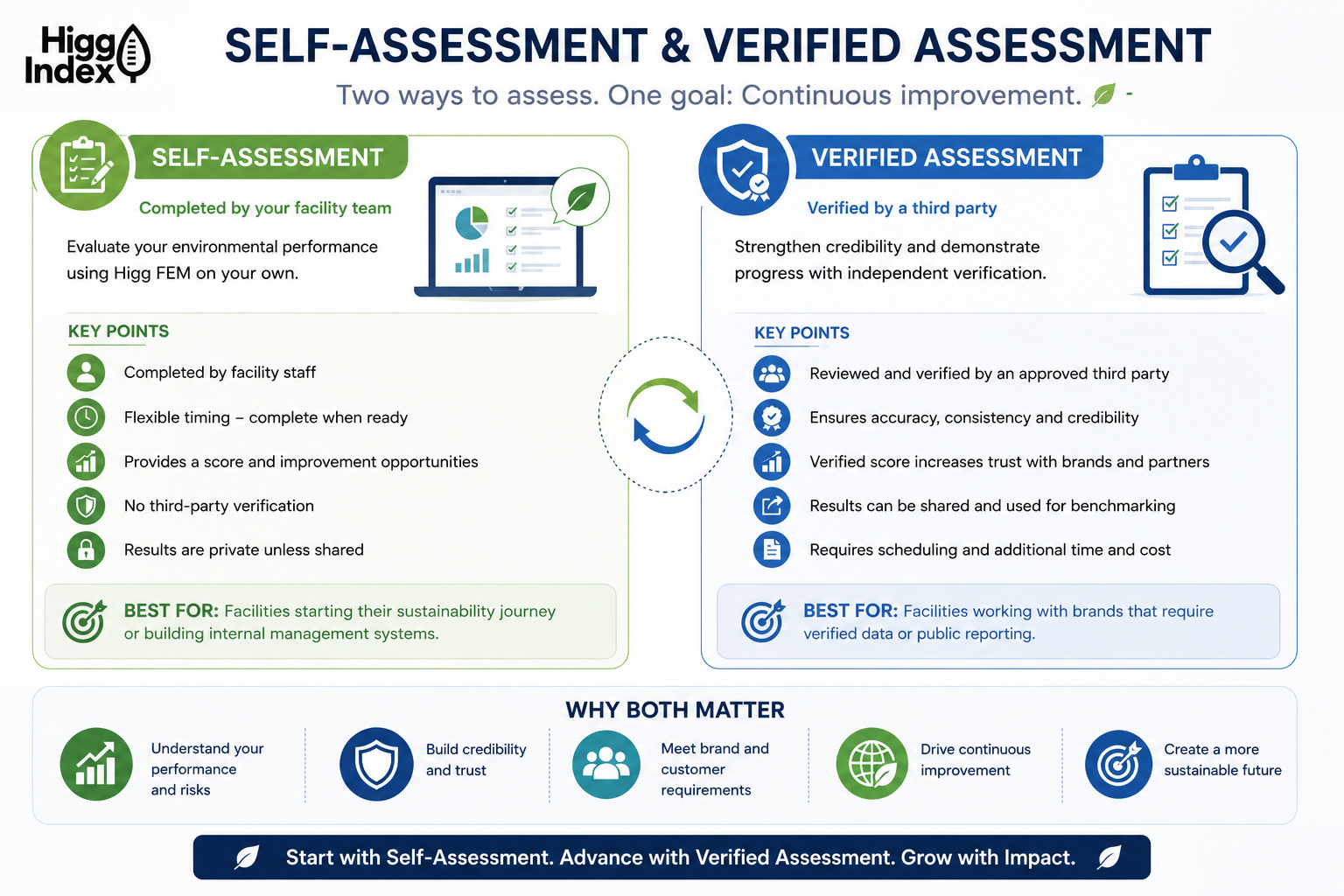
10. What Is the Difference Between Higg FEM Self-Assessment and Verification?
| Item | FEM Self-Assessment | FEM Verification |
|---|---|---|
| Performed by | The facility | A qualified verifier or verification body |
| Purpose | Declare environmental performance | Check the accuracy of declared data |
| Evidence | Prepared and entered by the facility | Reviewed against documents, data, and actual conditions by the verifier |
| Method | Completed on Worldly | May involve remote review or onsite assessment |
| Result | Self-assessment result | Result reviewed within the verification scope |
| Value when shared | Depends on customer requirements | Generally carries greater credibility when shared with partners |
Verification is not a consulting service intended to increase the score. Verifiers must remain independent and confirm whether the information declared by the facility is accurate.
Cascale requires verification to be performed by a qualified verifier or Verifier Body. Verification may include a desktop review or onsite verification at the facility.
Basic Verification Process
The facility completes and submits its self-assessment on Worldly.
The Verifier Body assigns a verifier.
The verifier reviews data, documents, and supporting evidence.
The facility provides explanations or additional evidence where necessary.
The verifier completes the verification on Worldly.
The facility reviews and publishes the verified results.
The results are shared with customers within the permitted scope.
This is the general process published by Cascale for the Higg FEM verification program.
Read more: Key Points to Consider When Completing Higg FEM Verification in 2026
11. Higg FEM Implementation Process at a Company
An effective implementation process can be divided into eight steps.
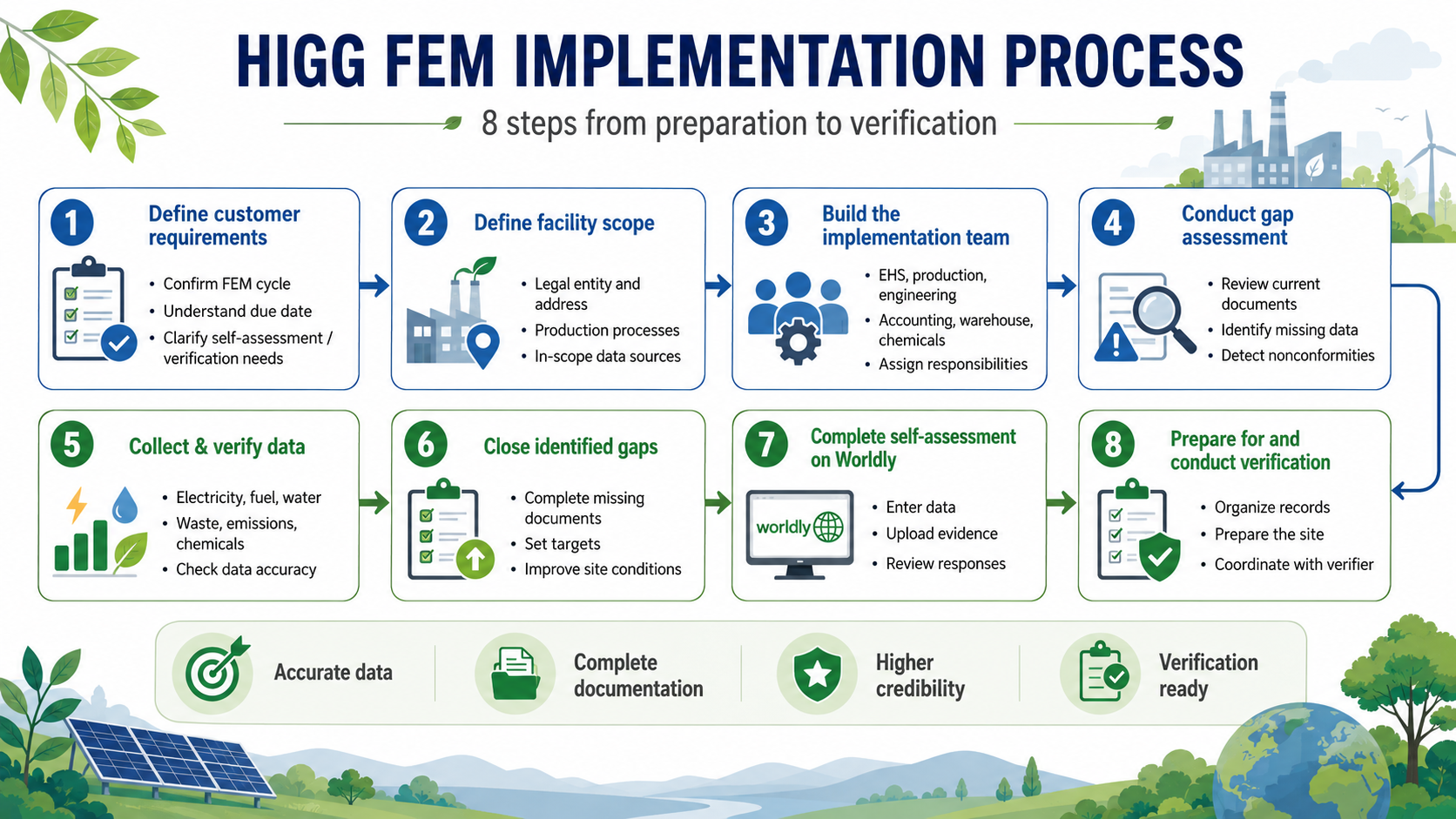
Step 1: Identify Customer Requirements
The company should clarify:
Whether the customer requires self-assessment or verification.
The data cycle to be reported.
The completion deadline.
The type of verification.
The scope or level required by the customer.
How the module should be shared on Worldly.
The company should not start entering data before fully understanding the customer’s requirements.
Step 2: Define the Facility Scope
The company should identify:
The legal entity.
The address.
Production activities.
Supporting areas.
Outsourced processes.
Data sources included in the scope.
Step 3: Establish the Implementation Team
A Higg FEM team normally includes representatives from:
Top management.
Environmental management.
Engineering.
Production.
Purchasing.
Chemical management.
Warehouse management.
Human resources and training.
Accounting or invoice-management functions.
Information technology or data-management functions.
Higg FEM should not be assigned entirely to one environmental employee because relevant data is held by multiple departments.
Step 4: Conduct a Gap Assessment
The company compares current practices against applicable questions to identify:
Missing documents.
Inconsistent data.
Incomplete permits.
Procedures that have not been issued.
Targets without established baselines.
Operational conditions that do not meet requirements.
Evidence that is not sufficiently reliable.
Step 5: Collect and Verify Data
Data should be checked for:
Reporting period.
Units of measurement.
Conversion factors.
Completeness.
Traceability.
Relationship to production volume.
Consistency between documentation and onsite conditions.
Step 6: Close Identified Gaps
The facility may carry out activities such as:
Adding missing procedures.
Completing source inventories.
Developing monitoring forms.
Establishing baselines.
Setting targets.
Reviewing permits.
Training employees.
Improving chemical- and waste-storage conditions.
Step 7: Complete the Self-Assessment on Worldly
The company enters data, uploads evidence, and reviews all responses before publishing the module.
Responses should be cross-checked to avoid:
Mismatched data.
Incorrect units.
Incorrect assessment scope.
Wrong reporting period.
“Yes” responses without supporting evidence.
Contradictory responses across different sections.
Step 8: Prepare for and Complete Verification
If the customer requires verification, the company should:
Organize records by question.
Assign personnel responsible for explanations.
Check source data.
Prepare the facility.
Conduct a mock assessment.
Coordinate with the Verifier Body.
Address identified issues.
12. Documents Required for Higg FEM
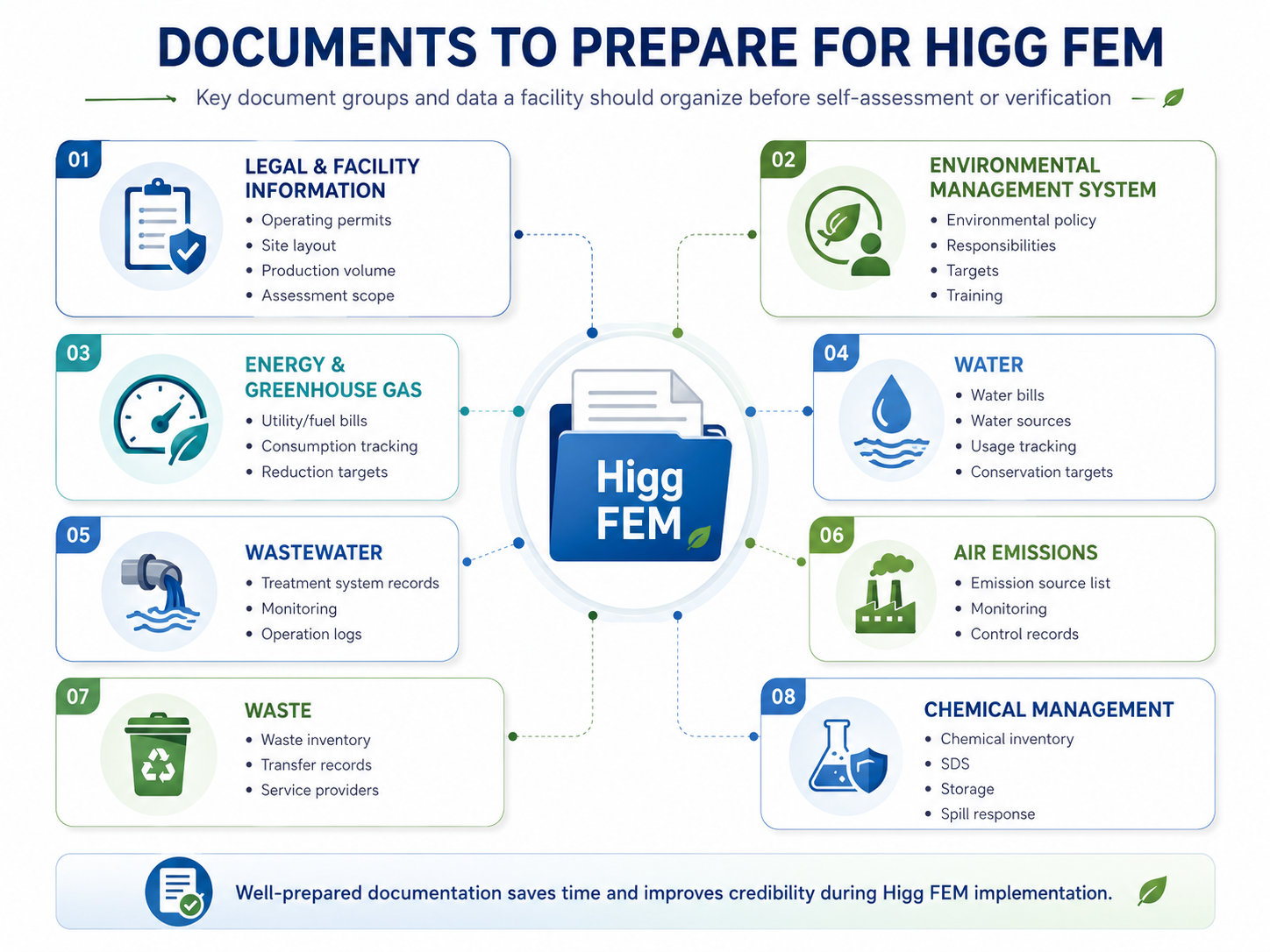
The specific documents depend on the facility type and applicable scope. However, companies generally need to prepare the following groups.
Legal and Facility Information
Business registration.
Operating licenses.
Environmental permits.
Site layout.
Production-flow diagram.
List of processes.
Production volume for the reporting period.
Operating days and hours.
List of contractors or other entities located at the same site.
Environmental Management System Documents
Environmental policy.
Responsibility structure.
Environmental-aspect assessment.
Register of legal requirements.
Environmental objectives and programs.
Training plan.
Internal inspections and audits.
Corrective-action records.
Management-review minutes.
Energy and Greenhouse Gas Records
Electricity invoices.
Fuel invoices.
Boiler-operation logs.
Generator-operation logs.
Inventory of energy-consuming equipment.
Energy-monitoring records.
Emission-calculation methodology.
Baselines and targets.
Energy-saving plans.
Renewable-energy records, where applicable.
Water Records
Water invoices.
Meter readings.
Water-extraction permits, where applicable.
Water-supply diagram.
Water-source inventory.
Water balance.
Baselines and reduction targets.
Water-reuse records.
Wastewater Records
Drainage diagram.
Treatment-system records.
Operating logs.
Monitoring results.
Discharge permits or related requirements.
Treatment-chemical records.
Sludge records.
Emergency-response plans.
System-maintenance records.
Air-Emission Records
Air-emission source inventory.
Permits and legal records.
Monitoring results.
Equipment-operation records.
Maintenance records.
Dust, vapor, and gas control plans.
Treatment-equipment records.
Waste Records
Waste inventory.
Waste quantities by type.
Monitoring logs.
Contracts with treatment providers.
Waste-transfer records.
Licenses of service providers.
Storage-area layout.
Waste-reduction and recycling records.
Targets for improving treatment methods.
Chemical Records
Chemical inventory.
SDS documentation.
Chemical labels.
Supplier list.
Chemical-approval records.
Purchasing and use procedures.
Warehouse-inspection records.
Training records.
Spill-response plan.
Restricted-substance records.
Records for replacing hazardous chemicals.
13. Common Mistakes When Completing Higg FEM
13.1. Focusing Only on Increasing the Score
Some companies select responses based on the score they want rather than actual conditions.
This can lead to:
No supporting evidence.
Evidence from the wrong reporting period.
Untraceable data.
Self-assessment results being adjusted during verification.
13.2. Incomplete Data Collection
Examples include:
Missing invoices for certain months.
Counting electricity but excluding fuel.
Excluding dormitories or canteens from the scope.
Production volumes that do not match reports.
Waste data that does not match transfer records.
13.3. Confusing Procedures with Implementation Evidence
Having a procedure does not automatically mean the requirement has been met.
The facility should demonstrate that:
The procedure has been issued.
Relevant personnel have been trained.
The activity has been implemented.
Results have been monitored.
Deviations have been addressed.
13.4. Setting Targets Without a Baseline
Targets such as “reduce electricity,” “reduce water,” or “reduce waste” lack a proper basis if the company has not identified:
The baseline year.
The baseline value.
The unit of measurement.
The scope.
The method for normalizing data against production volume.
The responsible person.
13.5. Starting Too Late
Collecting data for an entire year often involves multiple departments and document sources. If the company starts only a few weeks before the deadline, it may be difficult to resolve missing data or build evidence of improvement.
14. Benefits of Proper Higg FEM Implementation
Meeting Customer Requirements
The company can provide environmental data in a structure familiar to many brands and supply-chain partners.
Reducing Duplicate Data Requests
Instead of preparing multiple environmental-data sets in different formats, the facility can use FEM results to share information with connected partners on the platform, subject to access rights and each party’s requirements.
Identifying Areas for Improvement
Higg FEM helps the facility identify hotspots related to:
Energy consumption.
Water use.
Waste generation.
Chemicals.
Air emissions.
Wastewater.
Management systems.
Supporting Cost Control
Tracking data by source and production volume helps the company identify areas of inefficient resource use.
Improving ESG Data Quality
Higg FEM data can support environmental target setting, KPI monitoring, and information disclosure to customers or corporate groups.
Worldly has developed analytical tools that allow users to monitor KPIs, compare performance, and identify improvement opportunities from FEM data.
Supporting Continuous Improvement Rather Than Assessment Preparation Alone
The greatest value of Higg FEM is not a single score at one point in time. Its value lies in enabling companies to compare data between years, identify causes, and demonstrate the effectiveness of improvement programs.
15. TTS-CERT Higg FEM Consulting Services
TTS-CERT supports companies in implementing Higg FEM based on actual conditions, customer requirements, and the operational scope of the facility.
The Scope of Support May Include
Receiving and reviewing requirements from the company and its customers.
Defining the Higg FEM scope.
Conducting an initial gap assessment.
Developing an implementation plan.
Guiding data collection.
Reviewing permits and legal documentation.
Standardizing monitoring forms.
Supporting the development of baselines and targets.
Guiding responses to applicable questions.
Reviewing evidence before publication.
Training the Higg FEM implementation team.
Conducting a mock assessment before verification.
Providing guidance on closing identified gaps.
Supporting coordination with the verification body.
Official verification must be performed under the Cascale program by a qualified verifier or Verifier Body. Consulting support does not replace the verifier’s independent responsibilities.
TTS-CERT’s Implementation Approach
TTS-CERT focuses on three principles:
Data Must Be Accurate
All figures should have a source, correspond to the correct reporting period, and be traceable.
Documents Must Reflect Actual Operations
Documents should not be created merely to answer questions when the facility has not genuinely implemented the relevant practices.
Improvement Must Be Measurable
Targets should be linked to baselines, actions, responsible personnel, and results.
16. Higg FEM Implementation Timeline
The implementation timeline is not the same for every company.
Progress depends on:
Facility size.
Type of manufacturing operation.
Level of water and chemical use.
Number of energy sources.
Permit status.
Quality of existing data.
Maturity of the environmental management system.
Customer verification requirements.
Scope of applicable questions.
Level of cooperation between departments.
Companies that already have an ISO 14001 system and complete environmental-performance data are often better prepared. However, ISO 14001 does not automatically replace Higg FEM’s specific data and questionnaire requirements.
17. Higg FEM Consulting and Verification Costs
Costs commonly include separate categories:
Worldly account or module-access fees.
Consulting fees, if the company hires external support.
Verification costs.
Verification-access fees or other program-related charges.
Travel and accommodation costs for onsite activities.
Costs for onsite improvements or additional equipment, where needed.
The cost depends on the facility’s size, location, manufacturing type, verification scope, and level of readiness.
To receive an appropriate quotation, the company should provide at least:
Facility address.
Products and manufacturing processes.
Number of employees.
Facility area.
Customer requirements.
Required FEM cycle.
Whether self-assessment or verification is required.
Completion deadline.
18. Frequently Asked Questions About Higg FEM
Is Higg FEM an Environmental Certificate?
No. Higg FEM is an environmental-performance assessment module. A company may complete a self-assessment and verification, but Higg FEM should not be understood in the same way as an ISO management-system certification.
How Long Is Higg FEM Valid?
Higg FEM is completed for a specific data cycle and updated annually. Companies are generally required to complete the module for each year according to customer requirements.
What Higg FEM Score Does a Company Need to Achieve?
There is no universal passing score for all companies. Required scores, levels, or verification contents depend on each customer and supply-chain program.
Does a Facility with ISO 14001 Still Need Higg FEM?
It may still be required. ISO 14001 assesses an environmental management system, while Higg FEM requires extensive quantitative data and detailed information on energy, water, wastewater, waste, air emissions, and chemicals.
Is Higg FEM Verification Mandatory?
Not every module must be verified. Verification depends on the requirements of the brand, customer, program, or intended use and sharing of the results.
Can Higg FEM Verification Be Conducted Remotely?
The program includes remote-review and onsite-verification options. The appropriate method depends on the scope, applicable program rules, and customer requirements. Any external communication of results must comply with Higg Index communication guidance.
Does a Company with Multiple Factories Need Only One FEM?
Not necessarily. Facilities at different physical addresses generally require separate modules. The company should consider legal entities, permits, locations, and specific operational boundaries.
Does TTS-CERT Support Higg FEM Verification Preparation?
TTS-CERT supports gap assessments, data collection, documentation standardization, employee training, response review, and facility preparation before verification.
19. Conclusion
Higg FEM is a tool that enables manufacturing facilities to measure and improve environmental performance through structured data. Proper implementation not only helps a company meet customer requirements but also creates a foundation for more effective control of energy, water, air emissions, wastewater, waste, and chemicals.
Companies should begin by defining the correct scope, reviewing permits, checking data, and assigning responsibilities to relevant departments. Early preparation helps reduce data-entry errors, limit adjustments during verification, and support long-term improvement programs.
TTS-CERT supports companies in assessing current conditions, preparing data, completing documentation, and getting ready for Higg FEM self-assessment or verification.