Table of contents
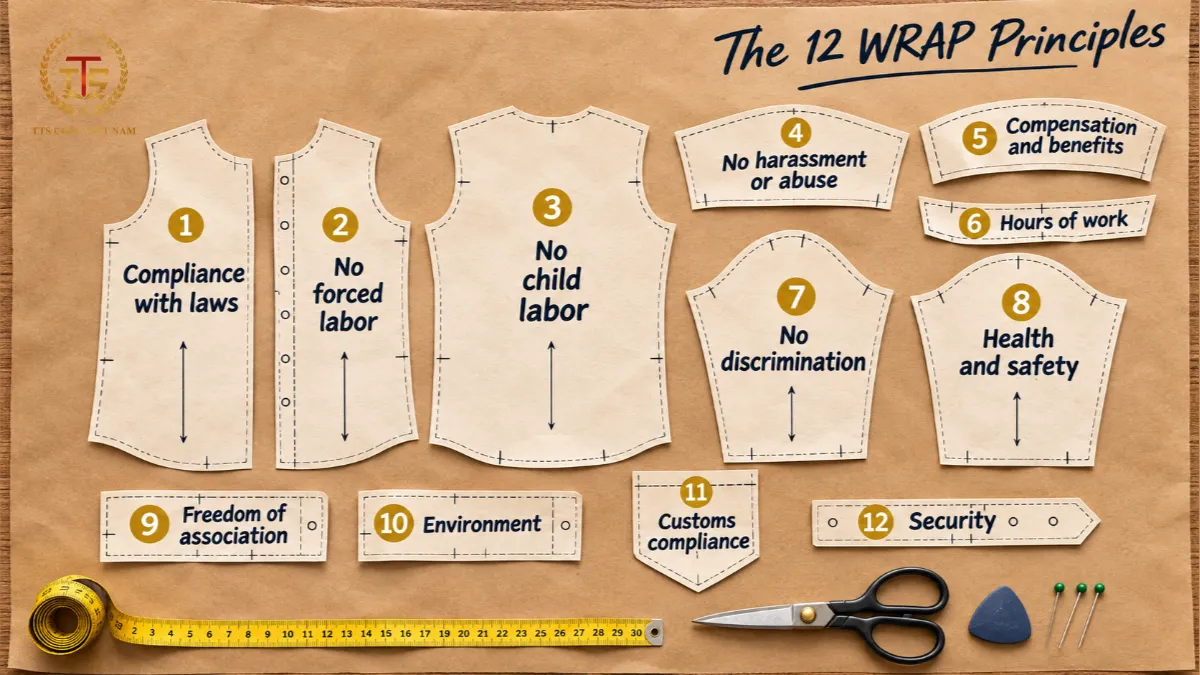
WRAP certification is a social compliance certification issued by WRAP (Worldwide Responsible Accredited Production) to individual facilities producing sewn products, footwear and related goods. Facilities are audited against 12 Principles covering labor, health and safety, environment, customs and security, based on local law and internationally accepted workplace standards.
Since 1 March 2026, WRAP no longer issues certification levels. Facilities that pass the audit receive an annual Certificate of Compliance valid for one year and must be re-audited every year.
TTS Cert provides full consulting to help factories prepare for WRAP certification: gap analysis, training, documentation, internal audits and support through certification. Audits are carried out by WRAP-accredited monitoring firms; WRAP reviews and issues the certification.
1. What Is WRAP?
WRAP is an independent, non-profit organization that runs a social compliance certification program for the sewn products sector and related industries. According to WRAP, more than 3,500 facilities worldwide are certified, employing over 3.25 million workers.
Unlike programs that only produce an audit report, WRAP issues a certificate to compliant facilities. Certified facilities can be listed on WRAP's website and may use the "WRAP Certified" logo under WRAP's guidelines.
WRAP audits are conducted by WRAP-accredited monitoring firms. Their auditors are trained by WRAP and recognized by APSCA (the Association of Professional Social Compliance Auditors).
2. Who Needs WRAP Certification?
| Business type | Why it is often needed |
|---|---|
| Apparel factories | Brands and retailers (especially in the US) make WRAP an ordering condition |
| Footwear, bag and sewn accessory factories | Part of the sewn products scope WRAP targets |
| Textile and home textile factories | Customers accept WRAP instead of their own audits |
| Walmart suppliers | One WRAP audit can cover both responsible sourcing and supply chain security requirements |
WRAP certifies individual production facilities. A company with several factories registers and audits each one. Brands and retailers do not certify themselves; they require their suppliers to be certified.
When should you start?
A new or existing customer adds WRAP certification to its supplier requirements.
You want one certification accepted by many customers to reduce audit numbers.
You sell to Walmart and need to meet its supply chain security requirements.
You are opening a new facility or moving orders to a new site.
Customer asking for WRAP? Request a readiness assessment
3. The 12 WRAP Principles
| # | Principle | Key requirement | Records and evidence typically reviewed |
|---|---|---|---|
| 1 | Compliance with laws and workplace regulations | Operate lawfully in every place of business | Licenses, register of applicable laws, internal labor rules |
| 2 | Prohibition of forced labor | Voluntary employment only; no withheld documents or bonded labor | Employment contracts, resignation rules, agency recruitment policy |
| 3 | Prohibition of child labor | No workers below the legal minimum age or WRAP's age floor | Age verification procedure, ID copies, juvenile worker register (if any) |
| 4 | Prohibition of harassment or abuse | No harassment, abuse or corporal punishment | Anti-harassment policy, disciplinary records, grievance records |
| 5 | Compensation and benefits | Pay at least the legally required total compensation, on time | Payroll, payslips, social insurance, payment records |
| 6 | Hours of work | Working hours and rest days within national limits | Time records, overtime approvals, rest day schedules |
| 7 | Prohibition of discrimination | Employment decisions based on ability to do the job | HR policies, recruitment and appraisal records |
| 8 | Health and safety | Safe, healthy workplace and housing (if provided) | Safety training, fire safety, workplace monitoring, health checks, first aid |
| 9 | Freedom of association and collective bargaining | Respect workers' rights to associate; provide a grievance mechanism | Union records, dialogue minutes, collective agreement (if any), grievance channels |
| 10 | Environment | Comply with environmental law and manage waste responsibly | Permits, environmental records, waste disposal contracts |
| 11 | Customs compliance | Follow customs law, prevent illegal transshipment, keep accurate records | Import/export records, origin documents, production records matching shipments |
| 12 | Security | Corporate, transportation and physical security procedures, with CTPAT guidelines as a baseline | Access control, seal control, container inspection, personnel security |
Principle 12: security built on CTPAT
Principle 12 uses the guidelines of CTPAT (the US Customs-Trade Partnership Against Terrorism) as its baseline. WRAP audits therefore cover facility security and cargo security during loading and transport. Factories that already apply CTPAT security criteria have a head start on this principle.
4. What Changed in WRAP on 1 March 2026?
On 1 March 2026, WRAP announced an update to its certification program:
No more two-year (Platinum) certificates from 1 March 2026.
No more certification levels. Facilities that pass receive a certificate marked as an annual Certification of Compliance.
Existing Platinum certificates remain valid until their expiry date; no immediate action is needed.
WRAP explains that the change aligns certification with the annual cadence of social audits and due diligence reporting now expected by many regulations and brands.
What it means for factories: there is no longer a "go Platinum for a two-year cycle" target. Factories need to keep their systems running continuously and prepare for an audit every year. Some materials still describe Silver, Gold and Platinum levels; this no longer applies to newly issued certificates.
5. The WRAP Certification Process
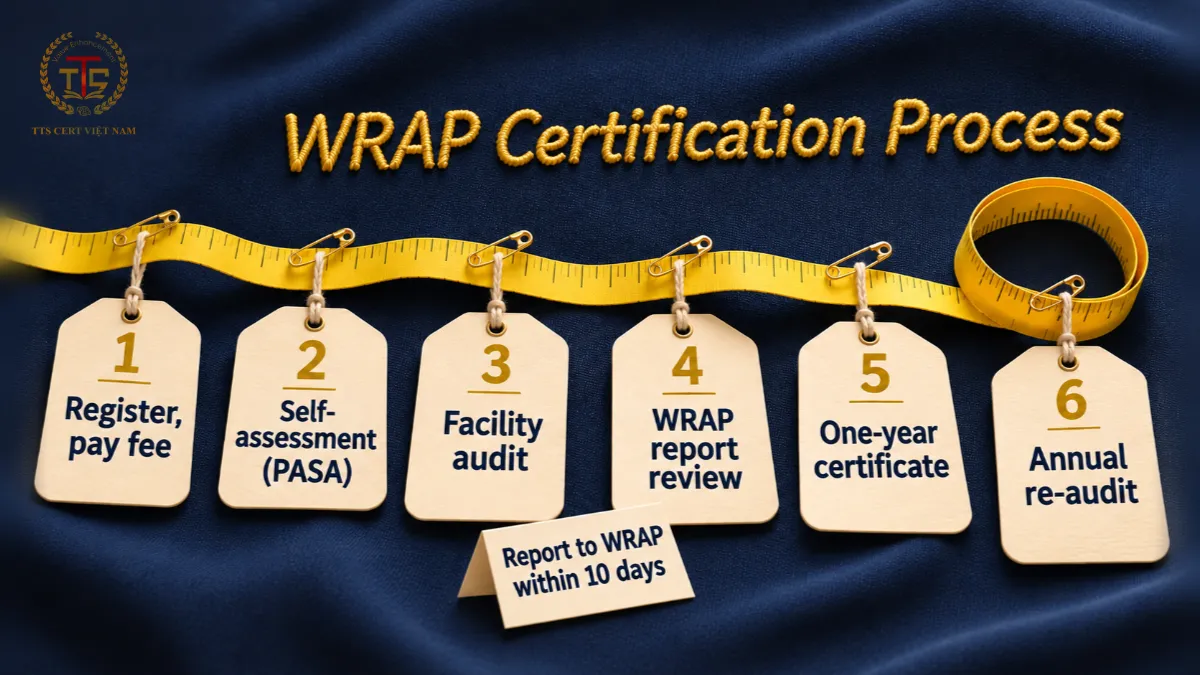
Registration: create an account, submit the application and registration fee on WRAP's platform, and select a WRAP-accredited monitoring firm.
Pre-Audit Self-Assessment (PASA): optional. It previews the questions auditors will ask and the records to prepare.
Facility audit: the monitoring firm conducts a full audit against the 12 Principles and submits the report to WRAP within 10 days of completion.
WRAP review: WRAP may request revisions or more information. If the facility is not yet compliant, it receives a list of corrective actions and an additional inspection.
Approval and certification: WRAP staff and its independent review board approve; the facility receives a certificate valid for one year.
Post-certification assessments (PCAs): WRAP may conduct random, unannounced assessments during the certification period.
Renewal: WRAP emails a reminder within 90 days of expiry. A new audit is still required; prior certification does not guarantee renewal.
6. Documents to Prepare
| Area | Key records |
|---|---|
| Legal | Business registration, relevant permits, internal labor rules, collective agreement (if any) |
| Recruitment and contracts | Recruitment procedure, age verification, employment contracts, separation records |
| Hours and wages | Time records, payroll, payslips, overtime, social insurance (typically last 12 months) |
| Health, safety and fire | Risk assessment, safety training, fire safety and drill records, workplace monitoring, health checks |
| Dialogue and grievances | Union records, dialogue minutes, grievance channels and case records |
| Social policies | Policies on forced labor, child labor, harassment and discrimination |
| Environment | Required environmental records, waste disposal contracts and records |
| Customs | Import/export records, anti-transshipment procedure, production-to-shipment reconciliation |
| Security | Access control, seal management, container inspection, background checks for sensitive roles |
| Subcontractors | List of subcontractors and outsourced processes, and how they are controlled |
The exact list is adjusted after the gap analysis.
Get a document checklist and gap analysis against the 12 Principles
7. Timeline and Costs
Timeline
Up to about 45 days to certification:
about 30 days of consulting and preparation;
about 15 days from the audit to certification.
If you need it sooner, TTS Cert can shorten the schedule depending on how ready your records are. Actual timing also depends on the monitoring firm's schedule, audit results and WRAP's review.
Registration fee paid to WRAP
This is paid directly to WRAP when registering, based on worker count (effective 1 January 2024, per wrapcompliance.org at the time of writing):
| Workers | Registration fee |
|---|---|
| 100 or fewer | USD 650 |
| 101–200 | USD 950 |
| 201–1,000 | USD 1,350 |
| More than 1,000 | USD 1,550 |
Other costs
Audit fee: quoted separately by the WRAP-accredited monitoring firm.
Consulting fee: depends on worker numbers, number of sites, current systems and the extent of corrective action needed.
8. WRAP and Walmart's Security Requirements
Walmart requires suppliers to demonstrate supply chain security compliance through one of several options, including an audit from an approved third-party program. According to WRAP, Walmart accepts WRAP certification for both responsible sourcing and supply chain security, and WRAP is the only third-party program Walmart recognizes in both categories.
For factories selling to Walmart, one WRAP audit can reduce the need for a separate security audit. You should still confirm the specific requirement with your customer before choosing a program.
9. WRAP vs BSCI, SMETA and SA8000
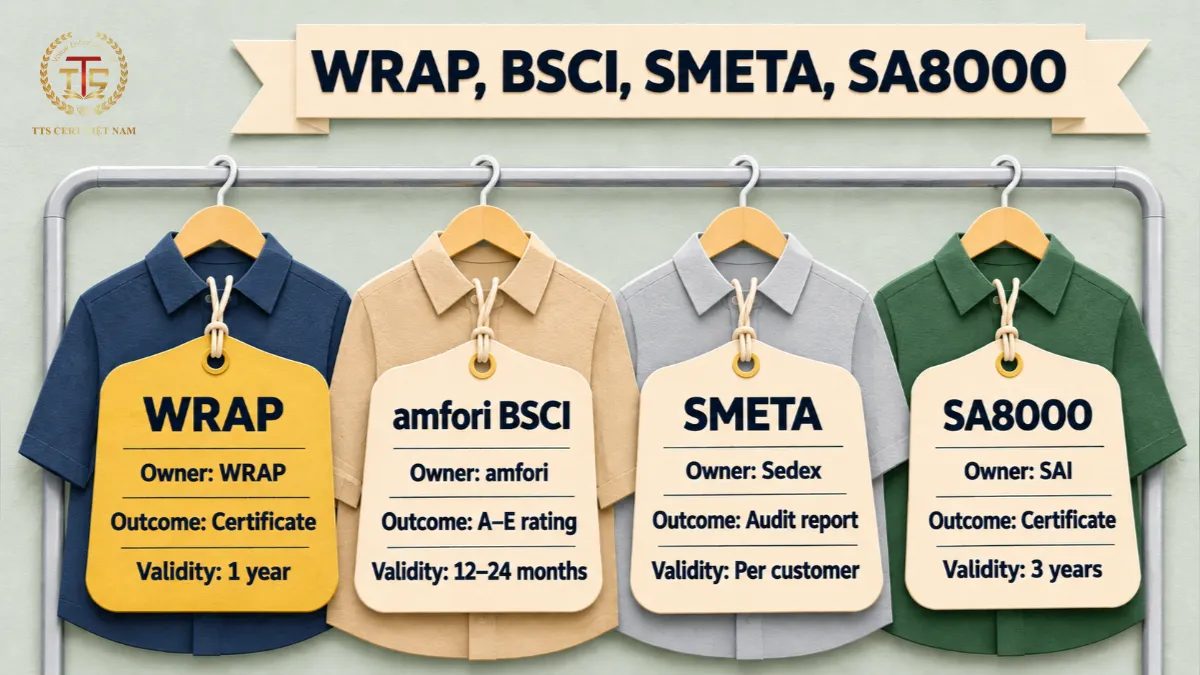
| Topic | WRAP | amfori BSCI | SMETA | SA8000 |
|---|---|---|---|---|
| Owner | WRAP | amfori | Sedex | SAI |
| Outcome | Certificate | Audit report, A–E rating | Audit report, not a certificate | Certificate |
| Validity | 1 year | 12–24 months depending on rating | Per customer requirements | 3 years, with surveillance audits |
| Distinctive content | Customs and security principles | amfori Code of Conduct | 4 pillars: labor, health and safety, environment, business ethics | Social accountability management system |
| Common with | US brands and retailers | European brands | UK and multinational brands | Customers requiring system certification |
See also: BSCI, SMETA, SA8000 certification and SMETA vs BSCI.
Which should you choose? Follow your customer's requirement. Many factories need two programs at once; in that case, build one shared document system that serves both to reduce preparation work.
10. Common Audit Findings
Overtime beyond legal limits, with time records and payroll that do not match.
Incomplete age verification, especially for workers hired through agencies.
Fire safety and exits: blocked aisles, missing drills, equipment overdue for inspection.
Subcontractors and outsourced processes not declared or not controlled.
Customs records not matching actual production and shipments.
Weak security: containers not inspected before loading, no log for seal control.
Policies on paper only: workers unaware of grievance channels, training not actually delivered.
11. How TTS Cert Supports You
TTS Cert provides full consulting for factories preparing for WRAP certification:
Gap analysis against the 12 WRAP Principles and Vietnamese labor law.
Corrective action plan: tasks, owners and deadlines.
Documentation: policies, procedures and forms for all 12 Principles, including customs and security.
Training for management, HR and compliance, security staff and workers.
Internal audit before the official audit.
Audit support and closing findings afterwards.
TTS Cert works with reputable domestic and international certification bodies, connecting businesses with professional audit and certification services to help them:
Meet the social compliance and supply chain security requirements of international brands and retailers.
Strengthen brand reputation, image and competitiveness.
Access promising export markets.
Meet customer and global supply chain requirements.
TTS Cert is a consultancy. Audits are conducted by WRAP-accredited monitoring firms; certification decisions and certificates are issued by WRAP.
Talk to a TTS Cert expert about your WRAP roadmap
12. Frequently Asked Questions
Is WRAP required by law? No. WRAP is voluntary, but brands and retailers commonly require it from suppliers.
Who issues WRAP certification? WRAP issues the certificate after reviewing the audit report from a WRAP-accredited monitoring firm.
How long is WRAP certification valid? One year. Facilities must be re-audited annually to keep certification.
Does WRAP still issue Gold and Platinum certificates? No. Since 1 March 2026, WRAP has removed certification levels and no longer issues two-year (Platinum) certificates. Existing Platinum certificates remain valid until expiry.
How much is the WRAP registration fee? USD 650 to 1,550 depending on worker count, paid directly to WRAP. The audit fee is quoted separately by the monitoring firm.
Can WRAP certification replace Walmart's security audit? According to WRAP, Walmart accepts WRAP certification for its supply chain security requirements. Confirm with your customer's responsible team.
Can factories outside the sewn products sector get WRAP? WRAP targets sewn products and related industries. Factories in other sectors should contact us for advice on the program that fits their customers' requirements.
Does TTS Cert issue WRAP certificates? No. TTS Cert is a consultancy that helps factories prepare for and achieve certification.
How long does it take to get certified? Up to about 45 days: about 30 days of consulting and about 15 days from the audit to certification. It can be faster depending on your readiness.
13. Conclusion
WRAP certification helps sewn-product factories show customers that production is lawful, humane and ethical, while also meeting supply chain security expectations. From 2026 every certificate lasts one year, so what matters is a system that genuinely runs, not preparation for a single audit. Start with a gap analysis against the 12 Principles to see what needs fixing before you register.