Table of contents
ESG (Environmental, Social, Governance) is how a company manages and demonstrates its impact on the environment, workers and communities, and the way it is run. For export manufacturers, ESG is increasingly not a slogan but data customers ask for: supplier questionnaires, EcoVadis scores, emissions figures, labor policies.
TTS Cert provides full ESG consulting: gap assessment, materiality, strategy and data systems, ESG reporting under GRI or VSME, EcoVadis and CDP preparation, and support when a third party provides assurance on your report.
1. What Is ESG and Why Should Manufacturers Care?
ESG is not a single standard. It is three groups of topics that customers, banks and investors use to assess a company, and each may use a different framework. ESG is not a certification either: no body issues a general "ESG certificate" to companies.
| Pillar | Typical topics in a factory |
|---|---|
| E – Environmental | Energy, greenhouse gas emissions, water and wastewater, waste, chemicals, materials |
| S – Social | Wages, working hours, health and safety, training, diversity and non-discrimination, human rights in the supply chain |
| G – Governance | Business ethics, anti-corruption, risk management, data security, grievance channels, supplier management |
Manufacturers often already hold part of their ESG data through existing programs: Higg FEM, SMETA, BSCI, SA8000, greenhouse gas inventories, legally required environmental records. ESG work brings this data into one system, sets targets and presents it consistently to each party asking.
2. Which Companies Need ESG, and Where Do Requirements Come From?
Companies usually need to work on ESG if they are:
suppliers to European, US or Japanese brands and importers that send ESG questionnaires or require EcoVadis;
FDI companies that must feed data into their parent's group report;
borrowers, especially for green credit, or companies raising investment;
public companies required to disclose environmental and social information;
facilities on the GHG inventory list;
exporters of goods in CBAM scope.
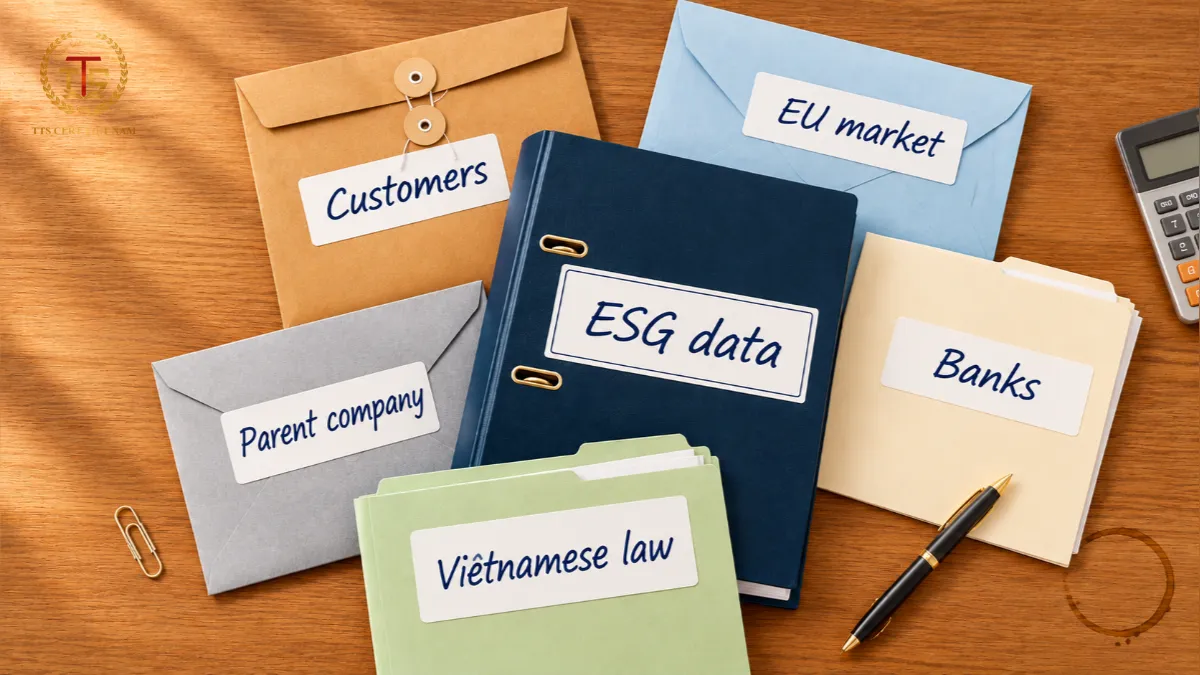
| Source | What they usually ask | Mandatory? |
|---|---|---|
| Customers, brands | Supplier questionnaires, EcoVadis scores, Higg data, SMETA reports, emissions data | Not by law, but a condition of purchase |
| European customers under CSRD, CSDDD | Value chain data: emissions, labor, human rights risks | Indirectly, through contracts |
| EU – CBAM | Product-related emissions (steel, aluminium, cement, fertilisers…) | Mandatory for goods in scope |
| Banks, investors | Environmental and social risks, green credit, sustainability reports | Depends on financing terms |
| Parent companies, groups | Data for consolidated group reporting | Per internal rules |
| Vietnamese law | Sustainability reporting (public companies), GHG inventories (listed facilities) | Mandatory for those in scope |
Customers and brands
This is the most common source for export factories. Each customer may use its own tool: EcoVadis, its own questionnaire, the Higg platform, Sedex. Without central data management, companies easily give different figures to different customers.
The EU market
The two main directives are CSRD (sustainability reporting) and CSDDD (supply chain due diligence). Both apply directly to large European companies, which then ask their suppliers, including Vietnamese suppliers, for data. In 2026 the EU significantly narrowed the scope of both (see section 3).
CBAM is the Carbon Border Adjustment Mechanism. It covers certain emission-intensive goods such as steel, aluminium, cement and fertilisers.
Banks, investors and parent companies
Banks use environmental and social information in lending, especially green credit. FDI companies often need to supply ESG data to their parent for group reporting.
Vietnamese law
Public companies: disclose environmental and social information in the annual report under Circular 96/2020/TT-BTC. The State Securities Commission has said it will study amending these rules to align more closely with international ESG practice.
Greenhouse gas inventories: listed facilities must carry out inventories under Decree 06/2022/ND-CP, as amended by Decree 119/2025/ND-CP and Decree 83/2026/ND-CP. The updated list under Decision 42/2026/QD-TTg covers 2,441 facilities, effective from 25 September 2026. See also GHG inventories under ISO 14064-1.
Beyond these two groups, most ESG requirements for manufacturers today come from customers, not from the law.
Received an ESG questionnaire? Let TTS Cert review it with you
3. What Did the EU Change in 2026 and What Does It Mean for Vietnamese Suppliers?
The Omnibus I Directive (EU) 2026/470, in force since 18 March 2026, amends CSRD and CSDDD:
| Before Omnibus | After Omnibus | |
|---|---|---|
| CSRD (sustainability reporting) | Large companies meeting 2 of 3 criteria: 250 employees, EUR 25 million balance sheet, EUR 50 million turnover | More than 1,000 employees and net turnover above EUR 450 million |
| CSDDD (supply chain due diligence) | More than 1,000 employees and worldwide turnover above EUR 450 million | More than 5,000 employees and worldwide turnover above EUR 1.5 billion |
| Climate transition plan under CSDDD | Required | Removed |
The value chain cap and VSME
The key change for suppliers is the value chain cap. Companies reporting under CSRD may not require partners with 1,000 employees or fewer to provide sustainability information beyond the voluntary standard adopted by the European Commission. That standard is built on EFRAG's VSME (Voluntary Sustainability Reporting Standard for SMEs).
VSME has a basic module (energy, GHG emissions, water, waste, workforce, health and safety, anti-corruption…) and a comprehensive module for companies that want to disclose more.
What it means for Vietnamese factories:
Most factories have fewer than 1,000 workers. When European customers ask for data, VSME is the maximum they can require under this mechanism.
VSME is also becoming the minimum European customers expect. Preparing data to VSME is enough without overdoing it.
Customers outside CSRD scope, or outside the EU, may still set their own requirements through contracts or EcoVadis.
4. Which ESG Standard Fits: GRI, ISSB, VSME, EcoVadis or CDP?
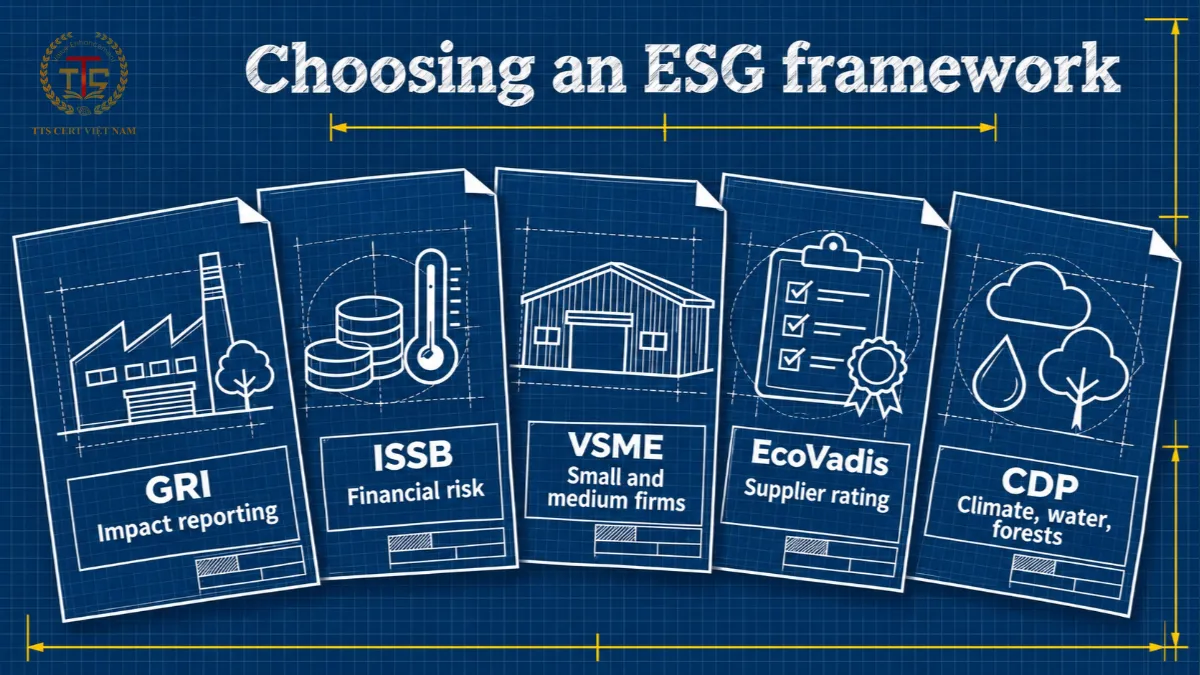
| Framework | Purpose | Users of the output | Suits | Scored? |
|---|---|---|---|---|
| GRI | Reporting the company's impacts on the environment and people | All stakeholders | Companies needing a full sustainability report | No |
| ISSB (IFRS S1, S2) | Disclosing sustainability risks and opportunities affecting finances | Investors, banks | Listed companies, companies raising capital | No |
| VSME | Concise reporting for small and medium companies | European customers, banks | Suppliers with fewer than 1,000 employees | No |
| EcoVadis | Supplier assessment across 4 themes: environment, labor and human rights, ethics, sustainable procurement | Buying customers | Suppliers asked by customers | Yes (score 0–100, medals) |
| CDP | Disclosure on climate, water and forests | Customers, investors | Suppliers invited through supply chain programs | Yes (A to D-) |
Recent updates:
GRI has issued GRI 102: Climate Change and GRI 103: Energy, effective for reports published from 1 January 2027. They replace the earlier emissions and energy disclosures.
Since 2024, EcoVadis has awarded medals by percentile ranking, not fixed score thresholds. Its methodology is updated quarterly, so last year's score does not guarantee next year's medal.
The TCFD climate disclosure recommendations are built into ISSB's IFRS S2. Since 2024, the ISSB has taken over monitoring of TCFD-aligned disclosure.
Which should you choose? Start with who is asking:
If a customer requires EcoVadis, prepare for EcoVadis.
If a European customer asks for data, use VSME.
If you need a full public report, use GRI.
Core data (energy, emissions, workforce…) serves every framework.
5. ESG Implementation and Reporting Process
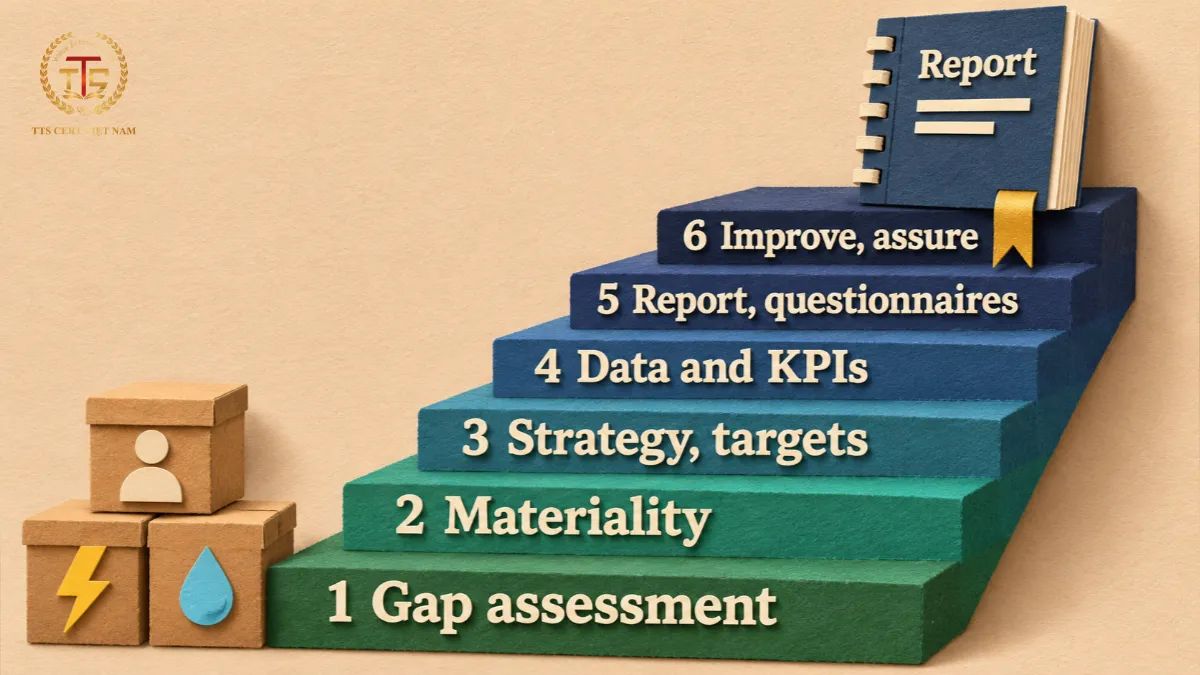
Gap assessment and customer requirements: collect the requests you are receiving and compare them with existing data and policies.
Materiality: which topics matter for your sector, your customers and your business. Depth depends on the framework (GRI, VSME or CSRD).
Strategy, policies and targets: environmental, labor and ethics policies, emission reduction targets.
Data system and KPIs: owners, data sources, collection frequency, checks.
Report or respond to questionnaires: ESG report under GRI or VSME, EcoVadis, CDP, customer questionnaires.
Improve and obtain third-party assurance where needed: track targets, prepare for independent assurance.
6. Data and Records to Prepare
Environmental
Electricity and fuel by source (last 12 months of invoices)
GHG inventory scopes 1 and 2; scope 3 if customers require it
Water use, wastewater, monitoring results
Waste by type, transfer documents
Chemical inventory, SDS, environmental permits
Social
Workforce by gender and contract type
Wages, working hours, overtime
Work accidents, safety training
Training hours, non-discrimination policy
Results of social audits (SMETA, BSCI, SA8000…)
Governance
Code of business ethics, anti-corruption policy
Grievance and whistleblowing channels and case records
Supplier assessment and selection procedure
Risk management, data security
Reusing Data from Existing Programs
| Program you already run | Data reused for ESG |
|---|---|
| Higg FEM | Energy, water, wastewater, waste, chemicals, air emissions (E) |
| SMETA, BSCI, SA8000, WRAP | Wages, working hours, safety, grievance channels, business ethics (S, G) |
| ISO 14064-1 | GHG emissions, scopes 1, 2 and 3 (E) |
| ISO 14001, ISO 45001 | Environmental aspects, safety risks, legal compliance (E, S) |
| GRS, RCS, FSC | Recycled content, material origin (E) |
As a result, the new data to collect is often less than companies expect. What is usually missing is policies, targets and presentation to the framework.
7. How TTS Cert Supports Your ESG Work
TTS Cert provides full ESG consulting, matched to the requirements you are actually receiving:
ESG gap assessment and review of customer, bank and parent company requirements.
Materiality, strategy, policies and targets.
Data system and KPIs, including GHG inventories under ISO 14064-1.
ESG and sustainability reports under GRI, or reporting under VSME.
EcoVadis and CDP preparation, and responses to customer ESG questionnaires.
Support during third-party assurance: evidence, explanations and corrections.
ESG training so your team can maintain the system.
ESG connects with the programs TTS Cert already supports: Higg FEM, SMETA, SA8000 certification, LCA, EPD and product carbon footprints, CBAM. Data from these programs is reused for ESG rather than collected twice.
TTS Cert works with reputable domestic and international certification bodies, connecting businesses with professional audit and certification services to help them:
Meet the ESG requirements of customers, brands and export markets.
Strengthen brand reputation, image and competitiveness.
Access promising export markets.
Meet customer and global supply chain requirements.
TTS Cert is a consultancy. EcoVadis scores are assessed by EcoVadis, CDP scores by CDP, and report assurance is provided by an independent assurance provider.
8. Timeline and What Drives ESG Consulting Costs
Timeline: up to about 45 days to complete your ESG report or response package:
about 30 days of consulting, data collection and standardisation;
about 15 days to finalise the report or responses.
If you need it sooner, TTS Cert can shorten the schedule depending on how much data is available. Time taken by EcoVadis, CDP scoring or third-party assurance is separate and follows their schedules.
Costs depend on:
The framework (VSME, GRI, EcoVadis, CDP) and how many you need at once.
Number of sites and factories in scope.
Data availability, and whether a scope 3 inventory is needed.
Whether third-party assurance is required.
Fees charged separately by EcoVadis, CDP or the assurance provider.
9. Common Challenges
Missing source data: no invoices or monthly readings, forcing estimates.
Scattered figures: each department keeps its own file and numbers don't match.
Reporting before data: a polished report that cannot be evidenced.
Choosing an overly heavy framework: full CSRD-style reporting when customers only need VSME or EcoVadis.
Policies on paper only: EcoVadis and customers both require evidence of implementation.
A different answer for every customer: inconsistent figures across questionnaires.
10. Frequently Asked Questions
Is ESG mandatory? There is no general ESG law for all companies. The law requires it only for some: public companies (sustainability reporting) and facilities on the GHG inventory list. For most manufacturers, ESG is a customer requirement.
Do small companies need ESG? Yes, if customers require it. VSME is designed for small and medium companies and is much lighter than a full report.
What does an ESG report contain? An ESG report typically covers:
company profile and reporting scope;
material topics;
policies and targets;
environmental, social and governance data under the chosen framework;
year-on-year results and next steps.
The level of detail depends on the framework: VSME is much lighter than GRI.
How is an ESG report different from a sustainability report and an annual report? ESG reports and sustainability reports are usually the same kind of report. The difference lies in the framework (GRI, VSME, ISSB…), not the name. An annual report covers financial and operational performance. Public companies may include environmental and social sections in it or publish a separate report.
Is there an ESG certification or ESG certificate? There is no single ESG certification or certificate. Companies can be scored (EcoVadis, CDP), have their report assured by an independent provider, or hold certifications for specific topics such as ISO 14001 or SA8000. TTS Cert is a consultancy and does not issue ESG certificates.
What is EcoVadis, and is it mandatory? EcoVadis is a supplier rating platform covering environment, labor and human rights, ethics and sustainable procurement, scored from 0 to 100. It is not legally required, but many customers make it a purchasing condition.
A European customer wants ESG data. How far do we have to go? If you have 1,000 employees or fewer and the customer is in CSRD scope, it cannot require more than the voluntary standard based on VSME. It may still agree additional items with you by contract.
Where should we start? With the list of requests you are receiving and the data you already have. A gap assessment shows what is missing before you choose a framework.
How long does it take? Up to about 45 days to complete a report or response package, faster depending on available data.
11. Conclusion
For export manufacturers, ESG starts with data: energy, emissions, workforce, safety, business ethics. With accurate, consistent data, you can respond to any framework, from VSME and EcoVadis to GRI. The EU's 2026 changes limit how much data European customers can demand, but they also set a clear minimum. Start with a gap assessment to see what needs to be done first.
References
Decision 42/2026/QD-TTg on the updated list of sectors and facilities required to conduct GHG inventories
Circular 96/2020/TT-BTC on information disclosure on the securities market