
Table of contents
FSC CoC certification for packaging manufacturers provides a recognized framework for controlling the sourcing, processing, traceability, and sale of FSC-certified paper and packaging products.
For manufacturers producing corrugated cartons, paper boxes, folding cartons, and printed packaging, FSC Chain of Custody (CoC) certification can support customer requirements for responsible material sourcing and verified product claims.
However, FSC certification is not automatically mandatory for every packaging manufacturer. Whether a factory needs certification depends on its products, business activities, customer requirements, and intended FSC claims.
This guide explains when packaging manufacturers need FSC CoC certification, the key requirements under FSC-STD-40-004 V3-1, the practical steps for implementation, and the documents factories should prepare before an audit.
1. What Is FSC CoC Certification for Packaging Manufacturers?
FSC stands for the Forest Stewardship Council, an international organization that develops standards for responsible forest management and the traceability of forest-based materials.
FSC Chain of Custody certification establishes a system for identifying, controlling, and accounting for eligible FSC materials as they move through the supply chain.
For packaging manufacturers, this can include activities such as:
Purchasing paper rolls, paperboard, corrugated sheets, and other forest-based materials.
Receiving and identifying incoming FSC materials.
Storing and controlling materials used in production.
Printing, cutting, laminating, folding, gluing, and assembling packaging.
Monitoring material quantities, waste, and production outputs.
Controlling FSC claims on sales documents.
Applying approved FSC labels to eligible packaging products.
The principal Chain of Custody standard is FSC-STD-40-004 V3-1.
Requirements concerning the use of FSC trademarks by certificate holders are established in FSC-STD-50-001 V2-1.
Applicable FSC directives and interpretations must also be considered when implementing these standards.
FSC Forest Management vs. FSC Chain of Custody
These two types of certification serve different purposes.
| Certification | Main Purpose |
|---|---|
| FSC Forest Management (FM) | Evaluates forest management activities against applicable FSC forest management requirements. |
| FSC Chain of Custody (CoC) | Verifies the control and traceability of eligible forest-based materials and FSC claims throughout production and commercial activities. |
For factories manufacturing paper boxes, corrugated cartons, and other paper-based packaging products, FSC CoC is generally the relevant certification type.
2. Is FSC CoC Certification Mandatory for Packaging Manufacturers?
FSC CoC is not a universal legal requirement for all packaging manufacturers in Vietnam.
Nevertheless, certification may become necessary to meet a particular customer's purchasing specifications or commercial requirements.
For example, an international customer may require its packaging supplier to deliver cartons carrying an appropriate FSC label or to issue sales documents with a valid FSC claim.
In such cases, the manufacturer must determine whether its operations require FSC CoC certification and how the proposed products will be included within the certification scope.
When Does a Packaging Factory Typically Need FSC CoC?
Certification is particularly relevant when the factory intends to:
Manufacture and sell eligible packaging products with FSC claims.
Apply FSC labels to packaging within an authorized certification system.
Process FSC-certified paper or board into finished FSC-certified packaging.
Supply semi-finished or finished FSC-certified products to customers.
Transfer FSC claims through invoices or other applicable sales documents.
A company that does not manufacture or sell products with FSC claims may not need its own CoC certificate merely because it operates in the packaging industry.
The exact requirements depend on the business model and the applicable FSC rules.
Important: FSC certification is a product-scope and claim-control system. Having an FSC CoC certificate does not mean every product manufactured by the factory is automatically FSC-certified.
3. Five Business Benefits of FSC CoC Certification for Packaging Manufacturers
3.1. Meeting Customer and Supply Chain Requirements
International buyers may establish FSC-related sourcing requirements as part of their purchasing policies.
For packaging manufacturers, certification can help demonstrate that eligible products are produced under a recognized Chain of Custody control system.
This may support supplier qualification, customer audits, and participation in supply chains where FSC-certified packaging is specified.
However, certification does not guarantee approval as a preferred supplier or the award of any commercial contract.
3.2. Improving Material Traceability
FSC CoC requires manufacturers to establish controls over eligible input materials and output claims.
A packaging factory must be able to demonstrate how materials are received, identified, processed, accounted for, and sold.
A well-implemented system can improve the reliability of purchasing records, material identification, and production documentation.
3.3. Strengthening Purchasing and Supplier Controls
Manufacturers must verify that materials purchased with FSC claims meet applicable requirements.
This includes checking relevant supplier certification information and ensuring that the FSC claims appearing on purchasing documents are appropriate.
Such controls can help reduce the risk of purchasing materials that cannot support the intended FSC output claims.
3.4. Supporting Responsible Sourcing Commitments
FSC certification enables businesses to demonstrate that eligible products comply with relevant FSC sourcing and Chain of Custody requirements.
This can help customers substantiate specific commitments relating to responsible forest-based materials.
However, certification should not be described as proof that every material in a factory originates exclusively from FSC-certified forests.
The actual material composition and permitted claims depend on the applicable FSC category and control system.
3.5. Improving Internal Production Management
Implementing FSC CoC can encourage clearer coordination between purchasing, warehouse, production, quality assurance, sales, and management personnel.
Practical improvements may include:
Better identification of material categories.
Clearer responsibilities for FSC product groups.
More consistent production and inventory records.
Reliable quantity reconciliation.
Stronger controls over product claims and artwork approval.
Improved preparation for customer and certification audits.
These operational benefits depend on the effectiveness of implementation.
4. FSC 100%, FSC Mix and FSC Recycled: What Packaging Manufacturers Must Understand
One of the most important aspects of FSC CoC implementation is understanding the differences between FSC material and product claims.
| FSC Category | General Meaning |
|---|---|
| FSC 100% | Material originates from FSC-certified forests, subject to the applicable FSC requirements. |
| FSC Mix | The product may contain eligible combinations of material from FSC-certified forests, recycled sources, and/or controlled sources under the FSC system. |
| FSC Recycled | The forest-based material is sourced from eligible recycled material in accordance with FSC requirements. |
Why Does This Matter for Packaging Production?
Consider a factory manufacturing printed corrugated cartons.
The factory may purchase different grades of paperboard from multiple suppliers. Some inputs may carry FSC Mix claims, while others may be purchased without FSC claims.
Simply having FSC-certified material somewhere in the warehouse does not automatically permit the manufacturer to sell every finished carton as FSC-certified.
The factory must establish:
Which finished products are included in its FSC product groups.
Which inputs are eligible for the intended output claims.
Which FSC control system is applied.
How material quantities and production outputs are accounted for.
Which FSC claims can be issued to customers.
Whether the packaging is eligible for the proposed FSC label.
The applicable input eligibility and output claim rules must be assessed under FSC-STD-40-004 and relevant supporting requirements.
Does the FSC Label on Packaging Certify the Product Inside?
Not necessarily.
An FSC label on a paper box may relate to the forest-based packaging material rather than the item packed inside.
For example, an FSC-labelled carton containing an electronic product does not automatically mean that the electronic product itself is FSC-certified.
Manufacturers must ensure that label use and any related statements accurately identify what is covered by the FSC claim.
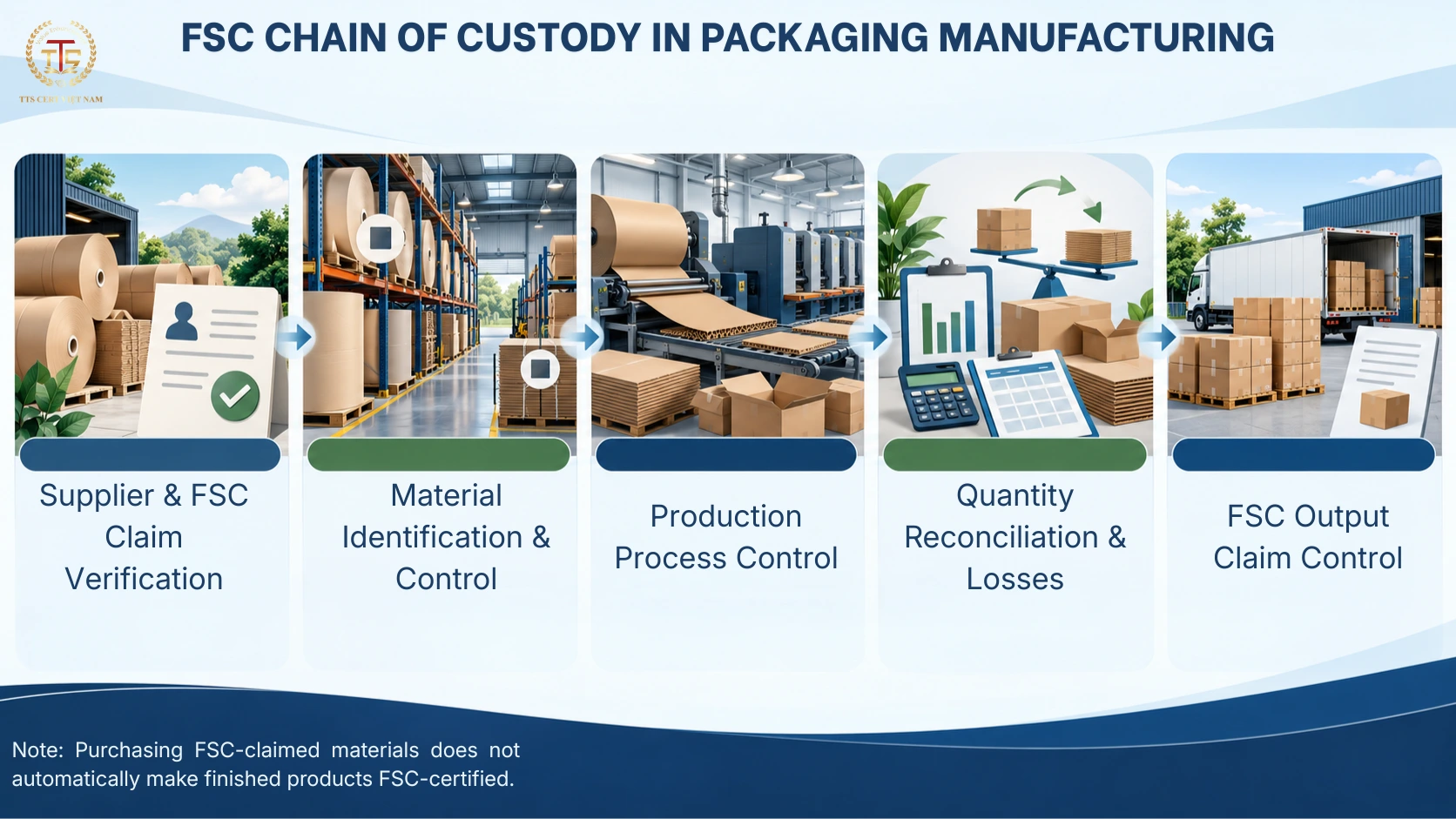
5. Key FSC CoC Requirements for Paper and Packaging Factories
The following requirements should be considered when establishing a Chain of Custody system.
5.1. Define the Certification Scope and Product Groups
The factory should identify the products and activities intended to fall within its FSC CoC certification scope.
For packaging businesses, these may include:
Corrugated cartons.
Folding cartons.
Paperboard boxes.
Paper bags.
Printed paper packaging.
Other eligible forest-based packaging products.
Product groups and applicable control systems must be established according to FSC requirements.
The factory should also identify relevant production sites, storage facilities, and outsourced activities.
5.2. Verify Suppliers and FSC Material Claims
Purchasing personnel must verify relevant supplier certification information and the FSC status of materials.
Verification should consider:
Whether the supplier has an appropriate FSC certificate.
Whether the certificate is valid and covers the relevant activities or products.
Whether the purchasing documents contain the required FSC claim.
Whether delivered products correspond to the purchased materials.
A supplier's logo, marketing brochure, or verbal statement is not sufficient evidence of an eligible FSC claim.
FSC certificate information can be checked through the official FSC certificate search system.
5.3. Identify and Control Incoming Materials
The warehouse must be able to distinguish materials according to their relevant FSC status.
Depending on the operations and applicable control system, appropriate identification may include:
Material codes.
Inventory classifications.
Warehouse labels.
ERP or inventory records.
Production order references.
FSC and non-FSC materials may be handled within the same facility, but their identification, use, and accounting must prevent unsupported claims.
5.4. Control Production Processes
Packaging production can involve several stages, including printing, cutting, die-cutting, folding, gluing, and packing.
The factory should establish controls that allow the relevant production inputs and outputs to be identified and accounted for.
A typical production sequence may be:
Material Receiving → Material Verification → Storage → Production Planning → Printing and Conversion → Finished Goods Identification → Dispatch
Actual process controls must be adapted to the factory's products, processing methods, and FSC control system.
5.5. Maintain Material Accounting and Quantity Reconciliation
Manufacturers must maintain records sufficient to support FSC material accounting and output claims.
Depending on the product groups and applicable control systems, these may include:
Opening and closing inventory.
Incoming material quantities and FSC claims.
Material issued to production.
Conversion factors.
Production output quantities.
Process waste and losses.
Quantities sold with FSC claims.
A paper packaging factory should be able to explain significant differences between incoming material quantities, production output, and recorded losses.
Accurate reconciliation reduces the risk of issuing FSC claims that cannot be supported by the applicable accounting system.
5.6. Select and Apply the Correct FSC Control System
FSC CoC provides different control systems, including transfer, percentage, and credit systems.
The appropriate system depends on the product group, input materials, intended claims, and applicable requirements.
Factories should not assume that mixing certified and non-certified paper automatically permits a proportional FSC output claim.
The eligibility of materials and the rules for calculating or transferring FSC claims must be verified before production and sale.
5.7. Control FSC Claims on Sales Documents
Where products are sold with FSC claims, relevant sales documentation must contain the information required by the applicable standard.
This includes clear identification of the FSC claim and appropriate certificate information, together with other required commercial details.
For example, a packaging manufacturer should not issue an invoice describing cartons as FSC Mix unless that claim is supported by its certification scope, control system, and records.
5.8. Control FSC Labels and Trademark Use
FSC trademarks are protected and subject to specific use requirements.
Certificate holders must comply with FSC-STD-50-001 and applicable trademark approval arrangements.
Before applying an FSC label to printed packaging, the factory should confirm:
That the product is eligible for the intended label.
That the correct label category and trademark licence information are used.
That artwork follows the applicable FSC rules.
That the required approval or verification process has been completed.
That production uses the authorized artwork version.
An FSC CoC certificate does not grant unrestricted permission to use any FSC logo on any packaging product.
5.9. Address Outsourced Activities
Some packaging manufacturers outsource activities such as printing, coating, cutting, or other processing.
The certification scope and applicable outsourcing controls must account for these arrangements.
The company should determine whether a particular contractor must hold its own FSC certification or can operate under an FSC-compliant outsourcing arrangement.
This assessment must reflect the actual contractual relationship, material ownership, processing activities, and applicable FSC requirements.
5.10. Implement FSC Core Labour Requirements
FSC CoC includes core labour requirements relating to fundamental workers' rights.
Organizations must demonstrate the implementation of requirements addressing:
Child labour.
Forced and compulsory labour.
Discrimination in employment and occupation.
Freedom of association and the effective recognition of the right to collective bargaining.
Factories must also maintain the required policy commitments and self-assessment, with evidence of implementation available for audit.
6. FSC CoC Audit Preparation Checklist for Packaging Manufacturers
Before the initial certification audit, packaging factories should verify that both their documents and actual operating practices are ready for assessment.
| Audit Area | Key Preparation | Typical Evidence |
|---|---|---|
| Certification scope | Define covered products, activities and sites | Scope statement, product group list |
| Management responsibilities | Assign personnel responsible for FSC controls | Organization chart, responsibility matrix |
| Supplier verification | Verify supplier certificates and relevant scope | Supplier list, FSC search records |
| Material purchasing | Verify valid FSC claims for eligible inputs | Purchase orders, supplier invoices |
| Material identification | Identify FSC status at receipt and storage | Warehouse records, stock labels |
| Production control | Link inputs, processes and outputs | Production orders, batch records |
| Material accounting | Maintain quantity balances and conversion factors | Inventory records, reconciliation reports |
| FSC claims | Verify sales claims are supported | Sales invoices, delivery documentation |
| Trademark use | Control labels and approval records | Artwork files, approval evidence |
| Outsourcing | Manage applicable outsourced processes | Agreements, subcontractor records |
| Core labour requirements | Implement relevant policies and self-assessment | Policy statements, self-assessment, evidence |
| Competence and records | Train relevant staff and maintain records | Training records, procedures, audit evidence |
A Practical Example: Corrugated Carton Manufacturing
A typical corrugated carton manufacturer should be prepared to demonstrate the following:
The incoming paper or corrugated board is supported by appropriate supplier documentation.
The warehouse can identify the material's relevant FSC status.
The production order identifies the required product and material specifications.
Records support the quantities transferred through the production process.
Finished cartons are identified and controlled according to the applicable system.
The FSC output claim is supported by material accounting.
FSC label artwork, where used, complies with applicable trademark requirements.
Sales documentation includes the correct claim and certificate information.
The applicable evidence will vary depending on the control system, product group, and factory processes.

Is Your Packaging Factory Ready for an FSC CoC Audit?
TTS Cert Vietnam helps packaging manufacturers assess their current controls, establish FSC CoC procedures, prepare material accounting records, and improve readiness for independent certification audits.
7. FSC CoC Certification Process for Packaging Manufacturers
A practical preparation and certification process can be organized into six stages.
Step 1. Define the Scope
Identify the packaging products, raw materials, production sites, outsourcing arrangements, and FSC claims required by customers.
Step 2. Conduct a Gap Assessment
Compare the existing factory system with applicable FSC Chain of Custody and trademark requirements.
Prioritize gaps that may affect material eligibility, traceability, quantity accounting, and output claims.
Step 3. Develop and Implement Controls
Establish the necessary procedures, responsibilities, records, and product group arrangements.
Train purchasing, warehouse, production, quality, sales, and other relevant staff.
Step 4. Engage an FSC-Accredited Certification Body
Select an appropriately accredited independent certification body and arrange the certification assessment.
The certification body is responsible for evaluating conformity and making the certification decision.
Step 5. Complete the Certification Audit
The auditor reviews relevant records, interviews personnel, and assesses the implementation of applicable requirements.
Any findings must be addressed according to the certification body's requirements before a positive certification decision can be finalized.
Step 6. Maintain Certification
Following successful certification, the factory must continue implementing the FSC system and undergo the applicable surveillance and recertification activities.
Certification does not remove the obligation to maintain traceability, control material claims, and manage changes in products or operations.
8. Common Problems Found During FSC CoC Preparation
Packaging manufacturers should pay particular attention to the following issues.
Incorrect supplier claims: Purchased paper is described as FSC-certified, but the supporting sales documentation does not include an appropriate claim.
Weak material identification: Warehouse personnel cannot clearly distinguish materials according to their relevant FSC status.
Incomplete quantity reconciliation: The factory cannot adequately explain production quantities, losses, or output claims.
Incorrect invoices: Finished products are sold with FSC claims unsupported by the applied control system.
Uncontrolled FSC artwork: Labels are printed without proper verification of the applicable trademark requirements.
Incomplete outsourcing controls: Printing or other subcontracted processes are not adequately addressed in the FSC system.
Insufficient core labour evidence: Required policy commitments, self-assessment, or supporting evidence are missing.
These problems should be addressed before the certification audit rather than relying on corrective action after the auditor identifies them.
9. How TTS Cert Vietnam Supports FSC CoC Implementation
TTS Cert Vietnam supports packaging manufacturers preparing for FSC Chain of Custody certification.
Our advisory and implementation support can include:
Certification Scope Assessment
Review factory products, raw materials, production activities, and customer expectations to identify a suitable proposed certification scope.
FSC CoC Gap Assessment
Assess existing purchasing, warehouse, production, inventory, sales, and documentation controls against the applicable requirements.
System and Documentation Development
Support the development of practical FSC procedures, product group arrangements, material identification systems, accounting records, and relevant control documents.
Staff Training
Provide guidance for purchasing, warehouse, production, quality assurance, sales, and management personnel.
Pre-Certification Readiness Review
Review implementation and supporting evidence before the independent certification audit, and support the factory in addressing identified weaknesses.
TTS Cert Vietnam provides consulting and preparation support. FSC certification audits and certification decisions are performed by appropriately accredited independent certification bodies.
10. Frequently Asked Questions About FSC CoC Certification for Packaging Factories
Is FSC CoC certification required for all packaging manufacturers?
No. FSC CoC is not automatically a legal requirement for every packaging manufacturer. It becomes relevant when the company intends to produce, sell, or label eligible FSC-certified packaging, or must satisfy particular customer requirements.
Can a factory use FSC-certified paper without obtaining its own FSC certificate?
A factory may purchase paper carrying FSC claims without automatically becoming FSC-certified.
However, if it intends to manufacture and sell finished packaging with FSC claims or apply FSC labels, certification and the applicable claim-control arrangements generally become necessary.
The exact requirement depends on the activities performed and relevant FSC rules.
Does purchasing FSC-certified raw material make finished packaging FSC-certified?
No. Purchasing eligible material is only one part of the Chain of Custody process.
The manufacturer must also meet the requirements for material control, production accounting, output claims, and certification scope.
Can FSC-certified and non-FSC packaging be produced in the same factory?
Yes, provided the company implements suitable controls and complies with the applicable FSC requirements.
The presence of non-FSC materials does not automatically prevent certification, but FSC claims must be supported by the relevant control system.
Can an FSC label be printed directly onto a cardboard box?
Yes, where the packaging product and label use meet the applicable FSC requirements.
The factory must ensure that the correct label artwork and required approvals or verification arrangements are in place.
Does an FSC label on packaging certify the product inside?
Not automatically. The FSC claim may apply only to the forest-based packaging material.
The label must not misrepresent which product or material is certified.
How much does FSC CoC certification cost?
Costs depend on factors such as the number of sites, product groups, operational complexity, certification body arrangements, and preparation needs.
Factories should obtain an appropriate quotation based on their actual certification scope.
How long does FSC CoC certification take?
The timeframe varies depending on the factory's readiness, complexity, certification body availability, and any corrective actions required.
Manufacturers should not assume a fixed certification timeframe without assessing the actual project.
11. Conclusion: Making FSC CoC Work for Your Packaging Business
FSC CoC certification can create meaningful opportunities for packaging manufacturers that serve customers requiring verified, responsibly sourced forest-based materials.
Its value goes beyond the ability to display an FSC label.
A well-implemented Chain of Custody system can strengthen material identification, traceability, supplier verification, production accounting, and customer confidence.
For Vietnamese manufacturers of paper boxes, corrugated cartons, and printed packaging, the first step is to understand the applicable requirements and define an appropriate certification scope.
Official References
Forest Stewardship Council — Chain of Custody Certification: https://fsc.org/en/chain-of-custody
FSC-STD-40-004 V3-1 — Chain of Custody Certification: https://open.fsc.org/handle/resource/302
FSC-STD-50-001 V2-1 — Requirements for Use of the FSC Trademarks by Certificate Holders: https://open.fsc.org/entities/publication/a4aa4bdb-a681-46ad-8651-0f155d261557
FSC Core Labour Requirements: https://us.fsc.org/chain-of-custody/fsc-core-labor-requirements

Lawyer Tran Thi Mai has more than 10 years of experience in legal affairs, social responsibility, ESG and sustainable development.
SEE MORE