Table of contents
The Content Claim Standard (CCS) is Textile Exchange's chain of custody standard. It verifies that a claimed material, such as recycled polyester or organic cotton, is actually present in the final product in the stated amount. Every organization that owns or handles that material along the supply chain is audited by an independent certification body.
From 31 December 2026, when the Materials Matter Standard (MMS) takes effect, the CCS becomes the main certification for spinning, weaving, dyeing and garment factories.
1. What is the CCS?
The CCS (document code CCS-101) is a voluntary standard owned and managed by Textile Exchange. The current version is CCS 3.1, released on 9 June 2022.
The CCS does not define material requirements, such as what counts as "recycled" or "organic". Those belong to material standards such as GRS, RCS, OCS or MMS. The CCS answers one question: does material verified at the source keep its identity and quantity as it moves through each processing step, up to the brand?
To do this, the CCS requires organizations to:
identify and segregate claimed material;
keep purchase, sales and production records;
reconcile input and output volumes;
use transaction certificates when selling.
The underlying concept is explained in our article on Chain of Custody (Vietnamese).
2. How does the CCS differ from GRS, RCS, OCS and MMS?
| Standard | Type | What it controls | Who applies it |
|---|---|---|---|
| CCS | Chain of custody | Identity and quantity of claimed material through each step | Every site that owns or handles the material, up to the brand |
| GRS | Recycled material, with social, environmental and chemical requirements | Recycled content plus additional requirements | Recycled supply chains (moving to MMS) |
| RCS | Recycled material | Recycled content only, no social or environmental requirements | Recycled supply chains (moving to MMS) |
| OCS | Organic material | Organic content | Organic supply chains |
| MMS | Material production | Requirements for material producers and primary processors, including recyclers | Tier 4, together with CCS |
The CCS is the chain of custody backbone of these standards. Organizations already certified to GRS or RCS already apply most CCS requirements.
3. Who needs CCS certification?
Sites that own or physically handle claimed material
Under CCS 3.1, every site that owns or takes physical possession of claimed material must be certified, up to and including the brand. Examples: spinning, weaving, knitting, dyeing, printing and sewing factories, and traders that receive goods into a warehouse.
Who is exempt
Traders without physical possession, only if they meet every condition in B1.2:
they are not a brand;
their supplier is certified;
they are named on the transaction certificate;
the volume is unchanged;
goods ship directly from supplier to customer with no processing.
Distributors handling only final products for a certified brand. Their sites may still be audited through the brand.
Retailers, unless they are also a brand or carry out more than minor processing.
Brands
Since CCS 3.0, on-product claims are only allowed when the chain of custody is certified up to the brand. Brands apply Section E of the standard: receiving final products, claims control, distribution sites, and product identification at sale.
4. CCS under Materials Matter: what Tier 1–3 suppliers need to do
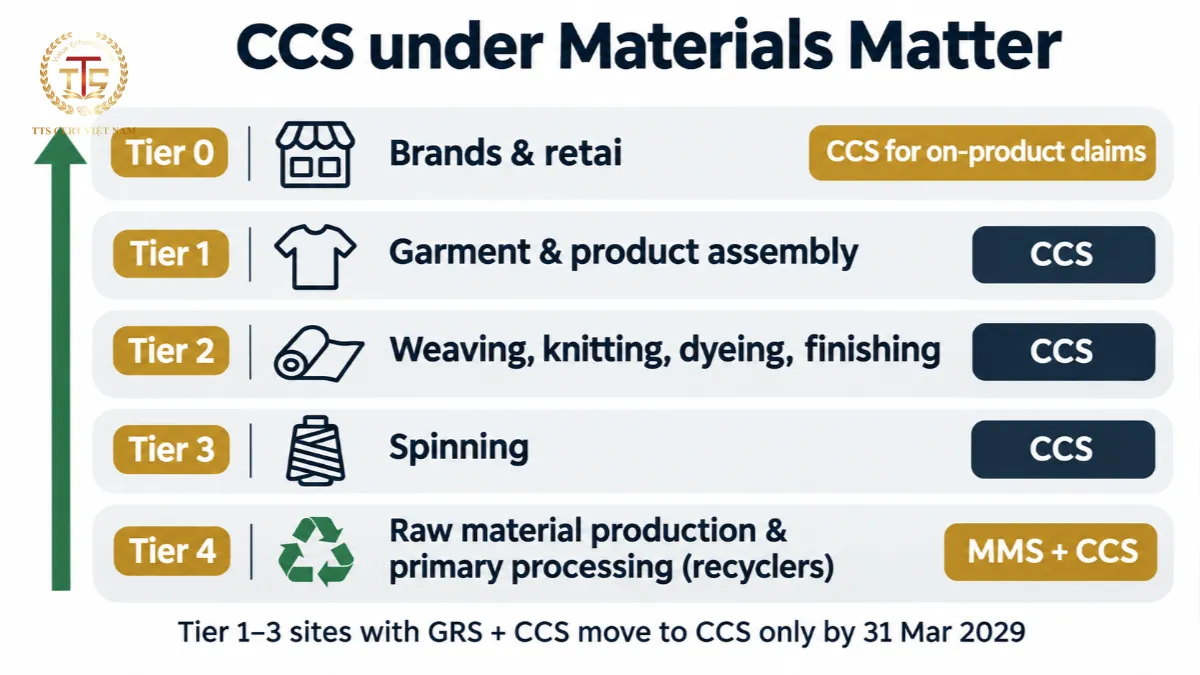
| Tier | Activity | Certification under Materials Matter |
|---|---|---|
| Tier 4 | Raw material production and primary processing (including recyclers) | MMS + CCS |
| Tier 3 | Intermediate processing (spinning) | CCS |
| Tier 2 | Material manufacturing (weaving, knitting, dyeing, finishing) | CCS |
| Tier 1 | Finished product manufacturing (sewing, assembly) | CCS |
| Tier 0 | Brands, retail, distribution | CCS when making on-product claims |
Key dates for organizations holding GRS or RCS:
31 Dec 2026: MMS takes effect.
31 Dec 2027: all audits must use MMS. No new GRS or RCS audits.
31 Mar 2029: Tier 1–3 sites holding GRS + CCS must move to CCS only. Remaining GRS and RCS scope certificates are withdrawn.
Tier 1–3 scope certificates are valid for one year.
RCS material is not an eligible input for Materials Matter products, even with a transition claim. GRS material is eligible with a transition claim.
See the full transition path for each tier in our Materials Matter Standard (MMS) guide.
Holding GRS or RCS? TTS Cert can quickly assess your path to CCS under Materials Matter.
5. Key CCS 3.1 requirements
Management system and training
Organizations need:
documented procedures for all requirements;
a management plan identifying risk points;
a material and process flow diagram;
an appointed management representative.
Internal inspections must take place at least once a year. Responsibilities must be defined, and staff must receive documented, regular training.
Volume reconciliation
Reconcile per lot or batch.
Use standard weight units. Item counts are allowed where final products are the inputs.
Define expected waste factors.
Review annually, including a physical inventory. Investigate waste deviations of more than 5%.
Record keeping
Records must be complete and auditable, and kept for at least five years.
Outsourcing
Outsourcing is allowed, but the contracting organization keeps full responsibility.
Keep a subcontractor list.
Obtain certification body approval before using a new subcontractor.
Include the required clauses in contracts.
Inputs, identification and segregation
Keep a supplier list with license numbers.
Check incoming transaction certificates before processing.
Claimed material must be clearly identified and kept separate from non-claimed material throughout storage and production. Machinery must be cleaned where contamination is possible.
If a product is suspected of non-conformity, stop referring to the claim and notify the certification body within seven days.
Blending
Blending is managed by batch, with composition calculations. For textiles and footwear, unclaimed trims may be excluded from the calculation if they total no more than 10% of product weight.
Transport and sale
Shipments must be packed and sealed so that substitution or contamination is not possible without visible damage.
Shipment labels must link to invoices and shipping documents.
6. Scope certificates and transaction certificates
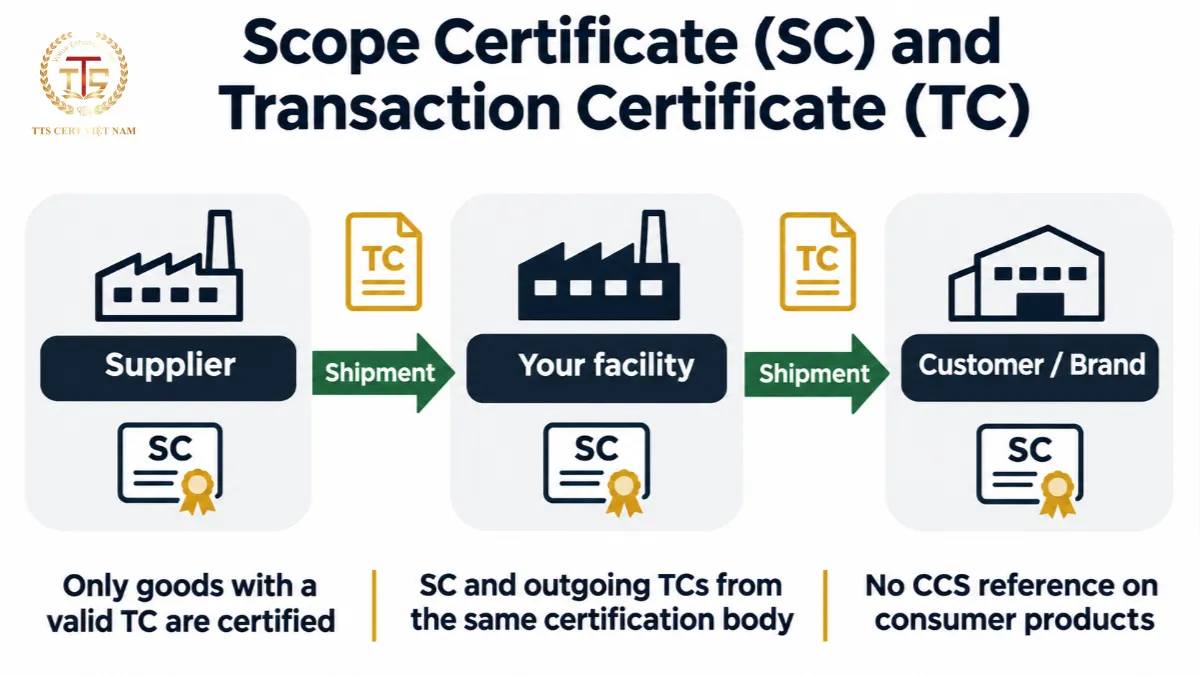
Scope Certificate (SC): confirms that an organization is able to produce and sell the claimed products and materials listed in its scope.
Transaction Certificate (TC): confirms that a shipment sold between two organizations conforms to the standard, so the buyer can treat it as claimed material.
Three points often missed:
Only products with a valid TC count as certified. An SC alone is not enough.
The SC and outgoing TCs must be issued by the same certification body.
The CCS must not be referenced on consumer products or consumer-facing marketing. On-product claims follow the material standard and Textile Exchange's claims policy.
7. CCS certification process
Consulting phase (TTS Cert)
Gap assessment against CCS 3.1. For GRS-certified sites, identify what needs to change.
Procedures and forms: identification, segregation, volume reconciliation, subcontractor control.
Training for the coordinator and the warehouse, production and purchasing teams.
Trial operation, internal audit and corrective actions before the audit.
Certification phase
The organization applies to a certification body approved by Textile Exchange.
The certification body carries out an on-site audit.
The organization closes any non-conformities, and the certification body issues the SC.
A TC is requested for each shipment sold.
On-site audits take place at least once a year to maintain certification.
Timing
The consulting phase usually takes about two months. If an organization needs results sooner, TTS Cert can add resources to shorten it. Actual timing also depends on how ready the records are and on the certification body's schedule. GRS-certified sites usually prepare faster.
Cost factors
Number of sites, processing steps and claimed materials.
Number of subcontractors in scope.
Existing certificates (GRS, RCS, OCS).
Audit, SC and TC fees charged by the certification body.
8. Documents to prepare
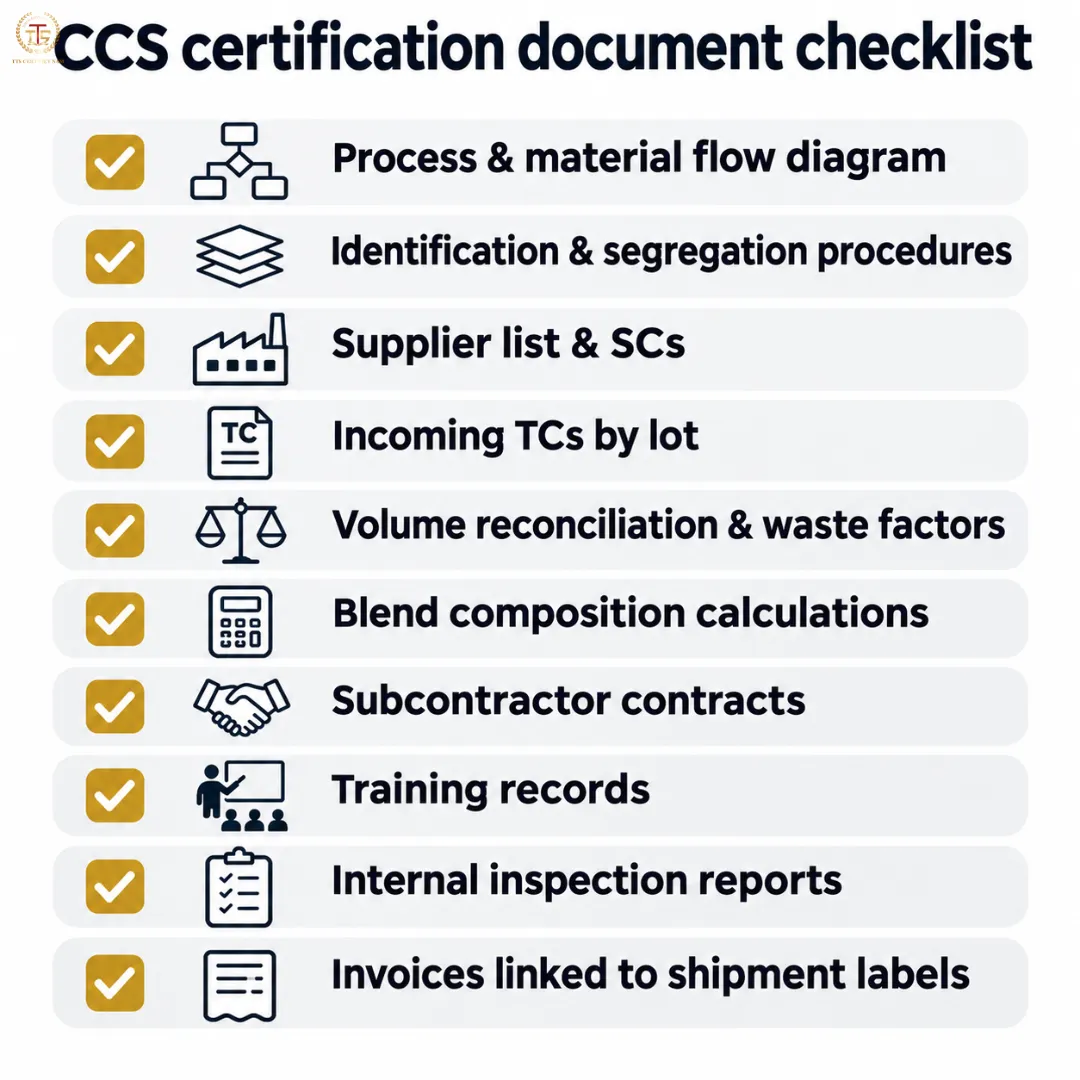
Process and claimed-material flow diagram
Identification, segregation and storage procedures
Supplier list with license numbers and supplier SCs
Incoming TCs for each lot
Volume reconciliation records per lot, with waste factors
Composition calculations for blended products
Subcontractor list and contracts
Training records and assigned responsibilities
Internal inspection reports
Sales invoices and documents linked to shipment labels
Send us your current documents and TTS Cert will review the gaps against CCS 3.1.
9. Versions and 2026–2027 updates
CCS 3.1 (CCS-101-V3.1) remains the current version.
CCS Certification Procedures CCS-102 V3.3, released 15 June 2026, replace V3.1 and V3.2:
effective from 1 October 2026;
all audits after 1 April 2027 must use V3.3.
Textile Exchange is running a full revision of the CCS to align it with Materials Matter. Finalization is expected by the end of 2027, with a public consultation of at least 60 days.
Revision progress is published on Textile Exchange’s Content Claim Standard page. TTS Cert will update this article when the new version is released.
10. How TTS Cert supports you
TTS Cert provides CCS consulting for Tier 1–3 suppliers and trading companies as part of its Materials Matter transition service:
Gap assessment against CCS 3.1, including the correct tier and scope.
Documentation: procedures, volume reconciliation forms, subcontractor control.
Training for the coordinator and relevant departments.
Transition planning from GRS/RCS to CCS before 31 March 2029, including a plan for RCS stock.
Audit support and closure of non-conformities.
TTS Cert is a consultancy. Audits, certification decisions, and SC and TC issuance are carried out by certification bodies approved by Textile Exchange.
11. FAQ
Is the CCS mandatory? Not by law. It is a voluntary standard, but suppliers need it to continue the chain of custody when brands make material claims.
Can the CCS be printed on products? No. The CCS may not be referenced on consumer products or consumer-facing marketing.
We already have GRS. Do we need separate CCS certification? GRS certification currently includes the chain of custody requirements. Under Materials Matter, Tier 1–3 sites must move to CCS certification before 31 March 2029.
Does a trader that never handles the goods need the CCS? No, if it meets every exemption condition: it is not a brand, its supplier is certified, it is named on the TC, the volume is unchanged, and goods ship directly with no processing. If any condition is missing, the trader must be certified.
How long does CCS certification take? The consulting phase usually takes about two months and can be shortened if needed. The audit and the certification body's issuance time follow.
Will CCS 3.1 be replaced? The CCS is being revised to align with Materials Matter, with finalization expected by the end of 2027. Until then, CCS 3.1 applies.
Conclusion
The CCS is not "one more certificate". It is the chain of custody work GRS-certified textile suppliers already do, and it becomes the main certification for Tiers 1–3 under Materials Matter. Organizations should review volume reconciliation, subcontractor control and RCS stock now, ahead of 31 December 2027 and 31 March 2029.

Expert Pham Van Chien has nearly 20 years of experience in quality management, information security and product technical standards.
SEE MORE