
Table of contents
ESD (electrostatic discharge) is the sudden flow of electricity between two objects at different electrical potentials when they touch or come very close. The small shock you feel when touching a door handle after walking across a carpet is a familiar example.
In electronics manufacturing, ESD damages components without operators noticing. Many discharges are too small for people to feel yet still destroy microcircuits or leave latent damage that makes products fail early in the field.
1. What Is ESD? Static Electricity vs Electrostatic Discharge
Static electricity is an electrical charge that builds up on the surface of an object because of an imbalance of electrons. It stays in place until it finds a path to escape.
Electrostatic discharge (ESD) is the moment that charge moves very quickly to another object at a lower potential, often within nanoseconds. The energy concentrated in such a short time creates local heat that can melt or puncture the tiny structures inside a component.
2. How Does ESD Happen?
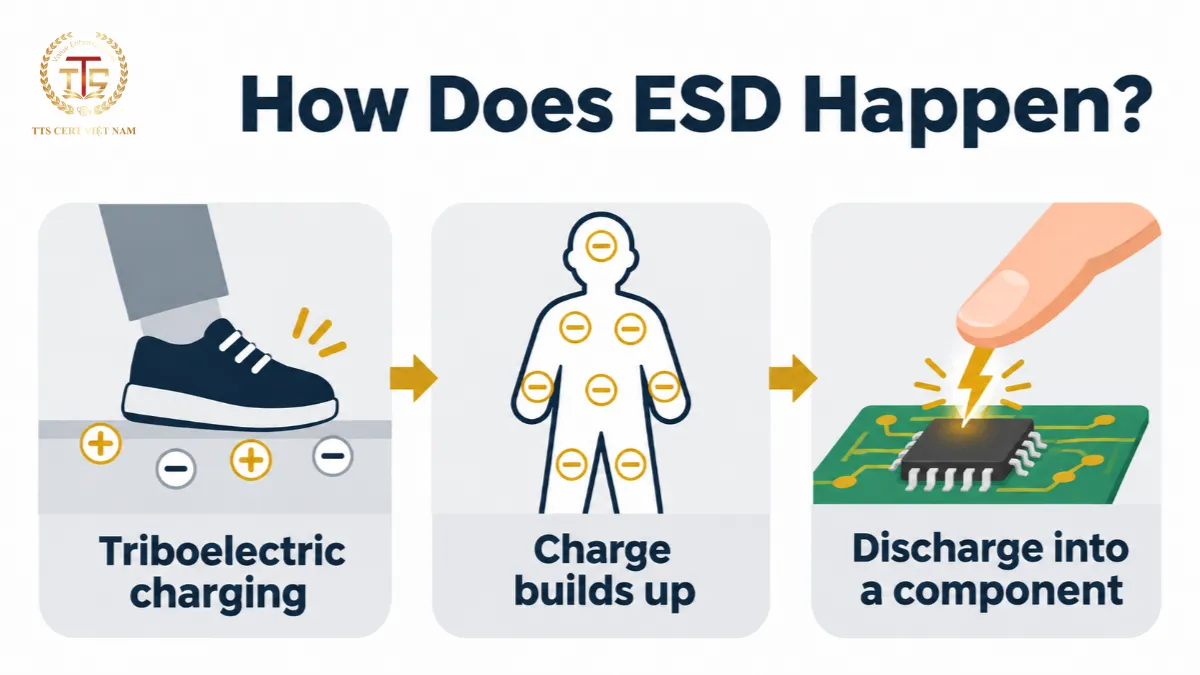
Triboelectric charging (contact and separation)
When two materials touch and then separate, electrons move from one to the other, leaving one positively and the other negatively charged. Walking on a floor, unrolling tape, pulling a plastic bag or sliding a plastic tray across a bench can all generate charge.
Charging by induction
A charged object placed near a conductor (for example a circuit board) redistributes the charge in that conductor. If the conductor is grounded at that moment, it can become charged without ever touching the original object.
What increases charge build-up
Low humidity: dry air lets charge build up more easily.
Insulating materials: ordinary plastics, foam, bags and paperwork hold charge for a long time and cannot be discharged by grounding.
People moving around: the human body is the most common source of charge in a factory.
3. Why Is ESD Dangerous for Electronic Components?
According to ESDA, people usually feel a discharge only from about 3,000 V upward, while many components can be damaged at much lower voltages. Most damaging discharges therefore go unnoticed.
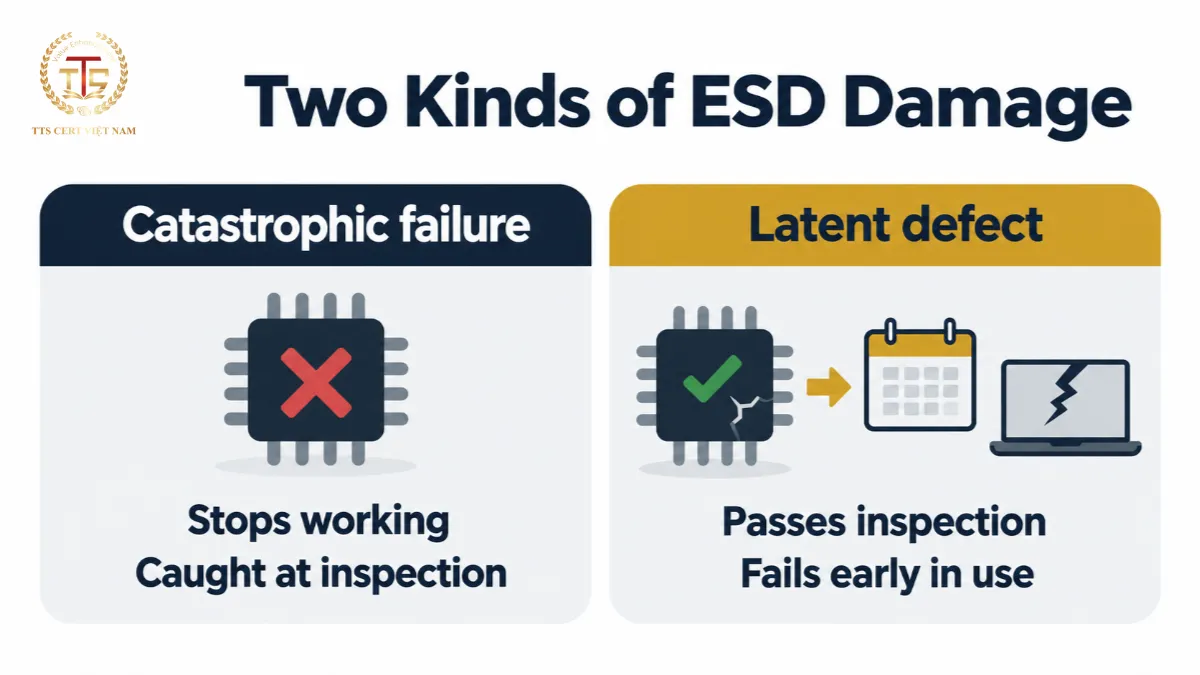
Catastrophic failure
The component fails completely and stops working. This can be caught at inspection, but it still costs scrap and rework.
Latent defect
The component is damaged but still works and passes inspection. Over time the damage grows and the product fails early in the field. This is the most dangerous type: it causes complaints, warranty costs and reputational damage, and the root cause is hard to trace.
4. What Are ESD-Sensitive (ESDS) Items?
ESDS (electrostatic discharge sensitive) items are parts, assemblies and equipment that can be damaged by ESD — for example integrated circuits, semiconductors, sensors, modules and populated circuit boards.
Sensitivity is measured with test models:
HBM (Human Body Model): simulates a discharge from a person touching a component.
CDM (Charged Device Model): simulates a charged component discharging when it touches a conductive surface, common in automated handling.
MM (Machine Model): an older model of discharge from machinery; no longer required for device qualification because HBM and CDM already provide the needed information.
A component's withstand voltage is usually stated in its datasheet. Common ESD control standards are designed to protect items with withstand voltages of 100 V HBM and 200 V CDM or more; more sensitive items need additional measures.
5. Where Does ESD Happen in a Factory?
Receiving and unpacking components.
PCB assembly, soldering and rework lines.
Inspection and functional test areas.
Packing, storage and internal transport in trays and carts.
Anywhere insulators sit close to components: plastic bags, cups, paperwork, foam boxes.
6. Four Principles of ESD Control
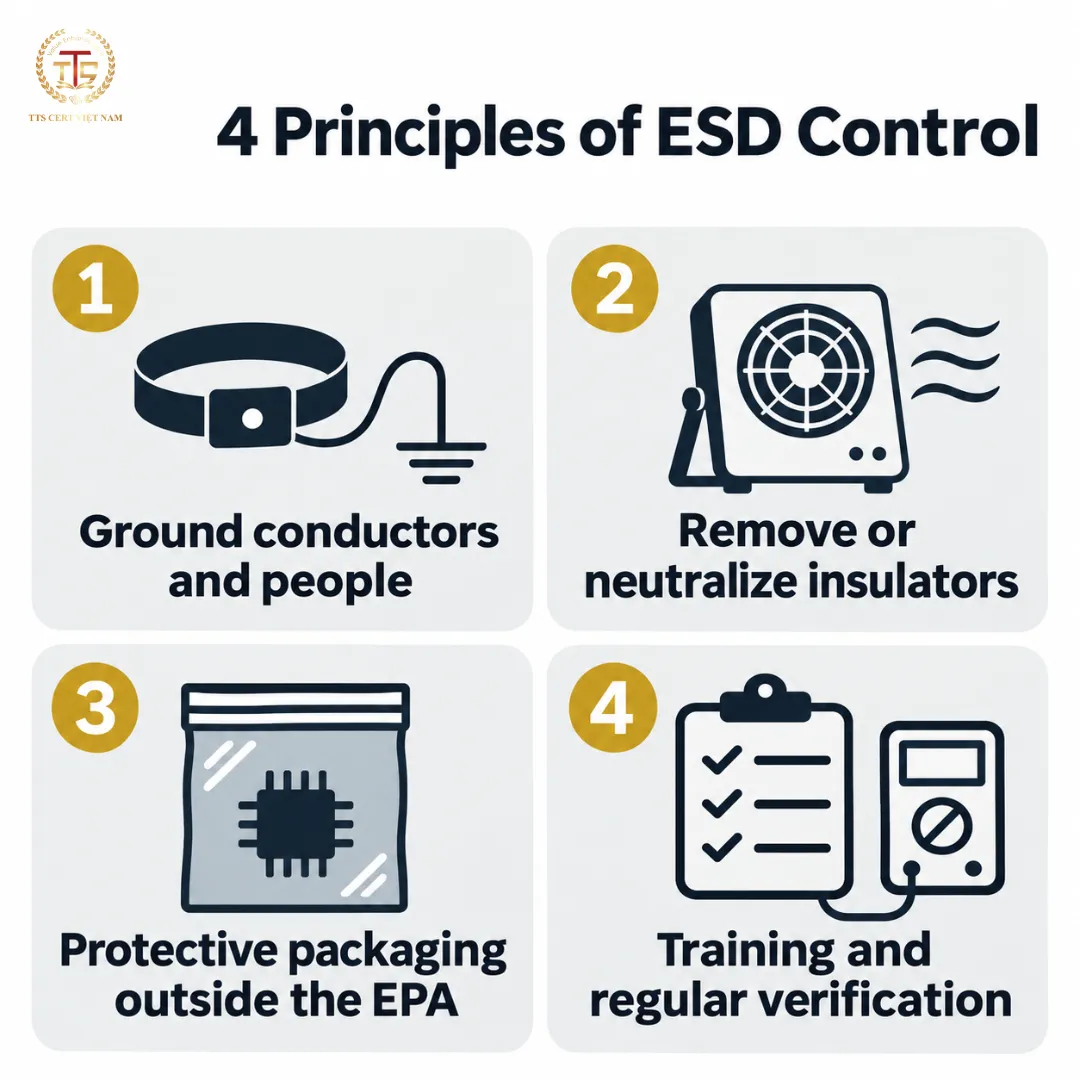
Ground all conductors, including people: wrist straps, ESD footwear and flooring, and benches and tools bonded to a common ground so everything is at the same potential.
Remove or neutralize insulators: keep unnecessary insulators out of the work area; neutralize essential ones with ionizers.
Protect items outside the controlled area: use suitable ESD protective packaging for storage and transport.
Train and verify regularly: operators understand why the rules matter, and ESD control items are measured periodically to confirm they still work.
These measures are organized in an ESD protected area (EPA) — a clearly bounded area where ESDS items are handled without protective packaging.
Humidity affects how much charge builds up, but humidity control does not replace grounding and the measures above.
7. Which Standards Define an ESD Control Program?
Two widely used, technically equivalent standards:
ANSI/ESD S20.20 (2021 edition) from the EOS/ESD Association (ESDA).
IEC 61340-5-1 (2024 edition) from the International Electrotechnical Commission (IEC).
Neither tells you which equipment to buy. Both require an ESD control program: a responsible coordinator, a written plan, training, qualification of ESD control products and periodic compliance verification. Organizations can be audited and certified by a certification body, usually at the request of customers in the electronics industry.
See the requirements, documents and process in ANSI/ESD S20.20 Certification Consulting.
8. Frequently Asked Questions
What does ESD stand for? ESD stands for electrostatic discharge.
What does ESDS mean? ESDS (electrostatic discharge sensitive) refers to parts, assemblies or equipment that can be damaged by electrostatic discharge.
Why do components fail from ESD without anyone noticing? People usually feel a discharge only from about 3,000 V, while components can be damaged at much lower levels. Latent damage also lets parts pass inspection and fail only after a period of use.
What is an EPA? An EPA (ESD protected area) is a clearly bounded area where grounding and insulator controls are applied so ESDS items can be handled safely.
Is a wrist strap enough? No. A wrist strap only grounds the person. You also need grounded surfaces and tools, insulator control, suitable packaging, training and periodic verification.
Does high humidity prevent ESD? Higher humidity reduces charge build-up but does not eliminate ESD and does not replace grounding or other controls.
Is ESD certification mandatory? Not by law. However, many electronics customers require suppliers to run an ESD control program to ANSI/ESD S20.20 or IEC 61340-5-1.
9. Conclusion
ESD is an invisible risk in electronics manufacturing: you cannot see or feel it, yet it destroys components and causes latent damage that directly affects product quality. Effective ESD control is not about buying more equipment but about a systematic program: grounding, insulator control, packaging, training and regular verification.
TTS Cert helps companies build ESD control programs to ANSI/ESD S20.20 and IEC 61340-5-1 and also runs ESD training courses.
References
ESDA – Fundamentals of Electrostatic Discharge
ESDA – ANSI/ESD S20.20-2021
IEC 61340-5-1:2024
JPL/NASA – Electrostatic Discharge (ESD) Control Standard D-1348

Expert Pham Van Chien has nearly 20 years of experience in quality management, information security and product technical standards.
SEE MORE