Higg FEM 4.0 introduced important improvements to environmental performance assessment, including better data quality, more relevant questions and revised verification arrangements.
Developed by Cascale, formerly the Sustainable Apparel Coalition, Higg FEM 4.0 was launched in November 2023 for the FEM 2023 reporting cycle. It represents a major update from FEM 3.0 rather than a new release introduced in 2026.
Here are five key Higg FEM 4.0 changes that manufacturing facilities should understand.
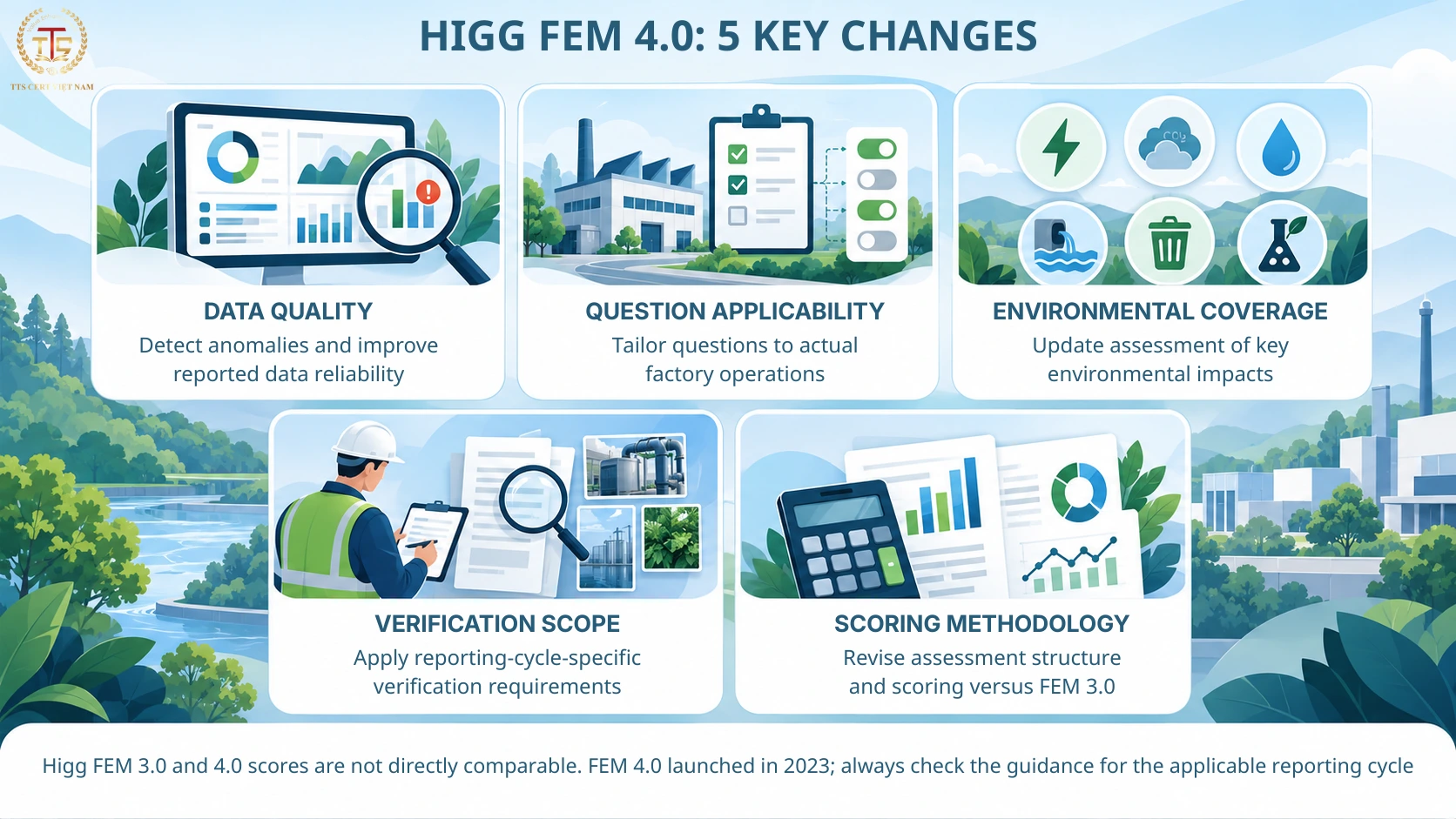
1. Improved Environmental Data Quality
Higg FEM 4.0 introduced an anomaly detection feature designed to identify potentially inconsistent or inaccurate reported data.
This encourages facilities to improve data collection and maintain reliable evidence supporting their environmental performance information.
Factories should pay particular attention to energy consumption, greenhouse gas emissions, water use and other applicable quantitative indicators.
2. More Relevant Questions for Each Facility
Higg FEM 4.0 improved its applicability criteria so that assessment questions better reflect a facility's actual operations and processes.
This helps manufacturers focus on relevant environmental impacts rather than spending time on questions that do not apply to their activities.
Accurate facility information is therefore essential to determine the appropriate assessment scope.
3. Expanded Environmental Assessment Content
The update provides more detailed coverage of important environmental impacts, including energy, greenhouse gas emissions, water, wastewater, waste and chemicals.
Certain environmental risks, such as groundwater contamination, also receive greater attention.
Higg FEM 4.0 strengthens alignment with relevant industry frameworks, including the GHG Protocol, Science Based Targets initiative (SBTi) and ZDHC Roadmap to Zero.
However, completing Higg FEM does not automatically establish compliance with every requirement of these separate frameworks or programs.
4. Changes to Higg FEM Verification
Cascale revised its verification approach during the transition to Higg FEM 4.0.
For the 2024 verification cycle covering FEM 2023, the verification scope was narrowed to a core set of questions focusing on foundational environmental practices and selected quantitative metrics.
Verification arrangements subsequently evolved in later reporting cycles.
Facilities should therefore distinguish their full self-assessment from the questions required for verification and check the requirements applicable to each reporting cycle.
5. Changes to Scoring and Performance Comparisons
The transition from Higg FEM 3.0 to 4.0 involved changes to assessment questions and scoring methodology.
According to Cascale, Higg FEM 3.0 and 4.0 scores are not directly comparable.
A change in score following the transition does not necessarily indicate an equivalent change in actual environmental performance.
Factories should review the applicable scoring methodology and underlying data before interpreting year-on-year trends.
What Should Factories Prepare?
Manufacturers should focus on four practical actions:
Review environmental data: Check relevant energy, emissions, water, wastewater, waste and chemical management information.
Verify supporting evidence: Ensure reported figures are backed by reliable records.
Confirm assessment applicability: Provide accurate facility and production information.
Check reporting-cycle requirements: Review current scoring, verification and customer-specific expectations.
Preparation should be integrated into daily environmental management rather than postponed until the verification period.
Conclusion
Higg FEM 4.0 represents a significant improvement in environmental data quality, assessment relevance and verification practices.
Understanding these changes helps Vietnamese manufacturers prepare more reliable information and strengthen their environmental management processes.
TTS Cert Vietnam supports factories with environmental data reviews, gap assessments, documentation preparation and Higg FEM verification readiness.
For a complete overview of the assessment scope, scoring and verification process, read What Is Higg FEM? Requirements, Scoring and Verification Process.
Official References
Cascale – Higg FEM 4.0: https://cascale.org/tools-programs/higg-index-tools/facility-tools/higg-fem-4-0/
Cascale – Higg FEM 4.0 Scoring Methodology: https://howtohigg.cascale.org/higg-index-tools/higg-fem/higg-fem4-0-scoring-methodology/

Expert Tang Mong Diep has more than 15 years of experience in environmental management, ESG and sustainable development, with particular expertise in the Higg Facility Environmental Module (Higg FEM).
SEE MORE