Table of contents
Manufacturers in the plastics, chemicals and packaging sectors increasingly need reliable evidence of where alternative feedstocks come from, how materials move through production and whether the claims provided to customers are supported by records. ISCC PLUS certification is one way to establish that evidence within a recognised chain-of-custody framework.
This guide covers the scope of ISCC PLUS, its three chain-of-custody methods, practical mass balance controls, required records, certification steps and the transition to new requirements on 1 January 2027. TTS Cert supports businesses in building their systems and preparing for independent certification audits.
1. What Is ISCC PLUS and Who Needs Certification?
ISCC PLUS is a voluntary certification scheme managed by International Sustainability and Carbon Certification (ISCC). It supports the verification of sustainability characteristics and traceability of eligible alternative feedstocks throughout supply chains, including bio-based, circular and other relevant materials.
A certified site does not automatically demonstrate that every individual product physically contains a particular percentage of recycled material. The applicable material category, activities, chain-of-custody method and scope of certification determine the claims that may be made.
| Business type | Typical reason for certification |
|---|---|
| Recyclers and waste processors | Demonstrate eligible input sourcing and control of processing activities |
| Chemical and polymer producers | Manage certified bio-based or recycled feedstocks through production |
| Packaging and industrial manufacturers | Supply certified materials or products to customers requesting ISCC PLUS traceability |
| Traders and storage operators | Maintain the required chain of custody when handling and transferring certified materials, where certification is applicable |
Before starting: Confirm the buyer's required feedstock type, preferred chain-of-custody method and expected transaction documents. These decisions affect the certification scope, bookkeeping and audit preparation.
2. Eligible Materials and Activities under ISCC PLUS
ISCC PLUS is widely used for eligible bio-based, circular/recycled and renewable-energy-derived feedstocks under the scheme's material classifications and requirements. Examples may include qualifying agricultural feedstocks, plastic waste, chemically recycled intermediates and products used in the chemical industry.
Not every material marketed as recycled or every waste stream is automatically eligible. The precise classification, origin evidence, material code, processing activity and certification scope must be established with the certification body (CB).
Important 2026 update for plastic waste operations: As of 22 September 2026, Plastic Waste Processor is no longer an applicable Processing Unit type for initial or recertification audits under ISCC PLUS. Depending on the actual process, operators may instead fall under Mechanical Recycling Plant, Treatment Plant for Waste/Residues or another appropriate category. Certificates still valid under the former category can remain unchanged until the next recertification, according to the transition notice.
The ISCC PLUS material framework is not identical to the product scopes covered by the Global Recycled Standard (GRS) or Recycled Claim Standard (RCS). Each scheme has its own verification and claims rules.
3. Core ISCC PLUS Requirements
The main question in an ISCC PLUS audit is whether a business can demonstrate which eligible inputs were received, how they were handled and what volume of certified characteristics may be allocated to outputs.
| Control area | Typical records and evidence |
|---|---|
| Scope and responsibilities | Certified sites and activities, material flow diagrams, assigned personnel |
| Supplier and incoming material checks | Supplier certificate checks, sustainability declarations, purchasing and receipt records |
| Storage and production | Material identification, production orders, inventory, consumption, conversion factors, losses and outsourced processing records |
| Chain of custody | Applied method, reconciliation records, calculation rules and traceability evidence |
| Sales and claims | Delivery documentation, quantities, product descriptions and appropriate outgoing sustainability declarations |
| Internal oversight | Training, internal reviews, correction of discrepancies and document control |
Requirements can be more demanding for particular waste and residue activities or higher-risk supply chains. The relevant checklist must follow the actual certification scope rather than a generic factory template.
4. Three ISCC PLUS Chain-of-Custody Methods
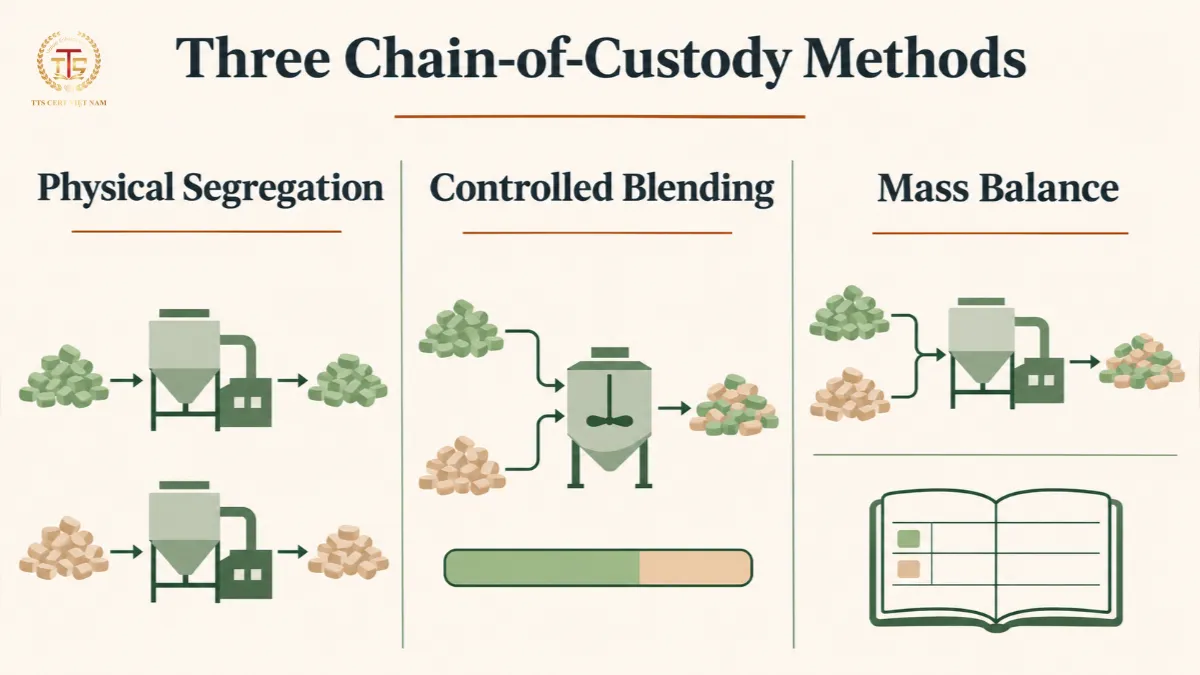
Chain of Custody (CoC) determines how certified material characteristics remain linked to material flows and downstream claims. ISCC PLUS offers three options:
| Method | Principle | Key control point |
|---|---|---|
| Physical Segregation | Certified material is physically managed separately as required by the scheme | Maintain identification and segregation throughout handling |
| Controlled Blending | Materials are blended with a known and documented certified proportion | Track and support the actual certified share of the blended output |
| Mass Balance | Certified and non-certified inputs may be physically mixed but are separately accounted for | Control quantities, processing losses, reconciliation periods and allocation of certified characteristics |
The selected method determines which output claims are permissible. Mass balance allocation must not be presented as proof that each individual product physically contains the allocated percentage of recycled content.
5. How Does ISCC PLUS Mass Balance Work?
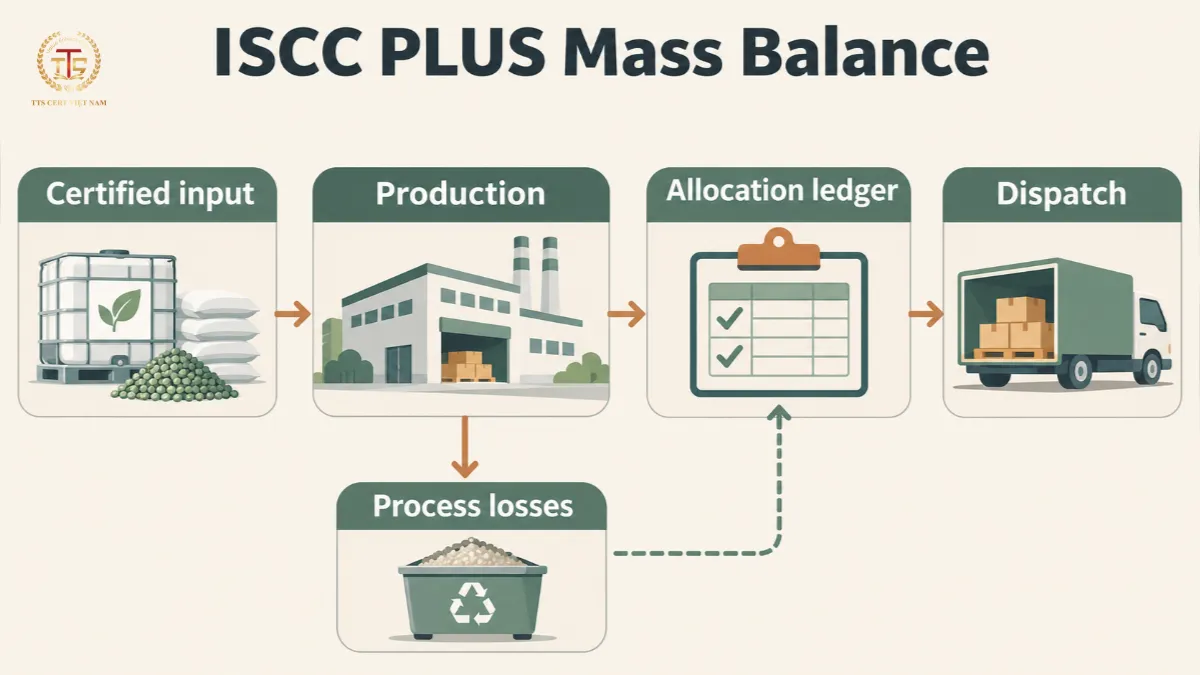
Mass balance is often the most technically demanding part of implementation. A facility needs a controlled record of certified inputs, physical outputs, production losses and the sustainability characteristics allocated to outgoing products. Calculations must comply with the applicable ISCC guardrails and the specific production process.
Five practical checks
Validate certified inputs: Verify supplier certificates, sustainability declarations, eligible material categories and quantities received.
Capture actual production data: Reconcile receipts, production, losses, stock movements and outputs within the relevant period.
Apply the correct calculation approach: Use appropriate conversion or consumption factors and the relevant technical restrictions.
Track allocation and remaining balances: Do not allocate more eligible certified characteristics than the rules and data support; retain adjustment history.
Reconcile outgoing claims: Ensure that dispatched quantities and sustainability declarations agree with the bookkeeping and certificate scope.
Illustration only—not a universal certification formula: Suppose a facility receives 200 tonnes of certified input and 800 tonnes of conventional input. It cannot automatically claim that any 200 tonnes of finished goods qualify as ISCC PLUS output. Production yield, technical connectivity, actual output, allowable allocation and the selected bookkeeping method must all be considered.
ISCC does not prescribe one mandatory spreadsheet for mass balance. A company may use its own spreadsheets or ERP system if records are complete, consistent, auditable and meet the scheme requirements.
6. ISCC PLUS Document and Record Checklist
The most useful audit file follows the material flow from purchasing through production to dispatch, rather than collecting unrelated policies in one folder.
| Record group | What to prepare |
|---|---|
| Legal and scope | Entity details, site addresses, material lists, activity scope, process and flow diagrams |
| Suppliers | Supplier register, valid certificate checks, orders, contracts and goods receipt records |
| Sustainability evidence | Incoming Sustainability Declarations (SDs) or other applicable ISCC documents linked to transactions |
| Warehouse and production | Inventory, production records, conversion factors, losses, batch tracing and outsourcing records |
| Mass balance | Accounting method, reconciliation periods, eligible inputs and outputs, allocated quantities and balances |
| Outgoing sales | Contracts, invoices, dispatch records, product descriptions and outgoing declarations |
| System management | Responsibilities, procedures, training, internal checks and corrective action records |
Why Sustainability Declarations matter
An SD communicates certified sustainability characteristics through the relevant supply-chain transactions. The facility should verify the supplier and buyer details, supplier certificate number, product and material information, quantity, dispatch date, chain-of-custody details and other mandatory data applicable to the document version.
An SD does not replace the supplier's site certificate. Both the supplier's certificate status and the specific transaction information must be checked. A photograph of a certificate alone cannot establish the certified status of every shipment.
7. ISCC PLUS 2027 Transition: What Changes?
ISCC has introduced standalone ISCC PLUS System Documents v1.1. The major transition date is 1 January 2027:
| Situation | What the facility should know |
|---|---|
| Audits conducted from 1 January 2027 | Must follow the applicable requirements of ISCC PLUS v1.1 |
| Audits in December 2026 | The transition guidance may permit an audit against v3.4.2 or v1.1, with certificate issuance in January 2027 |
| Companies certified under v3.4.2 before the transition | May generally continue under those requirements until the next recertification, subject to the specific SD transition provisions |
| Sustainability Declarations from 1 January 2027 | Must contain the mandatory information required under SD v4.0, whether the ISCC template or a compliant company-designed template is used |
Existing 2026 certificates do not automatically become invalid on 1 January 2027. Applicability depends on the audit date, certificate version and transitional provisions.
Manufacturers should review outgoing SD fields, input-characteristic reporting, allocation and recordkeeping rules, staff training and any applicable surveillance-audit obligations. For sites recertifying in 2027, a readiness assessment against v1.1 should begin before the renewal audit is scheduled.
8. ISCC PLUS Certification Process in Vietnam
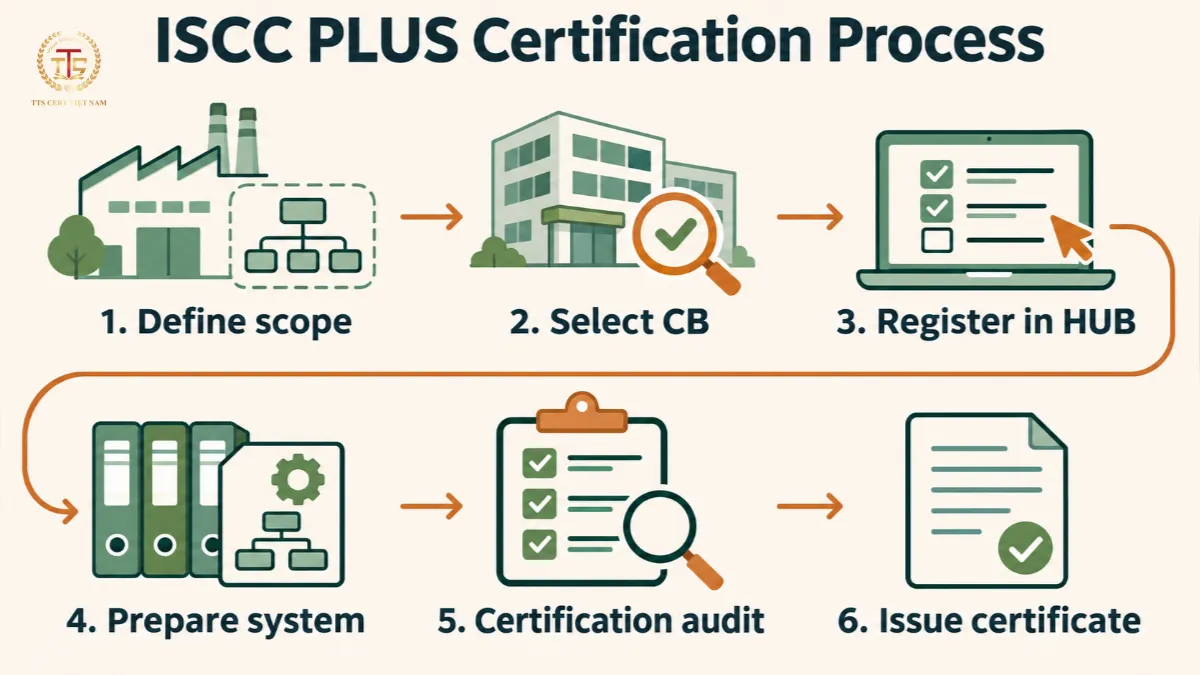
| Step | What happens |
|---|---|
| 1. Define the scope | Establish sites, activities, eligible materials and applicable CoC method |
| 2. Appoint a CB | Select an ISCC cooperating certification body with the relevant scope and capacity for Vietnam |
| 3. Register in the ISCC HUB | Submit the registration and obtain the necessary reviews before the audit |
| 4. Implement controls | Operate supplier checks, SD controls, production records, mass balance and internal reviews |
| 5. Undergo the audit | The independent CB assesses documents, transactions, processes and relevant on-site operations |
| 6. Close findings and receive the certificate | Resolve non-conformities where applicable; the CB makes the certification decision and issues the certificate |
ISCC provides a 40-day period for implementing corrective measures following non-conformities. The certification submission framework also provides for a maximum 60 calendar days after the audit, including the corrective-action period. This is not a promise that a new certification project can be completed within 60 days of the first consultation.
9. Costs, Timeline and Certificate Validity
An ISCC PLUS certificate is valid for 12 months, with its start and expiry dates shown on the certificate. Certification is generally site-specific, with defined provisions for certain group-certification scopes and address exceptions.
The timeline depends on the maturity of supplier controls, the complexity of the production process, record availability, the number of sites and the CB's audit schedule. Well-maintained material-flow and reconciliation data can make preparation substantially easier.
Budgeting should distinguish consulting fees, the CB's audit and certification fees, and applicable ISCC system fees. There is no responsible single fixed price for every plastics, chemicals or packaging facility; a meaningful quotation requires the intended scope and a review of site complexity.
10. Who Manages, Certifies and Verifies ISCC PLUS Certificates?
ISCC is the scheme owner and publishes the scheme requirements. Audits and certification decisions are carried out by independent cooperating Certification Bodies (CBs). ISCC itself does not conduct the facility audit, and a consulting provider does not issue the certificate.
Businesses can consult the official list of cooperating ISCC Certification Bodies and confirm a prospective CB's ISCC PLUS scope, regional coverage, lead time and quotation.
How to check a certificate
Visit the official ISCC certificate database.
Search by company name or certificate number, filter for ISCC PLUS and review the site, scope, validity and issuing CB.
Where appropriate, check the separate lists of suspended, withdrawn and fake certificates rather than relying only on a supplier-provided PDF.
Reconcile the certificate against the shipment's SD and transaction records. A valid site certificate alone does not verify every outgoing claim.
A certificate may be valid before its entry or full documents appear in the public database. If a recent certificate is not yet displayed, confirm with the CB or ISCC rather than assuming it is invalid.
11. ISCC PLUS vs ISCC EU and GRS/RCS
| Scheme | Primary purpose | Key distinction |
|---|---|---|
| ISCC PLUS | Voluntary certification of eligible alternative feedstocks and their traceability, including mass balance | Appropriate where customers specifically require ISCC PLUS-certified supply chains |
| ISCC EU | Certification aligned with relevant regulated renewable-fuel and energy requirements in the EU | An ISCC PLUS certificate should not be treated as an automatic substitute |
| GRS | Recycled-material verification with wider environmental, chemical and social requirements under Textile Exchange | Different traceability and product-claims framework |
| RCS | Recycled-content verification and traceability under Textile Exchange | Does not automatically validate ISCC PLUS claims |
Companies supplying textiles should also understand the separate transition to the Materials Matter Standard and Content Claim Standard within the Textile Exchange system. That transition does not replace ISCC PLUS. The correct certification decision should be based on the buyer's material requirements, intended claims and supply-chain evidence—not simply on the presence of the term “recycled”.
12. How TTS CERT Supports ISCC PLUS Certification
TTS Cert provides practical implementation support based on the client's material flows and production data:
| Consulting stage | Scope of support |
|---|---|
| 1. Scope and gap assessment | Review buyer requirements, eligible materials, sites, process flows, CoC options and existing records |
| 2. System development and implementation | Support supplier checks, SD control, material identification, production records, mass balance, claims, training and operational checks |
| 3. Audit readiness and follow-up | Internal review, evidence checks, coordination with the CB, clarification of records and corrective-action follow-up |
TTS Cert is a consultancy, not an ISCC PLUS certification body. Independent certification decisions and certificate issuance are carried out by an authorised CB in accordance with ISCC rules.
Frequently asked questions
Does ISO 9001 or GRS certification exempt a facility from an ISCC PLUS audit? No. Existing management or traceability controls may help with preparation, but the specific ISCC PLUS requirements and scope still apply.
Is dedicated mass balance software mandatory? Not necessarily. Internal spreadsheets or ERP solutions may be appropriate if they meet the data integrity, allocation and auditability requirements.
Can a company automatically place the ISCC PLUS logo on a product after receiving a certificate? No. Logo use and claims are subject to the applicable ISCC licensing, claims and trademark rules, and the type of claim must be permitted.
If a customer requests ISCC PLUS-certified bio-based or circular materials, TTS Cert can help identify your certification scope and assess the records you already maintain before the independent audit.