Table of contents
SLCP verification is a standardized process for collecting and independently verifying social and labor data at manufacturing facilities using the Converged Assessment Framework (CAF), developed by the Social & Labor Convergence Program (SLCP).
Instead of undergoing several overlapping social compliance assessments for different brands, a facility can complete one SLCP assessment and share its verified dataset with multiple customers where they accept it. This approach can reduce duplication, improve transparency and leave more resources available to improve working conditions.
SLCP is not a certification scheme: it does not issue certificates, score factories or provide an overall pass/fail decision. The output is a verified social and labor assessment report that business partners interpret according to their own requirements.
TTS CERT Vietnam provides consulting support for SLCP implementation, including gap analysis, document preparation, training, CAF completion support, data checks and preparation for independent verification.
1. What Is SLCP Verification? Is It Certification?
SLCP is a multi-stakeholder initiative aimed at reducing overlapping social audits in global supply chains and promoting improvements in working conditions. Its CAF provides a common method of collecting information on labor conditions, employment practices and social compliance management.
Facilities conduct a self-assessment or joint assessment, after which an SLCP-approved Verifier Body (VB) checks the accuracy of the information. Facilities retain control over how the verified data is shared.
What does a factory receive?
| Topic | SLCP approach |
|---|---|
| Program owner | Social & Labor Convergence Program (SLCP) |
| Core framework | Converged Assessment Framework (CAF) |
| Verification provider | An SLCP-approved VB eligible for the facility |
| Final output | Verified social and labor assessment report |
| Certificate | No SLCP certificate is issued |
| Scoring/rating | SLCP does not score or rank factories |
| Data sharing | SLCP Gateway and connected services, under facility-controlled permissions |
The report may identify non-compliances with legal requirements or international labor standards. However, each customer decides how to evaluate and use the information, rather than receiving an SLCP-wide pass/fail judgment.
Benefits of SLCP verification
Reduces overlapping assessments when customers accept the same verified data.
Standardizes recruitment, working-hours, payroll, benefits and health-and-safety information.
Improves transparency with brands, retailers and supply chain partners.
Helps identify corrective actions and measure improvements across assessments.
Provides inputs for human rights due diligence (HRDD).
Unlike WRAP certification, which may issue a certificate to a compliant facility, SLCP produces verified data. An SLCP report does not automatically replace every other social audit.
2. Which Factories Should Complete an SLCP Assessment?
SLCP is well suited to facilities participating in international supply chains, especially textile, apparel, footwear and related manufacturing businesses. Buyers may also ask facilities in other sectors for SLCP data.
| Situation | Purpose |
|---|---|
| A customer requests SLCP | Provide independently verified labor and social information |
| A factory supplies several international brands | Share one dataset where each customer accepts it |
| A facility implements Higg FSLM | Use CAF-based data collection and the associated verification process |
| A factory is improving labor management | Identify gaps between policy, records and actual practices |
| A supplier is expanding its customer base | Prepare reliable compliance data for new customers |
When should a factory start?
Preparation should begin when a customer identifies a deadline, required CAF Step or data-sharing platform. Without a specific requirement, check customer expectations before selecting the assessment scope.
If your facility already undergoes amfori BSCI assessments or Sedex SMETA audits, confirm whether customers will accept SLCP data or still require separate reports.
3. What Does the SLCP CAF Cover?
CAF comprises the Data Collection Tool, Verifier Guidance and Verification Protocol. As of November 2026, CAF v1.7.1, released in March 2026, is the current Data Collection Tool version.
The three assessment Steps
| Step | Scope | When to consider it |
|---|---|---|
| Step 1 – Essential | Foundational questions concerning labor law and international labor standards | The buyer requires foundational verified data |
| Step 2 – Progressive | Step 1 plus broader social and labor information and management systems | The facility has relevant systems and the buyer expects more depth |
| Step 3 – Advanced | Steps 1 and 2 plus practices beyond minimum compliance | The facility wants to disclose advanced workplace and worker-wellbeing practices |
A higher Step does not mean a better certification grade. Steps determine the depth and scope of data collected. They must be chosen in line with buyer requirements and actual facility circumstances.
Key CAF information areas
Depending on the selected Step, the questionnaire covers:
Recruitment, employment contracts and termination.
Child labor, forced labor and responsible recruitment.
Working hours, overtime and rest periods.
Compensation, benefits and social insurance.
Worker treatment, discrimination and harassment.
Worker representation, dialogue and grievance mechanisms.
Occupational health and safety and workplace conditions.
Management systems and advanced practices where applicable.
Not every factory answers every CAF question. Applicable questions vary according to the facility profile and earlier responses. The CAF Explorer available through SLCP Gateway helps teams review the questions before assigning documentation responsibilities.
4. The SLCP Assessment and Verification Process
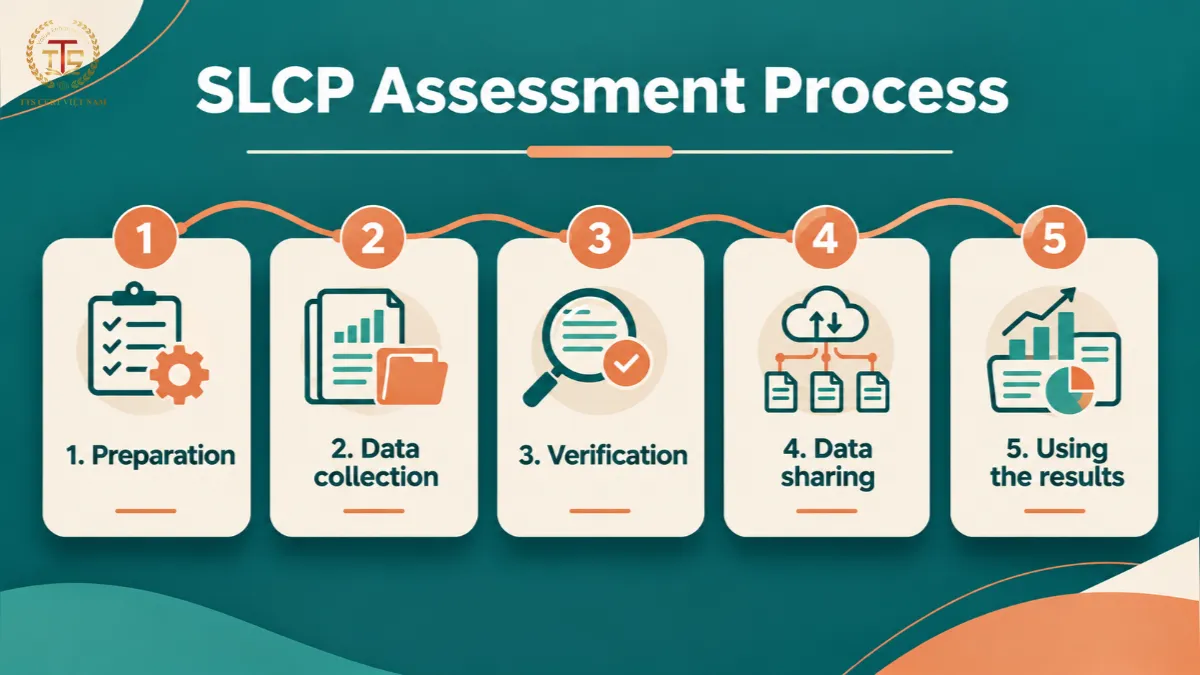
SLCP defines five broad stages: preparation → data collection → verification → data sharing → use of results. In practice, factories can implement them through seven steps:
Step 1. Learn the process and register on Gateway
The responsible team reviews SLCP guidance, completes any relevant introductory training and creates a profile on SLCP Gateway. Accurate facility, workforce, activity and language information matters because it can affect the eligible Verifier Body list.
Step 2. Connect to an Active Accredited Host
An Accredited Host (AH) is a platform approved by SLCP for relevant data collection, verification and sharing functions. According to the published list as of November 2026, Worldly is the only Active Accredited Host, allowing facilities to conduct an SLCP assessment through Higg FSLM.
Gateway and the AH platform have different purposes: Gateway manages verified information and sharing permissions, while the AH supports the assessment and verification workflow.
Step 3. Choose a CAF Step and complete initial data collection
Facilities may use either of the two approaches:
Self-assessment: the facility completes the questionnaire itself.
Joint assessment: an external organization assists the facility in gathering or completing the information.
Both approaches follow CAF. Answers must accurately represent actual working practices rather than being selected to create a favorable compliance impression.
Step 4. Review and submit the data
Before submission, reconcile answers against timekeeping, payroll, contracts, safety records, worker information and conditions on site. The completed data must be available to the VB at least 10 working days before verification.
Step 5. Select a VB and complete verification
The factory selects an eligible VB on the AH platform, agrees fees and scheduling, and prepares for the visit. The Verifier checks documents, observes working conditions, interviews workers and compares responses against evidence in accordance with SLCP requirements. Verification must occur within two months of completing the self- or joint assessment.
Step 6. Receive and review the report
The Verifier must upload the results within 10 working days after the verification visit. The facility has 30 calendar days to accept the report, request edits or use the dispute mechanism under SLCP procedures. Any discrepancies between facility responses and verified findings should be reviewed carefully.
Step 7. Finalize and share the verified data
After finalization, the facility may authorize customers and other partners to access the verified data through Gateway and connected channels. Brands can still request clarifications, corrective actions or additional audits according to their own policies.
5. Who Can Verify SLCP and How Can the Results Be Checked?
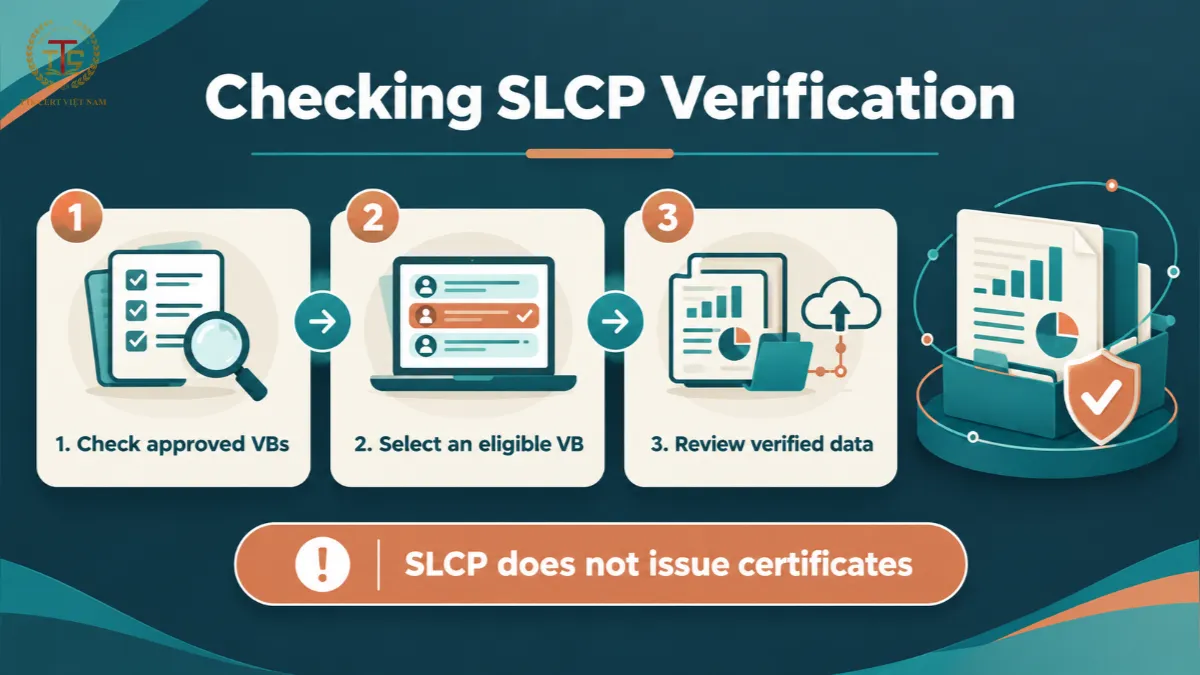
For data to qualify as SLCP-verified under the program, verification must be performed by an approved VB eligible for the facility.
Who approves Verifier Bodies?
SLCP runs a VB approval and quality oversight framework through the Verification Oversight Organization (VOO). Requirements published in 2026 cover appropriate third-party auditing status, social audit competence, relevant APSCA membership, personnel qualifications, independence and quality management.
An auditing firm's ISO management system certificate, if it holds one, does not by itself establish approval to conduct SLCP verification.
How to check an SLCP-approved VB
Open the official requirements for SLCP-approved VBs and Verifiers and follow the View the list of active VBs link.
Sign in to Worldly and use Select Verifier Body to view the facility's eligible selection list.
Compare the organization's name, local service eligibility, quality score, staff availability, proposed dates and quotation.
From 1 April 2026, the updated VB Selection Model limits selection to VBs appearing on the facility's eligible list. A public directory is an initial reference, not a substitute for the system's eligibility check. A VB's 0–5 quality score describes the organization's verification performance, not the factory's labor compliance.
How to review a verified SLCP report
SLCP does not have a public certificate registry because the program does not issue certificates. A facility or authorized customer should:
Check the Facility ID, Assessment ID, facility name and site address.
Review the verification completion status, CAF version, selected Step and verification date.
Confirm the VB and the responses verified during the assessment.
Read the source report and explanations, especially recorded non-compliances.
Access or share the original verified data using authorized Gateway permissions rather than relying only on an unattested PDF or Excel file forwarded by another party.
6. Documents to Prepare for SLCP Verification
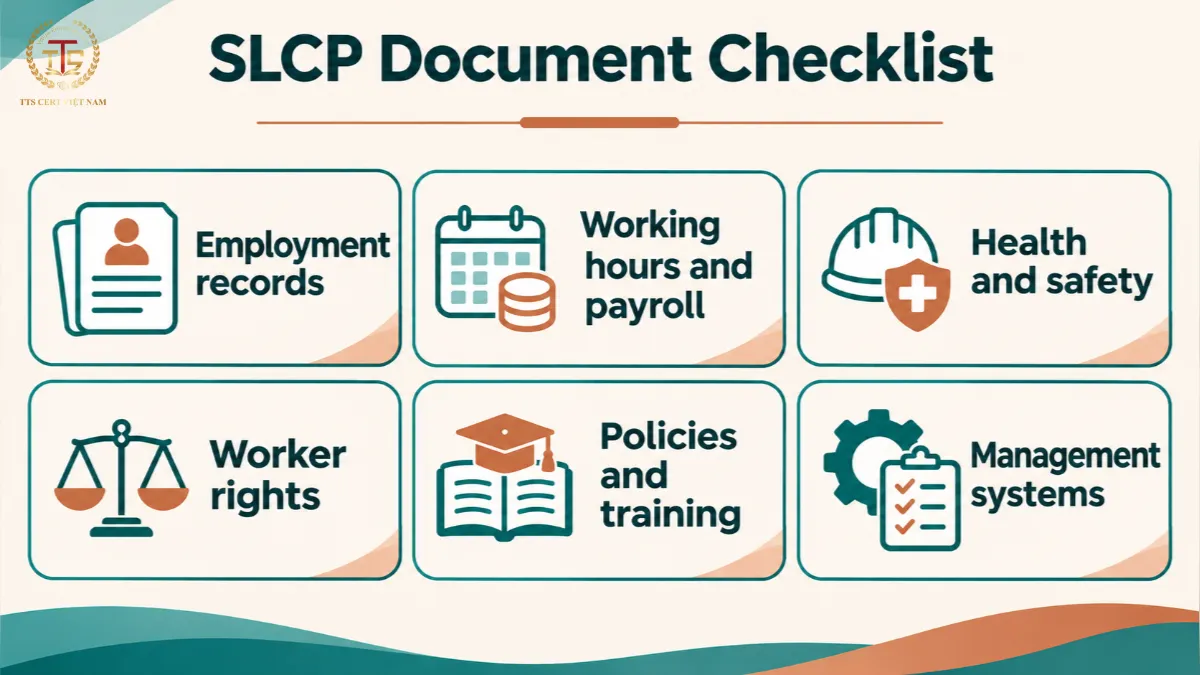
Preparation requires coordination across HR, payroll, operations, EHS, CSR/Compliance and worker representatives as appropriate. Under SLCP guidance, the assessment generally covers 12 months before submission; newly established facilities need at least three months of operational data.
Recommended records by department
| Function | Documents and evidence to review |
|---|---|
| Legal and management | Business registration, facility details, relevant permits, internal rules, organizational structure and management policies |
| Human resources | Recruitment files, contracts, age verification, young-worker records, termination, agency recruitment |
| Timekeeping and payroll | Attendance, payroll registers, payslips, overtime compensation, leave, allowances, insurance and calculation evidence |
| Social compliance | Policies on forced labor, discrimination and harassment, grievance procedures, training and risk assessments |
| Occupational health and safety | Risk assessments, OHS training, fire prevention, equipment checks, medical examinations, incidents and first aid |
| Worker representation | Dialogue records, collective agreements if applicable, worker grievance channels and resolution records |
| Production and site conditions | Production schedules, shift arrangements, relevant output records and workplace conditions |
| Management systems | Objectives, procedures, responsibilities, internal checks, corrective actions and improvement follow-up, especially Steps 2 and 3 |
This is a preparation guide rather than an exhaustive official list; the actual evidence depends on applicable CAF questions and the Verification Protocol.
Three quality checks before submission
First, reconcile working hours and pay. Attendance records, payslips, overtime payments and production schedules should match actual practices. Where errors are found, address root causes and worker entitlements instead of changing records to hide them.
Second, compare documentation with conditions on site. Policies and training plans on paper are insufficient when safety controls, worker communication or grievance procedures are not effectively implemented.
Third, protect workers' personal data. Review the necessity and sensitivity of documents before uploading them. Avoid disclosing unnecessary personal information and respect privacy and data protection requirements.
7. How Long Does Verification Take, What Does It Cost, and Does the Report Expire?
SLCP timeline
Actual timing depends on readiness, CAF Step, workforce size, VB availability and any changes needed in the initial data. The relevant milestones include:
| Activity | Typical/required timing |
|---|---|
| First-time self-assessment | SLCP suggests approximately two weeks |
| Experienced facility | May take a few days if records are ready |
| Completed dataset delivered to VB | At least 10 working days before verification |
| Verification | Within two months after completing the initial assessment |
| Verifier report submission | Within 10 working days after the site visit |
| Facility review | 30 calendar days from receipt of the report |
These are SLCP process milestones, not a guaranteed end-to-end project duration.
What does SLCP cost?
SLCP Gateway: free registration and core data management and sharing functions.
Accredited Host: platform subscription and related service fees according to the provider.
Verification: a quotation from the VB reflecting size, workforce, location, complexity and audit duration.
Consulting: optional fees for gap analysis, documents, training and readiness support.
SLCP publishes a USD 350 upcharge per CAF v1.7 verification charged to VBs. This is not a fixed all-inclusive verification price for factories. See the official SLCP cost overview.
Does an SLCP report expire?
SLCP verified data has no formal expiration date. However, SLCP recommends reassessment roughly every 12 months and encourages brands to accept reports verified during the past 12 months. Customers may apply stricter recency requirements when working conditions change.
8. CAF v1.7.1 and Expected CAF v2.0 Changes
Current CAF v1.7.1
Released in March 2026, CAF v1.7.1 primarily corrected a minor technical issue affecting the display of additional questions on occupational health and safety and bipartite committees. Because it is a limited update, much of the v1.7 guidance remains relevant.
New Report Overview from 23 October 2026
As of 23 October 2026, newly downloaded CAF v1.7.1 reports from Gateway contain an Overview worksheet summarizing facility information, verification details and groups of recorded non-compliances. This improves navigation but does not replace the full report or introduce an SLCP performance score.
What should factories prepare for CAF v2.0?
SLCP has announced plans to introduce CAF v2.0 towards the end of 2026. Announced directions include:
Simplifying the questionnaire and eliminating duplication.
Strengthening evidence, explanation and data quality requirements.
Moving towards semi-announced verification, with a defined notice window.
Increasing worker engagement during self-assessment.
Supporting human rights due diligence and remediation information.
Facilities should improve source data, document control and worker engagement practices in advance. Do not treat proposed CAF v2.0 features as already effective CAF v1.7.1 requirements. Check the official CAF v2.0 announcement before applying future rules.
9. How Does SLCP Differ from Higg FSLM, SMETA and BSCI?
These programs cover related social topics but differ in purpose, method and output:
| Item | SLCP | Higg FSLM | SMETA | amfori BSCI |
|---|---|---|---|---|
| Program owner | SLCP | Cascale | Sedex | amfori |
| Purpose | Collect and verify labor and social data | CAF-based social and labor assessment tool | Ethical trade and social auditing method | Supply chain social compliance monitoring |
| Output | Verified dataset/report | Report and Higg FSLM scoring features | SMETA audit report | amfori audit report and rating |
| Certificate | No | Not SLCP certification | No | Not a certification scheme |
| Data sharing | Gateway and connected services | Worldly and supported channels | Sedex system | amfori arrangements |
Are SLCP and Higg FSLM separate audits?
Higg FSLM uses the SLCP CAF and verification process as its foundation. Cascale adds analysis and scoring functionality for Higg FSLM users, whereas SLCP itself does not score facilities.
Higg FSLM covers social and labor topics. It should not be confused with Higg FEM, a separate facility tool focused on environmental performance.
Can SLCP replace SMETA or BSCI?
Not automatically. Acceptance depends on each customer's policy. Factories may maintain a common internal records system to support SLCP, Sedex SMETA and amfori BSCI, while still completing separate assessments where requested.
10. Common Issues During SLCP Preparation and Verification
Attendance and payroll data do not agree
Time clock records, payroll registers, payslips and production schedules contain conflicting numbers. Action: reconcile original data, identify root causes, correct pay or calculation errors and report actual conditions. Do not falsify records to conceal overtime or payments.
Missing employment records
Age verification, recruitment agency records, allowance calculation evidence or termination documentation may be incomplete. Action: review each record category, obtain lawful evidence and strengthen the underlying process.
Safety documents do not match workplace conditions
Written procedures or training files exist while real hazards remain, including exits, equipment, chemicals or sanitation. Action: prioritize actual risk reduction, then document actions and monitor their effectiveness.
Wrong CAF Step or unsupported answers
The Step may not match customer expectations, or answers may lack evidence. Action: confirm the buyer's requirements, use CAF Explorer and assign data ownership by department.
Poor verification scheduling
The facility completes the assessment but selects a VB too late, causing delays. Action: check the eligible VB list and availability early in the preparation process.
Failure to review the report in time
Discrepancies between self-reported data and verifier findings may be missed. Action: assign reviewers by topic and use the applicable report response procedures within the allowed period.
11. SLCP Consulting Services from TTS CERT Vietnam
TTS CERT supports manufacturing facilities in preparing reliable SLCP data through a combination of management system review, document preparation and practical checks of workplace conditions.
Stage 1 – Assessment and gap analysis
Review employment practices, payroll, working hours, occupational health and safety, social policies and the proposed CAF Step.
Stage 2 – Implementation planning
Prepare a prioritized task list, identify responsible functions, set deadlines and focus on issues that may undermine data accuracy.
Stage 3 – Documentation and management systems
Support improvements to policies, procedures, forms and data management methods according to the facility's actual circumstances.
Stage 4 – Training and CAF support
Explain applicable questions, guide departments in collecting information and supporting evidence, and review data entered into the platform.
Stage 5 – Pre-verification review
Reconcile platform responses with source documents and workplace conditions, and identify unresolved issues to address before the VB visit.
Stage 6 – During and after verification
Help the facility prepare records, coordinate responses, review the report, clarify documented issues and track improvement actions.
What the facility receives
A practical implementation roadmap tailored to the factory.
A departmental document checklist and clear responsibilities.
Guidance on the selected CAF Step and data preparation.
Support in understanding and using the eligible VB selection process.
Guidance on reviewing and sharing the final verification report.
Recommendations to improve labor management and working conditions.
TTS CERT is a consulting provider. It does not issue SLCP certificates or replace an independent approved VB.
12. Frequently Asked Questions About SLCP
Does SLCP issue certificates? No. Its result is a verified social and labor dataset and assessment report.
Does SLCP pass or fail factories? No. Non-compliances may be recorded, but SLCP itself does not issue an overall pass/fail decision or score.
Is SLCP mandatory under Vietnamese law? There is no general requirement for every Vietnamese factory to complete SLCP. Requirements often arise from brands and supply chain partners.
Can a factory conduct its own assessment? Yes. It can self-assess or receive support through a joint assessment; the official verification must be completed by an eligible independent VB.
How long can the report be used? There is no formal expiration date. SLCP recommends reassessment about every 12 months, subject to buyer policies.
Are SLCP and Higg FSLM the same? Higg FSLM uses CAF but adds Cascale's scoring and analysis; SLCP does not score facilities.
How do I verify a VB's authorization? Check the public Active VB list and confirm its eligibility on the facility's AH platform.
What is the price of SLCP verification? There is no single fixed price. Costs depend on the facility, platform, VB, verification scope and optional consulting.
Does TTS CERT perform official verification or issue reports? No. TTS provides consulting support; an eligible SLCP-approved VB carries out the independent verification.
Conclusion
SLCP helps factories build reliable and shareable social and labor information for global supply chains. Its value is not a certificate but accurate verified data that can inform improvements in working conditions.
Start by confirming the customer's requirements, choosing the correct CAF Step, reviewing authentic records and scheduling an eligible VB early.