PEFC Certification: Chain of Custody, Forest Management and Consulting
PEFC certifies forests and forest-based products. This page covers PEFC CoC and VFCS/PEFC forest management, the three PEFC claims, process, documents and TTS Cert's PEFC consulting and training.
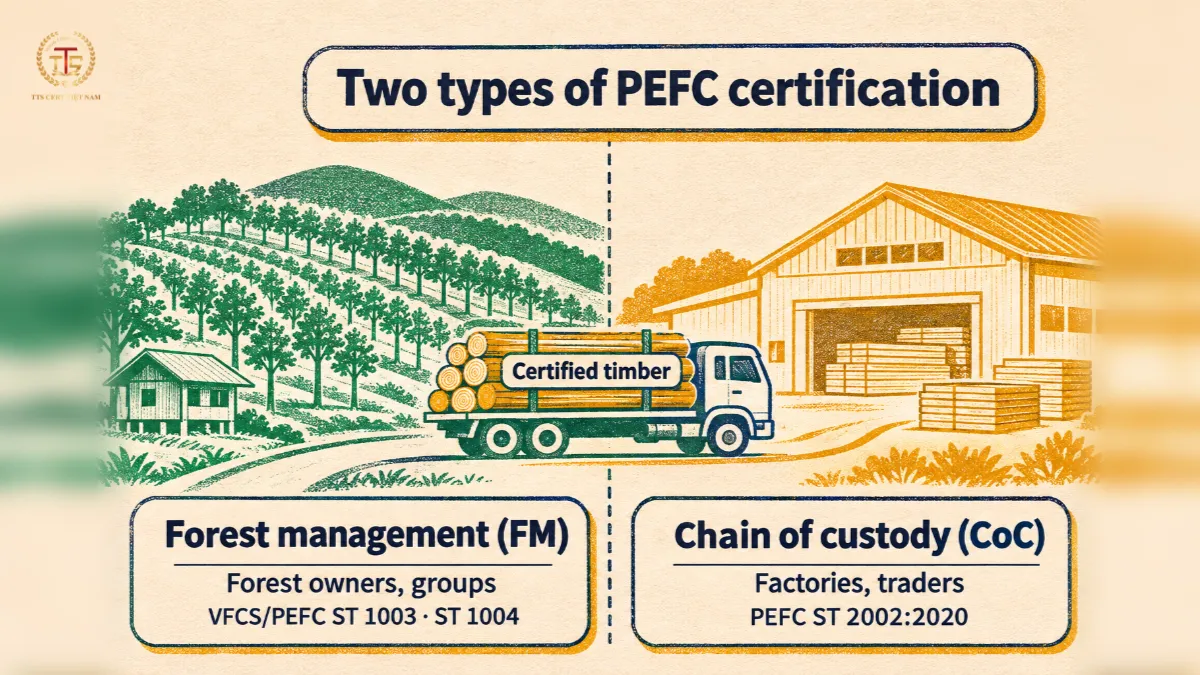
PEFC certification is issued by certification bodies recognised by PEFC. It shows that wood, paper and other forest-based products come from sustainably managed or controlled sources. PEFC has two main types: chain of custody (CoC) for processors and traders, and forest management certification for forest owners. In Vietnam, forest management certificates are issued under the national scheme VFCS/PEFC.
Companies usually need PEFC because customers require PEFC claims on invoices, delivery notes or product labels.
TTS Cert provides consulting and training to help companies prepare: gap analysis, training, system and documentation, internal audit, audit support and closing findings. Audits and certification are carried out by a PEFC-recognised certification body, not by TTS Cert.
1. What Is PEFC and Which Certifications Does It Cover?
PEFC is a system of mutual recognition between national forest certification schemes. PEFC does not itself certify companies; certification is carried out by recognised certification bodies.
Certification
For
Standards
Chain of Custody (CoC)
Companies producing, processing or trading wood, paper, packaging and forest-based products
PEFC ST 2002:2020 (CoC requirements); PEFC ST 2001:2020 (trademark and label use)
Sustainable Forest Management (FM)
Forest owners, companies and cooperatives managing forests
VFCS/PEFC ST 1003:2019 (individual); VFCS/PEFC ST 1004:2019 (group)
Which one do you need? Companies that buy certified wood or paper to process, sell or label need CoC. Owners managing plantations need forest management certification. Companies with both a raw material base and processing may need both, and the two systems should be designed to fit together.
Vietnam's national forest certification system (VFCS) is run by the Vietnam Forest Certification Office (VFCO) and has been endorsed by PEFC since 2020. VFCO also manages VFCS/PEFC certification activity and licenses use of the VFCS/PEFC label in Vietnam.
2. Who Should Implement PEFC?
Business type
Why it is often needed
Wood processing and furniture factories
Importing customers require certified wood and claims on documents
Paper, packaging and printing factories
Brands require paper packaging from certified sources
Traders of wood, wood chips and forest products
Need to prove origin and pass claims on to customers
Companies working with smallholder growers, cooperatives, forest owners
Want to sell certified wood to customers that require PEFC
Small companies seeking lower cost
May join group certification (see section 4)
When should you start?
A new or existing customer makes PEFC a purchasing condition.
You want to sell products with the PEFC label or PEFC claims on documents.
Your suppliers already hold PEFC certification and you want to receive and pass on their claims.
You already hold FSC and customers also need PEFC (or the reverse).
3. PEFC CoC: What the Certification Body Assesses
PEFC CoC assesses your management system: identifying inputs, controlling material with and without PEFC claims, recording quantities and applying the right claim at sale. The standard is PEFC ST 2002:2020. Companies that use the PEFC logo must also comply with PEFC ST 2001:2020.
A CoC system typically covers: scope and product list; supplier identification and verification of certificate validity; control of materials and products; production records; internal audits and management review; complaints and non-conformities; staff training.
4. Key PEFC CoC Requirements
4.1. Two CoC methods
Method
Core idea
Typically suits
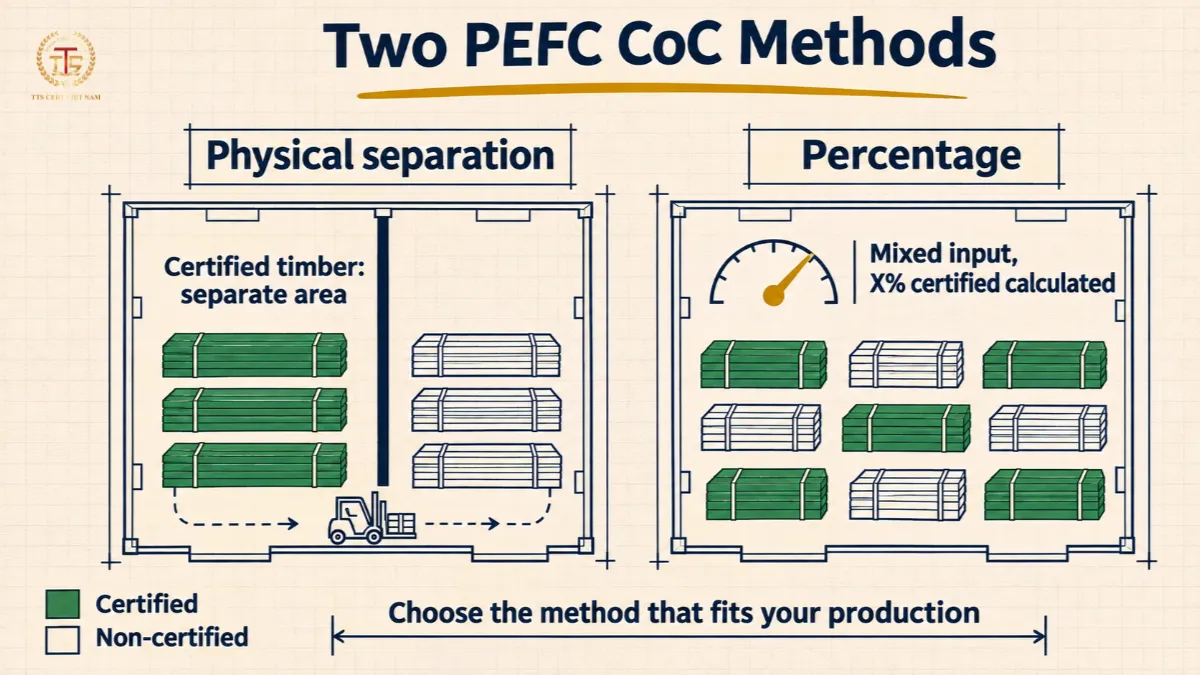
Physical separation
Material and products with PEFC claims are kept apart from other material throughout the process
Companies selling all output with a PEFC claim, or receiving certified input from several sources
Percentage-based
Material may be mixed and the certified percentage is calculated for output (average percentage and volume credit calculations)
Factories mixing certified and non-certified input in one line
Choose the method after reviewing your production process and customer requirements. A wrong choice is a common reason for rework.
4.2. The three PEFC CoC claims
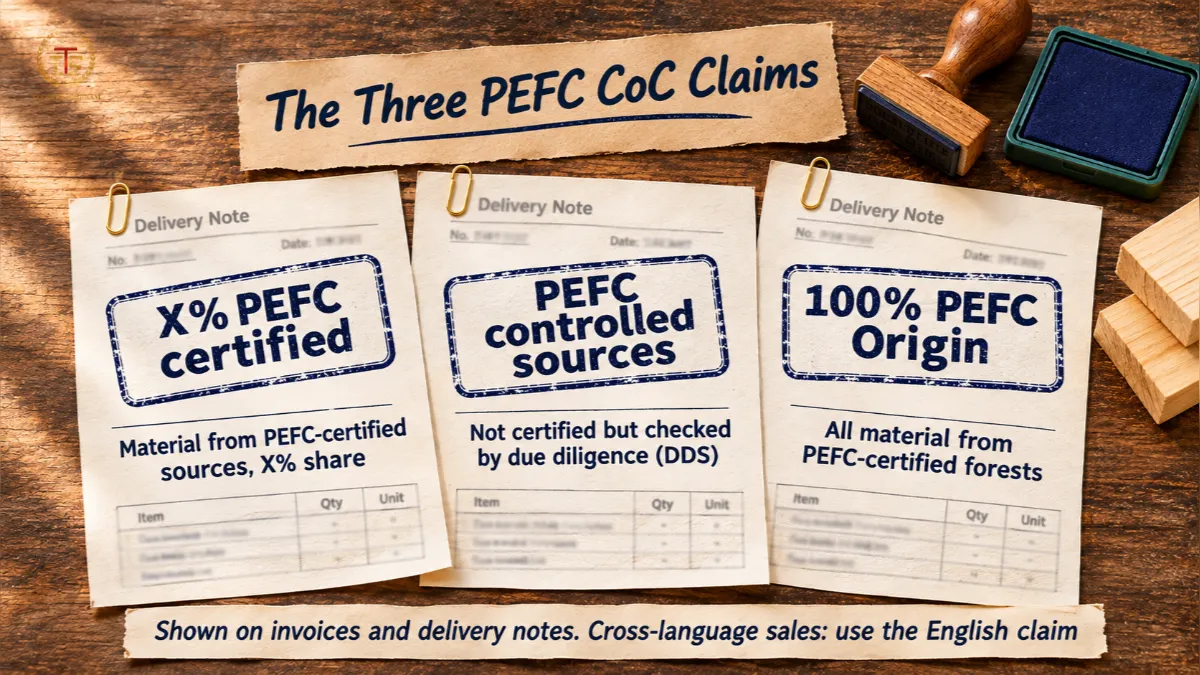
According to PEFC, every sale of PEFC-certified material must carry a CoC claim. There are three:
Claim
Short meaning
X% PEFC certified (may be shortened to "X% PEFC")
The product contains X% material from PEFC-certified sources
PEFC controlled sources
Material without PEFC certification that has gone through a due diligence system to exclude controversial sources
100% PEFC Origin
All material comes from PEFC-certified forests
For sales between countries with different languages, PEFC requires the official English claims. Wrong claim wording on invoices and delivery notes is among the most frequent audit findings.
4.3. Due diligence system (DDS)
"Controlled sources" material must go through your DDS: risk assessment by source, and mitigation where needed. You need procedures, supplier records and evidence of control.
EUDR context: PEFC has published an optional EUDR due diligence module (PEFC EUDR DDS). It is optional within PEFC. Companies need to confirm their EUDR obligations with customers and competent authorities; TTS Cert does not offer EUDR consulting.
4.4. Three CoC certification forms
Form
Main conditions (per PEFC)
Individual
One company, one or a few sites, holds its own certificate
Multi-site
An organisation with several sites linked by common ownership or management; a central office holds the certificate and runs annual internal audits; the certification body audits a sample of sites
Group (small companies)
Members are small companies (at most 50 full-time equivalent employees and EUR 10 million turnover), in the same country and independent of each other. The group entity holds the certificate and audits every member internally each year; the certification body samples members
Group certification lets small companies work through the group entity rather than directly with a certification body, which often lowers cost. Ask the group entity or a certification body whether a group in Vietnam is accepting new members.
5. VFCS/PEFC Forest Management Certification for Forest Owners
Forest management certification shows that a forest is managed under a sustainable forest management standard. In Vietnam:
VFCS/PEFC ST 1003:2019 for individual forest management. It has 7 principles, 34 criteria and 122 indicators covering legal compliance, economic, technical, environmental and social aspects.
VFCS/PEFC ST 1004:2019 for group forest management. Groups such as associations, companies, cooperatives and unions of cooperatives managing several smaller owners must meet both the forest management standard and group management requirements.
Forest management audits are carried out by certification bodies accredited for sustainable forest management; accreditation in Vietnam is handled by the Bureau of Accreditation (BoA). VFCO manages VFCS/PEFC and licenses the VFCS/PEFC label.
Companies working with smallholder growers usually need to design a group model: who is the group entity, member records, membership rules, annual internal audits and how non-compliant members are handled. TTS Cert supports all of these steps: designing the group model, building membership rules and member records, training the group entity and members, internal audits, audit support and closing findings.
6. Implementing PEFC with TTS Cert
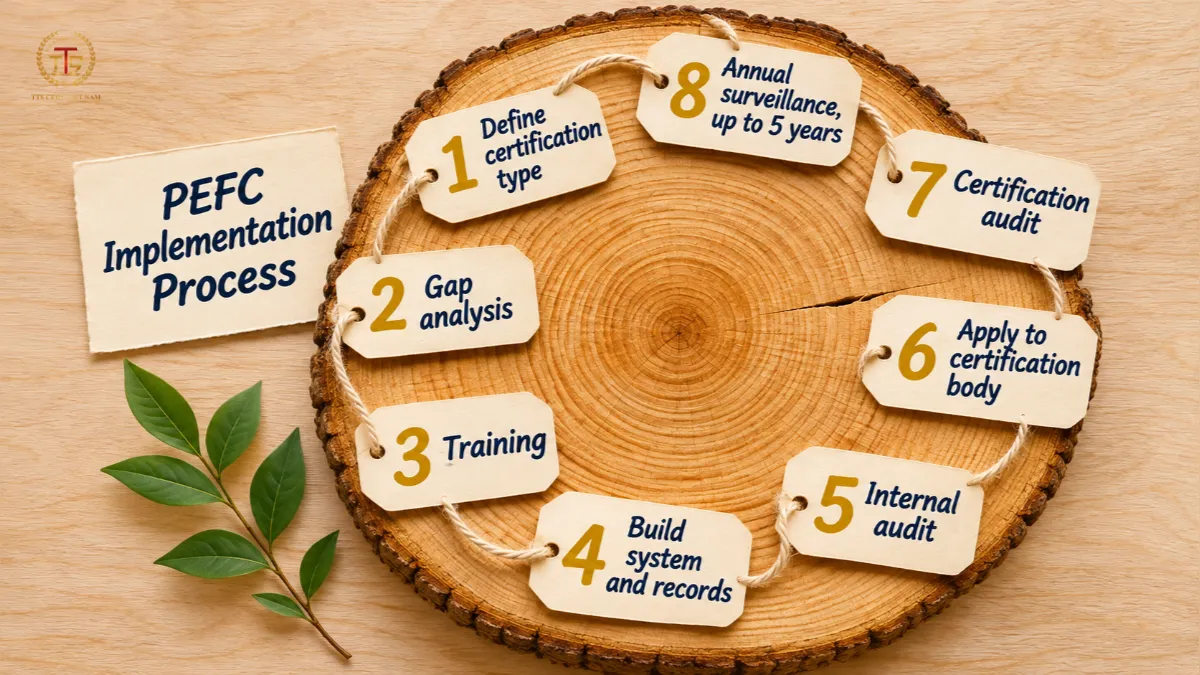
Define needs: certification type (CoC, forest management or both), form (individual, multi-site, group), products and claims.
Gap analysis against PEFC ST 2002:2020 (or VFCS/PEFC ST 1003/1004) and current practice.
Training for management, purchasing, warehouse, production, sales and system owners.
Build the system and documents: manual, procedures, material identification forms, DDS (if using controlled sources), production records, label use procedure.
Trial run and internal audit.
Apply to a PEFC-recognised certification body and prepare the trademark licence agreement if you will use the PEFC label.
Certification audit: the certification body assesses the system; non-conformities must be closed within the set time before certification. TTS Cert supports you during the audit and in closing findings.
Maintain: a CoC certificate is valid for a maximum of 5 years with annual surveillance audits; recertification is needed before expiry.
Documents to prepare (CoC)
Area
Key records
Scope
Product list, sites, production process, material flow diagram
Receiving, identification, storage, separation or percentage calculation procedures
Records
Purchase, sales and stock records, conversion factors, volume reconciliation
Sales
Invoice and delivery note templates with PEFC claim and certificate number
Labels
Approval and use procedure under PEFC ST 2001:2020
System
Policy, responsibilities, training, internal audit, management review, complaints and non-conformities
Subcontractors
List of outsourced processes and how they are controlled
The exact list is adjusted after the gap analysis. Forest management records (area, land use rights, forest management plan, environmental, labour and community records) are listed separately once scope is defined.
7. Timeline
CoC certification
Up to about 45 days to certification:
about 30 days of consulting and preparation;
about 15 days from the audit to certification.
It can be faster depending on your readiness. TTS Cert does not fix the timeline: actual timing also depends on the certification body's schedule, audit results and closing of non-conformities.
Forest management certification
Timing depends on area, number of owners or group members and the state of records; it is set after the gap analysis.
8. What Affects Cost
Cost has three separate parts:
Certification fee: quoted by the certification body. According to PEFC, certification bodies set their own prices, which vary by country and body.
Trademark/label fees (if you use the label): per the rules of the trademark administrator.
Consulting and training fees: quoted by TTS Cert based on your needs.
Factors that change cost: certification form (individual, multi-site, group); number of sites; headcount; complexity of material and product flows; CoC method; use of "controlled sources" material; number of group members; current system and the extent of corrective action.
9. Common Difficulties
Material not identified as with or without PEFC claim at receiving, especially with mixed sources.
Wrong CoC method for the real production process.
Wrong claims on invoices and delivery notes; missing certificate numbers.
Volume reconciliation fails: purchase, sales, stock and conversion factors cannot be explained.
Supplier certificate validity not checked before accepting goods with PEFC claims.
Label used before approval or against label rules.
Subcontractors left out of scope or not controlled.
Group models: missing member records, incomplete internal audits.
10. PEFC vs FSC
Topic
PEFC
FSC
Model
Mutual recognition of national forest certification schemes (in Vietnam: VFCS/PEFC)
Own international standards
CoC certification
Yes (PEFC ST 2002:2020)
Yes
Forest management certification
Yes (in Vietnam: VFCS/PEFC ST 1003, ST 1004)
Yes
Group and multi-site
Yes
Yes
Claims and labels
Three CoC claims; own label rules
Own claim and label rules
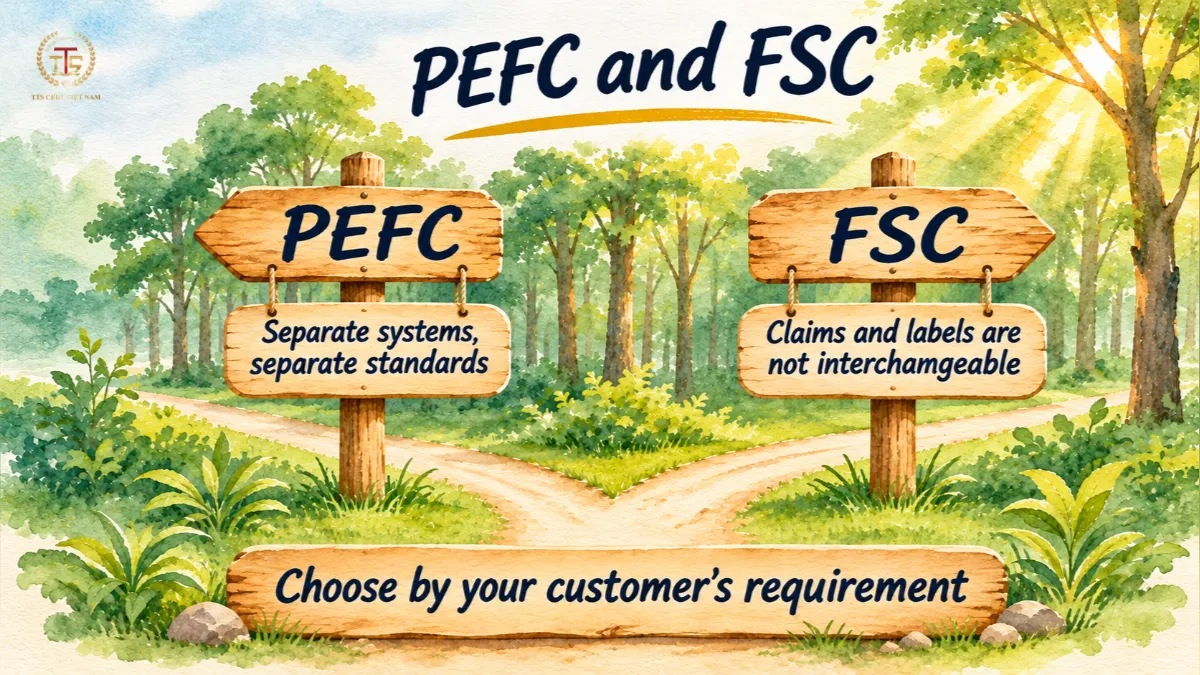
The two systems are run by different organisations, and their claims and labels are not interchangeable. Which should you choose? Follow your customers and target markets. Many companies hold both; in that case build one shared document system, and ask your certification body whether audits can be coordinated (depends on the body).
TTS Cert provides consulting and training for PEFC preparation:
Choose the right certification type and form (CoC, forest management, individual, multi-site, group).
Gap analysis against the applicable PEFC standard.
Training on PEFC CoC, DDS, claims and label rules.
System and documentation: procedures, forms, document templates carrying claims.
Internal audit before the official audit.
Audit support and closing findings afterwards.
TTS Cert works with reputable domestic and international certification bodies, connecting businesses with professional audit and certification services to help them:
Meet customer and import-market requirements for responsible wood and forest-product sourcing.
Strengthen brand reputation, image and competitiveness.
Access promising export markets.
Meet customer and global supply chain requirements.
TTS Cert is a consultancy and training provider. Audits and certification are carried out by a PEFC-recognised certification body; use of the VFCS/PEFC label in Vietnam is licensed by VFCO.
12. Frequently Asked Questions
Is PEFC required by law? No. PEFC is voluntary, but customers, brands and buyers often require it.
Who issues PEFC certification? A PEFC-recognised certification body issues it after an audit. Neither PEFC nor TTS Cert certifies companies directly.
How do PEFC CoC and VFCS/PEFC forest certification differ? CoC is for processors and traders to control material flow and claims. Forest certification is for forest owners to show sustainable forest management.
How long is a PEFC CoC certificate valid? Up to 5 years, with annual surveillance audits.
What is PEFC controlled sources? A claim for material without PEFC certification that has passed a due diligence system to exclude controversial sources.
Can small companies get PEFC at lower cost? They can join group certification if they qualify as small companies under PEFC (up to 50 FTE and EUR 10 million turnover) and a group is accepting members.
Can we use the PEFC logo right after certification? Not automatically. You must sign a trademark licence agreement and follow PEFC ST 2001:2020; products and label use usually need approval.
Can PEFC replace FSC? No. They are separate systems. Follow your customers' requirements.
Does TTS Cert issue PEFC certificates? No. TTS Cert is a consultancy and training provider that helps companies prepare for and achieve certification.
How long does it take? For CoC: up to about 45 days, made up of about 30 days of consulting and about 15 days from the audit to certification; it can be faster depending on your readiness. For forest management, timing depends on scale.
13. Conclusion
PEFC helps wood, paper and packaging companies and forest owners prove origin and management of their material to customers. The hardest part is usually day-to-day operation rather than the audit: identifying material, keeping records and applying the right claim on documents. Start by defining which certification you need and run a gap analysis before applying to a certification body.