Table of contents
When a customer asks for BCI Cotton, a company will often encounter two terms:
Mass Balance and Physical BCI Cotton.
Both are part of the Better Cotton Initiative system, but they differ significantly in the way cotton, transactions and traceability are managed.
The simplest distinction is:
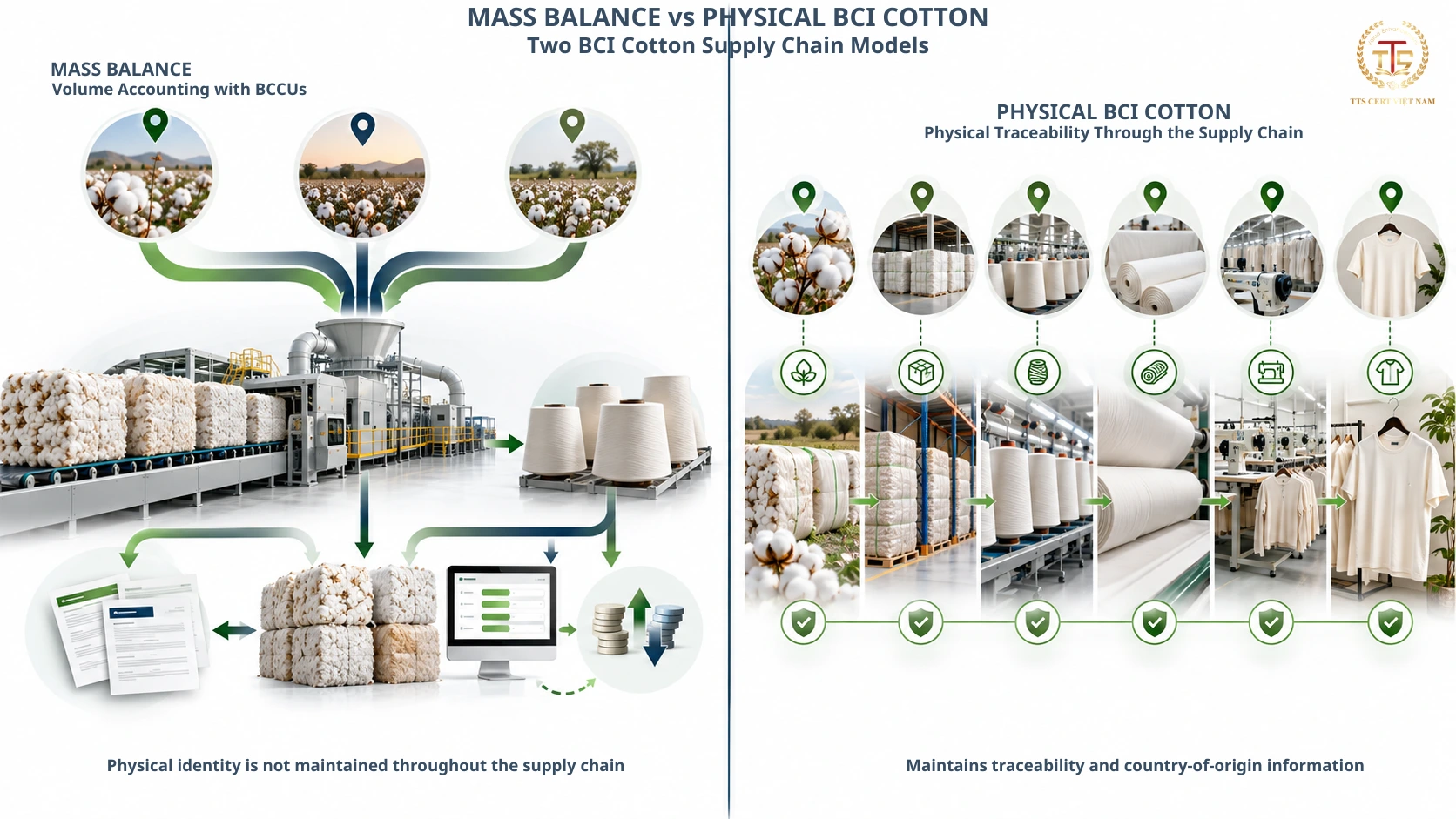
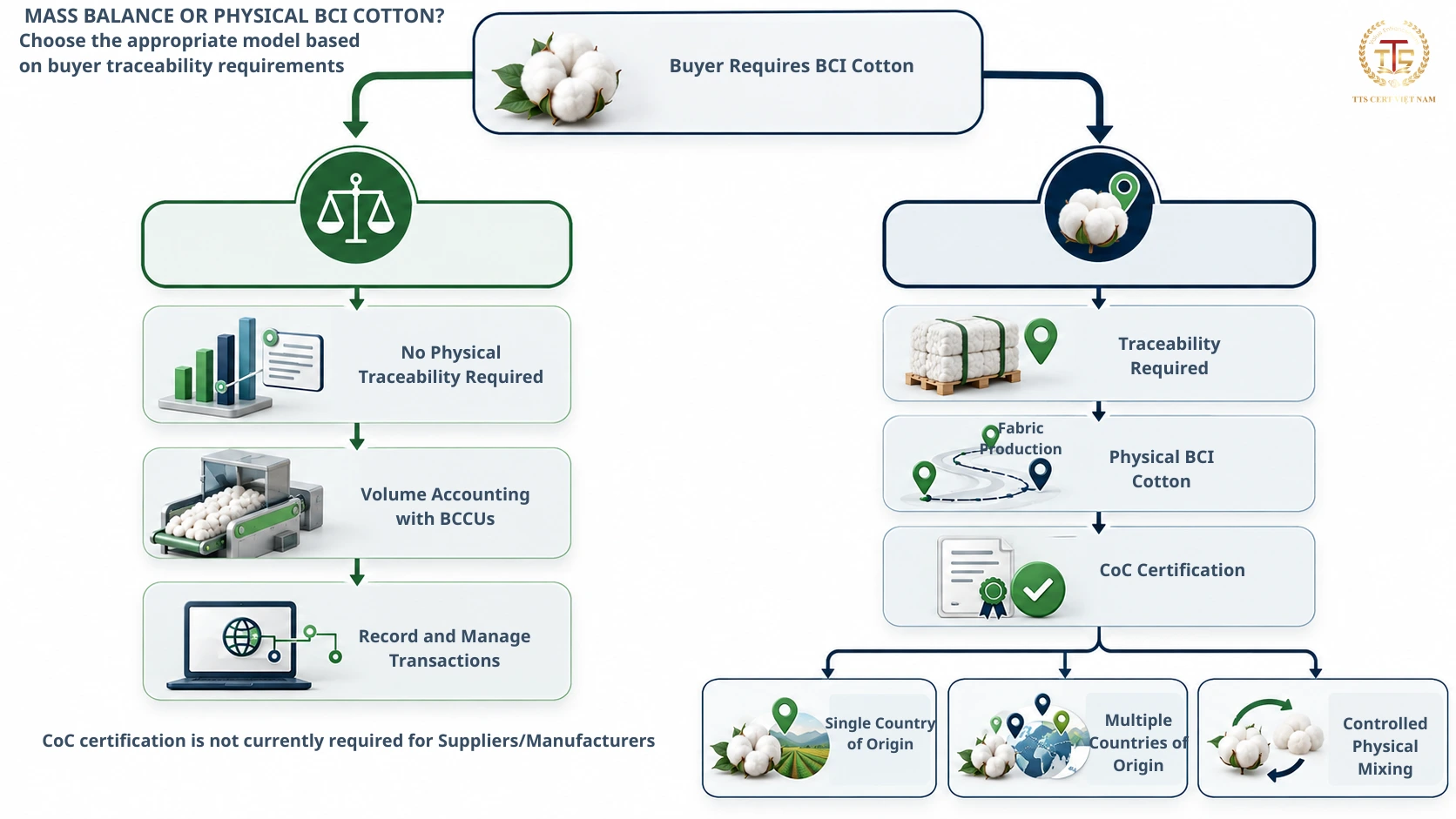
Mass Balance tracks BCI Cotton primarily through volumes and BCCUs, while Physical BCI Cotton maintains physical traceability through applicable Chain of Custody models.
Only products sourced through Physical CoC models are traceable to their country of origin.
Read more: What is BCI Cotton?
1. What Is Mass Balance BCI Cotton?
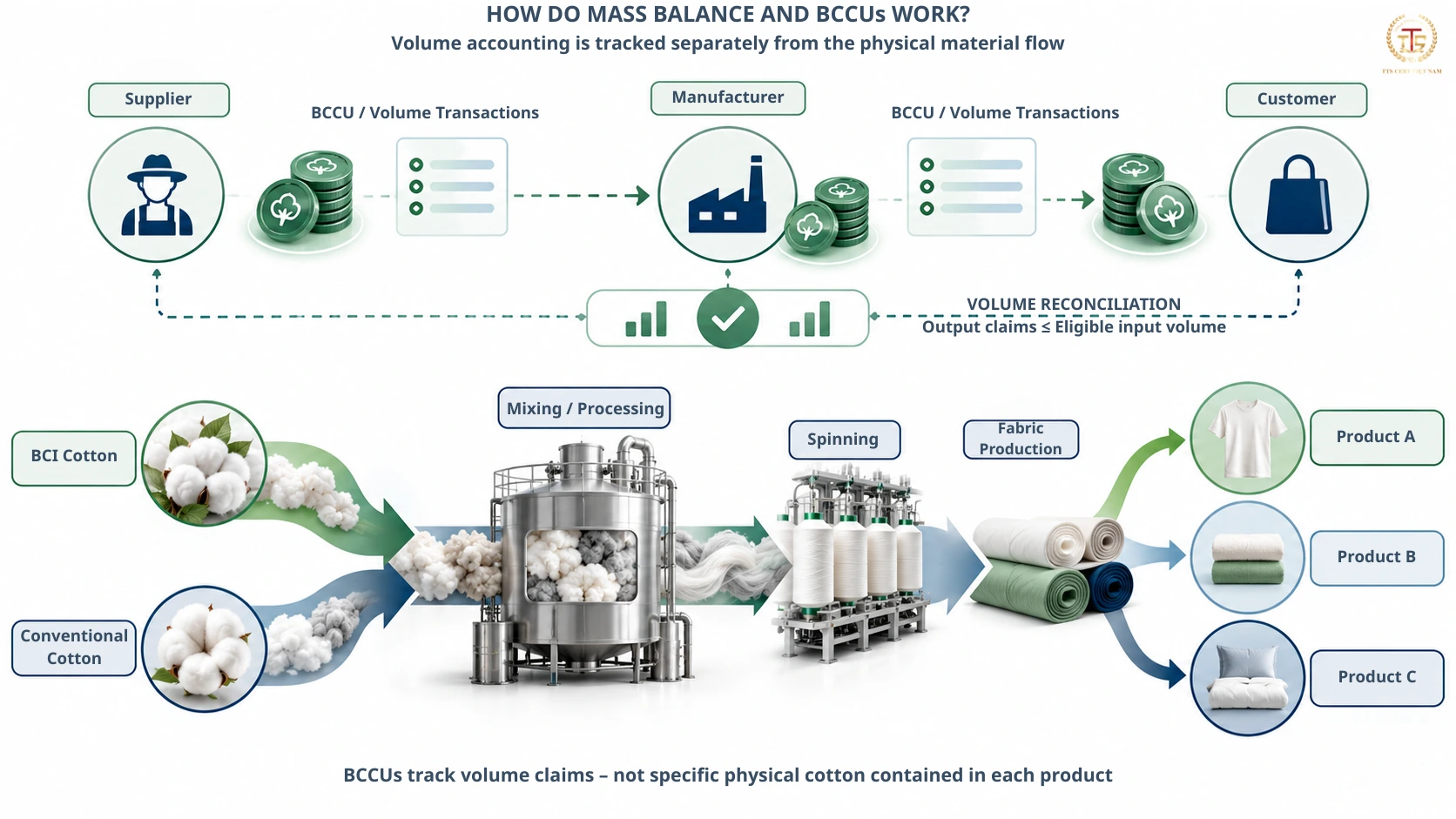
Mass Balance is a Chain of Custody model based on volume accounting.
From the ginner onwards, BCI Cotton may be substituted or mixed with conventional cotton, provided that the amount sold as BCI Cotton does not exceed the eligible volume purchased.
Between the farm and gin, however, BCI Cotton must remain physically segregated from other cotton.
What Is a BCCU?
Each kilogram of BCI Cotton lint leaving the gin is assigned one BCI Cotton Claim Unit (BCCU).
BCCUs move through the supply chain to represent the volume of BCI Cotton sourced in an order.
However, BCCUs do not have to remain physically linked to the original cotton. Therefore, Mass Balance BCI Cotton is not traceable to its country of origin.
2. What Is Physical BCI Cotton?
Physical BCI Cotton is sourced using physical Chain of Custody models designed to maintain traceability.
BCI Traceability currently enables users to identify the country of origin of Physical BCI Cotton.
There are three Physical CoC models:
Segregation – Single Country
Segregation – Multi-Country
Controlled Blending
Controlled Blending permits Physical BCI Cotton and conventional cotton to be mixed within a production batch while maintaining a percentage claim for the Physical BCI Cotton used.
3. Mass Balance vs Physical BCI Cotton
| Topic | Mass Balance | Physical BCI Cotton |
|---|---|---|
| Tracking method | Volume accounting | Physical traceability |
| BCCUs | Yes | Not the primary mechanism |
| Physical identity maintained | No | Yes |
| Country-of-origin traceability | No | Yes |
| CoC models | Mass Balance | Segregation / Controlled Blending |
| BCI Platform | Yes | Yes |
| Supplier/Manufacturer certification | Not currently required | Required |
For Suppliers and Manufacturers, BCI currently states that Mass Balance does not require certification, while organisations sourcing, processing and selling Physical BCI Cotton need CoC certification.
4. Is Mass Balance “Virtual Cotton”?
No.
Mass Balance is based on actual BCI Cotton entering the system, but it allows the volume claim to become separated from the physical identity of the original cotton later in the supply chain.
It is therefore more accurate to describe Mass Balance as a volume-accounting model, not as virtual cotton.
BCI continues to retain Mass Balance as a sourcing option alongside Physical BCI Cotton.
5. Can Physical BCI Cotton Be Traced Back to the Farm?
Not necessarily.
BCI currently provides country-of-origin traceability for Physical BCI Cotton.
Depending on the country of origin, Route to Market information may provide visibility further back to the ginner or spinner.
This should not be interpreted as automatic farm-level traceability for every transaction.
6. How Is the BCI Platform Used?
The BCI Platform supports both models.
For Mass Balance, the Platform tracks BCCUs and related transaction volumes.
For Physical BCI Cotton, Physical volumes are captured at transactions throughout the supply chain to support traceability.
Read more: What Is the BCI Platform?
7. Does Mass Balance Require Certification?
For Suppliers and Manufacturers, Mass Balance does not currently require CoC certification.
However, participating organisations still need to comply with applicable CoC and Platform requirements.
8. Does Physical BCI Cotton Require Certification?
Yes.
Supply-chain organisations wishing to source, process and sell Physical BCI Cotton must be certified against BCI Chain of Custody Standard v1.2.
They must also already have a BCI Platform account before certification.
Read more: What Is BCI Chain of Custody v1.2?
9. Which Model Should a Company Use?
The appropriate model should be based first on customer requirements and the type of claim or traceability expected.
Mass Balance may be suitable where the customer accepts volume-based sourcing without country-of-origin physical traceability.
Physical BCI Cotton should be considered where the customer requires origin information, traceability or eligibility for applicable Physical BCI Cotton claims.
The former Mass Balance on-product mark was phased out by May 2026, while the newer BCI Cotton label is linked to Physical BCI Cotton and applicable certification requirements.
Not Sure Whether Your Buyer Requires Mass Balance or Physical BCI Cotton?
TTS Cert can review buyer requirements and your supply-chain flow to determine the appropriate BCI sourcing model before Platform registration or certification preparation.
10. Common Misunderstandings
Mass Balance means the physical cotton in the product is Physical BCI Cotton.
Incorrect.
A BCCU represents a specific kilogram of cotton in the final product.
Incorrect. BCCUs are volume claims and are not necessarily linked to the original physical cotton.
Physical BCI Cotton is always traceable to a specific farm.
Incorrect. Current BCI Traceability primarily provides country-of-origin traceability.
The BCI Platform is only for Mass Balance.
Incorrect. It supports both Mass Balance and Physical BCI Cotton.
11. Frequently Asked Questions
What is Mass Balance BCI Cotton?
It is a volume-accounting CoC model that allows BCI Cotton to be substituted or mixed with conventional cotton while maintaining eligible volume claims.
What is a BCCU?
A BCCU is a BCI Cotton Claim Unit used to track Mass Balance sourcing volumes.
Can Physical BCI Cotton be traced?
Yes. BCI currently supports traceability to the country of origin.
Does Mass Balance require certification?
Not currently for Suppliers and Manufacturers.
Does Physical BCI Cotton require certification?
Yes. Applicable supply-chain organisations need CoC certification.
12. How Can TTS Cert Support Companies?
TTS Cert can support companies with:
Buyer requirement review
→ Mass Balance / Physical determination
→ BCI Platform requirement review
→ CoC certification analysis
→ Gap Assessment
→ BCCU or traceability controls
→ Staff training
→ Audit preparation
Select the Correct BCI Model Before Implementation
If a buyer requests BCI Cotton but the sourcing model is unclear, defining the correct model first can prevent unnecessary Platform, documentation or certification work.

Lawyer Tran Thi Mai has more than 10 years of experience in legal affairs, social responsibility, ESG and sustainable development.
SEE MORE