The EUDR is the European Union's anti-deforestation regulation. Under it, wood, coffee, rubber and several other commodities can only be sold in the EU if they are proven to be deforestation-free after 31 December 2020 and produced legally. The EUDR applies from 30 December 2026 to large and medium-sized companies. Vietnamese companies are not directly regulated, but EU customers will ask their suppliers for origin data, down to the coordinates of the plot where the raw material was grown or harvested.
Last updated: 13 November 2026.
1. What is EUDR?
EUDR stands for the EU Deforestation Regulation, formally Regulation (EU) 2023/1115 on deforestation-free products, which entered into force in June 2023. It prohibits placing on the EU market, or exporting from the EU, products from seven commodity groups if they are linked to deforestation or forest degradation.
FSC and GRS are voluntary standards, but the EUDR is mandatory law, and there is no "EUDR certification". Companies comply by carrying out supply chain due diligence and submitting a due diligence statement (DDS) to the EU information system before the goods are released for customs clearance or sold.
2. Why did the EU introduce the EUDR?
The EU is one of the largest consumers of commodities linked to deforestation, such as wood, coffee, palm oil and soy. The EUDR is part of the EU Biodiversity Strategy under the European Green Deal. It aims to make sure that products consumed in the EU do not contribute to global forest loss, and so to cut greenhouse gas emissions and biodiversity loss. It is one of several EU green rules affecting imports, alongside the Carbon Border Adjustment Mechanism (CBAM).
EUDR vs EUTR: what is the difference?
The EUTR (EU Timber Regulation, Regulation 995/2010) has applied since 2013 and bans illegally harvested timber from the EU market. Many Vietnamese furniture exporters already know it well. The EUDR replaces the EUTR and goes further:
| Criterion | EUTR | EUDR |
|---|---|---|
| Products | Timber and timber products only | 7 commodities: wood, coffee, rubber, cocoa, oil palm, soya, cattle |
| Main requirement | Legal timber | Legal and deforestation-free after 31 Dec 2020 |
| Traceability | Country and harvest area | Geolocation of every plot of land |
| Filing | No statement per shipment | DDS submitted before placing goods on the market |
The EUTR continues to apply during a transition period to timber harvested before the EUDR application date.
3. Which products are covered by the EUDR?
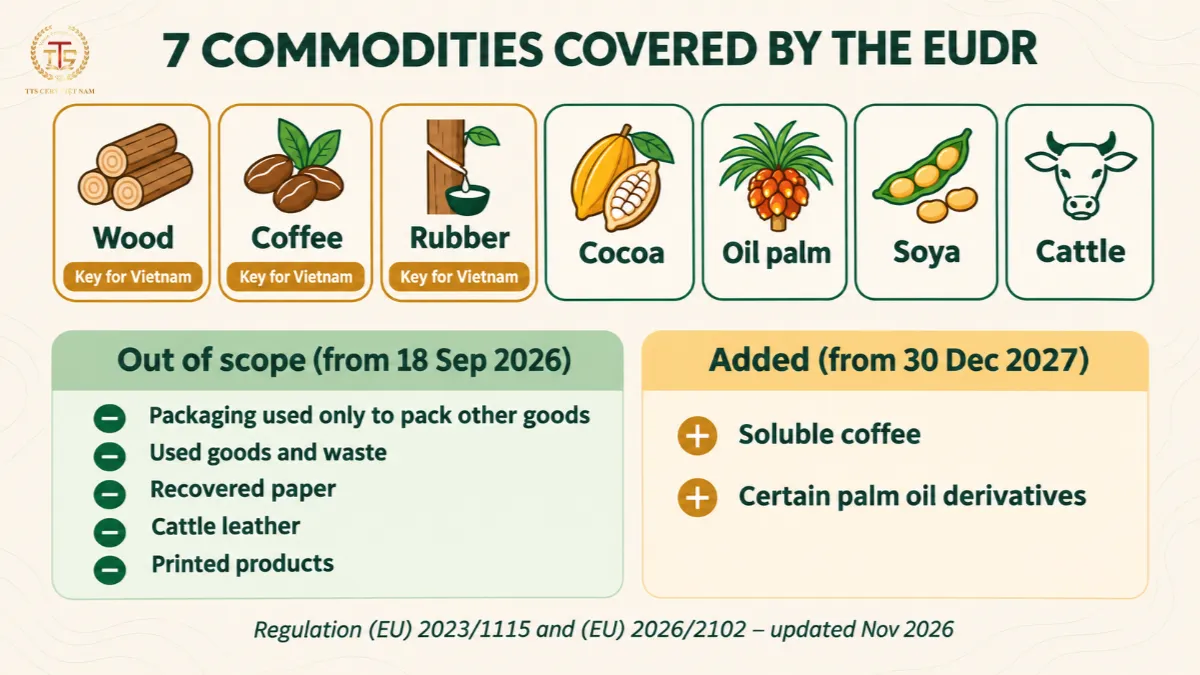
The EUDR covers seven commodities and the derived products listed by HS code in Annex I:
| Commodity | Examples of products in scope | Relevance for Vietnam |
|---|---|---|
| Wood | Logs, sawn wood, plywood, wood pellets, pulp, paper and paperboard, wooden furniture, prefabricated wooden buildings | Very high |
| Coffee | Green and roasted coffee | Very high |
| Rubber | Natural rubber, certain rubber products such as tyres | High |
| Cocoa | Cocoa beans, cocoa butter, chocolate | Medium |
| Oil palm | Palm oil and certain derivatives | Low |
| Soya | Soybeans, soybean meal | Low |
| Cattle | Beef, live cattle | Low |
Scope changes from September 2026
Delegated Regulation (EU) 2026/2102, in force since 18 September 2026, amended Annex I:
Removed from scope: packaging used only to hold, protect or carry another product (including wooden pallets and cartons), used goods, waste and recovered paper, samples and marketing material. Cattle leather and some rubber products were also removed.
Still in scope: packaging sold as a product in its own right, if its HS code is listed in Annex I. Example: a packaging plant selling cartons to an EU customer.
Newly added: soluble coffee and certain palm oil derivatives, applying from 30 December 2027.
Printed products (books, newspapers and other Chapter 49 items) were already removed by the December 2025 amendment.
Companies should check the exact HS code of each product against the current Annex I, not just the commodity name.
4. Three conditions for selling products in the EU
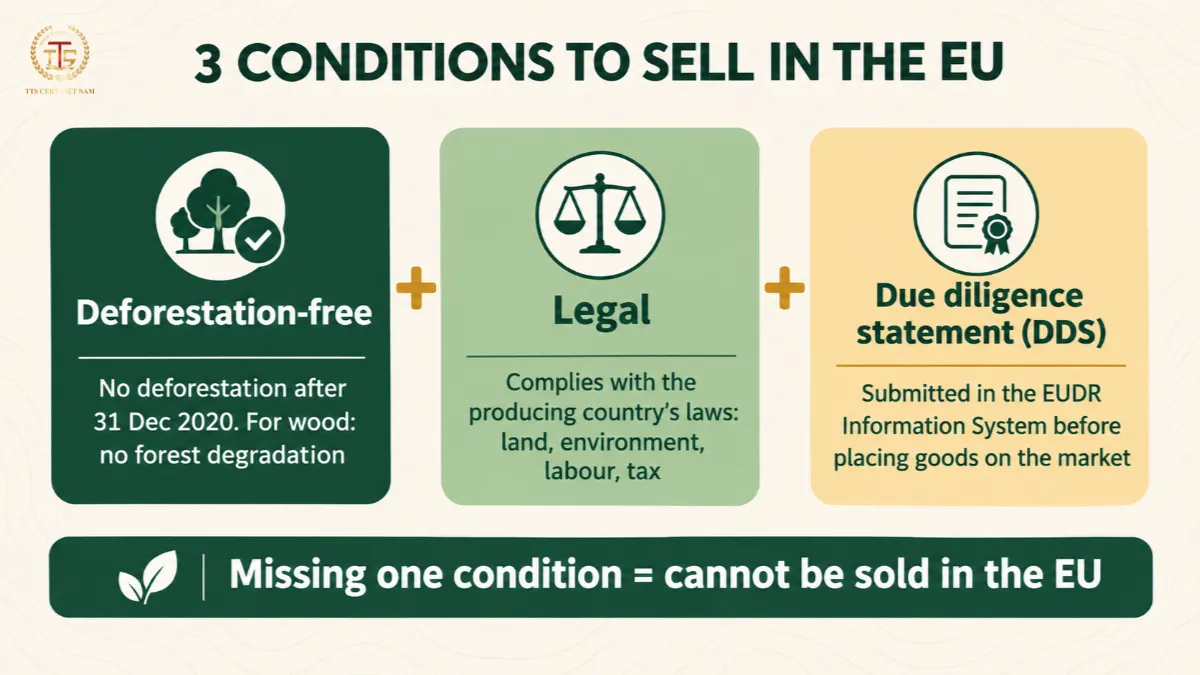
A product within the scope of the EUDR may only be placed on the EU market if it meets all three conditions:
Deforestation-free: produced on land that has not been deforested after 31 December 2020. For wood, harvesting must also not have caused forest degradation after that date.
Legal: produced in line with the laws of the country of production, including land use rights, environmental protection, labour, tax and the rights of local communities.
Covered by a due diligence statement (DDS): the company placing the goods on the EU market has submitted a DDS in the EU information system.
5. When does the EUDR apply?
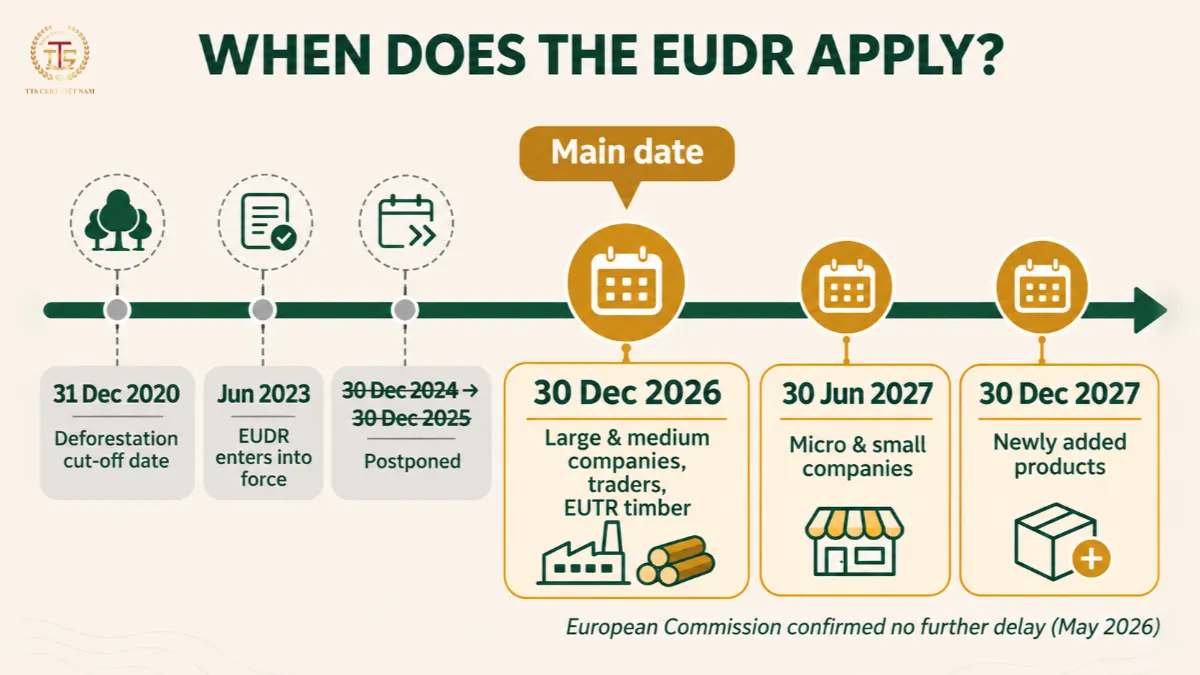
The EUDR entered into force in June 2023, but its application date has been postponed twice. In May 2026 the European Commission published its simplification review and confirmed that the legal text will not be reopened, keeping the current deadlines:
| Date | Applies to |
|---|---|
| 30 Dec 2026 | Large and medium operators; downstream operators and traders of all sizes; micro and small operators of timber products already covered by the EUTR |
| 30 Jun 2027 | Eligible micro and small operators and natural persons, for other products |
| 30 Dec 2027 | Products newly added to Annex I (soluble coffee, palm oil derivatives…) |
Postponement history:
Original date: 30 December 2024.
First delay: 30 December 2025 (Regulation 2024/3234).
Second delay: 30 December 2026 (Regulation 2025/2650).
Older articles that still cite 30 December 2024 or 1 January 2026 are out of date.
6. Who is responsible for EUDR compliance?
Legally, EUDR obligations fall on the company in the EU that first places the product on the EU market (the operator). The December 2025 amendment concentrated the DDS obligation on this first operator and reduced the paperwork for downstream operators and traders.
Vietnamese companies exporting wood, coffee or rubber to the EU do not submit a DDS, but they are directly affected:
EU customers cannot submit a DDS without data from their suppliers, especially the geolocation of the raw material plots.
Shipments with missing or unverifiable data will not clear EU customs.
EU customers are therefore adding EUDR requirements to contracts, supplier questionnaires and supplier assessments, often alongside wider ESG requirements.
If a Vietnamese company has its own importing entity in the EU, that entity is the operator and must submit the DDS itself.
The due diligence statement (DDS) and the TRACES system
The DDS is an electronic statement in which the EU company confirms that it has carried out due diligence and that the product complies with the EUDR. It is submitted through the EUDR Information System, built on the European Commission's TRACES platform. Each DDS receives a reference number, which is used in the customs declaration and passed on to companies further down the supply chain.
Due diligence has three steps:
Information collection.
Risk assessment.
Risk mitigation, where the risk is not yet negligible.
For products from low-risk countries such as Vietnam, steps 2 and 3 are simplified (see section 8).
7. What information do Vietnamese suppliers need to prepare?
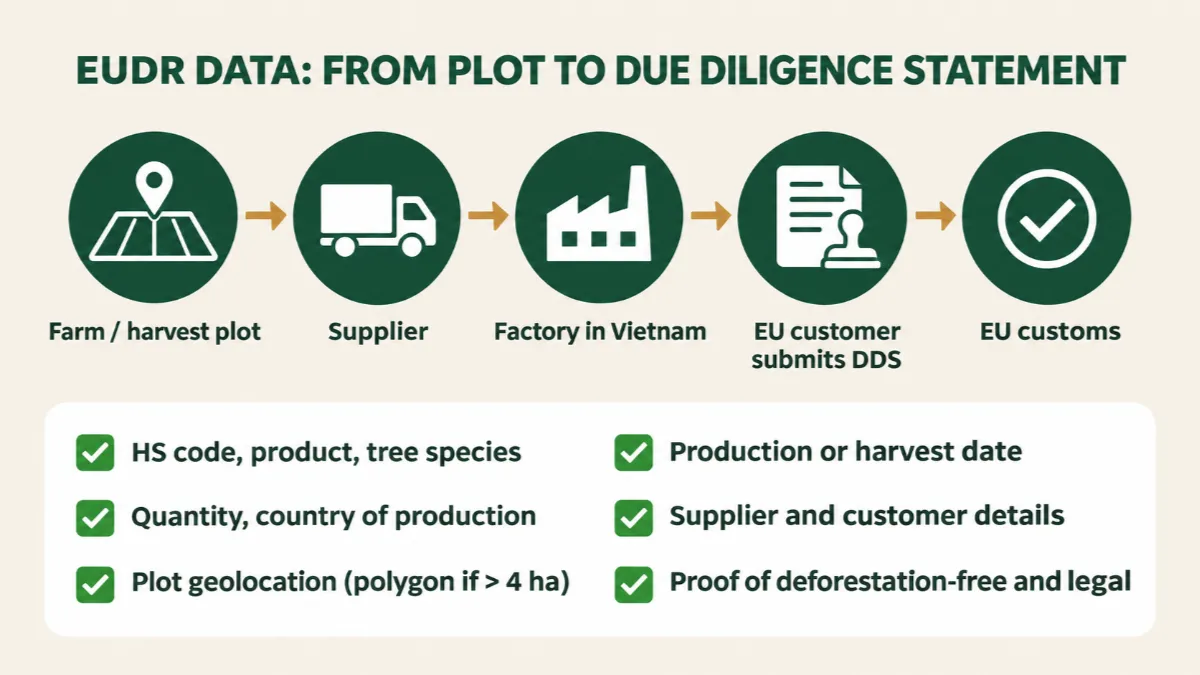
Under Article 9 of the EUDR, each shipment requires:
Product description, HS code and trade name; for wood, the tree species (common and scientific name).
Quantity.
Country of production.
Geolocation of all plots of land where the commodity was grown or harvested, as latitude and longitude with at least six decimal places.
Plots larger than 4 hectares: a polygon of the plot boundary.
Plots of 4 hectares or less: a single point is acceptable.
Data is usually shared as a GeoJSON file.
Date or period of production or harvest.
Details of suppliers and customers in the chain.
Evidence that the product is deforestation-free and legal: land documents, harvesting permits, forest product records, invoices and similar.
Quick checklist for processing plants (furniture, paper, rubber)
| Question | Yes / Not yet |
|---|---|
| Have we identified the HS code of every product sold to EU customers and checked it against Annex I? | |
| Do we know which suppliers and which plots our raw material comes from? | |
| Do we have coordinates (point or polygon) for the growing or harvesting areas? | |
| Do we have legality records for the raw material (land, harvesting, transport, purchase)? | |
| Can our warehouse keep material with data separate from material without data? | |
| Can we trace a finished batch back to its raw material batches? | |
| Have we agreed the data format and timing with our EU customers? |
The biggest challenge for Vietnamese companies is usually raw material from smallholders: smallholder rubber, household coffee farms and household-grown plantation timber. This material often passes through collectors, gets mixed, and lacks land documents and coordinates.
8. What does Vietnam's "low risk" classification mean?
In May 2025 the European Commission classified Vietnam as a low-risk country for deforestation. Products from low-risk countries qualify for simplified due diligence:
EU companies must still collect all the required information, including geolocation and legality evidence.
The risk assessment and risk mitigation steps are lighter.
Competent authorities carry out fewer checks.
In short, "low risk" does not exempt anyone from providing data.
9. EUDR and FSC CoC certification: how do they differ?
| Criterion | EUDR | FSC CoC |
|---|---|---|
| Nature | Mandatory EU law | Voluntary certification |
| Scope | 7 commodities and derived products | Wood, paper and forest products |
| Output | Due diligence statement (DDS) per shipment | Chain of custody certificate, right to use FSC claims |
| Checked by | Competent authorities of EU member states | Accredited certification bodies |
| Deforestation cut-off | 31 Dec 2020 | Per FSC requirements |
The European Commission has made clear that certification such as FSC can support risk assessment but does not replace the mandatory EUDR due diligence. Even so, companies that already hold FSC CoC are usually faster to prepare, because they already have:
controls on incoming material and supplier verification;
batch traceability and material segregation;
purchase and volume records that are audited regularly.
What is usually missing is plot-level geolocation and legality evidence in the format the EUDR requires.
Read more: What Is FSC Certification? FSC CoC Process and Costs